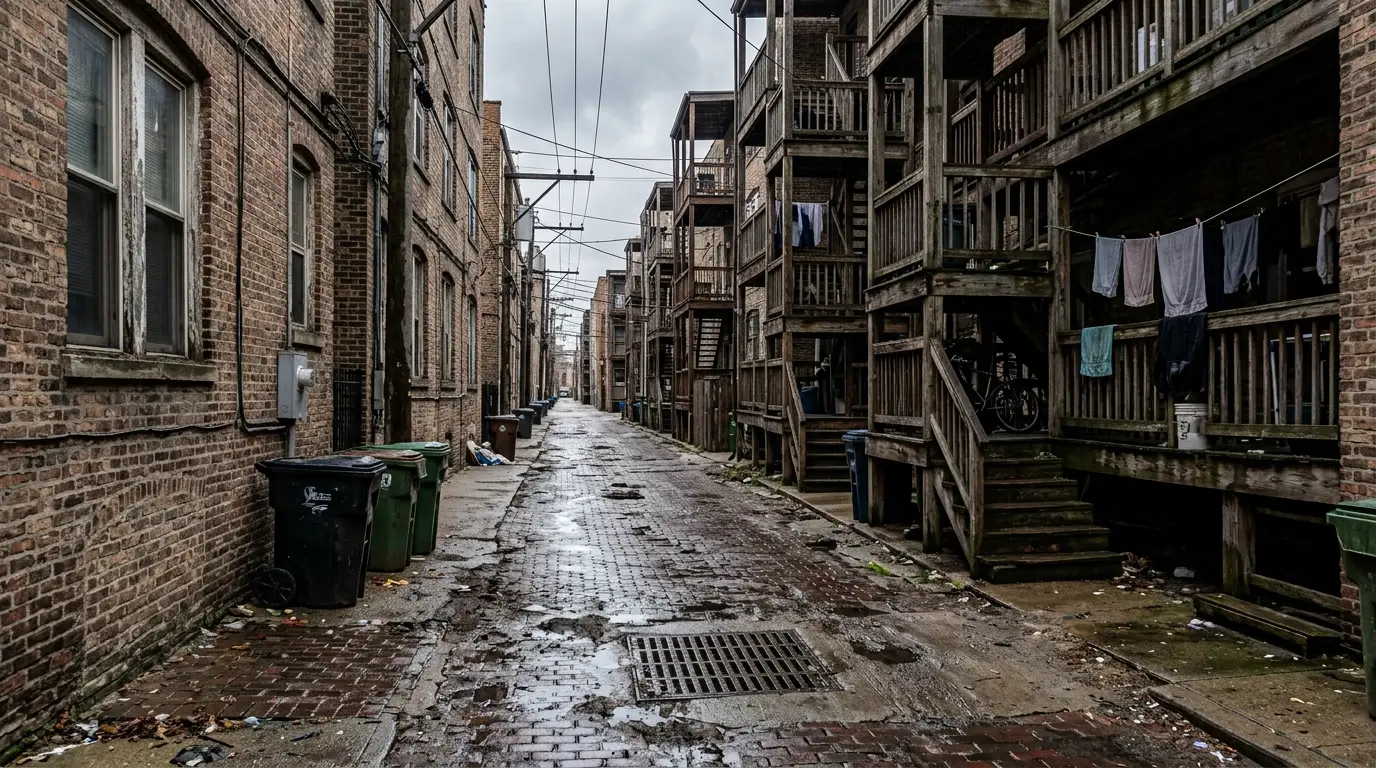
Plumbing in the City of Chicago
One sewer system carrying both rain and waste, a housing stock built mostly before 1930, and a rule most owners only discover during a repair: in Chicago the pipe under the parkway is yours.
One sewer, carrying both the rain and the waste
Almost the whole city sits on a combined sewer system: the pipe under the street takes sanitary waste from the buildings and stormwater off the roofs and streets in the same barrel. That single fact explains most of the plumbing calls Chicago generates, and it is the reason heavy rain is a plumbing risk here in a way it simply is not in a suburb built on a separated storm system.
What happens in a real storm is a matter of hydraulics rather than fault. Rain arrives faster than the main can carry it away, the level inside the main rises, the term for it is surcharge, and once that level is above the level of your basement floor, the system looks for the lowest opening on the block and uses it. That is a floor drain, a shower pan set into the slab, or a laundry tub, in whichever building sits lowest. Households describe it as the sewer backing up, which is exactly right, and they usually assume it means their line is blocked, which usually it does not.
Because the cause is external, the remedy is not a cleaning. There are two real ones: a valve that closes against reverse flow, or re-draining the building so its discharge enters the sewer above the surcharge level. The diagnostic reasoning sits on basement flooding and sewer backup, and the two remedies are backwater valve installation and overhead sewer conversion. Which one fits depends on the building, not on preference.
What no valve will fix
If the water comes in at a window well, an areaway, a gangway door or the bottom of an exterior stair, that is surface water and the sewer had nothing to do with it. A backwater valve will not stop a drop of it. Grading, the areaway drain and the downspouts are the work, and anyone selling a valve for that problem is selling you the wrong thing.
Catch basins, and why yours is probably still down there
Chicago plumbing has a component most of the metro does not: the catch basin. It is a settling pit between the building drain and the sewer lateral: a concrete cylinder, three or four feet across, with a lid at grade in the gangway or the back yard. It was standard for decades, on the reasoning that grease and grit should drop out of suspension on private property rather than accumulate in the public main. In a great many properties it is still doing that, often under a slab of pavement or a flower bed installed by someone who had no idea it was there.
A basin that has silted up does not announce itself. The symptom is a whole-house drain that has become gradually slow, or a line that gets rodded, runs beautifully for a month or two, and closes down again. That pattern is the tell, and it is where the money gets wasted: rodding a lateral through a basin full of solids re-establishes a channel that will close again shortly, and the invoice says the line was cleared. Pumping the basin out is a separate operation with separate equipment.
So the first question on a slow-drain call at an older city property is whether the basin is live, filled, or bypassed, renovations abandoned plenty of them without record. That is answered by camera inspection and by lifting the lid, not by assumption, and it decides whether the right work is rodding, hydro jetting, or a pump-out.
Bungalows, two-flats and greystones
The city’s plumbing is largely the plumbing of brick built between 1890 and 1930: the bungalow belt across the northwest and southwest sides, two- and three-flats everywhere, greystones through the older west and south side blocks. That vintage came with galvanized steel supply and cast iron drain and vent, and both fail on a schedule rather than at random. Galvanized closes from the inside as corrosion builds, so it presents as pressure that has quietly gone away upstairs and a rusty first draw after the building has sat empty. Cast iron thins from the inside along the horizontal runs and at the hub joints, so it presents as a weeping stack in a wall or a drain line that has lost its bottom.
What makes city work different from the same house in a suburb is that there is no room around it. Supply and drain get re-routed through gangways five feet wide, through shared masonry walls, and up rear porches, so repiping is a route-planning exercise before it is a pipe exercise, and the honest version of that conversation happens before anything opens. Below-grade units are the other city-specific condition: a garden unit’s fixtures sit under the level of the sewer, which means everything it drains has to be lifted mechanically by an ejector pump, and the failure of that pump is not an inconvenience but a flooded apartment.
Lead service lines, and water you are not being billed for by volume
Chicago required lead water service lines by ordinance until the federal ban took effect in 1986, which leaves the city holding the largest inventory of them in the country. The practical read on a pre-1986 building whose service has never been touched is that lead is the likely material, and the way to move from likely to known is the city’s own address-level material inventory rather than a plumber’s eye at the kerb. Where replacement follows, it should be end to end: a partial replacement leaves lead in the ground and disturbs the protective scale inside what stays, and that can make water quality worse for a period rather than better. The route is water service line replacement, not filtration, which is a different question with a different answer.
The second half of this section is the one nobody expects. A large share of Chicago single-family property is still on unmetered flat-rate water billing, and that removes the alarm every metered household relies on. A running toilet, a supply line weeping inside a wall, an irrigation zone left open, in a metered suburb the bill jumps and somebody investigates. On a flat rate the bill is identical, so the leak runs for months or years and is discovered by damage instead of by arithmetic. It is the strongest argument in the city for periodic leak detection on an older building, and for treating an unexplained damp patch as urgent rather than cosmetic.
Where the city’s responsibility ends, and yours starts
In Chicago the owner is responsible for the sewer lateral and the water service from the building to the connection at the public main, including the run under the parkway and under the street. That is a genuine difference from much of the surrounding metro, where the municipality takes over at the property line, and it is where a repair conversation in the city turns expensive: the trench crosses a public way, the pavement has to be opened and restored, the work is permitted and inspected, and the schedule is set partly by the city rather than entirely by the crew.
Two things follow. The first is that a quote for an excavated sewer repair in the city is not comparable to a suburban one, and anybody presenting them as equivalent is not describing the same job. The second is that renewing a lateral along its existing route, where the pipe’s condition allows it, stops being a nicety and becomes the materially cheaper option: the limits of that, and the cases where it is the wrong call, are set out on trenchless sewer repair rather than glossed over here.
How dispatch works in the city
Inside the city, access changes arrival time more than distance does. An address on its own is rarely enough: on a two- or three-flat we need the unit, whether the entrance is the front stair or the rear porch, whether the basement door is off the gangway or the alley, and whether the shutoff sits in a shared basement that a neighbour has to open. Thirty seconds of that on the phone routinely saves half an hour on the street, and on a call where water is running it is the difference that matters.
Crews are assigned by side rather than sent out from one yard, so the plumber who arrives has usually worked the same housing stock and the same sewer conditions many times over. For rental and multi-unit property, the other thing worth settling before anyone is dispatched is who can authorise work and who can grant entry. That is the whole subject of multi-unit building plumbing, and getting it wrong is how a crew ends up parked outside a building nobody can let them into.
What We Dispatch For
Work called in most often across the City of Chicago
Coverage
Six sides of the city
Crews are assigned by side, and the housing stock changes with them, the bungalow belt is not the lakefront, and neither is the Far South Side. Side pages are being published one at a time.
Lakefront high-rises, dense frame three-flats and Lincoln Square bungalows, shared stacks, garden-unit ejectors and rear-porch runs.
The bungalow belt. Brick single-family on 25-foot lots, original galvanized supply, clay laterals under parkway trees.
Greystones and masonry two-flats, much of it pre-1910, with the oldest laterals and the highest share of steam heat in the city.
Brick bungalows and two-flats on flat ground, where combined-sewer surcharge in heavy rain is the dominant call.
Bungalow and ranch stock plus a large inventory of catch basins still in service behind the building line.
Low-lying blocks near the Calumet system, long service runs and the city’s deepest basement-backup exposure.
Common Questions
Answers before you call
Why does my basement back up only in heavy rain?
Because the sewer in the street carries rain as well as waste. When a storm fills that main faster than it can drain, the water level inside it rises above the level of your basement floor, and the lowest opening in the lowest building on the block is where it comes out: a floor drain, a shower pan, a laundry tub. Your own pipe can be in perfect condition and it will still happen.
That is why the fix is not a cleaning. It is either a valve that closes against reverse flow or a re-drain that puts the building’s discharge above the surcharge level, and which one suits your building depends on how it is drained today. A rodding crew that clears a line and leaves without saying that has sold you a service that will not hold.
What is the catch basin in my yard, and does it need service?
It is a settling pit between your building drain and the sewer lateral, standard on Chicago properties for decades: a concrete cylinder with a lid, usually in the gangway or the back yard, and often paved or planted over by now. Its job is to let grease and grit drop out before they reach the public main.
It fills up, and when it does the symptom is not dramatic: a whole-house drain that runs slow, or repeated rodding that only buys a few months each time. Pumping a basin is a different job from rodding a line, and the two get confused constantly, rodding a lateral through a full basin restores flow for a few weeks and proves nothing. The first thing worth establishing is whether yours is still live at all, because plenty were bypassed or filled during renovations.
How do I find out whether my water service line is lead?
Start with the city record rather than a guess. Chicago required lead water service lines by ordinance until the federal ban in 1986, so on a pre-1986 building with an original service, lead is the likely material, but the Department of Water Management holds a material inventory searchable by address, and that is a better starting point than anyone’s opinion at the kerb.
If replacement is on the table, replace the whole run. Taking out only the section that happens to be in your trench leaves lead in the ground and can disturb the scale inside what remains, which makes water quality temporarily worse rather than better. That is why we treat this as a service line question, not something to answer with a filter.
Who pays for the sewer pipe under the parkway or the street?
You do. In Chicago the owner’s responsibility for both the sewer lateral and the water service runs from the building all the way to the connection at the main, including the length under the parkway and under the pavement. Owners who have previously held property in the suburbs are often expecting the municipality to take over at the property line, and here it does not.
It is also the single biggest reason an excavation quote inside the city looks nothing like the same repair in a suburb. The trench crosses a public way, the street has to be opened and restored, and the work is permitted and inspected. Where the pipe’s condition allows it, renewing the line along its existing route instead of digging it up is not a preference, it is a materially cheaper job.
Does plumbing work in the city need a permit?
Chicago writes and enforces its own plumbing code rather than following the state code, and the threshold for a permit is lower than most owners assume. Repairing or swapping a fixture in place is generally maintenance. Moving or adding pipe, opening a wall, re-draining a basement, changing a water service or working in the public way is permitted work with inspection attached.
It matters beyond compliance. Unpermitted drainage work is the thing that surfaces years later at closing, and a basement re-drain that was never inspected is very hard to warrant to a buyer. Ask for the permit number on any job that involves the sewer or the water service.
Water came up through the floor drain?
In the city that is usually the public main surcharging in a storm rather than a blockage in your own line. Which of the two fixes applies depends on how the building is drained, and that is a question footage answers.
24/7 · Chicago metro dispatch · (833) 615-3680