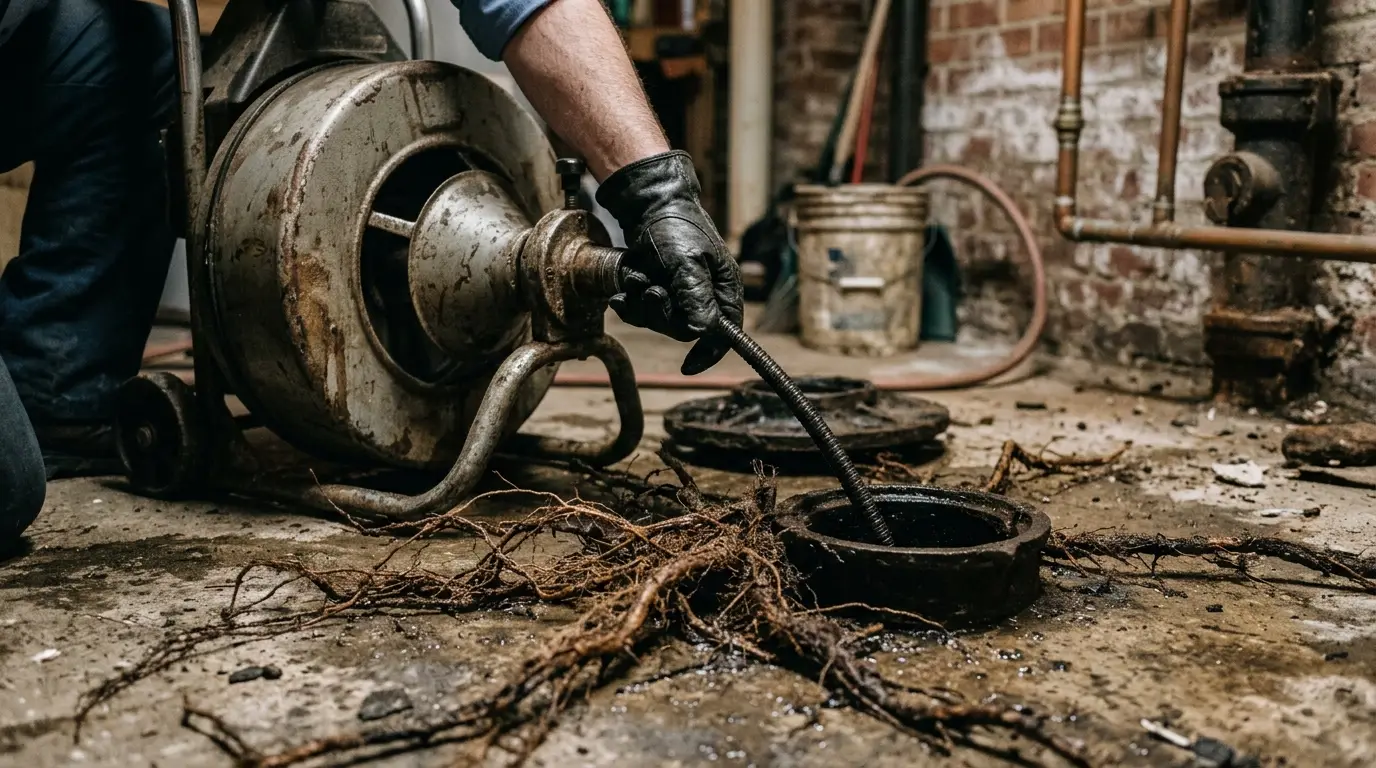
Sewer rodding for main-line blockages and seasonal root cutting
Rodding is the fast, mechanical answer to a blocked main. It is the right tool often, and the wrong one in a few specific cases, which is worth knowing before the machine comes off the truck.
When rodding is the right call
A drain machine drives a flexible steel cable into the line with a head on the end that cuts, breaks up, or retrieves whatever is in the way. It is the standard first response to a blocked main and for good reason: it is fast, it is comparatively inexpensive, and for a discrete obstruction it is exactly the correct tool.
The cases it suits well:
- A root mass in a lateral. A cutting head shears through it and restores flow, which on an urgent backup is the immediate objective.
- A solid plug. Accumulated paper, wipes, or debris packed at a restriction, the classic main-line blockage.
- A retrievable object. Something that needs pulling out rather than pushing along, which water pressure cannot do.
- Any urgent backup where the priority is getting the building draining. Rodding is the fastest route to that, and a fuller diagnosis can follow in daylight.
What it does not suit is a deposit lining the pipe wall. Against grease that has condensed onto cold cast iron over years, a cable bores a hole through the middle and leaves the rest adhered. Flow returns, the drain appears fixed, and it closes again over the following weeks. That is the recurring blockage pattern, and clearing it the same way a second time is not a plan.
The recurrence test
One blockage is an event. The same line twice in a year means either the tool was wrong for the material, or the pipe has a defect. A camera settles which of the two it is, and nothing else will.
Sectional and drum machines
Sectional machines use individual lengths of cable coupled together as the operator advances. The advantage is feel: with a short length of cable in play, the operator can sense what the head is meeting and tell the difference between a root mass, a hard obstruction, and a defect in the pipe. On older pipe of uncertain condition that feedback is genuinely valuable, and it is the main reason experienced crews still favour sectional machines for main-line work.
Drum machines carry the cable coiled inside a rotating housing. They are faster to deploy, cleaner to work with, and they suit interior branch work and shorter runs well. The trade-off is reduced feel, because a long length of cable in the drum absorbs the feedback from the head.
Cable diameter is matched to pipe size. Too light in a large line and the cable coils and balls up rather than cutting; too heavy in a small line and it cannot negotiate the bends. A cable that balls up in a partially blocked lateral can turn a partial obstruction into a complete one, which is one of several reasons rented equipment in inexperienced hands goes wrong.
Head selection, which is most of the skill
The machine is a motor. The head determines what actually happens in the pipe, and choosing it correctly is the difference between a cleared line and a damaged one.
Cutting heads, various blade and saw configurations sized to the pipe, for roots and hard obstructions. Sized correctly they cut the intrusion back to the pipe wall. Oversized in a fragile line they cut the pipe.
Retrieving heads, corkscrew or hook forms, to pull material out rather than push it through. Right for a foreign object and for hair-and-debris mats.
Spade and arrow heads for penetrating a solid plug and establishing initial flow, usually as a first pass before a larger head follows.
Expanding heads that open to full bore, used on a return pass to clear the pipe wall after a channel has been made.
The general method is progressive: a small head to establish flow, then successively larger to bring the line back toward full bore. Going straight in with the largest head is faster when it works and is how pipe gets damaged when it does not.
Root cutting and the seasonal interval
In the older parts of this metro, root intrusion into clay laterals is the single most common cause of main-line blockages, and it behaves on a schedule rather than at random.
The mechanism: clay laterals are short sections with mortared joints, and mortar deteriorates. Roots seek moisture, find it at a joint or a crack, and a hair root enters. Inside the pipe it has water and nutrients continuously, so it thickens into a mass that catches everything passing. Growth is seasonal, peaking through the growing months, which is why root blockages cluster in summer and early autumn.
Cutting them out works and it is not permanent. A cutting head shears the mass off at the pipe wall, which restores full flow immediately, but the root system outside the pipe is undamaged and the entry point is still there. It regrows. Jetting with a root nozzle strips the intrusion back considerably further and cleans the joint, which meaningfully extends the interval, but the entry point remains.
So the honest framing is management versus repair. Management is a rodding or jetting interval matched to how fast yours returns, which becomes knowable after one or two cycles and is far cheaper booked in autumn than discovered in July. Repair means eliminating the entry point: lining the affected section, which seals every joint along it, or replacing the run. Where a single joint is the culprit, lining that section ends the cycle rather than managing it forever.
Same lateral every summer? The interval is predictable, and so is the alternative to living with it.
Call about root cuttingCleanouts and access
Where the cable goes in shapes the whole visit.
An accessible exterior cleanout is the best case by a wide margin: the work happens outside, nothing comes through the house, and the cable enters pointing the right way along the lateral. If your building has one and it is buried under six inches of soil and turf, finding and marking it is worth doing on a dry afternoon rather than during a backup.
An interior cleanout at the stack base or on the building drain works well and means the crew is working in the basement. Fine, and messier by definition.
No cleanout means access through the stack from above, or by pulling a toilet. Both are workable, both add time, and pulling a toilet adds a reset and a new wax ring to the job.
Where no accessible cleanout exists, installing one is a modest job that makes every future inspection and cleaning faster and cheaper. On a property with a known root cycle it pays for itself quickly, and it is the kind of thing worth doing at the same time as any other lateral work while the ground is already open.
Where rodding does damage
Being direct about this, because the risk is real and it is concentrated in exactly the pipe this region has most of.
Cracked or offset clay. A cable can catch a lip at an offset joint or enter a crack rather than passing it, and a powered machine has enough torque to make either worse.
Deteriorating Orangeburg. Bituminised fibre pipe that has gone soft and oval offers very little resistance to a cutting head. Aggressive rodding in Orangeburg can perforate it.
Cast iron channelled along the invert. Where corrosion has thinned or removed the bottom of the pipe, there is not much material left for a cable to work against.
Any line where the cable balls up. An undersized cable in a large line, or a cable forced past a resistance it should not have been forced past, can knot. Retrieving a balled cable from a lateral is its own difficult job.
The mitigations are straightforward and they are what distinguishes a careful crew: a camera first on any line with a history or of unknown condition, progressive head sizing rather than starting large, sectional machines where feel matters, and stopping to look rather than pushing harder when the head meets something that does not behave like a blockage.
What should happen afterwards
Flow returning is the start of the conclusion, not the whole of it.
A flow test with real volume. Running a tap is not a test. Filling a tub and releasing it, or running several fixtures together, loads the line the way normal use does and reveals a restriction that a trickle passes straight through.
A statement of what came out. Roots, paper, grease, or a foreign object, that single fact tells you whether this recurs and on what timescale, and it should be said rather than left implied.
A camera, on any repeat. First blockage in a line with no history: rod it and see. Second one: look at it. That threshold is where the money is saved.
An honest recommendation about the interval. If this is a root cycle, roughly when to expect the next one and what the alternative to repeating it is. If it is grease, that jetting rather than rodding is the tool. If footage shows a defect, what it is and how urgent.
Scheduling rather than reacting
For properties with a known pattern (a clay lateral under mature trees, an older building with a documented root cycle, a rental where a backup means an emergency call-out at whatever hour it happens) a booked interval is straightforwardly cheaper than reacting.
The arithmetic is simple. A scheduled autumn visit is priced as ordinary daytime work, happens when the building is convenient, and takes as long as it needs. An emergency call in July, on a weekend, with sewage on a basement floor, is priced as emergency work and carries the clean-up behind it.
Autumn is the right time for root work specifically, because growth has slowed and the line goes into winter clear. For grease-prone commercial lines the interval is set by throughput rather than season, and it is usually quarterly or monthly.
None of that is a maintenance contract worth signing blindly. It is worth having the interval stated plainly, with the reasoning, and worth revisiting once footage exists, because for a fair number of properties the honest answer is that lining one bad joint would end the cycle for good.
Common Questions
Answers before you call
What is the difference between rodding and snaking?
Nothing substantive. They are the same operation and the words are used interchangeably. “Rodding” is the older regional term and it is still what most Chicago-area plumbers say for main-line work; “snaking” tends to be used for smaller interior drains.
The distinction that actually matters is rodding versus jetting: mechanical cable against hydraulic scouring. Those genuinely do different things, and the wrong one produces a drain that keeps blocking.
How often should a clay lateral be rodded for roots?
It depends on the tree and the defect, and the interval becomes knowable after one or two cycles. Some properties come back in eighteen months, others run five years. The first repeat tells you far more than any general rule.
Once the interval is established, booking it in autumn is much cheaper than discovering it in July, and it converts an emergency into a scheduled visit. Where the intrusion is at a single defective joint, lining that section ends the cycle instead of managing it.
Can rodding break my pipe?
In sound pipe, no, the cable is working against the obstruction, not the pipe. In compromised pipe, yes, and this is a real risk rather than a theoretical one. A cable driven hard into cracked clay, deteriorating Orangeburg, or cast iron that has channelled along its invert can find the defect instead of the blockage.
That is why a line with a history, or one of unknown condition, warrants a camera before an aggressive cable. On a first-time blockage in a line that has never given trouble, rodding first is entirely reasonable.
Why did it block again a month later?
Usually because the cable made a channel through the obstruction rather than removing it. Against grease or scale lining the pipe wall, that is what a cable does: flow returns immediately and the opening closes over the following weeks.
Or because the pipe has a defect holding material back: a sag, an offset joint, a root intrusion point, a broken section. Either way, a second visit to the same line is the point at which a camera stops being optional. Rodding it blind a third time is billing for the symptom.
Do you need to come inside?
Preferably not, and with an accessible exterior cleanout the whole job can happen outside. That is faster, cleaner, and it is one of the reasons an exterior cleanout is worth having.
Without one, access is through an interior cleanout, the stack base, or occasionally by pulling a toilet. All workable, all messier, and all slower. If your building has no accessible cleanout, installing one usually pays for itself over a couple of visits.
Is rodding enough, or do I need jetting?
Rodding for a discrete obstruction lodged in the pipe: a root mass, a foreign object, a solid plug. It is faster and cheaper and it is the correct tool for those.
Jetting where the problem is a deposit adhered to the pipe wall, which is most kitchen-line grease and most mineral scale. The test is recurrence: a line cleared more than once in a year is usually telling you the deposit was never removed.
Main line blocked, or backing up again?
Tell us which fixtures are affected and whether it has happened before. Both change what comes on the truck.
24/7 · Chicago metro dispatch · (833) 615-3680