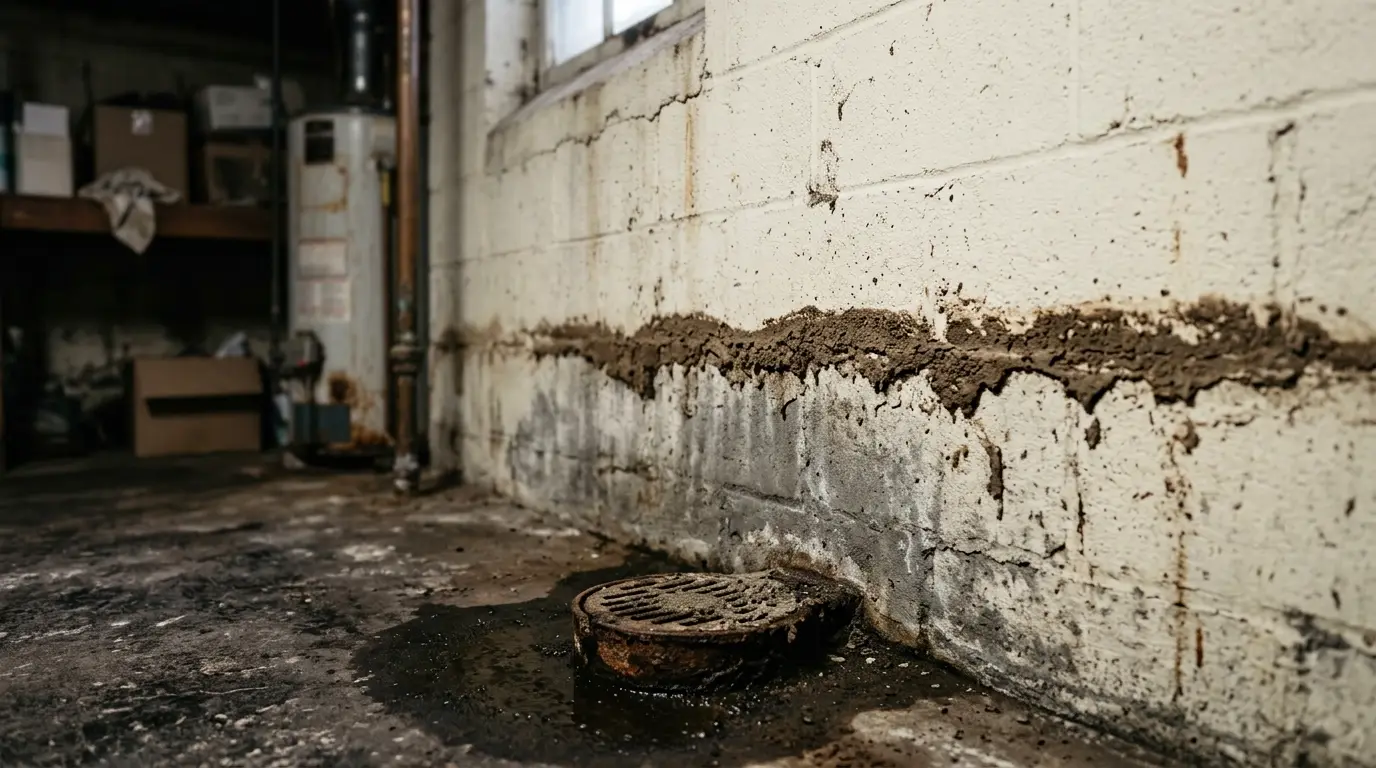
Basement flooding, and finding out which system failed
Water on a basement floor arrives by one of four routes, and the route determines everything that follows. The first job is telling them apart.
Four ways water reaches a basement floor
Everything about the response, the cost, and the prevention depends on which of these happened, and they are distinguishable by evidence rather than guesswork.
1. A surcharged sanitary or combined sewer
The public main fills faster than it can drain, pressure builds, and it finds the lowest opening on any connected building. That is a basement floor drain, a shower base, or a laundry standpipe. The water is dirty, it rises rather than spreads, and it appears during or just after heavy rain. This is the most common serious basement event in the older parts of this metro.
2. A blocked private lateral
Roots, grease, a collapsed joint, or a bellied section restricts your own pipe. Everything the building sends down comes back through the lowest fixture. It has no relationship to rainfall, and it usually announces itself for weeks beforehand with slow drains and gurgling.
3. Groundwater
Water in the soil against the foundation finds a way in: through the wall-floor joint, a crack, a window well, or the drain tile when the sump cannot keep up. The water is clean, it spreads from the perimeter or from around the crock rather than from the drain, and it correlates with rain and snowmelt.
4. A failure inside the building
A split supply line, a failed water heater, a burst washing-machine hose, a leaking ejector basin. Clean water, no relationship to weather, and frequently a great deal of it very quickly because a supply line is under constant pressure.
The distinguishing question
Where did the water appear first, and was it raining? Dirty water rising out of a floor drain during a storm is a sewer event. Clean water spreading from the wall-floor joint is groundwater. Clean water with no rain is a failure inside the building. That single observation directs the whole response.
The first hour
In order, and the order matters.
- Stop using water in the building. If the lateral is blocked or the main is surcharged, every flush and every appliance cycle adds to what is on the floor. This is the single most effective thing a householder can do, and it costs nothing.
- Kill the power to the affected area before entering it. Outlets near floor level, extension cords, the furnace, the water heater, and the sump itself are all down there. If the panel is in the basement and reaching it means standing in water, do not, call the utility.
- Do not wade into sewage. It is a health matter, not a squeamishness matter. Boots and gloves at minimum, and keep children and pets out entirely.
- Shut the water off if the source is a supply failure. The main valve where the service line enters the building. Knowing where it is before you need it is worth five minutes on a dry afternoon.
- Photograph everything before moving anything. Wide shots and close shots, the water line on the wall, and the contents. This is the evidence for both the insurer and the municipality, and it cannot be recreated later.
- Note the time and the weather. Whether it was raining, how hard, and when the water appeared. It is diagnostic, and it matters for a municipal claim.
- Get air moving once the power situation is safe. Mould begins within a day or two in a warm basement, and time is the variable you control.
What not to do: do not run the washing machine to test whether the drain is clear, do not pour drain chemicals into a blocked lateral you are about to have someone else work in, and do not start tearing out finishes before the water has been documented.
Why the public sewer backs up here
Large parts of the older metro are served by combined sewers, which carry sanitary waste and storm runoff in the same pipe. That design is a century old and it works until the rainfall rate exceeds what the system can move. When that happens the main pressurises, and every connection to it becomes a potential relief point.
Your building is one of those connections. The lowest opening below the level the water reaches in the main is where it comes out, and in most of this housing stock that is a basement floor drain. The water is not travelling from your fixtures; it is travelling backwards up your lateral from the street.
Several things make it worse in specific places. Newer separated-sewer suburbs remove the storm contribution but not the possibility of a sanitary surcharge. Downspouts and driveway drains connected to the sanitary system, common in older properties and prohibited now, add rainfall directly to the sewer, and disconnecting them is one of the cheapest improvements available. Heavy clay soil across the region sheds water rather than absorbing it, so runoff arrives fast. And a lateral with roots or a belly restricts flow in both directions, which makes a surcharge that a sound lateral would have shrugged off into a basement full of water.
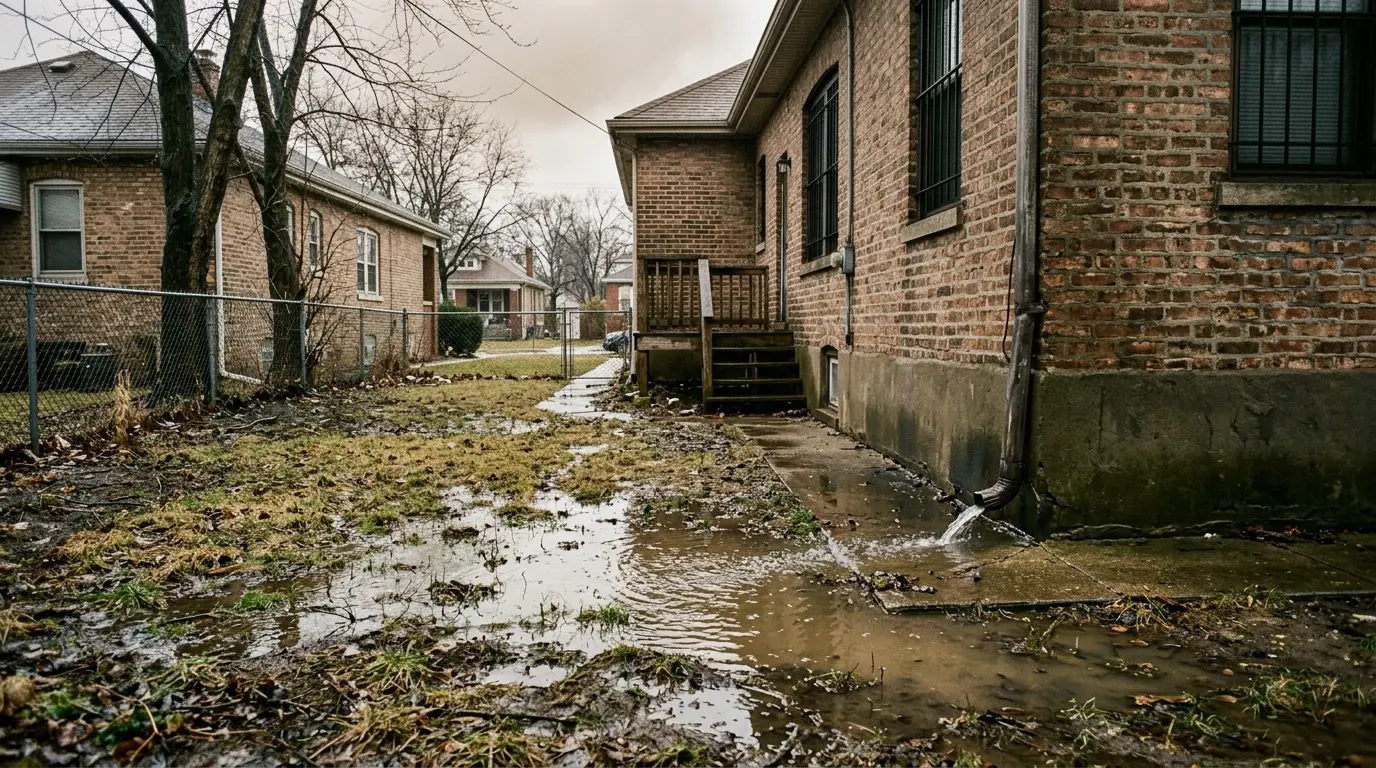
Establishing what actually happened
Once the water is down, the diagnosis is the whole value of the visit, because it decides both the repair and whose problem it was.
Where the water entered. Staining, debris lines, and the pattern on the slab. Water from the drain radiates outward from it; groundwater tracks the perimeter.
What the lateral looks like inside. A camera inspection after the line is clear shows roots, offsets, bellies, cracks, and Orangeburg deformation, with distances and depths recorded. This is the difference between a plausible story and a documented cause, and it is what a municipal claim or an insurance claim needs.
Whether the restriction was yours. If the lateral is sound to the property line and the main surcharged, that is a public-system event. If your line is 60% closed by roots at eighteen feet, it is not.
What the pumps were doing. Sump and ejector both get checked: power, float, check valve, discharge. A failed sump during a storm looks exactly like groundwater intrusion because that is what it is.
The rain record. Rainfall intensity for that hour is a matter of record, and a storm well beyond the system's design capacity is part of the explanation rather than an excuse.
Where the lateral is the cause, the repair options run from rodding for a root blockage through to lateral repair or replacement where the pipe itself has failed.
If it has happened once, the camera inspection is what stops you guessing about the second time.
Call to book an inspectionClean-up, and what has to be thrown out
Plumbing stops at the cause; the clean-up is a separate trade, and it is worth knowing what good practice looks like so you can judge what you are being sold.
Sewage-contaminated water is treated differently from clean water. Porous materials that have absorbed it do not get dried and kept: carpet and pad, upholstered furniture, mattresses, particle board, and the lower portion of drywall and its insulation come out. Hard surfaces are cleaned and disinfected. That sounds aggressive and it is the standard, because what is in the water is not just water.
The sequence is extraction, removal of what cannot be saved, cleaning, disinfection, then drying with air movers and dehumidification, with moisture readings taken until the structure is genuinely dry rather than dry to the touch. Cavities matter more than surfaces: a wall that feels dry with wet insulation behind it becomes a mould problem in a month.
Two things worth insisting on. Documentation throughout (photographs, moisture logs, a list of what was removed), because your insurer will want it. And an honest answer about the furnace and water heater: appliances that were submerged, particularly gas controls and electronic ignition, generally need assessment rather than a wipe down.
The insurance conversation
Worth understanding before an event, because after one it is too late to change.
Standard homeowner policies in this region commonly exclude backup through sewers and drains. Cover is available as an endorsement, it is usually modest in cost, and it is frequently sold with a sublimit well below what a finished basement costs to restore. Sump-pump-failure cover is often separate again. Groundwater seepage is generally not covered at all, and flooding from a watercourse is a different programme entirely.
Which means three practical steps: read the policy for the endorsement and its limit, ask what a finished lower level would cost to replace, and make the claim promptly with the documentation from the first hour. Where the cause was the public main, there is often a parallel process with the municipality with its own short notice period, and pursuing both is normal rather than double-dipping.
The prevention ladder
In rough order of cost, and each step is only worth doing if it addresses the cause you actually have.
Fix what is in your own lateral. Roots cut and the line rodded, a bad joint or a bellied section repaired. If your pipe was contributing, this is the cheapest and most direct improvement.
Disconnect what should not be connected. Downspouts, driveway drains, and window well drains tied into the sanitary system add rain to the sewer. Re-routing them to grade is inexpensive and helps you and the street.
Grade and drainage above ground. Extend downspouts well away, correct negative grading against the wall, and clear window wells. Groundwater problems are frequently surface-water problems in disguise.
Get the sump right. Correct capacity for the lift, a sound check valve, a discharge that cannot freeze, an alarm, and battery backup, because the storm that floods you is the storm that takes the power out. Covered under sump pump repair and installation.
Fit a backwater valve. A one-way valve on the lateral that closes when flow reverses. It is the proportionate answer to an occasional surcharge, and it comes with the requirement that you stop using water while it is closed. See backwater valve installation.
Convert to an overhead sewer. The complete answer: basement drainage is re-routed to an ejector and the building drain leaves above the level the main can reach, so there is no longer a low opening to surcharge into. It is drainage work rather than a fitting, and it is covered under overhead sewer conversion.
When it keeps happening
A second event changes the question from what happened to what is going to be done about it, and it is worth being systematic.
Establish the pattern: does it track rainfall, or use? Rain-driven events point at the public system or at groundwater; use-driven events point at your lateral. Note the rainfall threshold that produces it, a basement that floods in a once-a-decade storm is a different risk from one that floods every June.
Then confirm the lateral is not contributing, because a marginal main and a restricted lateral together produce floods that neither would produce alone. Then decide proportionately: a valve where events are occasional and the basement is unfinished; an overhead conversion where the basement is finished, holds mechanical plant, or floods repeatedly.
Ask the municipality what they know, too. Communities keep records of main-line surcharge complaints, and some have improvement programmes, subsidised valve or conversion schemes, or planned work on your street. That information is free and it occasionally changes the decision entirely.
What drives the cost
Emergency response against scheduled work. Clearing a blocked lateral at two in the morning during a regional storm, when every crew in the metro is already out, costs more than the same work on a Tuesday.
What the cause turns out to be. Rodding a root blockage is a modest job. Replacing a failed section of lateral under a driveway is not, and the diagnosis is what tells you which conversation you are in.
The clean-up, which is usually the largest number. Driven by how much finished space was affected and how long the water sat. It is also the part insurance is most likely to touch.
Prevention chosen. A valve is a defined installation with an access pit. An overhead conversion is slab work, re-routed drainage, a basin, a pump, and backup power.
Access. A cleanout in an open utility area is straightforward. A lateral with no accessible cleanout, or one under a finished floor, adds work before the work starts, and installing a proper cleanout during any repair pays for itself the next time.
Common Questions
Answers before you call
Water is coming up through my floor drain. What do I do first?
Stop using water anywhere in the building: no toilets, no taps, no laundry, no dishwasher. If the lateral is blocked, everything you send down is arriving on the floor, and a running washing machine cycle can be thirty gallons of it.
Then stay out of the water until the power to that area is off, because outlets, extension cords, and the furnace are all down there. Do not use the basement stairs as a viewing platform for long; sewage backups carry gas as well as bacteria. Call from upstairs.
Is this my fault or the city's?
It depends on where the restriction is, and that is a factual question with a findable answer. If your lateral is blocked by roots, grease, or a failed joint, it is yours. If the public main surcharged during a storm and pushed back through a sound lateral, it is not.
A camera inspection of the lateral after the water is down settles it, and it is worth doing before assuming either answer. Municipalities generally investigate main-line surcharge complaints, and the timeline for reporting one is usually short, so report it the same week.
Does my homeowner's insurance cover this?
Standard policies in this region commonly exclude water that backs up through sewers and drains unless a specific endorsement has been added, and that endorsement is usually inexpensive relative to what a finished basement costs to replace.
It is worth reading your policy now rather than after an event, and worth checking the limit as well as the presence of cover, a modest sublimit will not go far against a finished lower level. Sump-pump-failure cover is often a separate item again.
Can I just get a bigger sump pump?
Only if the water is groundwater. A sump pump moves clean water arriving through the drain tile, and it has no effect whatever on sewage coming back through a floor drain from the lateral, the two systems are separate.
Fitting a larger pump for a sewer problem is the most common piece of wasted money in this whole subject. Establish which system delivered the water first; the remedies are entirely different.
How do I know it will not happen again next storm?
You do not, until the cause is established. If the cause was a defect in your lateral, repairing it removes the problem. If the cause was the public main surcharging, the only reliable answers are a backwater valve or an overhead sewer conversion, because the main will surcharge again.
The honest framing is that a backwater valve blocks reverse flow and an overhead conversion removes the low opening the water uses. One is a few hundred to a few thousand; the other is drainage work. Which is proportionate depends on how often it happens and what is on the floor.
Why did the neighbours stay dry?
Usually because their lowest opening is higher than yours, or they already have protection. A house with no basement bathroom, no basement floor drain, or an overhead sewer has no low point for a surcharged main to use.
Elevation differences of a foot or two across a block are enough to decide who floods, which is why the pattern along a street looks arbitrary and is not.
Water rising through a floor drain right now?
Stop running water anywhere in the building and call. That one action often halts what is happening while we are on the way.
24/7 · Chicago metro dispatch · (833) 615-3680