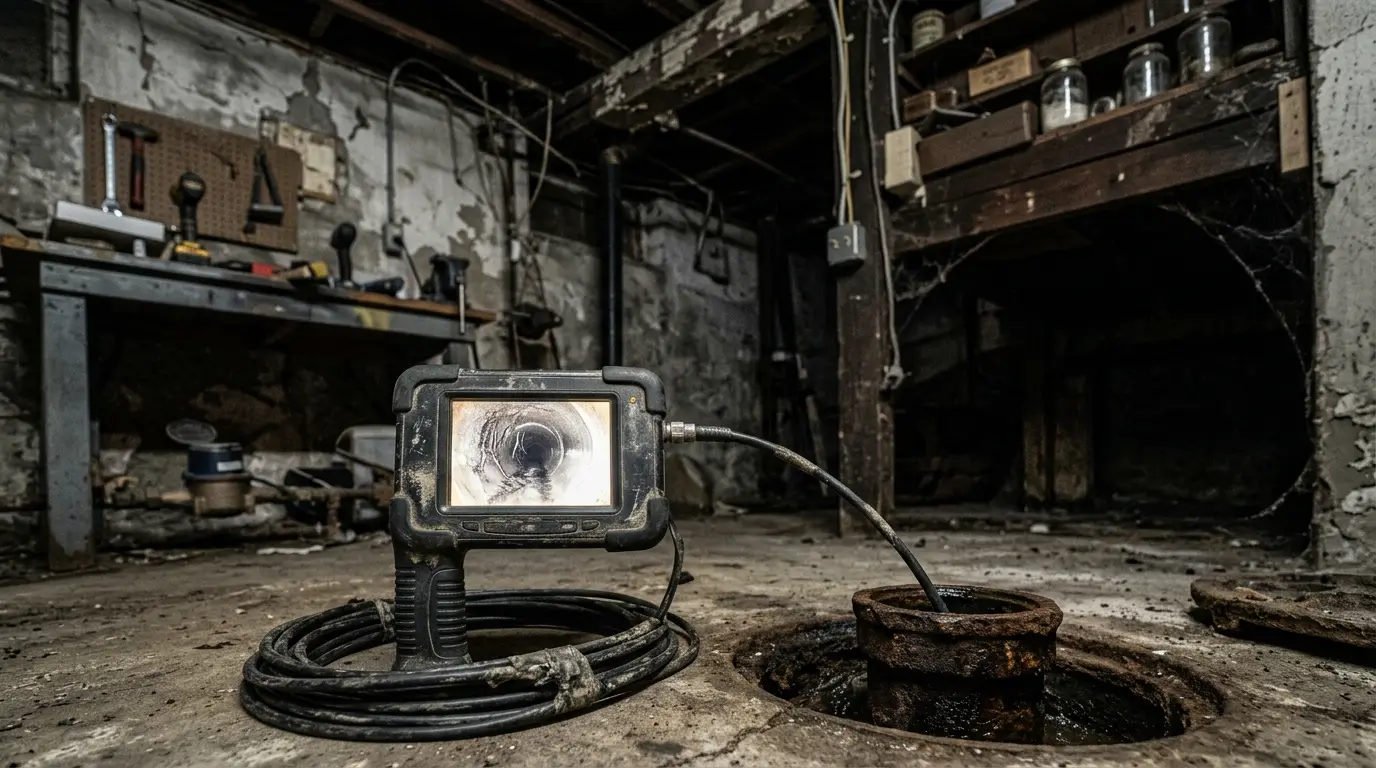
Sewer camera inspection, and what a proper one gives you
An inspection is a document, not an opinion. You should finish it holding footage, a located position and depth for every defect, and a plain statement of what each one means.
Why footage before any sewer decision
Sewer work is the one area of residential plumbing where the diagnosis and the price differ by an order of magnitude depending on findings that are entirely invisible from inside the building. A blocked lateral might need an hour of rodding or a full replacement under a public street, and the symptoms upstairs are identical.
That is the whole argument. Every option (rodding, jetting, spot repair, lining, bursting, open-cut) has prerequisites that can only be established by looking. Root intrusion at sound joints is a lining candidate. The same symptom caused by a belly is not, because no liner corrects grade. A quote produced without footage is a quote produced without knowing which of those is true.
It also protects you commercially. Footage is transferable: it lets you take the same evidence to a second contractor and get a comparable price, rather than comparing two descriptions of two different guesses. On a five-figure decision that is worth considerably more than the inspection costs.
The rule worth holding to
No sewer work gets quoted without footage, and no footage means no decision. It is the cheapest step in the sequence and it determines every step after it.
What you should receive
Four things. If a report is missing any of them, it is incomplete.
The recording itself, as a file you keep. Not a description, not a still, not a link that expires in a week. The full run, so a second opinion is possible.
A located position for every defect. Measured distance from a stated reference point (the cleanout, the foundation wall), so an excavation can be dug in the right place. “About halfway along” is not a location.
A depth reading at each of those positions. Depth drives excavation cost more than anything else, and it is taken with a locator receiving the sonde in the camera head. A quote for open-cut work without depth readings is a quote with a large unpriced variable in it.
A plain-language statement of what was found and how urgent each item is. Not a list of timestamps. What the defect is, what it will do if left, and what the realistic options are, including doing nothing for now, where that is honest.
A good report also says where the inspection stopped and why, and is explicit that pipe beyond that point was not assessed.
The equipment, and what each part does
The camera head is a sealed, self-levelling lens with its own lighting, sized to the pipe. Self-levelling matters more than it sounds: a rotating image makes it much harder to tell whether you are looking at a crack along the top or a channel along the bottom, and that distinction changes the diagnosis.
The push rod is a semi-rigid fibreglass cable on a reel, stiff enough to advance the head through bends and flexible enough to negotiate them. Length determines reach; a residential reel typically covers a full lateral run comfortably.
The sonde is a transmitter in the head that broadcasts a locatable signal. Paired with a receiver on the surface, it gives position and depth, the two numbers that turn footage into something you can excavate against. An inspection without a sonde locate produces video but not a plan.
The footage counter measures distance travelled, which is how defects get referenced consistently between the recording and the written report.
The monitor and recorder produce the file. On-screen distance overlay is worth having, because it ties every frame to a position without cross-referencing.
Reading footage yourself
You do not need to be a plumber to get real value from watching your own footage. A few things are unmistakable once pointed out.
Standing water in a horizontal run is a belly. The camera enters water and stays submerged for a distance, then emerges. That is a grade problem, it cannot be cleaned away, and it cannot be lined away.
Roots look like roots, fine white or brown fibres entering at a joint, sometimes filling the bore. Note whether they appear at one joint or at many, because that difference decides between a spot repair and lining the run.
An offset joint shows as a visible step or lip where one section sits proud of the next. Small offsets catch solids; large ones are structural.
Channelling in cast iron is the bottom of the pipe appearing dark, rough, or simply absent while the top looks intact. This is corrosion through the invert and it is a replacement conversation.
Deformation is the pipe looking oval rather than round. In a lateral of the right vintage that is the signature of Orangeburg, and it precedes collapse.
Grease coats the wall in a pale, uneven layer and reduces the bore visibly. It is a cleaning problem rather than a structural one, but it also hides the pipe wall, which is why footage taken through a dirty line is worth less.
Have footage you would like read through with you? That is a conversation worth having before you decide.
Call and talk through your footagePre-purchase inspections
On any older property in this region, a lateral inspection before completion is among the highest-value few hundred dollars in the entire transaction, because the failure modes are expensive, invisible, and age-correlated in a housing stock that is overwhelmingly old.
What it realistically finds: Orangeburg pipe in a post-war property, which is beyond its design life wherever it survives. Root-filled clay under mature parkway trees. A collapsed or badly offset section under a driveway or the public way. A belly from settlement. Cast iron channelled along the invert. Any of those is a significant number, and several of them are not visible in any other part of a survey.
Two practical points. Insist on the footage and the locate rather than a summary, because if it becomes a negotiation you want the evidence in your own hands. And get it done early enough that there is time to price the repair properly, a finding on the last day before closing is a finding you cannot act on.
It is worth saying that a clean inspection is also a result. Knowing the lateral is sound clay in good condition is genuinely useful information about a building you are about to own.
Why the line is cleaned first
A camera cannot see the pipe wall through a grease deposit or a root mass, and it cannot travel past an obstruction. So on any line with symptoms, cleaning and inspection are sequenced together rather than sold separately.
This has a consequence worth anticipating. Cleaning frequently reveals defects that the deposit was hiding: a crack under the grease, an offset joint behind the roots, a channelled section that the debris was effectively patching. Finding those is a good outcome even though it is unwelcome news, because they were going to cause the next blockage regardless.
It also means the sequence of a first visit on a problem line is usually: partial inspection to assess condition and choose a method, clean, then full inspection to assess the pipe. A crew that jets an unknown older lateral at full pressure before looking at it is taking a chance with your pipe, and the pre-clean look is the safeguard.
What a camera cannot tell you
Worth being clear about, because footage gets over-read in both directions.
It does not show pipe wall thickness. A pipe can look acceptable from inside and have very little material left. Cast iron in particular can present a reasonable-looking bore while being thin enough to fail under load.
It does not show what is outside the pipe. Voids in the bedding, washed-out soil, and groundwater movement around a defect are all invisible, and they matter for how a repair is done.
It does not assess pipe it did not reach. If the camera stopped at thirty feet, thirty feet were inspected. This is the most common way footage gets over-interpreted.
It does not read grade precisely. Standing water proves a belly exists; it does not quantify fall across the run. That takes levels.
It does not find supply-side leaks. Different problem, different equipment: pressure testing, acoustic, thermal, tracer gas.
Getting a second opinion
On any significant sewer proposal, a second opinion on the same footage is reasonable and normal, and it costs nothing but time if you hold the recording.
What to bring: the file, the written locate and depth readings, and the quote. What to ask the second contractor: what they see, what method they would use and why, and specifically whether they agree about grade, because a belly is the single most consequential thing to disagree about, and it is the finding that most often separates a lining proposal from an excavation.
Reasonable people do differ here, and a difference is not evidence of bad faith. Two competent contractors can look at the same moderately offset joint and land on spot repair versus lining the run, with defensible reasoning on both sides. What is not defensible is a proposal that cannot point to the frame it is based on.
Common Questions
Answers before you call
How much does a camera inspection cost?
It is priced as its own service, in the low hundreds for a straightforward residential lateral, and it is deliberately quoted separately from any repair. That separation matters: a company that bundles inspection into repair work has an incentive to find something.
Relative to what it informs, it is inexpensive. A lateral replacement is a five-figure decision in many cases, and making it without footage is guessing with a lot of money.
Do I get to keep the recording?
You should, as a matter of course, and a contractor who will not hand it over has told you something useful. The recording is the deliverable: it is what lets you get a second quote on equal footing, and it is the baseline that makes a future inspection meaningful.
Ask for the file rather than a link that expires, and ask for the locate and depth readings in writing alongside it. A defect described as “about halfway along” is not a location anyone can dig to.
Can you inspect without a cleanout?
Often yes, by pulling a toilet or entering through the stack, but it is more disruptive and sometimes limits how far the camera can travel. An accessible exterior cleanout makes every future inspection and cleaning cheaper.
Where none exists, installing one is frequently worth doing on its own merits. It is a modest job that pays for itself over the life of the building.
Is it worth inspecting if I have no problems?
In two situations, clearly yes. Before buying a property, because the things it finds (Orangeburg, root-filled clay, a collapsed section under the parkway) are expensive and invisible from a survey. And before any significant work you would rather not undo, like finishing a basement or laying a new driveway over the lateral.
Otherwise, if the building is older and has never been looked at, a baseline inspection is reasonable but not urgent. Where it earns its keep is that a defect caught early is often a lining candidate; the same defect found after collapse is an excavation.
The camera stopped partway. What does that mean?
That something is blocking it, and what that something is matters a great deal. A root mass, a heavy grease deposit, a severe offset joint, a deformed section, or a full collapse all stop a camera and they lead to very different repairs.
It usually means the line needs cleaning and re-inspecting, because a camera cannot see past an obstruction and cannot assess pipe it has not reached. An inspection that stopped at twenty feet has assessed twenty feet, and the report should say so rather than implying the rest is fine.
Can a camera find a leak in a water pipe?
No, these are drain cameras, and they work in gravity pipe with air in it. A pressurised water supply line has no space for a camera and no access point to insert one.
Supply-side leaks are found by other means entirely: pressure isolation, acoustic listening, thermal imaging, and tracer gas. That is a different service with different equipment.
About to spend serious money on a sewer line?
Footage first. It is the cheapest part of the job and it decides everything after it.
24/7 · Chicago metro dispatch · (833) 615-3680