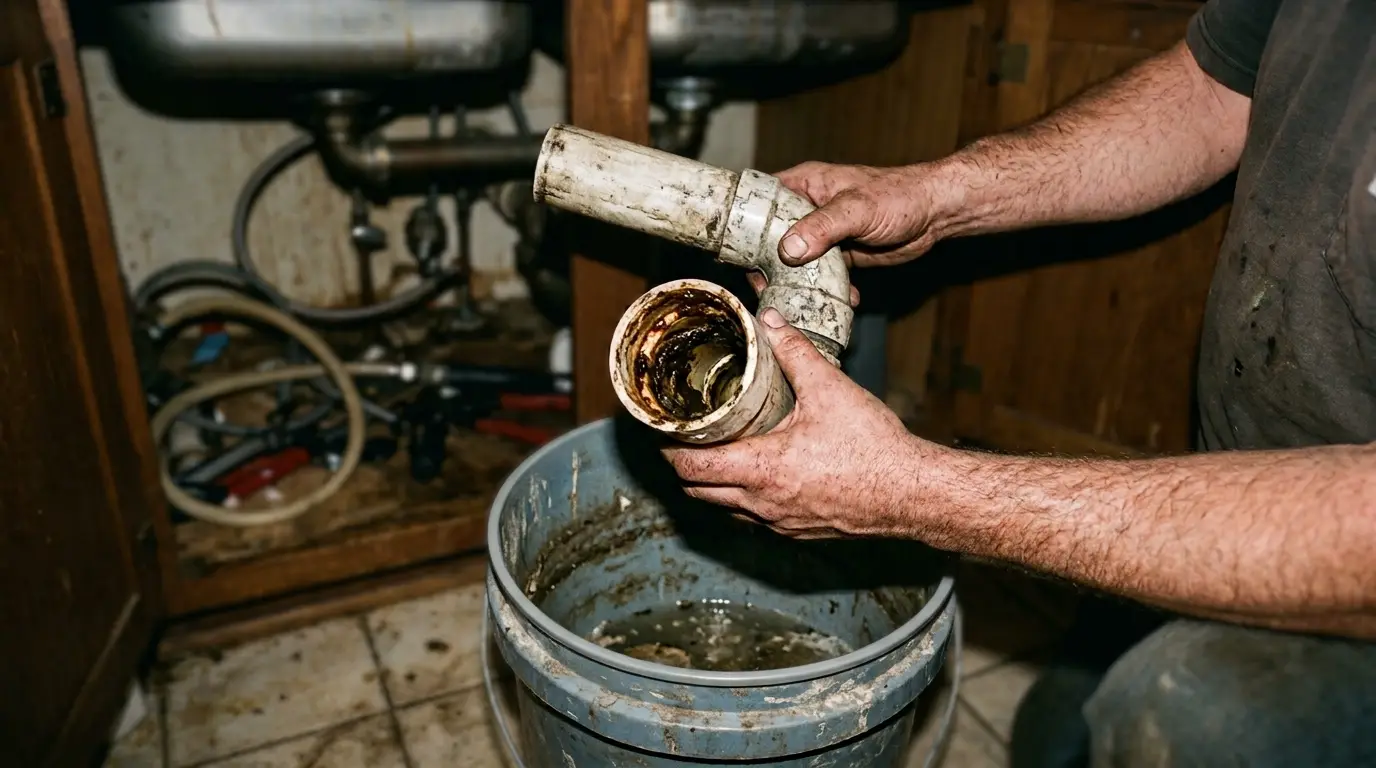
Drain cleaning, and finding out why it keeps happening
Clearing a blockage is the easy half. The half that matters is establishing whether it was a one-off, a habit, or the pipe telling you something about its condition.
Which drain is blocked tells you a lot
Before any equipment comes out, the pattern of which fixtures are affected locates the blockage with surprising precision. It is the first thing a dispatcher asks and it is worth knowing the logic.
One fixture only. The blockage is in that fixture’s trap or its branch line, upstream of anything shared. Smallest, cheapest, least urgent.
Two fixtures near each other. A sink and the tub in the same bathroom, say. The blockage has moved to the branch that serves both, still local, still straightforward.
Everything on one floor. A horizontal branch or a section of stack. Bigger job, and worth a camera if it has happened before.
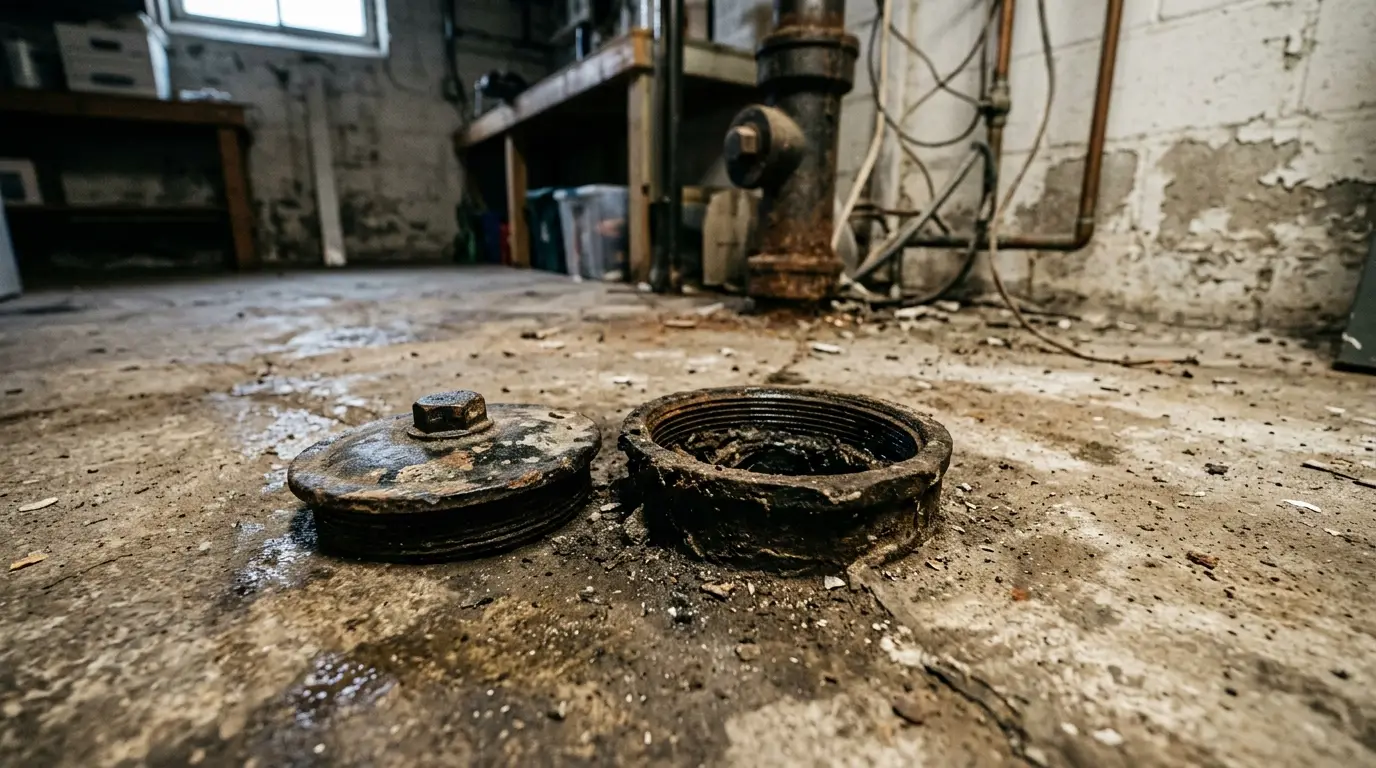
Lowest fixtures in the building, or a floor drain. The main line or the lateral out to the sewer. This is the serious one: water has nowhere to go and the lowest opening in the building is where it will emerge. Stop using water.
Gurgling in a fixture when another one drains. Air being pulled through a trap because the system cannot breathe properly. Often a venting problem rather than a blockage, and in winter here, sometimes a frozen vent stack.
The two-fixture rule
One slow fixture is a fixture problem. Two or more affected means shared pipe, and shared pipe means stop using water until it is cleared.
What actually blocks drains here
By fixture, in rough order of frequency.
Kitchen sinks: grease and starch. Almost never a poured cupful of fat. It arrives dissolved in hot water, then condenses on the cold pipe wall a metre or two downstream and builds up in layers. Rice, pasta and potato peelings absorb water and pack into the deposit. In a building with cast iron drains the rough interior gives it purchase, and the result is a hard, adhered deposit rather than a loose plug.
Bathroom sinks: hair and soap. Soap scum (particularly from bar soap in hard water, which is most of this region) binds hair into a mat that catches everything else. Concentrated at the trap and the pop-up assembly.
Tubs and showers: hair, at the strainer and just past it. Nearly always within arm’s reach, which is why this is the most successfully self-cleared blockage there is.
Toilets: the things that do not break down. Wipes marketed as flushable are the dominant cause and they do not disperse; they arrive intact at the first restriction and catch. Also cotton products, dental floss, and in households with small children, a remarkable variety of solid objects.
Main lines: roots, first and foremost. Clay laterals with mortared joints are standard in the pre-war parts of the metro, and tree roots find the joints, enter, and grow into a mass that catches everything passing. Root intrusion is seasonal, it peaks in the growing months, and it recurs on a predictable cycle in the same properties.
Main lines: collapse and misalignment. Older clay and Orangeburg laterals settle, crack, and deform. A blockage that returns quickly after clearing, in the same place, usually means the pipe is defective rather than dirty.
Cabling, and when it is the wrong tool
A drain machine drives a flexible steel cable into the line with a cutting or retrieving head on the end. It is the standard tool, it is fast, and for the majority of blockages it is entirely correct.
Sectional machines use lengths of cable added as the operator advances, which gives good feel for what the head is meeting, useful in older pipe where knowing whether you are hitting a root mass or a broken section matters. Drum machines carry the cable coiled in a housing; faster to deploy and the usual choice for interior branch work. Head selection matters as much as the machine: a retrieving head to pull hair out, a cutting head for roots, a grease head for a build-up.
The important limitation is what cabling does to an adhered deposit. Against grease or scale lining the pipe wall, a cable bores a hole through the middle. Flow returns immediately and the drain appears fixed, but most of the deposit is still there and the opening closes again over the following weeks. That is the classic recurring blockage, and clearing it the same way a second time is not a plan.
The other limitation is condition. In a fragile clay lateral or a cast iron line that has channelled out along the bottom, an aggressive cable can find the defect rather than the blockage. On any line with a known history, a camera before the cable is the cheaper sequence.
Where the deposit is adhered rather than lodged, hydro jetting is the tool that actually removes it, high-pressure water scouring the pipe wall back to its full bore rather than punching a channel through the middle.
Second time this year on the same drain? That is a camera job, not another cable.
Call and describe the patternWhy chemical drain cleaner makes it worse
Worth being direct about, because the products are sold hard and they cause real damage.
Caustic and acidic drain cleaners work by generating heat and dissolving organic matter. Against a hair clog in an accessible trap they sometimes work. Against grease, roots, scale, or anything solid, they mostly do not: the product sinks to the top of the obstruction, reacts with whatever it can, and then sits there.
What sitting there does: heat softens and distorts plastic traps and PVC branch lines, and can loosen solvent-welded joints. Acid attacks the interior of cast iron and old galvanized, accelerating exactly the corrosion that causes blockages in the first place. Repeated use is a measurable contributor to premature drain failure in older systems.
And then there is the safety issue for whoever opens the drain next. A trap full of standing caustic solution is a hazard to a plumber removing it, and it means the job starts with neutralising and disposal rather than with the repair. Anyone who has had it splash back knows why professionals object.
Enzyme-based maintenance products are a different category and a reasonable thing to use, they work slowly on organic film and they do not attack pipe. They are a maintenance measure rather than a clearing agent, and they will not touch an existing blockage.
If you have already used it
Say so when you call. A trap holding caustic solution changes how the job starts, and a plumber would much rather know before opening it than after.
When a camera is worth it
Not on every call, a first-time hair clog in a tub does not need one. It earns its place in four situations.
A repeat blockage in the same line. The single strongest indication. Recurrence means either the clearing method was wrong for the material, or the pipe has a defect. Both are visible on camera and neither is visible any other way.
Any main line or lateral blockage. Because the possible causes (roots, sag, crack, collapse, offset joint, foreign object) lead to completely different repairs, and the cost difference between them is enormous.
Before buying a property. A lateral inspection on an older building is inexpensive relative to what it can find. Orangeburg pipe, root-filled clay, and a collapsed section under a parkway are all things it is far better to know about before completion.
Before any significant drain work. Nobody should be quoting a lateral replacement without footage and a located depth, and you should be given the recording rather than a description of it.
What a proper inspection produces is a recording you keep, a located position and depth for any defect, and a plain statement of what was found. Camera inspection is a diagnostic service in its own right for exactly that reason.
Cast iron, and what age does to a drain
A large share of buildings in this region drain through cast iron, and its condition drives a great deal of the drain-cleaning caseload.
New cast iron is smooth. Old cast iron is not: it corrodes from the inside, and the corrosion product builds into a rough, scaled interior that reduces the bore and gives grease and debris something to hold onto. A line that was four inches internally can be meaningfully narrower and dramatically rougher after several decades of service.
The failure mode that follows is channelling. Waste sits along the bottom of horizontal runs, and corrosion is worst where it sits, so the pipe thins along its invert and eventually opens there. From inside, a camera shows the bottom of the pipe missing over a length, not a hole, a channel.
This matters for cleaning because it changes what is safe. Aggressive cabling in a channelled line can break through the remaining wall. High-pressure jetting has to be pressure-matched to the pipe’s condition rather than run at full. And a line in that state is on a replacement path regardless of how well it is cleaned, cleaning buys time, and the honest conversation is about how much.
What is reasonable to try yourself
Worth doing: pulling the pop-up assembly out of a bathroom sink and cleaning the hair off it, which solves a large fraction of slow bathroom sinks in about five minutes. Removing and cleaning a sink trap, with a bucket underneath and the knowledge that plastic slip nuts are hand-tight, not wrench-tight. Plunging a toilet properly: a flange plunger, a good seal, and steady strokes rather than violent ones. A hand auger in a tub or bathroom sink.
Worth trying first on a slow kitchen sink: a kettle of very hot (not boiling, which can damage plastic) water followed by a strong plunge. It will not shift an established deposit but it clears a soft one.
Not worth it: chemical cleaners, for the reasons above. Renting a powered drain machine, which is genuinely capable of destroying pipe and injuring the operator; the cable stores a lot of energy and a snag transfers it to whatever is holding the machine. Anything involving a main line or a cleanout under pressure, opening a cleanout on a blocked main releases whatever is standing behind it, and there is often a great deal.
Keeping them clear
Habits, mostly, and they work.
- Strainers in every sink and tub. The cheapest plumbing intervention there is, and it removes the single largest cause of bathroom blockages.
- Grease into a jar, not the sink. Including the residue on pans. Wipe with kitchen paper before washing.
- Nothing flushed but the obvious. Wipes especially, whatever the packaging says, and regardless of what the previous occupant did.
- Run water into unused fixtures monthly. Keeps traps sealed, which stops smells and stops the trap drying and cracking.
- Hot water down the kitchen drain after washing up. Helps carry dissolved grease past the cooling zone rather than letting it condense in the branch.
- If you have mature trees over a clay lateral, schedule root cutting. Annually or seasonally depending on how fast yours comes back. A booked visit in autumn costs a fraction of an emergency in July, and the interval is knowable after the first couple of cycles.
Common Questions
Answers before you call
One sink is slow but everything else is fine. Is that urgent?
No, and that pattern is good news: a single slow fixture means the blockage is in that fixture’s own trap or branch line, which is the smallest and cheapest kind to clear.
It becomes urgent when a second fixture joins in, because two fixtures affected means the problem has moved downstream to shared pipe. Book the single slow drain at your convenience; treat the second one as a different problem.
Water comes up in the tub when the toilet flushes. What does that mean?
That the blockage is downstream of both, in the main line serving the whole building, not in either fixture. Water leaving the toilet cannot get past the obstruction, so it takes the next available opening, which is the lowest fixture on that stack.
Stop using water throughout the building and call. Continuing to run fixtures upstairs while a main line is blocked is how a slow drain becomes water on a basement floor.
Will a drain snake from the hardware shop work?
For a hair clog in a tub or a bathroom sink trap, often yes, and it is a reasonable thing to own. Those blockages are within a few feet of the opening and a hand auger reaches them.
Beyond a branch line it stops being useful and starts being risky. A light cable in an older cast iron or clay line can find a crack rather than the blockage, and can snag and ball up in a way that turns a partial obstruction into a complete one.
The drain clears and then blocks again a few weeks later.
That is diagnostic and it should change the plan. A recurring blockage in the same place means the cable punched a hole through the obstruction rather than removing it, or the pipe has a defect holding material back: a sag, a root intrusion, a broken section, or heavy scale.
The second visit for the same drain should include a camera. Clearing it a third time without looking is charging for a symptom.
Is it grease, even though I never pour grease down the sink?
Frequently, yes. Grease does not arrive as a poured cupful; it arrives dissolved in hot washing-up water, then condenses onto the cold pipe wall a few feet downstream where the water cools. Every wash adds a layer.
In a building with cast iron drains the rough interior gives it something to key into, and it builds into a hard deposit that a cable bores a hole through and leaves in place. That is exactly the case where jetting is the right tool instead.
My basement floor drain smells but drains fine.
That is a dry trap, not a blockage. Floor drains have a water seal like any other, and a floor drain that is rarely used evaporates dry, particularly through a heating season, leaving an open path for sewer gas.
Pour a couple of litres of water down it, plus a splash of cooking oil to slow future evaporation. If the smell persists with a full trap, that is worth investigating properly. It can mean a cracked trap or a venting fault.
Blocked, slow, or backing up somewhere else?
Which fixtures are affected tells us where the blockage is before anyone arrives. It is the first thing we will ask.
24/7 · Chicago metro dispatch · (833) 615-3680