Ejector pumps for anything plumbed below the sewer
A basement bathroom drains uphill. The pump, the sealed basin and the vent are one system, and most of the calls we get are about the parts that are not the pump.
What an ejector pump does
Plumbing works by gravity. Every fixture in a building drains downhill to the building drain, out through the lateral, and into the public sewer under the street. That arrangement stops working the moment a fixture sits below the level of the sewer: which is exactly where a basement bathroom, a basement laundry, or a below-grade floor drain sits in most of the housing stock here.
An ejector system solves it by collecting that waste in a sealed basin set into the floor and pumping it up to a point where gravity can take over again. The pump lifts sewage into a discharge line, the line rises above the sewer level, and from there it falls into the building drain and out to the lateral normally.
The system is four things, not one: the basin, the pump inside it, the sealed and vented lid, and the discharge with its check valve. When people call about an ejector pump, the fault is as often in the other three as in the pump itself, particularly the odour complaints, which are almost always seal or vent problems.
It matters in this region because so many buildings have finished lower levels or basement apartments added to houses built when a basement was for coal. Any bathroom, laundry sink, shower, or wet bar added below grade after the fact needs one of these.
Sealed for a reason
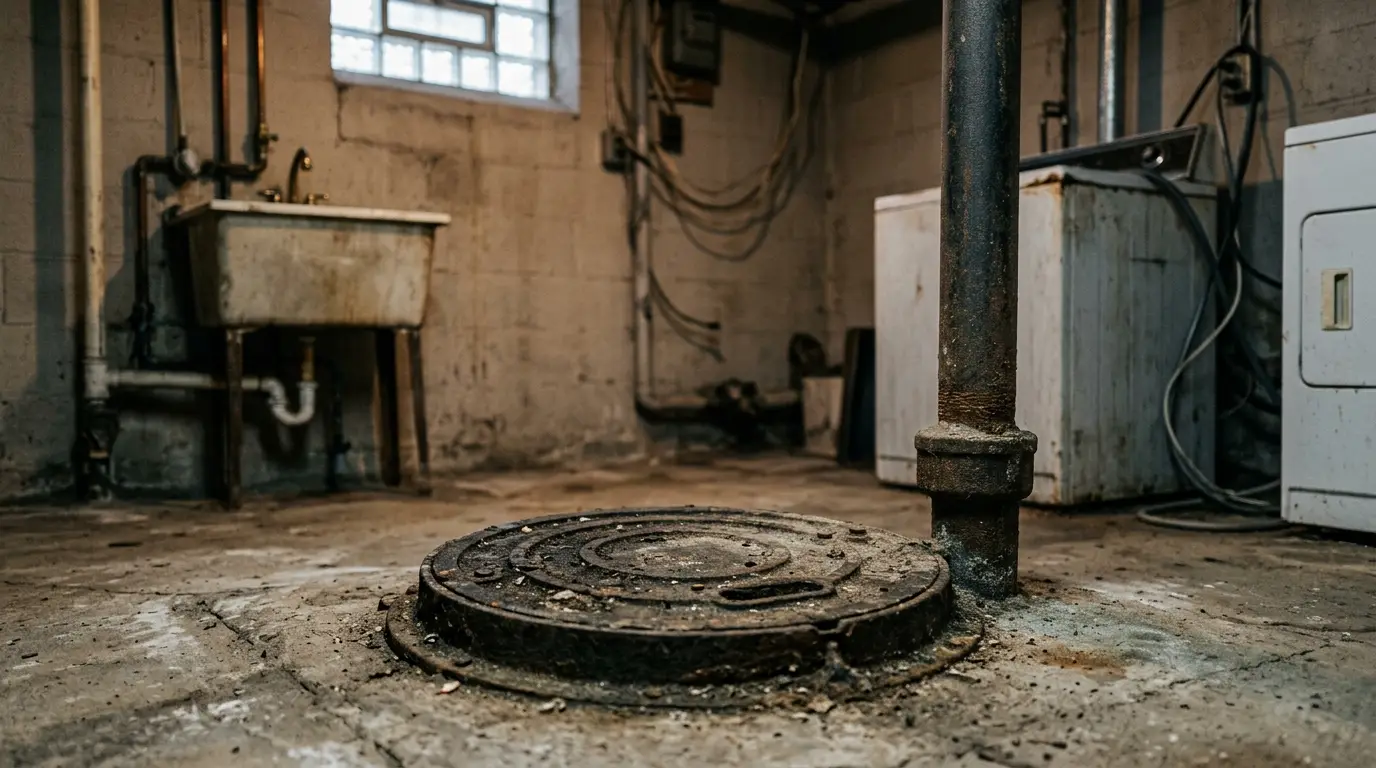
An ejector basin contains sewage, so it contains sewer gas. The lid is gasketed and bolted, every penetration through it is sealed, and the basin is vented to the building’s vent stack. A sump crock has none of those requirements. This is the single most important difference between the two, and the one most often ignored in improvised installations.
Ejector, grinder, or sump
Three pumps that look superficially similar and are not interchangeable.
Sump pump
Moves clean groundwater from the drain tile around the footing to the outside of the building. Open pit, no vent required, discharge to grade. It is not built for solids and it must never be connected to the sanitary sewer. Covered separately under sump pump repair and installation.
Solids-handling ejector pump
The standard residential sewage pump. It passes solids up to around two inches whole rather than cutting them, into a two-inch discharge line. For a basement bathroom and laundry on a normal gravity lateral this is the right pump: fewer moving parts than a grinder, less electrical demand, and it moves more volume for the same power.
Grinder pump
Cuts waste into a slurry before pumping it, which lets it push through a smaller discharge line and over longer distances and higher lifts. The residential case for a grinder is a long or high pumped run, a small-diameter discharge, or a property on a pressurised municipal sewer system. It costs more, draws more current, and has cutters that wear, and it is not a licence to flush things that should not be flushed.
The wrong pump in the right basin causes real problems. A sump pump handling laundry and bathroom waste will bind on solids within months. A grinder specified where a solids-handling pump would do adds cost and electrical load for no gain. And a solids-handling pump asked to lift twenty feet through a small line will run continuously and never clear the basin.
The basin, the lid, and the vent
This is where installations succeed or fail, and it is worth understanding before anyone quotes you.
The basin. Set into the floor, sized to give the pump a sensible cycle rather than a constant one, and deep enough that the inlet from the fixtures enters above the high water level. A basin that is too small short-cycles the pump; one with an inlet set too low backs water into the branch drain when the pump is briefly behind.
The lid. Gasketed, mechanically fastened, and sealed at every penetration: the discharge pipe, the vent, the power cord, and the float or alarm leads. Each of those is a path for sewer gas, and the basin is momentarily pressurised every time the pump starts. This is why odour arrives in waves that coincide with pump cycles, and it is the first thing to check when a basement smells.
The vent. Not optional and not satisfied by a hole. The basin is vented, at full size, into the building’s vent system so displaced air leaves above the roof rather than into the room. It also lets air in as the basin empties, which prevents the pump fighting a vacuum. An unvented basin is the most common defect we find in owner-installed and unpermitted basement bathrooms, and it is both a code violation and a permanent odour source.
The discharge and its check valve. Full-size pipe rising to above the sewer level, with a check valve to stop the column falling back into the basin when the pump stops. The valve is placed so it can be serviced, and a union above it means the pump can be lifted for service without cutting pipe. A failed check valve is the classic cause of a pump that cycles endlessly and the classic cause of the smell of stale sewage from a basin that never quite empties.
Symptoms and what they mean
- Sewage odour, in waves. Lid gasket, an unsealed penetration, or a vent problem. Waves that coincide with the pump running point at the seal; constant odour points at the vent or a dry trap.
- The alarm sounding. The basin is filling faster than it is emptying. Stop using the fixtures on it and call, basin volume is small and the next flush has nowhere to go.
- Pump runs, level does not drop. Bound or worn impeller, failed check valve, or a blockage in the pumped line.
- Short, rapid cycling. Almost always the check valve returning the discharge, sometimes a float with too little travel or a basin that is too small for the fixture group.
- Slow drainage or gurgling from a basement fixture. The basin is not clearing between uses, or the vent is restricted so the branch cannot breathe.
- Grinding or rattling. Solids or a foreign object in the impeller, or bearings at the end of their life.
- Nothing at all, with the basin full. Power first (GFCI, breaker, cord), then the float. Failed floats are more common than failed motors.
- Water around the basin rim. A lid seal failing under pressure, or a basin overflowing at the inlet. Either way it is sewage on a floor and it is urgent.
Where the basement also has a floor drain and the water appearing is not obviously from the basin, the question becomes which system is at fault. Clean water at the wall-floor joint is groundwater and a sump matter; anything rising out of a floor drain with odour is the lateral surcharging, which is basement flood and sewer backup territory and a different response.
Why ejector pumps fail
Wipes. The dominant cause, and the reason to be blunt about it. Products labelled flushable do not disperse in water; they rope together and wrap an impeller or a cutter. A grinder tolerates them longer than a solids-handling pump does, and both fail eventually.
The float switch. As with sump pumps, the switch fails more often than the motor. In an ejector basin it can also be fouled by grease and lint, which is why a basin taking laundry needs more attention than one taking a bathroom alone.
Grease and lint. Laundry discharge carries lint and warm water carries grease; both cool in the basin and coat the float, the impeller, and the basin wall. It is the reason a laundry-and-bath basin needs cleaning on a schedule.
The check valve. Failure returns the discharge column to the basin, multiplying cycles and shortening the pump’s life while making the basin smell.
An undersized or wrongly specified pump. Too little capacity for the lift, or a sump pump pressed into ejector service. It runs long, overheats, and clogs.
Electrical. A shared circuit, an extension cord, or a tripped GFCI in a corner of the basement nobody looks at. An ejector should be on its own properly protected circuit.
A blocked pumped line or a problem downstream. The pump can be sound while the discharge is obstructed, or while the building drain it empties into is partly blocked. Where the pumped line discharges into a lateral with roots or a bad joint, the ejector is a symptom rather than the fault, and a camera inspection of the lateral is the sensible next step.
Adding a bathroom below the sewer
The most common reason people meet this equipment for the first time. A new bathroom, laundry, or wet bar in a basement, and the discovery that the drain has to go up.
The sequence is: establish where the building drain runs and at what level, cut and excavate the slab for the basin, set and connect the basin with its inlet above high water, run the branch drains from the fixtures to it, vent the basin properly into the stack, install the pump with a check valve and union on a discharge that rises above the sewer level, provide a dedicated protected circuit and an alarm, then patch the slab. Permitted and inspected throughout.
Two decisions are worth making early. First, whether to serve the whole below-grade group from one basin or to keep the laundry separate, one basin is cheaper and simpler, separate basins keep lint and grease away from the bathroom pump. Second, the basin location: close to the fixtures keeps branch runs short and sloped correctly, and close to the stack keeps the vent connection simple. Those two pull in different directions and the compromise is worth drawing rather than assuming.
There is an alternative worth naming: an above-floor macerating unit behind a fixture, which avoids cutting the slab entirely. It is genuinely useful in a powder room where the slab cannot be opened, it is more limited in capacity, and it puts a mechanical component in the finished room rather than under the floor. For a full bathroom that will be used daily, a proper basin is the better installation.
Planning a basement bathroom? The basin location and the vent route are worth settling before the framing goes up.
Call and talk through the layoutEjectors in overhead sewer conversions
There is a second, larger use of this equipment in this region, and it is worth knowing about if your basement has ever taken sewage from a surcharged main.
Much of the older metro is served by combined sewers, which carry sanitary waste and storm water in the same pipe. In a heavy rain the public sewer can fill and pressurise, and the lowest opening in any connected building becomes the relief point. That is a basement floor drain.
An overhead sewer conversion removes the vulnerability by removing the low opening. The basement drains are disconnected from the gravity lateral and re-routed to an ejector basin, and the new building drain leaves the building above the level at which the public sewer can surcharge. Everything above grade continues to drain by gravity; the basement drains through the pump. Because there is no longer an opening below the surcharge line, a backed-up main has nowhere to enter.
It is the most complete protection available and it is a substantial job: slab work, re-routed drainage, a larger basin, and a properly sized pump with backup power, because the whole basement now depends on it. The lighter alternative is a backwater valve on the lateral, which is far cheaper and blocks reverse flow rather than eliminating the opening. Which one is right depends on how often the main surcharges and what is on the floor down there.
Maintenance and what not to flush
An ejector needs slightly more attention than a sump because of what passes through it, and almost all of it is prevention.
- Household rule, stated plainly. Waste, water, and toilet paper. No wipes of any description, no sanitary products, no floss, no cotton, no cat litter, no grease down the laundry sink. Every household member and tenant needs to know it.
- Annual basin service. Lid off, basin cleaned of grease and lint, float and impeller checked, intake clear. More often where a laundry shares the basin.
- Re-seal the lid properly every time it is opened. Gasket seated, all fasteners in, penetrations sealed. A lid put back loose is next month’s odour call.
- Check valve and union. Listen for one clean closure per cycle. Falling water means it is failing.
- Test the alarm. A high-level alarm is the cheapest component in the system and the one that prevents the expensive event. Test it, and fit one if there is not one.
- Watch the cycle count. If the pump starts cycling more often with no change in use, something has changed: the check valve, the float, or the discharge.
- Backup power where the basement is finished. An outage stops an ejector as surely as a sump, and the consequences are worse.
What drives the cost
Pump replacement against system repair. Swapping a pump in a sound, correctly vented basin is a defined job. Correcting an installation (adding a vent, replacing a basin, fixing a discharge that was never right) is larger, and with unpermitted work it is frequently what is required.
Pump type and capacity. A solids-handling pump costs less than a grinder to buy and to run. Specify by lift, line size, and fixture load rather than by preference.
New installation. Cutting and patching the slab, excavating, setting and connecting a basin, running branch drains, and making a proper vent connection is a multi-day, multi-trade job. The vent route is often the item that decides the price, because it has to reach the stack.
Access. A basin under a finished floor with a wall built over the discharge costs considerably more to service than one in an open utility area. Where a basement is being finished, leaving proper access to the basin is free at that moment and expensive later.
Electrical. A dedicated protected circuit and an alarm circuit. Where the basin currently runs on a cord to a shared outlet, that is part of the work.
Overhead conversion. A different order of project from a pump replacement: re-routed building drainage, slab work, and a system the whole basement depends on. Priced as drainage work rather than as a pump.
Emergency against planned. A failed ejector in a finished basement is an urgent call with sewage involved. Replacing a nine-year-old pump on a planned visit costs less and smells better.
Common Questions
Answers before you call
What is the difference between a sump pump and an ejector pump?
What they move. A sump pump handles clean groundwater from the drain tile around your footing and sends it outside to grade. An ejector pump handles sewage and waste water from fixtures below the sewer line and sends it up into the sanitary lateral.
That difference drives everything else. An ejector basin must be sealed and vented because it contains sewer gas; a sump crock does not. They are not interchangeable in either direction, and putting a sump pump in an ejector basin is both a code violation and an odour problem.
Why does my basement smell like sewage?
In a basement with an ejector, the most likely causes are the lid seal and the vent. The basin is under slight pressure each time the pump runs, and a failed gasket, a loose bolt, or an unsealed cord or pipe penetration lets gas out at exactly that moment: which is why the smell often comes in waves rather than constantly.
The other candidates are a dry floor drain trap, which a cup of water settles, and a vent that was never properly connected. A basin vented into the room instead of to the stack will smell forever no matter what pump is in it.
Can I flush wipes if I have a grinder pump?
No. Grinder pumps handle more than solids-handling pumps do, but wipes are the single most common cause of ejector failure regardless of type: they do not break down in water, they rope together, and they bind an impeller or a cutter.
The rule in a house with an ejector is stricter than in a house on gravity drainage: waste, water, and toilet paper only. No wipes labelled flushable, no sanitary products, no dental floss, no cat litter, no grease.
How long does an ejector pump last?
Seven to ten years for a decent unit in normal residential use, and less where the basin takes laundry lint and grease along with the bathroom. As with sump pumps, cycle count matters more than calendar age.
It is a good component to replace deliberately rather than on failure, because the failure mode is unpleasant. When it does get replaced, the check valve, the lid gasket, and the float go with it, not just the pump.
Do I need a permit to add a basement bathroom?
Yes, and this is one where the inspection genuinely protects you. A below-grade bathroom involves cutting the slab, connecting to the building drain, a sealed and vented basin, a pumped discharge with a check valve, and usually electrical work, all of it inspected.
It also matters at resale. An unpermitted basement bathroom is a disclosure problem and occasionally a demand to remove work that was done well but never recorded.
The alarm is going off but the pump seems to run. What now?
Stop using the fixtures on that basin and call. A high-level alarm with the pump running means the pump is turning but not moving what it should: a bound impeller, a failed check valve returning the discharge, or a blockage downstream in the pumped line.
The reason to stop using the fixtures is that the basin has limited volume and the next flush has nowhere to go. If it overflows it does so into a finished basement, and that is a much larger job than the pump.
Sewage smell in a basement with a bathroom?
That is a seal or a vent, and it is a fixable fault rather than something to live with. Call and describe when you notice it.
24/7 · Chicago metro dispatch · (833) 615-3680