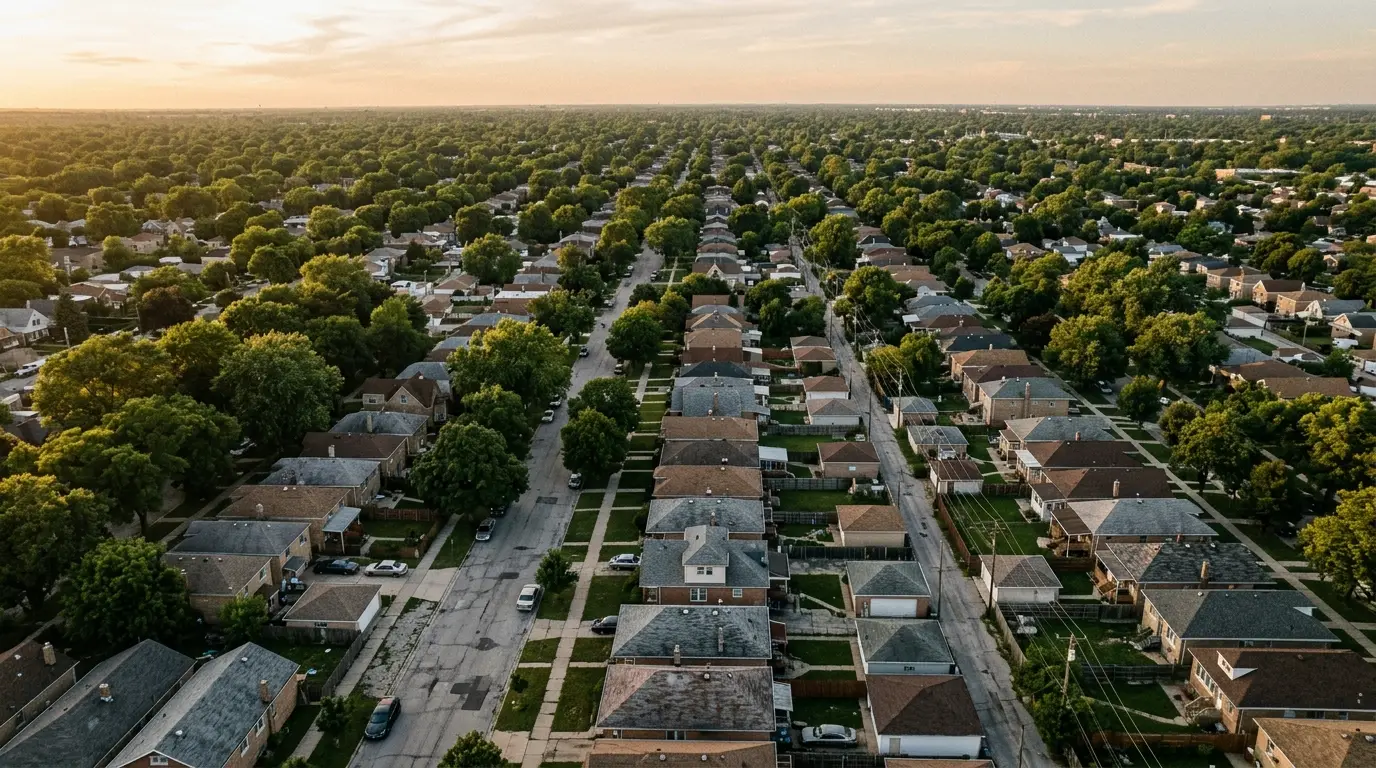
Where we dispatch, and what changes from one part of the metro to the next
Two hundred and sixteen communities across nine regions. The plumbing is not the same in all of them, the housing stock, the sewers and the water differ enough that it changes how a job is approached.
Nine regions, because the plumbing genuinely differs
Grouping 216 communities into regions is not a marketing convenience. The Chicago metropolitan area contains, within about sixty miles, combined sewers and separated ones, water hardness ranging from moderate to severe, housing built anywhere between the 1880s and last year, and a frost line that behaves differently over a plowed street than over a snow-covered lawn. A plumber who knows which of those they are walking into starts the job ahead.
Three differences do most of the work. Sewer type determines whether heavy rain is a plumbing risk at all, in combined-sewer neighbourhoods a summer storm can surcharge the public main and push water back toward buildings with no backflow protection, which simply does not happen on a separated system. Housing vintage determines the materials: galvanized supply and cast iron drain in the pre-war core, copper and PVC in the post-war ring, PEX in the newest subdivisions, each failing in its own characteristic way. Water chemistry determines what wears out first, and hardness across the western and northwestern counties is high enough to measurably shorten water heater life.
How coverage actually works
The footprint is the seven counties of the Chicago metropolitan area (Cook, DuPage, Lake, Will, Kane, McHenry and Kendall), plus a short list of outlying Illinois markets: Rockford and Winnebago County, Sycamore, LaSalle, Kankakee, the Quad Cities and Carbondale. The seven metro counties are covered comprehensively; the outlying markets are a deliberate short list rather than a claim to blanket downstate coverage.
Crews are assigned regionally rather than dispatched centrally, so response times vary across the footprint and are quoted honestly rather than optimistically. Inner-ring communities see the shortest windows. The outlying markets at the edge of the list are covered, but an overnight call there during a regional weather event is a genuinely different promise, and it gets described as one.
Individual community pages are being published region by region. Until yours is live, the phone covers the same ground faster.
The footprint
Nine regions, 216 communities
City of Chicago
Pre-1930 brick two-flats, bungalows and greystones over a combined sewer system, with galvanized supply and cast iron drain still in service across most of the housing stock.
North Side · Northwest Side · West Side · South Side · Southwest Side · Far South Side
North Shore
Large older homes on mature lots, deep basements, heavy tree cover over clay laterals, and a high proportion of steam and hot-water heating still running.
Deerfield · Evanston · Fort Sheridan · Glencoe · Glenview · Golf · Highland Park · Highwood · Kenilworth · Lake Bluff · Lake Forest · Lincolnwood · Morton Grove · Niles · Northbrook · Skokie · Techny · Wilmette · Winnetka
Northwest Suburbs
Post-war ranches and split-levels alongside 1970s and 1980s subdivisions: copper supply, PVC drain, and sump pumps doing most of the seasonal work.
Arlington Heights · Barrington · Des Plaines · Elk Grove Village · Harwood Heights · Hoffman Estates · Mount Prospect · Palatine · Park Ridge · Prospect Heights · Rolling Meadows · Schaumburg · Schiller Park · Streamwood · Wheeling
West Suburbs & DuPage
The widest spread in the region: pre-war near-west villages with combined sewers next to newer DuPage subdivisions on separated storm systems.
Addison · Bartlett · Bellwood · Bensenville · Berkeley · Berwyn · Bloomingdale · Broadview · Brookfield · Carol Stream · Cicero · Clarendon Hills · Darien · Downers Grove · Elmhurst · Elmwood Park · Eola · Forest Park · Franklin Park · Glen Ellyn · Glendale Heights · Hanover Park · Hillside · Hines · Hinsdale · Itasca · La Grange · La Grange Park · Lisle · Lombard · Lyons · Maywood · Medinah · Melrose Park · Naperville · Oak Brook · Oak Park · River Forest · River Grove · Riverside · Roselle · Stone Park · Villa Park · Warrenville · Wayne · West Chicago · Westchester · Western Springs · Westmont · Wheaton · Willowbrook · Winfield · Wood Dale · Woodridge
South Suburbs
Flat terrain, high water table, and a large inventory of post-war housing where basement backup protection is the dominant plumbing question.
Alsip · Bedford Park · Blue Island · Bridgeview · Burbank · Calumet City · Chicago Heights · Chicago Ridge · Country Club Hills · Crestwood · Dolton · Evergreen Park · Flossmoor · Glenwood · Harvey · Hazel Crest · Hickory Hills · Hometown · Homewood · Justice · Lansing · Lemont · Markham · Matteson · Midlothian · Oak Forest · Oak Lawn · Olympia Fields · Orland Park · Palos Heights · Palos Hills · Palos Park · Park Forest · Posen · Richton Park · Riverdale · Robbins · South Holland · Steger · Summit · Thornton · Tinley Park · Willow Springs · Worth
Lake County
A mix of dense older lakefront communities and low-density outer townships, with private wells and septic still present at the northern edge.
Antioch · Buffalo Grove · Fox Lake · Grayslake · Great Lakes · Gurnee · Ingleside · Lake Villa · Lake Zurich · Libertyville · Lincolnshire · Mundelein · North Chicago · Round Lake · Russell · Vernon Hills · Wadsworth · Wauconda · Waukegan · Winthrop Harbor · Zion
McHenry, Kane & the Fox Valley
Hard water is the defining condition here, along with older river-corridor housing and a significant number of properties on private wells.
Algonquin · Aurora · Batavia · Burlington · Carpentersville · Cary · Crystal Lake · Dundee · Elburn · Elgin · Fox River Grove · Fox Valley · Geneva · Gilberts · Hampshire · Huntley · Island Lake · Lake in the Hills · Marengo · McHenry · Mooseheart · Oswego · Richmond · Ringwood · Saint Charles · South Elgin · Spring Grove · Union · Wasco · Wonder Lake · Woodstock · Yorkville
Will County
Rapid subdivision growth over the last three decades sitting beside a much older core, so the plumbing ranges from six years old to a hundred and twenty.
Beecher · Bolingbrook · Crest Hill · Crete · Elwood · Frankfort · Homer Glen · Joliet · Lockport · Manhattan · Minooka · New Lenox · Plainfield · Romeoville · Shorewood · Wilmington
Outlying Illinois
Beyond the collar counties, where response times are longer and honest scheduling matters more than a fast promise.
Bourbonnais · Carbondale · Kankakee · LaSalle · Leland · Loves Park · Machesney Park · Moline · Pembroke Township · Rock Island · Rockford · Roscoe · Seneca · Sycamore
Common Questions
About coverage
Do you charge more the farther out I am?
Distance affects how long it takes to reach you, not the rate for the work. What it does affect is whether an overnight call is realistic, a 2 a.m. dispatch to Rockford in an ice event is a different proposition from one to Berwyn, and you should be told which one you are getting.
If someone closer to you will genuinely arrive sooner, a dispatcher will say so. For a flooding basement that is the answer that matters.
My town is not on the list. Do you still cover it?
Probably. The list reflects where we have a documented service history, not a boundary fence. Small unincorporated areas and townships between listed communities are almost always covered by the same crews.
Call and give the cross streets. It takes a moment to confirm and it is more reliable than reading a list.
Why does the region matter for a plumbing job?
Because it changes what is likely to be wrong before anyone arrives. A basement backup in a pre-1930 combined-sewer neighbourhood suggests a surcharged main or a root-blocked clay lateral. The same symptom in a 1990s Will County subdivision on a separated storm system points at the ejector or the sump instead.
It also changes the fix. Hard water through the Fox Valley shortens water heater life and drives softener work. Deep frost penetration across the northern counties drives the winter caseload. Knowing the area narrows the diagnosis before the first question is asked.
Are the crews local to my area?
Crews are assigned by region rather than dispatched centrally across the whole footprint, so the plumber who arrives has usually worked on the same housing stock and the same sewer system many times before.
That matters more than it sounds. Knowing that a particular vintage of two-flat has its shutoff behind the front stair, or that a given subdivision has a known lateral problem, saves real time on arrival.
Tell us the cross streets.
Confirming coverage takes a moment, and it is quicker than reading a list of two hundred town names.
24/7 · Chicago metro dispatch · (833) 615-3680