Plumbing on the West Side
The oldest housing stock in the city, a great deal of it still heated by steam, and a significant number of buildings coming back into use after years of sitting empty.
The oldest stock in the city
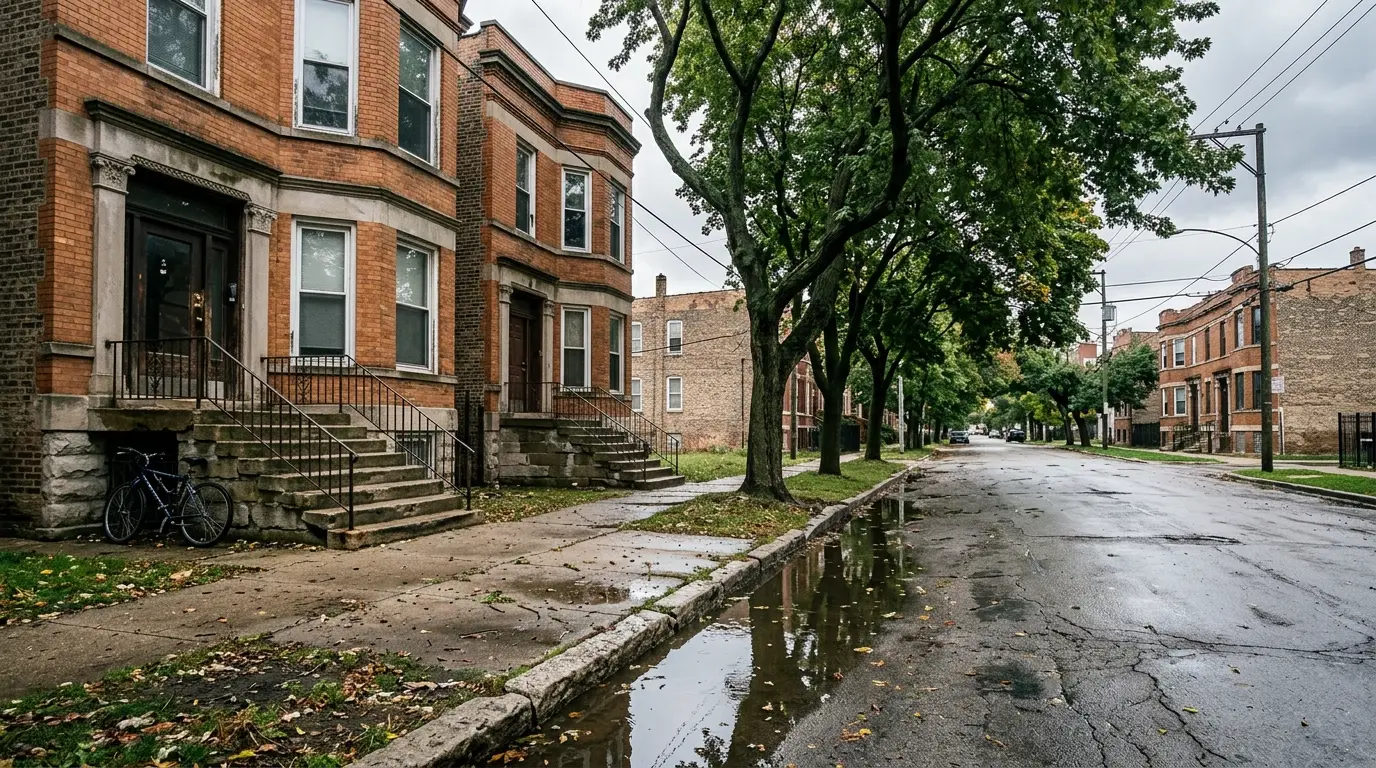
A good deal of the West Side was built before 1910, which makes it the oldest large concentration of housing in Chicago and gives the plumbing here a distinct character. Greystones and masonry two-flats dominate, along with frame cottages that predate the buildings around them. That vintage means the original systems were installed when indoor plumbing itself was new: galvanized steel supply, cast iron drain and vent with hub-and-spigot joints packed with lead and oakum, and clay laterals out to the street laid before the street was paved.
What follows from age is not that everything is failing but that nothing is original by accident. Most of these buildings have had two or three generations of partial work done, and the joins between those generations are where the problems sit: copper spliced to galvanized without a dielectric break, a section of plastic drain tied into cast iron at a fitting that was never designed for it, a bathroom moved in the 1970s with drainage that was borrowed rather than run. Reading a West Side building means reading the repairs as much as the original.
It also means the cast iron drainage is genuinely old. Cast iron thins from the inside along the horizontal runs and at the hubs, so it announces itself as a stack weeping inside a wall or a house drain that has lost its bottom under the basement floor. Neither is dramatic until it is, and both are the kind of thing sewer and drain line repair exists for.
One-pipe steam, and why it matters
The West Side has the highest proportion of original steam heat left in the city, and it is worth understanding as a plumbing system rather than as a heating curiosity. In a one-pipe system the same pipe carries steam up to the radiator and condensate back down, which imposes real requirements on pitch, pipe sizing and venting. When those are right the system is quiet, even and remarkably durable. When they are not, the building has cold rooms, banging pipes, and an owner being told the boiler needs replacing.
The failure that gets misdiagnosed most often is the air vent. Every radiator has one, its job is to let air out as steam arrives and close before the steam escapes, and it is a consumable part. A building whose vents have never been changed will have several that have failed shut, giving radiators that stay cold while the boiler runs perfectly well. That is a small repair mistaken for a large one with some regularity.
The genuinely expensive mistake is a boiler replaced by someone who treats one-pipe steam as a hot-water system: sized by square footage instead of connected radiation, with near-boiler piping that ignores the dimensional requirements. The result is a new boiler that heats worse than the old one, and it is not fixable by adjustment. The material on boiler, radiator and steam heat service covers what a correct job looks like.
Buildings coming back into use
A meaningful share of West Side work is on buildings that have been empty (some for a season, some for years), and being brought back. This is its own category of plumbing, and the mistake that defines it is treating the first fill as a formality. A system that has stood dry, or frozen and thawed, does not have one failure point. It has several, they are usually on the upper floors where nobody is standing, and they all open at once when the main is turned on.
The controlled version is straightforward: someone stationed on every floor, the main opened part way rather than fully, and the building brought up slowly with time to hear water arriving where it should not be. Before that, the water heater must not be fired dry, the gas appliances should be isolated, traps that have evaporated need refilling, and the shutoff at the parkway needs to be confirmed operable, on a building that has sat for years, servicing that shutoff is sometimes the first job of all.
Frozen and thawed is worse than frozen
A pipe that split while frozen holds nothing back until the ice goes. Buildings reoccupied in February routinely flood in March, and the reason is that the failure happened weeks before the water arrived to prove it.
Where pipe has been damaged, the honest scope is usually larger than the visible split: burst pipe repair stabilises the building, but a system that froze through is a candidate for repiping rather than for a series of patches. Deciding that at the start costs less than discovering it across four separate call-outs.
The water service, and what is in it
Chicago required lead water service lines by ordinance until the federal ban in 1986, and on the West Side that means the great majority of buildings whose service has never been touched have lead in the ground. The city holds an address-level inventory of service line materials, and starting there is better than an opinion at the kerb. It is a matter of record, and it costs nothing to check.
Where replacement follows, it needs to be end to end. Replacing only the length inside your trench leaves lead in the ground and disturbs the protective scale inside what remains, which can make water quality worse for a period rather than better, the reason water service line replacement is a service line question rather than a filtration one. Remember too that in Chicago the owner’s responsibility runs to the connection at the main, including under the parkway and the pavement, so this is public-way work with permits and street restoration attached.
One local wrinkle worth knowing: a large share of Chicago single-family property is still on unmetered flat-rate water billing, which removes the signal metered households rely on. A supply line weeping inside a wall produces no change in the bill at all, so it runs until it does visible damage. On an older West Side building that is the argument for treating an unexplained damp patch as urgent and for periodic leak detection rather than waiting for arithmetic that will never arrive.
What We Dispatch For
Work called in most often on the West Side
Coverage
Where this covers
Austin and Galewood east through Humboldt Park and West Town, and south through the Garfield Park and Lawndale blocks.
Austin · Galewood · Humboldt Park · West Town · Wicker Park · Ukrainian Village · East Garfield Park · West Garfield Park · North Lawndale · Little Village · Near West Side · Tri-Taylor · Pilsen · Garfield Ridge
Common Questions
Answers before you call
The building has been vacant. What should be checked before the water goes on?
Treat the first fill as the job rather than as a formality. A system that has been dry, or frozen and thawed, does not fail at one point, it fails at several simultaneously, and the failures are upstairs where nobody is standing. The sequence that works is: someone at every floor, the main opened part way, and the building brought up slowly with time to hear water where it should not be.
Before that, the things worth confirming are that the gas appliances are isolated, that the water heater is not going to be fired dry, that traps have not evaporated to nothing, and that the meter or the shutoff at the parkway is actually operable. A building that has sat for years often needs the shutoff itself serviced before anything else can be done safely.
Is the old steam boiler worth keeping?
Frequently, yes. Cast iron radiators and steam distribution are durable and comfortable, and a system is not obsolete because it is old. What decides it is whether the boiler is sound and whether the near-boiler piping, the vents and the traps are right: those, rather than the boiler’s age, are what make a steam system heat evenly or not at all.
The expensive mistake on the West Side is a replacement installed by someone treating one-pipe steam as though it were a hot-water system. Steam is sized from the connected radiation, the near-boiler piping has real dimensional requirements, and getting either wrong produces a building whose top floor never heats regardless of how new the boiler is.
Half the radiators heat and half do not.
On a one-pipe system that is almost always vents and traps rather than the boiler. Each radiator has an air vent whose job is to let air out as steam arrives and then close; when it fails shut, steam never reaches that radiator, and when it fails open, steam escapes and the system cannot balance. The pattern of which rooms are cold usually identifies which vents have gone.
It is also the cheapest repair in the whole heating system, which is why it is worth ruling out before anyone quotes a boiler. Vents are consumable parts and a building that has never had them changed is very likely to have several that no longer work.
We are gutting the building. What triggers a permit?
More than most owners expect. Repairing or replacing a fixture in place is generally maintenance, but moving or adding pipe, opening walls, re-draining a basement, altering the water service or working in the public way is permitted work with inspection attached, and Chicago writes its own plumbing code rather than following the state one.
It matters at resale rather than only at inspection. Unpermitted drainage and service work is what surfaces years later during a sale, and a basement re-drain nobody inspected is very difficult to warrant to a buyer. Ask for permit numbers on anything touching the sewer or the water service.
Elsewhere in the City
The other sides
Turning the water on in a building that has been sitting?
Do it with someone there and the main partly open. A system that has been dry or frozen fails at several points at once, and the difference between a controlled first fill and an uncontrolled one is measured in ceilings.
24/7 · Chicago metro dispatch · (833) 615-3680