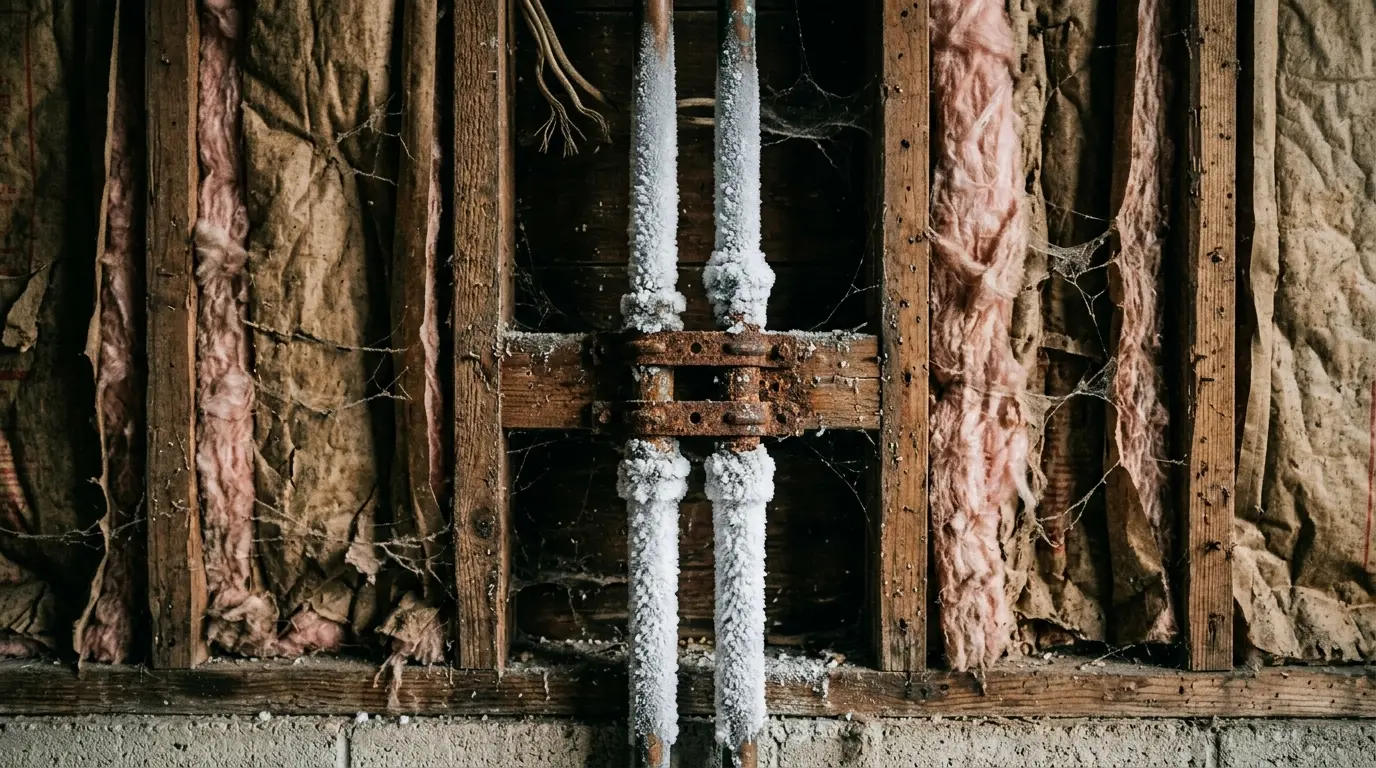
Frozen pipe repair for Chicago-area homes and buildings
A frozen line has two failure points: the ice, and the split it leaves behind. Both get handled on the same visit: thaw, pressure test, repair, then fix the reason it froze.
Why pipes freeze here specifically
Freeze damage is not a function of how cold it gets. Plenty of colder places see less of it. It is a function of cold air reaching pipe that was never meant to be in cold air, and the Chicago-area building stock is unusually good at arranging that.
Three overlapping conditions do most of the work. First, a very large inventory of housing built between roughly 1890 and 1960, when the concept of a continuous thermal envelope did not exist and supply lines were routinely run through exterior walls, unheated porches, and unconditioned crawlspaces. Second, retrofits: a century of additions, enclosed porches, finished basements, and re-routed plumbing, each of which quietly moved some length of pipe from the warm side of the envelope to the cold side. Third, wind: sustained lake-effect wind driving into a north or west wall strips heat from a wall cavity far faster than still air at the same temperature.
That third factor is the one people underestimate. A pipe in a wall cavity at 10°F with no air movement may hold. The same pipe with a 25 mph wind finding its way through a gap in the sheathing will freeze in a few hours. It is why freezes cluster on the windward side of a building and why the same house can freeze in one January and not the next.
The real variable
Freezes are caused by air movement across under-insulated pipe, not by outdoor temperature alone. That is why the fix is almost always about air sealing, not just adding insulation.
Where they freeze in local housing stock
After enough winters the map becomes predictable. In rough order of frequency:
Kitchen supply lines on an exterior wall
The single most common freeze in the region. A sink on an outside wall, cabinet doors closed, a cold-air gap behind the base cabinet. The cabinet becomes an insulated box that keeps house heat out and cold in. This is why the standing advice on the coldest nights is to open the cabinet doors. It works, and it is free.
Enclosed and converted porches
Two-flats and bungalows with a rear porch closed in at some point in the last eighty years. The enclosure looks like interior space and is thermally still exterior. Any plumbing routed through it during that conversion is exposed.
Rim joists and the sill plate
Where the basement ceiling meets the foundation, particularly where a contractor drilled through for a cable, a dryer vent, or a gas line and never sealed the penetration. Cold air enters there and pools along the joist bay, directly over the supply runs.
Crawlspaces and rooms over garages
Vented crawlspaces are exterior space by design. Bonus rooms over unheated garages are a modern-construction version of the same problem, and the pipes serving their bathrooms run in the floor cavity directly above cold air.
Hose bibs and their interior runs
A frost-free sillcock protects itself only if the hose is disconnected, because a connected hose traps water against the seat and defeats the pitch that is supposed to drain it. The resulting split is inside the wall, and it does not announce itself until someone opens the outdoor tap in April.
Reading the symptoms before the split
A freeze in progress is legible if you know the signs. Catching it here rather than after the thaw is the difference between a service call and a claim.
- One fixture, reduced flow, cold side only. The most reliable early indicator. Ice does not form all at once; a partially frozen line still passes water, weakly. If a single tap has gone from full flow to a trickle overnight in January, treat it as a freeze until proven otherwise.
- Flow that varies with the wind. Worse on the windiest nights, recovering slightly during the day. That pattern is diagnostic on its own, it points directly at a wind-driven envelope leak.
- Frost or condensation on visible pipe. Anywhere the run is exposed, frost on the outside is a direct reading of the pipe wall temperature.
- Smell from a drain. A frozen trap or a frozen section of vent stack lets sewer gas past. Uncommon, but it happens in unheated additions.
- Unusual banging on shutoff. Ice in a line changes how pressure waves travel through it.
Flow dropping at one fixture and the temperature is falling? That is the window where this is still cheap.
Call before it splitsWhat not to do
No open flame. Ever. Torching a frozen pipe is the leading cause of plumbing-related structural fires in cold snaps. Beyond the obvious ignition risk in a joist bay full of dust and old paper-faced insulation, localised flame heat flashes trapped water to steam inside a sealed ice plug, and the resulting pressure spike ruptures the pipe violently. It is not a faster method; it is a different accident.
Do not thaw from the middle. Heating the centre of an ice plug traps meltwater between two remaining plugs with nowhere to expand. Always work from the fixture end, the open end, back toward the supply, so released water has an exit.
Do not leave a thaw unattended. The moment a plug releases is the moment a split starts flowing. Someone should be standing there with the main within reach.
Do not assume the visible frozen section is the only one. If a run froze at one point, the conditions that caused it usually extend along a length of pipe. Thawing the obvious spot and walking away frequently means being called back to the same run two nights later.
How the repair is actually made
The sequence matters more than the tooling.
Isolate and depressurise. Main closed, lowest fixture opened to drain the standing column. Working on a pressurised system that may already be compromised is how a small split becomes a large one.
Thaw under control. Electric pipe-thawing equipment passes low-voltage current through the metal itself and warms the pipe uniformly along its length, the right tool for a long or partially concealed run. For accessible sections, a heat gun on low, moved constantly, works fine. Either way, from the open end inward.
Pressure test before restoring service. This is the step that gets skipped. Reopen the main slowly with the run under observation and the section still accessible. Splits show immediately. Restoring pressure and walking away, then discovering the split from the ceiling stain three days later, is the expensive version.
Cut back to sound material. A freeze split is rarely confined to the visible opening. Copper that has been stretched by ice is work-hardened and thinned for some distance either side, and a repair coupling landed on damaged material will fail again. Cut generously and land the fittings on pipe that has not been stressed.
Rejoin appropriately. Press fittings in confined or combustible spaces, solder where there is room and safe clearance, PEX with expansion fittings where the run needs to snake through joist bays. On galvanized systems, the honest recommendation is usually to replace the section in copper or PEX with a proper dielectric transition, because threading new galvanized into a sixty-year-old line just relocates the next failure.
Finding the split you cannot see
When a freeze happened inside a wall and the evidence is a damp patch two rooms away, the diagnosis is a separate job from the repair. Water travels along joists, down studs, and across the top of a vapour barrier before it appears anywhere visible, and cutting drywall where the stain is usually finds nothing.
Three techniques, in order of use. A thermal camera reads surface temperature differentials through finish material and shows both the cold line and the wet plume around it, most effective while the differential is still large, which is to say immediately. Acoustic detection listens for the specific frequency of pressurised water escaping through a small opening, useful once the pipe is thawed and back under pressure. Moisture meters map the extent of saturation so the demolition is cut once, in the right place, at the right size.
The objective throughout is a single opening rather than exploratory holes. On a plaster-and-lath wall, that distinction is worth a great deal, because plaster does not patch invisibly the way drywall does.
Rebuilding so it does not recur
Repairing the split without changing the conditions guarantees a repeat, usually within two winters. The permanent fix has three parts, in priority order.
Reroute if you can. The best fix for a pipe in an exterior wall is a pipe that is no longer in an exterior wall. Often a run can be brought inside the thermal envelope through an interior partition or along a basement ceiling for very little more than the cost of the repair itself, particularly when the wall is already open.
Air seal before you insulate. Insulation slows heat loss; it does not stop moving air. Sealing the rim-joist penetration, the gap behind the base cabinet, or the unsealed sheathing joint is what actually ends the freeze. Pipe insulation over an unsealed cavity mostly just insulates the pipe from the house heat that was keeping it alive.
Heat trace where rerouting is impossible. Self-regulating heat cable with a proper thermostat, on a dedicated circuit, is a legitimate permanent solution for a run that genuinely cannot be moved, a crawlspace main, an exposed line in a converted porch. It needs to be installed to the manufacturer’s spacing and it needs a power source that will not be switched off by someone tidying a panel in July.
Order of operations
Reroute first, air seal second, insulate third, heat trace last. Doing them in the reverse order is common and it is why some houses freeze every single winter.
Vacant units, rentals, and second homes
A disproportionate share of severe freeze damage happens in buildings nobody is standing in. A split in an occupied home is discovered in minutes. The same split in a vacant two-flat unit runs for eleven days.
For any property that will be unoccupied through the cold months, three measures matter. Keep positive heat: 55°F is the usual figure and it is not arbitrary, it accounts for the temperature gradient between a thermostat in a hallway and a pipe in an exterior wall cavity. Fit a low-temperature alarm and a water sensor that report to a phone; both are inexpensive and both pay for themselves the first time they fire. And if the building will be empty for a full season, have the system properly drained and the traps treated rather than relying on heat alone, because heat depends on a furnace, and furnaces fail.
Landlords with multiple units should also record where every unit’s isolation valves are, in writing, somewhere that is not one person’s memory. The most expensive twenty minutes in a winter emergency is the twenty minutes spent looking for a valve.
Common Questions
Answers before you call
My pipe is frozen but has not burst. Do I still need a plumber?
Not necessarily: a short, accessible freeze in a basement or crawlspace can often be thawed safely with a hair dryer or a space heater, working from the fixture end back toward the ice so meltwater has somewhere to go.
Call if the frozen section is inside a wall or ceiling, if it is a long run, if the pipe is galvanized steel, or if you cannot see the whole length. Those are the cases where thawing without a plan reveals a split you did not know was there, at full pressure, inside a finished space.
How do I know if it split while it was frozen?
You usually cannot, until it thaws. Ice holds the wound closed. That is exactly why the thaw is the dangerous moment and why it should be done with the main closed and someone watching the pipe, not left to warm up overnight on its own.
The proper sequence is thaw, then close the main, then reopen slowly under observation, then pressure test. A split announces itself immediately under that method, with a bucket already under it.
Will copper survive a freeze better than PEX?
PEX tolerates a freeze noticeably better. It can expand with the ice and often relaxes back. That is a real advantage and it is why PEX is common in re-pipes of cold-exposed runs here.
It is not immunity. PEX fittings, especially brass insert fittings, do not expand, and a hard freeze concentrates stress there. Copper, by contrast, work-hardens and splits along the run, usually longitudinally, and usually within a few inches of the coldest point.
Why did it freeze this year and not last year?
Almost always because something about the airflow changed. New insulation that inadvertently put a pipe on the cold side of the thermal envelope. A rim joist opened for a cable run and never resealed. A basement window left cracked. A furnace supply register closed off in a room nobody uses.
Freezes are a building-envelope symptom, not a plumbing symptom. Finding what changed is a large part of making sure it does not repeat.
Is the frost line relevant to my house pipes?
For buried service lines, yes: local code depth exists precisely because seasonal frost penetration in this region can drive well past three feet in a hard winter, and service lines buried shallow by long-ago work do occasionally freeze.
For interior plumbing, no. Interior freezes are about air, not soil: an uninsulated pipe in a 20°F airstream freezes far faster than a buried pipe in 32°F soil, because moving cold air removes heat much more efficiently than static earth.
Can I leave the heat off in a room I do not use?
Only if no supply or drain line runs through it. Closing a register in a spare bedroom over an unheated garage is one of the most reliable ways to create a freeze, because the room becomes a cold reservoir surrounding pipes that were designed to be in conditioned space.
If you want to save on heating an unused room, insulate the pipes and leave the room at a low but positive setpoint rather than shutting it off entirely.
Frozen line, or one you think is about to be?
Same-day thaw and repair through the cold months, with the pressure test that tells you whether the pipe survived.
24/7 · Chicago metro dispatch · (833) 615-3680