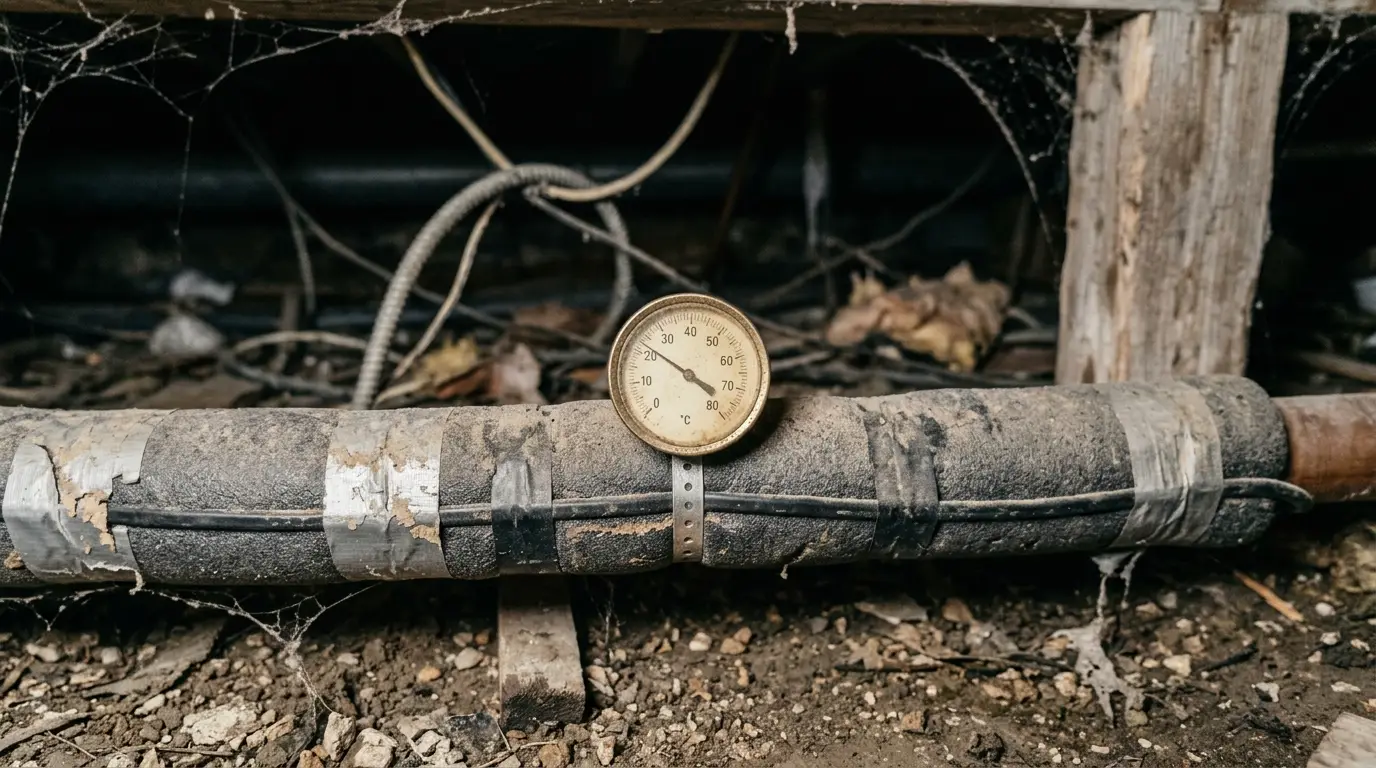
Pipe thawing for supply lines, water services, and drains
Thawing is a controlled procedure, not a matter of applying heat until something changes. The method depends on what is frozen, what it is made of, and whether anyone can reach it.
What is actually happening inside the pipe
Water expands by roughly nine percent when it freezes, and that expansion is what everyone blames for burst pipes. It is not quite the mechanism. Ice forming against a pipe wall does push outward, but copper and steel tolerate that better than the numbers suggest.
The damage usually comes from something else: a sealed pocket. Ice tends to form a plug at the coldest point rather than freezing the whole run uniformly. Once a plug is complete, water on the downstream side, between the plug and a closed fixture, is trapped. As that pocket continues to freeze, it has nowhere to expand to, and pressures climb into the thousands of psi. The pipe then fails somewhere in that trapped section, which is often several feet away from the ice plug itself.
Two practical consequences follow. First, the split is frequently not where the ice is, which is why finding the frozen zone and finding the damage are separate diagnostic tasks. Second, thawing direction matters enormously: heating from the open end backward lets meltwater escape continuously, while heating the middle of a run creates a second trapped pocket and can cause a burst during the thaw itself.
Why direction matters
Thaw from the open fixture end toward the supply. Meltwater needs somewhere to go, and an ice plug at each end of a warming section is how a frozen pipe becomes a burst pipe.
The four thawing methods and when each applies
Electric resistance thawing
Low-voltage, high-amperage current applied across two points on a continuous metal pipe. The pipe’s own resistance generates heat along its entire length simultaneously, which means the frozen section can be buried, walled, or otherwise unreachable. It is the fastest method for long runs and by a wide margin the most useful in finished spaces.
Requirements and limits: the run must be continuous metal between the two contact points, so any plastic fitting, PEX section, or dielectric union breaks the circuit. Electrical bonding must be disconnected and verified first, and the building’s grounding arrangement has to be understood before a single amp is applied. On old Chicago-area systems where the water pipe doubles as the electrical ground, this is not a formality.
Direct applied heat
Heat gun, heat blanket, or a space heater directed at an exposed run. Slow, entirely safe when done correctly, and the right answer for a short accessible section in a basement or crawlspace. Constant movement of the heat source, working from the open end, and never a flame.
Hot water jetting
For frozen drains, sewer laterals, and larger-diameter lines, a small-diameter hose is fed into the pipe delivering hot water at the ice face. It melts progressively and carries the meltwater out ahead of the hose. This is the standard approach for a frozen lateral and for frozen buried lines where electric thawing is not viable because the pipe is plastic.
Steam thawing
A steam generator feeding a lance down the line. Effective on buried services and on cast iron, works on plastic where electric will not, and is the method of last resort before excavation. It is slower and messier than jetting and needs careful handling, but it reaches places nothing else does.
Frozen buried water services
Every few winters the region gets a stretch cold enough and long enough that frost drives deep, and buried service lines start freezing. It is uncommon, it is regional rather than individual, and it behaves differently from an interior freeze.
The tell is that it is rarely just you. If several houses on the same block lose water within a day or two of each other, frost has reached the service depth on that street, often because the street was plowed clear of insulating snow while lawns kept theirs. A crew’s first diagnostic move is almost always to ask what the neighbours have.
Lines that freeze are usually the ones buried shallow: work done decades ago to a different standard, a line rerouted under a driveway where plowed pavement conducts cold straight down, or a section disturbed by later excavation and backfilled higher than it started. A line at proper depth in undisturbed soil under a snow-covered lawn essentially never freezes here.
Thawing one means determining which side of the curb stop is frozen, then applying electric current or steam along the run. Where the line is copper and continuous, electric thawing from the interior valve to the b-box is quick. Where it is plastic, increasingly common on lines replaced in recent decades, steam or hot jetting is the only option, and it needs an access point.
The uncomfortable part: a service line that froze once at shallow depth will freeze again, every hard winter, until it is re-laid at proper depth. Thawing is the emergency measure. Replacement is the fix, and it is a spring job.
No water at all, and the neighbours are asking the same question? That is a service-line call, not a fixture call.
Call about a frozen serviceFrozen drains, traps, and vent stacks
Drains freeze more often than people expect, because they hold standing water by design.
Traps. Every trap holds a water seal. In an unheated space (a vacant unit, a garage, a seasonal cottage, a rarely-used basement bathroom) that seal freezes solid and the fixture stops draining. Thawing a trap is usually straightforward; the more useful outcome is a conversation about whether that fixture should be winterised with antifreeze solution instead of relying on ambient heat.
Lines with a sag. A horizontal drain that has settled holds water permanently at the low point. In a cold crawlspace that becomes an ice plug, and it will keep becoming one until the pitch is corrected. Thawing it is a temporary answer to a slope problem.
Vent stacks. The one that catches people out. Warm humid air from the building rises through the stack and condenses near the cold roof penetration. Over a long cold spell, that condensate builds into a restriction and then a closure. The symptom is not a frozen drain: it is gurgling fixtures, slow drainage everywhere at once, and traps being siphoned dry, which lets sewer gas into the building. Clearing it is roof work, and a stack that closes repeatedly is usually undersized at the roof or poorly insulated through the attic.
Multi-unit buildings and shared risers
In two-flats, courtyard buildings, and small apartment blocks, a freeze is rarely contained to one unit, and the response has to account for that.
Shared vertical risers mean a plug at one floor removes service from every unit above it. Rear-porch and light-court risers, extremely common in Chicago-area courtyard buildings, run in shafts that are effectively exterior, and they freeze at the same two or three elevations year after year.
The operational difficulty is access. Thawing a riser needs contact points on multiple floors, which means coordinating entry to units, which at 11 p.m. in a building with absent owners is the actual bottleneck, not the plumbing. Buildings that handle winter well keep a current contact list and a documented valve map with the engineer, and they get thawed in a third of the time.
One more thing specific to this stock: many older buildings have had partial re-pipes, so a riser that is copper on three floors may be galvanized on the fourth. That changes which thawing method works and it is worth knowing before a crew is standing in the stairwell.
What you can safely do yourself
A short, visible, accessible run is a reasonable homeowner job. Anything else is not, and the line between them is worth being clear about.
Reasonable: a section you can see and touch along its entire frozen length, in copper or PEX, in a basement or under a sink. Open the affected fixture so meltwater has an exit and so you can hear when flow returns. Apply a hair dryer or heat gun on a low setting, moving constantly, starting at the fixture end. Keep a bucket and towels there. Know where the main is and be prepared to close it the instant flow resumes with a hiss instead of a stream.
Not reasonable: anything inside a wall, ceiling, or floor cavity; anything buried; galvanized steel of unknown age; a run you cannot see end to end; any situation involving a space heater left unattended; and every version of an open flame. Also: electric thawing equipment, which is available to rent and should not be, given how much depends on understanding the building’s grounding before use.
The one rule
If you cannot see the whole frozen length, you cannot tell whether it has already split, and thawing a split pipe without the main closed is how a frozen pipe becomes a flooded floor.
What happens after the ice releases
The thaw is the middle of the job, not the end. Three things follow immediately.
Controlled repressurisation. Main closed, then reopened slowly with the run visible and someone watching. Sudden full pressure into a compromised pipe finds every weakness at once.
A held pressure test. Flow returning is not proof of integrity. A hairline split can pass water and leak steadily, and the amount that comes out of a hairline in a joist bay over a weekend is remarkable. The test is a static hold with the fixture closed, watching for pressure decay.
An honest conversation about the cause. Any thaw that ends without identifying why the pipe froze is a thaw you will be paying for again. That means locating the air path, the missing insulation, or the routing error, and saying plainly whether the fix is a fifteen-dollar can of foam or a rerouted run.
How long a thaw takes
Rough figures, useful for planning rather than promises. An accessible interior section with direct heat: twenty minutes to an hour, depending on pipe diameter and how cold the space is. Electric thawing on an interior run with good contact points: often under thirty minutes once the setup and safety checks are done, and the setup is the majority of the time.
A buried service line: two to five hours is typical, and it can go longer where the run is long, plastic, or of uncertain route. A frozen lateral or drain by hot jetting: one to three hours. A vent stack: a roof visit plus an hour, weather permitting, and weather frequently does not permit during exactly the cold spell that caused it.
What extends all of these: an unknown pipe route, no accessible contact points, a mixed-material system, and cold that is still deepening while the work is underway. What shortens them: knowing where your valves are, having the space cleared, and calling on the first day flow dropped instead of the third.
Common Questions
Answers before you call
How much does pipe thawing cost?
It scales with access and length, not with how frozen it is. An accessible interior run reached in twenty minutes with a heat gun is a short service call. A ninety-foot buried service line under a driveway is a half-day operation with specialised equipment and possibly an excavation contingency.
The variable worth asking about up front is what happens if the pipe turns out to be split. A quote that covers the thaw but goes silent on the repair is only half a number.
Can you thaw a pipe without opening the wall?
Frequently, yes. Electric thawing works through the pipe itself, so as long as there are two accessible points of contact on the same continuous metal run (a fixture stop at one end, an exposed section in the basement at the other) the frozen middle can be inside a finished wall and never touched.
It does not work on plastic, and it does not work if the run is broken up by plastic fittings, dielectric unions, or a section of PEX. In those cases the wall usually has to come open, and the opening gets planned deliberately rather than guessed.
Is electric thawing safe for old wiring or gas lines?
Handled properly, yes, but it is genuinely not a homeowner method. The current follows the path of least resistance, and in a building where plumbing has been used as an electrical ground, which is common in pre-1960 Chicago-area stock, that path can include circuits and bonding straps nobody knew were there.
A crew disconnects the bonding, verifies isolation, and confirms there is no parallel path through a gas line or an appliance before any current is applied. Skipping those checks is how thawing equipment sets fires.
My water service from the street is frozen. Is that my problem or the city's?
The dividing line is usually the curb stop at the parkway: the utility owns the main and its side of the valve, the property owner owns the line from there into the building. Which side froze determines who does the work, and that is not always obvious from inside the house.
In practice, a crew determines the frozen zone first, often by checking whether neighbours on the same main have water, then tells you plainly which side of the line the problem sits on before anyone starts billable work on it.
Why did my drain freeze? Drains are not under pressure.
Standing water is the culprit. A trap always holds water, and a drain line with a sag or a poor pitch holds more. When the surrounding air drops below freezing, that standing water freezes even though nothing is flowing.
It happens most in unheated additions, vacant units, exterior stair drains, and garage floor drains. It also happens in vent stacks, where warm moist air rising from the building condenses and freezes near the roof, gradually closing the opening until the system cannot breathe.
Once it is thawed, will it just freeze again tonight?
If nothing changes, yes, and that is the honest answer most people do not get. A thaw restores service; it does not alter the conditions that caused the freeze.
Practical same-day measures that actually hold: temporary heat aimed at the cold zone, opening cabinet or access doors, running a slow continuous trickle at the affected fixture overnight, and sealing whatever obvious air path is feeding the cavity. Those buy you until the permanent fix can be scheduled in daylight.
Something is frozen and you need it flowing.
Tell us what has stopped and what the pipe is made of. That is usually enough to send the right equipment on the first trip.
24/7 · Chicago metro dispatch · (833) 615-3680