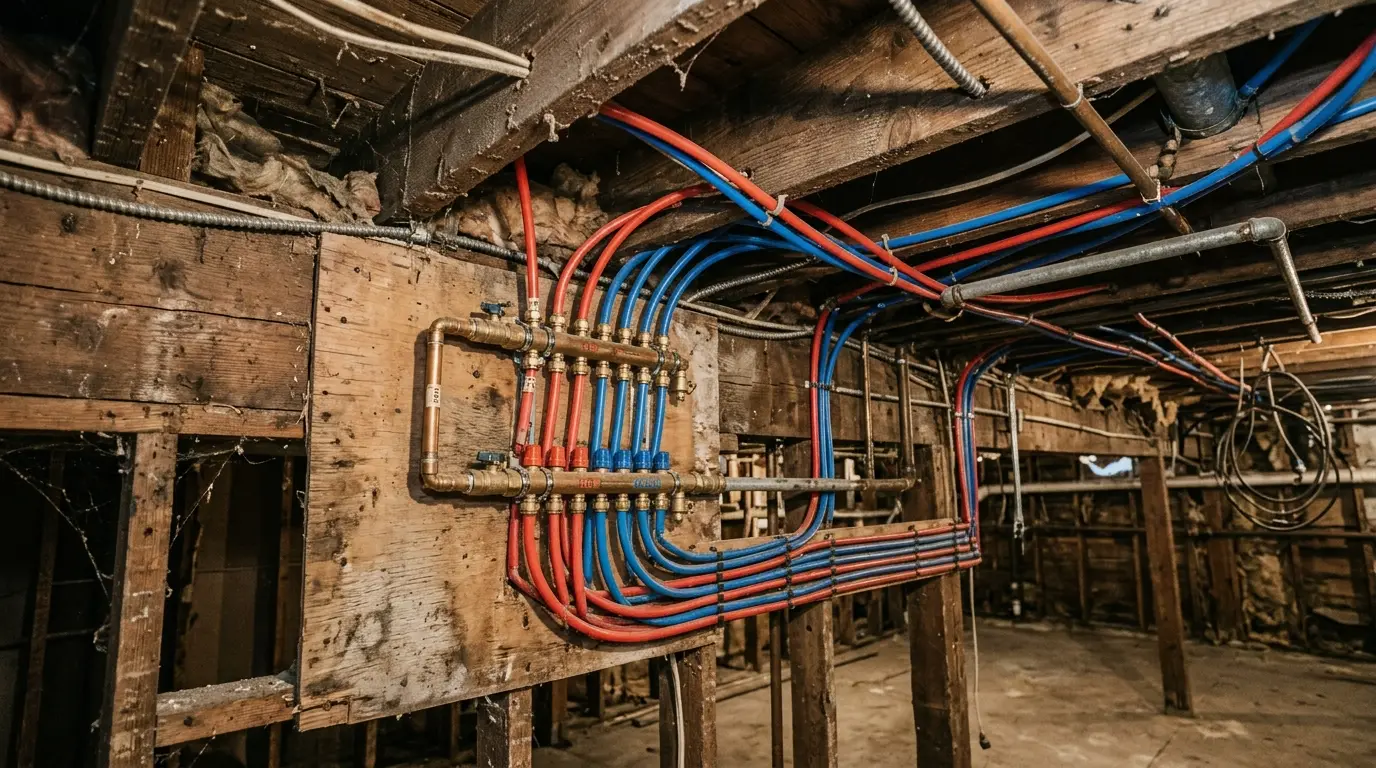
Whole-home repiping, staged so you keep the water on
Replacing a century-old galvanized supply system is mostly a question of access and sequence. Done properly, a household is without water for hours at a time, not weeks.
How you know the pipe is the problem
Supply piping fails gradually, which is why people live with it for years and describe it as normal. The pattern is what identifies it, not any single symptom.
- Rusty or brown water, worst on the first draw. Overnight the water sits still in the pipe and picks up corrosion product. Clears after a minute, comes back tomorrow.
- Pressure that collapses when a second fixture opens. Static pressure fine, flow poor. That is a bore problem: the pipe has less inside diameter than it started with.
- Hot side noticeably worse than cold. Heat accelerates scaling, so in a galvanized system the hot lines usually close up first.
- Pinhole leaks appearing at intervals. One is an incident. Three in two years is a system telling you its remaining life.
- Visible rust at threads and unions in the basement. The joints go first because that is where the wall is thinnest.
- Aerators clogging repeatedly with grit. The scale is breaking loose and travelling.
- Water heater filling with sediment faster than it should. Same debris, collected at the bottom of the tank.
Two cheap tests separate pipe from everything else. A pressure gauge on an outside hose bib reads static pressure in seconds, if that number is healthy but the shower still fades when the dishwasher runs, the restriction is interior. And a meter test with the house isolated tells you whether you are also losing water underground, which is a different job covered under main water line repair.
Cut one nipple open
The most convincing diagnostic in this trade costs nothing: remove a short galvanized nipple from the basement piping and look at the end. A three-quarter inch pipe with a quarter-inch hole left in it ends the discussion faster than any amount of description.
What galvanized steel actually does
Galvanized steel was the standard for domestic supply piping from roughly 1900 into the 1960s, which covers an enormous share of the housing stock across this region: the bungalow belt, the pre-war two-flats, the early post-war subdivisions.
The zinc coating protects the steel until it is consumed. After that the steel corrodes from the inside, and it does two things at once: it thins, and it builds a hard tuberculated scale that grows inward. The scale is the part people underestimate. A three-quarter inch line can be reduced to a quarter inch of effective bore while looking entirely sound from the outside. Meanwhile the pipe wall behind that scale is thinning toward the day it weeps.
Three consequences follow. First, flow keeps falling; households adapt to it and stop noticing. Second, the failure, when it comes, is a pinhole rather than a burst: slow, hidden, and frequently inside a wall. Third, and most importantly, the whole system is the same age in the same water, so a leak in one place is a statement about all of it. Repairing galvanized with galvanized is fitting a new section to pipe that will fail next to it.
Horizontal runs tend to be worse than verticals because debris settles in them, and hot lines are worse than cold. The basement mains, being both horizontal and oldest, are usually the worst in the building. This is why a repipe that starts anywhere other than the mains often disappoints.
Copper that has started pinholing
Copper replaced galvanized from the 1950s onward and most of it is still doing fine. When it does fail here, it fails in recognisable ways.
Pinhole pitting. Small perforations, often on the underside of horizontal runs, sometimes several within a few feet. Once a system starts producing them it usually continues, because the cause is the water chemistry and the installation, not that spot.
Erosion at elbows. Water moving too fast wears the inside of fittings, and the wear concentrates just past a bend. Undersized pipe carrying too much flow, or a high-pressure system without a regulator, produces this.
Failed joints. Poor soldering shows up years later. A dry joint or a poorly cleaned fitting can hold for a decade and then weep.
Freeze damage. Rigid copper splits when the water in it expands. Any run in an exterior wall, a rim joist, an unheated crawlspace, or an unconditioned attic is exposed, and the split is not always where it froze. That failure mode is covered in more detail under frozen pipe repair.
Where a copper system is pinholing repeatedly, one worthwhile check is static pressure. Excessive pressure accelerates erosion and stresses everything downstream, and a properly set regulator with an expansion tank is a fraction of the price of a repipe. Repiping into unregulated high pressure repeats the problem in new pipe.
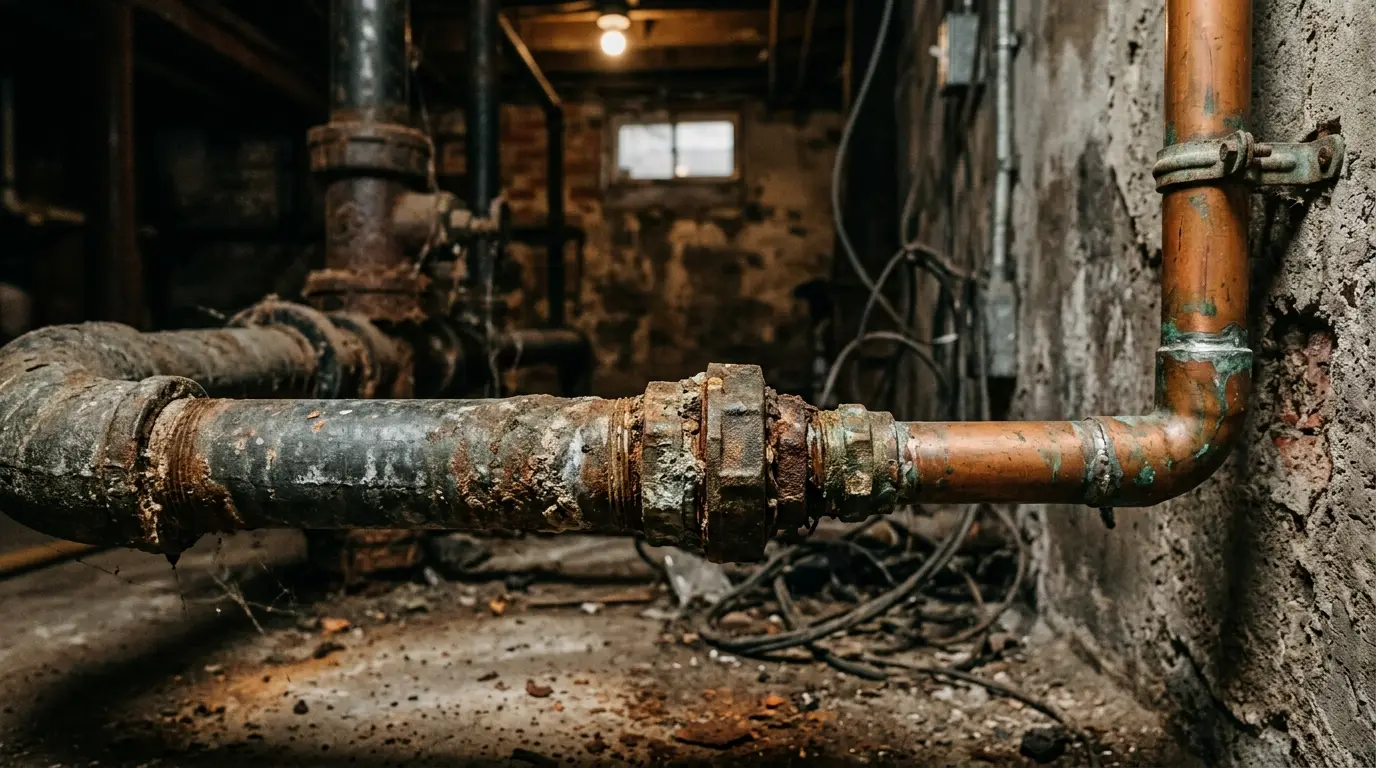
Copper, PEX, and what your code allows
Both are legitimate. The local code often narrows the choice before preference gets a say, so that is checked for your address first.
Copper, type L, rigid
The long-established interior material. Rigid, so it looks orderly and supports itself between hangers; indifferent to UV and to rodents; and it has a fifty-year track record in these buildings. It costs more in material and considerably more in labour, since every joint is a soldered or pressed fitting. It is also the material most vulnerable to a freeze, and it should be run with dielectric fittings anywhere it meets steel.
PEX, cross-linked polyethylene
Flexible tubing in long coils. It has no corrosion mechanism, needs far fewer fittings because it turns corners without them, survives a freeze that would split copper, and is quieter in a wall. In an old house its real advantage is installation: a coil can be pulled through a stud bay or a joist run in one continuous length, which means fewer openings in your plaster. It must not be exposed to sunlight, it needs protection where it passes through framing, and it wants proper support so it does not sag between joists. Where a home-run manifold layout is used, every fixture gets its own line back to a central panel, and isolating one fixture no longer means shutting the house.
The practical answer in this region is frequently a hybrid: copper for the exposed basement mains and any run that wants rigidity, PEX for the branches that have to travel inside finished walls. That combination minimises both the openings and the cost without compromising anything.
Whole house, or the part that is failing
Not every building needs everything replaced, and the honest scope depends on what is there.
Where the system is uniformly galvanized and of one age, partial replacement is usually false economy. The remaining pipe is the same age in the same water, and the new section makes the old section obvious rather than better.
Where a building has been worked on in layers (copper from a 1990s kitchen remodel, galvanized elsewhere, a stretch of something improvised behind the laundry) the sensible scope is everything of the failing generation, keeping sound copper where it is genuinely sound. That decision is made with the basement open and a nipple cut, not from a photograph.
Two things belong in the scope even when they look separate. Shutoff valves: an old gate valve that has not turned in thirty years will not close when it matters, and replacing valves at the fixtures and branches during a repipe is what makes future work small. And the water heater connections, including a proper expansion arrangement, since the system is open anyway.
If you can tell us the era of the building and what the basement piping looks like, we can sketch the scope before a visit.
Call and describe the basementGetting at the pipe in an old house
This is the craft of the job. Anyone can install pipe; the difference between a good repipe and a bad one is how much of the house is opened to do it.
Old buildings here have specific advantages. Pre-1930 balloon framing leaves stud bays running uninterrupted from the basement to the attic, which makes vertical routing far easier than in later platform-framed houses. Unfinished basements put the mains in full view. Bathrooms and kitchens are usually stacked, so one chase serves several fixtures. Closets stacked above each other are the classic route, and the back of a closet is the cheapest wall in the house to open.
The strategy is to work from the unfinished spaces inward: mains in the basement, verticals in existing chases or stud bays, and horizontals in joist bays reached from below. Openings then happen only where a branch has to surface at a fixture group, and they are placed where patching is easy: low on a wall, inside a vanity, above a dropped ceiling.
Plaster and lath deserve a specific note. It does not cut like drywall and it does not patch like drywall; it cracks beyond the cut if it is handled roughly, and keying a patch into it properly is a plasterer’s job. So plaster openings are scored and cut deliberately, kept small, and listed and priced before the work starts. A repipe quote that does not mention patching is not a complete quote.
Two other realities in this housing stock: original piping is sometimes buried in the plaster rather than in a cavity, and asbestos-containing pipe insulation is common on old mains and on steam lines nearby. Suspect material is not disturbed. It is tested, and abated by the appropriate trade if positive. That is a schedule item, and it is better known in week one.
Staging the work around a household
The fear people arrive with is weeks without water. That is not how it goes when the work is sequenced properly.
The reason it works is that the new system is installed alongside the old one, not in place of it. New pipe is run, supported, and pressure tested while the existing system is still live and the house is still functioning. Only the changeover, cutting into the old line and tying the new one in, needs the water off, and that is done branch by branch.
A typical single-family sequence: mains and risers first, with the water off for part of one day; then each fixture group tied over on its own day, with at least one bathroom and the kitchen kept in service at all times. Nights and weekends the house has water. Where a household cannot lose the only bathroom even briefly, the tie-over for that group is scheduled first and completed within a day.
What we ask of you is access and clearing: the basement walls where the mains run, the backs of the closets in the route, and under the vanities. Every hour spent moving stored belongings is an hour on the bill.
Two-flats, three-flats, and risers
The classic multi-unit buildings here, the two-flat and three-flat, were plumbed with vertical risers serving stacked kitchens and bathrooms, and repiping them is a different problem from a single-family house.
The riser is shared, so replacing it affects every unit above it, and the work has to be coordinated across tenancies rather than around one family. The advantage is that the stack is a single route: one chase opened at each floor can serve the whole vertical. The disadvantage is that the openings land in finished space in units whose occupants did not choose the schedule, and notice requirements matter.
The usual approach is riser by riser rather than unit by unit: one stack completed end to end, restored, and then the next. It keeps the number of simultaneously disrupted units to a minimum and it keeps the pressure test meaningful. Where the building has a single shutoff for all units, common in these buildings, adding isolation valves per unit during the repipe is a small cost that changes how every future repair goes.
Timeline and what drives the cost
A single-family repipe is typically a matter of days on site rather than weeks, plus the inspection and then patching and paint, which are usually other trades. A two- or three-flat runs longer because of coordination, not because of pipe.
Fixture count and layout. The number of fixture groups and how far apart they are. Stacked baths in one chase are far cheaper than a bathroom at each end of the building and a kitchen in the middle.
Access. The largest variable after size. A house with an unfinished basement, open stud bays, and stacked closets costs a fraction of an identical house with a finished basement ceiling, tiled bathrooms, and no chase.
Material and code. Copper is more material and much more labour than PEX. Where code requires copper, that is the number.
Number of storeys and riser count. Every additional riser is another vertical route and another set of openings.
Occupied or vacant. Staging around a household costs real time. If the building is empty between tenants or before a move-in, that is the cheapest time to do this work by a clear margin.
Restoration. Drywall patching is routine. Plaster patching, tile, and matched trim are not, and they belong in the budget from the start rather than appearing at the end.
What else is open. If the walls are coming apart for a kitchen or bathroom remodel anyway, the marginal cost of repiping that area is a fraction of doing it as its own project. The best time to repipe is during other work.
Common Questions
Answers before you call
How long will my house be without water?
In a staged repipe, hours at a time rather than days. The new pipe is run and tested alongside the old system while the old one is still live; the water is only off for the changeovers, which are scheduled one branch at a time.
The usual arrangement on a single-family house is that you lose water for part of the working day and have it back by evening, with one bathroom kept in service throughout. A vacant house can be done faster and more cheaply because that constraint disappears.
Is PEX as good as copper?
For potable water inside a house, yes, with different trade-offs. PEX does not corrode, tolerates a freeze far better than rigid pipe, needs fewer fittings because it bends, and is quieter. Copper is rigid, unaffected by UV, long-proven, and does not care about rodents.
The decision here is often made for you by the local code, some jurisdictions in this region restrict what may be used inside a building, and a few require copper. We check the code for your address before quoting rather than after.
Will you have to tear open all my walls?
No, and the plan is built around not doing that. Old houses here are unusually cooperative: balloon-framed walls with open stud bays, unfinished basements with joists in full view, closets stacked above one another, and old chases where the original risers went. Most of a repipe travels through those.
Where openings are needed they are deliberate and small, typically at fixture groups and at ceiling changeovers. We agree the list before starting, and we say plainly which ones are in plaster, because plaster patching is a specialist job and belongs in the budget from the beginning.
Can I do it a bathroom at a time?
Often yes, and for many households it is the sensible route. A repipe divides naturally by branch: the kitchen and laundry, each bathroom group, the basement, and the risers between floors.
There are two caveats. Each visit carries its own mobilisation and its own openings, so the total is higher than doing it in one go. And if the horizontal mains in the basement are the worst of it, they usually have to come first regardless, because new branches fed by scaled mains do not deliver.
Does repiping fix low pressure?
If the cause is interior galvanized pipe scaled closed, yes, and dramatically. That is the most common cause of gradual whole-house flow loss in older buildings here, and it is what a repipe is for.
If the cause is upstream (an undersized or corroded service line from the curb stop, or a failing pressure-reducing valve) a repipe will not help much. Which is why a gauge reading and a meter test come before the quote: they separate the two, and one of them is a much smaller job.
Do I need a permit for this?
Yes. A repipe is permitted and inspected work in every jurisdiction here, and the inspection is on your side: it is a third party confirming the material, the pressure test, and the connections before anything is closed up.
It also matters at resale. Unpermitted plumbing surfaces in inspections and in disclosure, and a documented, permitted repipe is an asset in that conversation rather than a question.
Rusty water in the morning and pressure that fades?
That pair of symptoms is close to diagnostic. Call and we will tell you what a staged plan looks like for your building.
24/7 · Chicago metro dispatch · (833) 615-3680