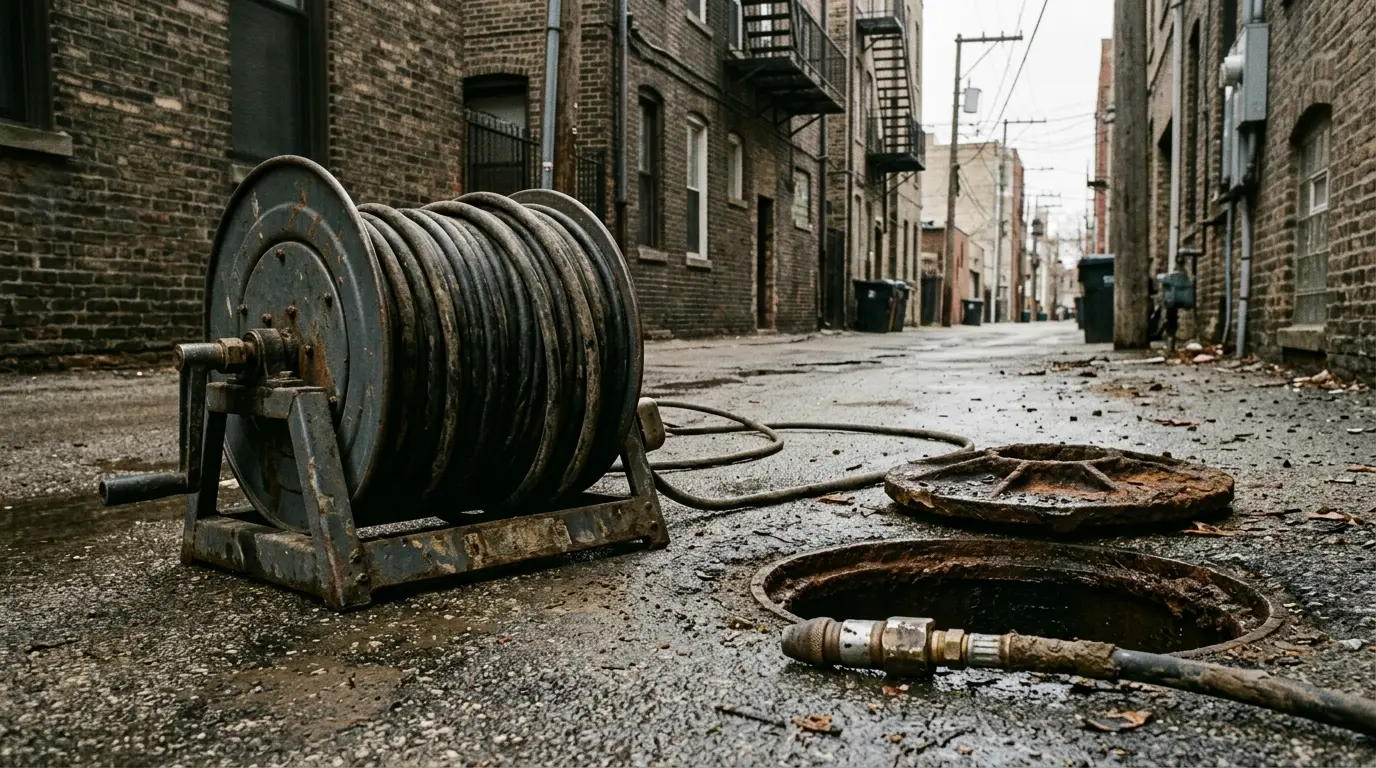
Hydro jetting, for the blockages a cable only bores a hole through
A cable makes a channel through a deposit. Water at pressure takes the deposit off the pipe wall. Which one you need depends entirely on what is in there, and on whether the pipe can take it.
Jetting versus cabling, honestly
These are not competing products. They are different tools for different obstructions, and the commonest reason a drain keeps blocking is that the cheaper tool was used against a deposit the expensive one exists for.
A cable is mechanical. It drives through the line and the head engages whatever it meets: pulling hair out, shearing roots, boring through a plug. Against a discrete obstruction lodged in the pipe, that is exactly right, and it is faster and cheaper than anything else.
Against a deposit adhered to the pipe wall, it does something different. Grease that has condensed onto cold cast iron over years is not a plug sitting in the middle of the pipe; it is a lining. A cable bores a hole through the middle of that lining. Water flows, the drain appears fixed, and the remaining deposit closes the opening again over the following weeks. The customer’s experience is a drain that gets cleared four times a year.
Jetting attacks the lining. Water leaving a nozzle at high pressure strips material off the wall and flushes it downstream, and the pipe comes back to close to its original bore. That is the whole distinction, and it explains most of the cases where one works and the other does not.
The recurrence test
If a line has been cleared more than once in a year, the question is not which cable head to use next. It is whether the deposit was ever removed, and whether the pipe has a defect holding it there.
How the equipment actually works
A jetter is a high-pressure pump feeding a flexible hose with a specialised nozzle on the end. The nozzle is the interesting part: most of its jets face backwards. Those rear-facing jets do two things at once: they propel the hose up the line against the flow, and they direct water at the pipe wall behind the nozzle, scouring as the hose is drawn back out. A forward jet clears a path through the obstruction so the nozzle can pass it.
The work is therefore done on the return, not on the way in. The nozzle is advanced past the blockage, then drawn slowly back with the rear jets stripping the wall along the way. Debris is flushed downstream toward the sewer, which is why jetting needs somewhere for the material to go and why the line downstream of the working section has to be clear.
Nozzle selection is most of the skill. A penetrating nozzle for making the first pass through a solid obstruction. A flushing nozzle with a wide rear pattern for grease and general scouring. A rotating nozzle that spins a concentrated jet for hard scale. A root nozzle for cutting intrusion back into the joint it came through. Using a root nozzle where a flushing nozzle is called for is how a fragile pipe gets damaged.
Pressure and flow are matched to the pipe. Flow, the volume moving through, does the carrying; pressure does the cutting. A small line needs a different balance from a six-inch lateral, and an eighty-year-old clay lateral needs a different balance again from twenty-year-old PVC.
When jetting is the right call
Grease in a kitchen line. The textbook case, and the one where the difference from cabling is most dramatic. Domestic kitchen branches in older buildings, and restaurant lines of any age, both accumulate the same way.
Scale and mineral build-up. Hard water across much of this region deposits mineral scale in drains as well as in water heaters. It is hard, adhered, and a cable barely touches it.
Root mass in a lateral. A cutting head shears roots at the pipe wall and leaves a stub that regrows quickly. A root nozzle strips the intrusion back much further and cleans the joint, which meaningfully extends the interval before the next visit.
Sludge and silt in a low-flow line. Floor drains, laundry lines, and any run with poor pitch accumulate fine material that a cable simply passes through.
Before lining a sewer. Non-negotiable. A liner bonds to the host pipe, and it cannot bond to grease. Any trenchless rehabilitation begins with the line jetted clean and camera-verified.
Scheduled maintenance on a known problem line. Where a defect cannot be repaired immediately, a booked jetting interval is a legitimate way to manage it, provided everyone is clear that it is management, not repair.
When it is the wrong call
Worth stating plainly, because jetting is the higher-priced service and it is over-sold.
A first-time hair clog. A tub blocked at the strainer needs a hand tool and five minutes. Jetting it is absurd.
A discrete foreign object. A toy, a toothbrush, a rag. Water pressure pushes it further down the line. It needs retrieving, which is cable work.
A structurally compromised line. Cast iron that has channelled along its invert, cracked or offset clay, deteriorating Orangeburg. High-pressure water in a pipe that has lost its wall can enlarge the defect, wash out bedding material behind it, and turn a repair into an excavation. This is the case that matters and it is the reason for the camera.
Where there is nowhere for debris to go. If the downstream line or the municipal connection is itself obstructed, jetting relocates the material rather than removing it, sometimes into a worse position.
As a substitute for a repair that is already indicated. If footage shows a collapsed section, jetting it clean changes nothing about the collapse. Selling a maintenance interval against a known structural defect is not a service, and a crew should say so.
Not sure which your line needs? The camera answers it, and it costs less than the wrong tool.
Call and talk it throughWhy the camera comes first
On any line of unknown condition, and on every older lateral, the inspection precedes the jetting. Three reasons, all practical.
It establishes what the obstruction is. Grease, roots, scale, a foreign object, and a structural collapse all look identical from a slow drain upstairs and they need completely different responses. Guessing wastes a visit at best.
It establishes whether the pipe can take it. This is the safety case. Pressure appropriate for sound PVC is not appropriate for clay with open joints, and there is no way to know which you have from the outside.
It sets the pressure and the nozzle. Not a formality, the difference between a line that comes back to full bore and a line that gets damaged is largely this decision.
Afterwards, the camera runs again. Post-jetting footage is what demonstrates the work was actually done, and it frequently reveals defects that were hidden under the deposit: a crack, an offset joint, a sag holding water. Finding those is a good outcome, even when it is unwelcome news, because they were going to cause the next blockage.
What a jetting visit looks like
Access. The hose goes in through a cleanout wherever one exists: typically an exterior cleanout, a basement cleanout, or the stack base. Where no accessible cleanout exists, installing one is often part of the job and is worth having regardless, because it makes every future visit cheaper.
Inspection. Camera down the line, condition and obstruction assessed, pressure and nozzle chosen.
Protection. Fixtures downstream isolated or protected, because material is being flushed and it has to pass somewhere. In a basement with an open floor drain this matters.
The pass. Nozzle advanced past the obstruction, then drawn back slowly. Usually several passes, working progressively rather than in one aggressive run.
Verification. Camera again, and a flow test with fixtures running. Footage handed over, with the defects noted and located.
A domestic kitchen line is usually an hour or two. A residential lateral with roots is longer. A commercial grease line is a scheduled half-day and is normally booked outside trading hours.
Restaurants and grease management
Commercial kitchens produce grease at a volume that makes domestic advice irrelevant, and the plumbing consequences are entirely predictable, which means they are manageable on a schedule rather than as emergencies.
The grease interceptor is the first line and the most neglected. It needs pumping on an interval set by actual throughput rather than by habit, and an interceptor that has not been serviced is passing grease straight into the building line. Records matter here for reasons beyond plumbing.
Beyond the interceptor, kitchen branch lines and the main run accumulate anyway. A jetting interval (quarterly is common, monthly for high-volume operations) keeps them at full bore. The economics are straightforward: a scheduled visit outside trading hours costs a fraction of a blocked main during a Friday service, which closes the kitchen.
Scheduling around trading is the other half of the service. Nobody should be jetting a restaurant main at seven in the evening, and a contractor who cannot work early mornings or overnight is not a serious option for a food business.
Keeping the line clear afterwards
A jetted line starts clean, which makes the following months the cheapest time to change what caused the deposit.
For kitchen lines: grease into a jar rather than the sink, pans wiped before washing, strainers fitted, and hot water run after washing up to carry dissolved fat past the branch. Enzyme maintenance products have a genuine role once the line is clean, they work on the thin organic film that starts the process, and they do not attack pipe.
For laterals with roots: the interval is knowable. After one or two cycles it becomes clear whether yours returns in eighteen months or five years, and booking accordingly in autumn is far cheaper than discovering it in July. Where the intrusion point is a single defective joint, lining that section ends the cycle rather than managing it.
And keep the footage. A recording from this visit is the baseline that makes the next inspection meaningful, a defect that has not changed in three years is a different proposition from one that has.
Common Questions
Answers before you call
Is hydro jetting safe for old pipes?
In sound pipe, yes, pressure is matched to the material and the equipment is run well below what the pipe can take. In compromised pipe, it is a genuine risk, and that is exactly why a camera inspection should come first.
Cast iron that has channelled along its invert, cracked clay, deteriorated Orangeburg, and any line with an open joint can be made worse by full-pressure jetting. A crew that jets an unknown older line without looking at it first is taking a chance with your lateral.
How is it different from rodding?
Rodding is mechanical, a steel cable with a head that cuts or pulls. Jetting is hydraulic, water at high pressure through a nozzle that scours the pipe wall and flushes debris downstream.
The practical difference is what is left behind. Rodding through a grease deposit opens a channel and leaves the rest adhered, so flow returns and then closes again. Jetting removes the deposit itself and returns the pipe to something near its full bore.
Will jetting fix a root problem permanently?
It removes the root mass thoroughly, which cabling often does not: a cutting head shears roots off at the pipe wall and leaves the intrusion point untouched, while jetting with a root nozzle strips them back much further.
Permanently, no, and nobody should say otherwise. Roots enter through a defect, and while the defect exists they return. Jetting resets the clock; lining or replacing the section is what stops it.
Does it damage the inside of the pipe?
Not sound pipe at correct pressure. The water is doing work against a deposit, not against the pipe, and pipe materials are considerably harder than grease, scale or root mass.
The nuance is nozzle selection and pressure. A root-cutting nozzle run at high pressure in a fragile line is a different proposition from a flushing nozzle at moderate pressure. Both are jetting; only one is appropriate for an eighty-year-old clay lateral.
How long does it last?
Longer than cabling on the same line, usually substantially. Because the deposit is removed rather than perforated, a jetted kitchen line typically runs clear for a year or more where cabling bought a few weeks.
Where a pipe defect is feeding the problem (roots at a joint, a sag holding waste) the interval is set by the defect, not the cleaning. That is the case where the honest recommendation is repair rather than a maintenance schedule.
Can it be done in winter?
Yes, with adjustments. The equipment carries water and the water freezes, so the truck needs to be managed, the hose kept moving, and the setup time is longer in hard cold.
The more common winter complication is that the downstream line or the cleanout itself is frozen. Jetting into a frozen section achieves nothing until the ice is dealt with, so a cold-weather call sometimes begins as a thawing job.
Same line blocking again?
Recurrence usually means the deposit is still on the pipe wall. That is the problem jetting exists to solve.
24/7 · Chicago metro dispatch · (833) 615-3680