Whole-house filtration, specified against a water test
Filtration is only as good as the question it answers. Chlorine taste, well iron, and lead at the kitchen tap need three different pieces of equipment in three different places.
Start with what is wrong with the water
Filtration is the part of plumbing most often sold as a general good. It is not one: a filter is a device for removing a specific thing, and a system that removes the wrong thing is an expensive way to change nothing.
So the first conversation is about the complaint, in the owner's words, because the complaint usually identifies the category.
"It smells of a swimming pool." Chlorine or chloramine. Carbon, at point of entry, with the media chosen according to which disinfectant the utility uses.
"There is grit in the aerators, and it got worse after they worked on the street." Sediment. A sediment filter, and possibly a look at whether old galvanized piping is shedding.
"Everything stains orange or black." Iron, manganese, or both. Well territory, and it needs oxidation and filtration rather than a cartridge.
"Rotten eggs, mostly from the hot tap." Hydrogen sulphide. If it is only the hot side, the anode rod in the water heater is reacting with sulphate in the water and the answer may be an anode change rather than a filter.
"I am worried about lead." A legitimate concern in this housing stock, and one that filtration answers only partly, see the section below.
"The water tests fine but I want to be sure." Then the test comes first, and the honest outcome may be that nothing is needed.
Five numbers cover most of it: hardness, iron, manganese, pH, and total dissolved solids, plus a coliform test on any private well and a lead result where lead is in question. For a municipal supply, the utility's annual water quality report is a genuine starting point; for a well, nothing but a sample will do.
The rule this page is built on
No equipment is recommended before a number exists. Filtration specified against a symptom sometimes works; filtration specified against a measurement works reliably.
Point of entry versus point of use
Two places to treat water, and choosing wrongly is the most expensive mistake available here.
Point of entry treats everything as it comes into the building. It is the right place for anything you want gone from all the water: sediment, chlorine taste and smell, iron and manganese staining, sulphur odour, and hardness. It protects the water heater, the appliances, and every fixture.
Point of use treats the water at one tap. It is the right place for drinking-water concerns (lead, nitrate, taste refinement), because the equipment that removes those things thoroughly is slow, has limited capacity, or wastes water, and none of that matters at one kitchen tap while all of it matters at forty gallons a minute.
The failure this distinction prevents: a large point-of-entry carbon system sold on a lead concern. Carbon at the whole-house level, sized for the flow a house needs, has a fraction of a second of contact time, nothing like what lead reduction requires. Meanwhile a small point-of-use unit under the sink, tested to the relevant NSF/ANSI standard for lead, does the job for a fraction of the cost.
Where both are appropriate they work together: point of entry for the water the building uses, point of use for the water the household drinks.
Treating a lake-water supply
For the city and the large part of this metro drawing treated Lake Michigan water, the specification is usually short.
Sediment pre-filtration. A spun or pleated cartridge, or a spin-down filter with a flush valve. It catches the grit that arrives after main breaks and hydrant work, which is the most common single complaint on an otherwise good supply, and it protects everything downstream. On a pleated washable cartridge it is close to maintenance-free.
Carbon for taste and odour. The important choice here is media. If the utility uses free chlorine, standard granular activated carbon is fine. If it uses chloramine, and several utilities in this region do, then catalytic carbon, or a much larger bed for longer contact, is required. This is where most disappointment with whole-house carbon originates.
Then the format decision. Cartridge systems are cheap to buy and depend on somebody changing cartridges; when the carbon is exhausted, the water tastes of chlorine again and there is no other signal. Backwashing media tanks cost more, need a drain connection and a small amount of water for periodic backwash, and then look after themselves for years. For a household that will not diarise a cartridge change, the tank is the better long-run answer.
One caution specific to older buildings on this supply. If the discolouration is coming from inside the building's own galvanized piping rather than from the street, a filter treats the symptom while the pipe keeps corroding. That is a repiping conversation, and it is better to know which it is before buying equipment, running a tap that has been unused for a day and comparing it with a long-flushed tap tells you a great deal.
Treating a private well
In the outer counties and the outlying Illinois markets, plenty of properties are on their own water, and this is where filtration becomes genuine engineering rather than an accessory.
The order of treatment matters as much as the equipment, and it generally runs: sediment, then oxidation and iron or manganese removal, then softening, then carbon, then any point-of-use polishing, with ultraviolet last where it is needed.
Iron. Dissolved ferrous iron needs oxidising before it can be filtered. Air injection with a catalytic media bed handles moderate levels well; chemical oxidation is used at higher concentrations. Under about one part per million, a softener may cope on its own; above that, giving the softener that job destroys its resin.
Manganese. Needs a higher oxidation state and a higher pH than iron to remove reliably, which is why systems specified for iron alone leave black staining behind.
Hydrogen sulphide. The rotten-egg smell. Air injection and catalytic media again, sized generously. Worth confirming whether the smell is on both taps or only the hot one first, the hot-only version is a water heater anode reaction, not a well problem.
Nitrate. A real consideration in agricultural areas, and one where the health guidance is specific rather than aesthetic. Removal is by anion exchange or reverse osmosis, and in most households the sensible arrangement is point-of-use reverse osmosis for drinking and cooking water.
Bacteria. A positive coliform result is a repair problem before it is a filtration problem: well cap, casing seal, and any route by which surface water reaches the well. Fix, shock disinfect, retest. Ultraviolet then guards against recurrence, and it requires clear water and an annual lamp change to be worth anything.
Arsenic and radium. Present in some Illinois aquifers, both with their own specific treatment technologies. Neither is guessable and neither is a job for general-purpose filtration.
Lead, and why filtration is not the whole answer
This deserves its own section because the Chicago area has more lead service lines than anywhere else in the country, and because filtration is routinely sold as the answer to it.
Lead in drinking water almost never comes from the source. It comes from the pipe: the lead service line between the street and the building, lead solder at joints in copper systems installed before the mid-1980s, and brass fixtures of a certain age. The water leaving the treatment plant is not the problem; what the water touches on the way to your glass is.
Three consequences.
Point-of-entry filtration does not solve it. A whole-house filter sits where the water enters the building, downstream of the service line, and upstream of every foot of interior pipe and solder joint that may also contribute. Contact time at household flow rates is far too short for lead reduction in any case.
Point of use does. A filter at the kitchen tap, tested to NSF/ANSI 53 for lead reduction, or a reverse osmosis unit under the sink, treats the water you actually drink at a flow rate where the chemistry works. This is the immediate, effective, inexpensive step.
The permanent answer is removing the pipe. And here is the part that must be said plainly: replacing only part of a lead service line can make things temporarily worse rather than better, because disturbing lead pipe releases particulate lead and a partial replacement leaves galvanic conditions behind. Full replacement, coordinated with the utility's own programme, is the correct approach, covered in detail under water service line replacement.
In the meantime, two habits that genuinely help: flush the tap for a minute or two after any long period of no use, and use cold water for drinking and cooking, because hot water dissolves lead more readily.
Lead concern and an unknown service line? Identifying the material is the first step and it is usually straightforward.
Call about your service lineSizing for flow, not just capacity
Two numbers size a filtration system, and the one people ignore is the one they notice afterwards.
Capacity is how much water the media can treat before it is exhausted. Getting it wrong means changing cartridges more often than expected.
Service flow rate is how much water can pass at once without an unacceptable pressure drop or a collapse in contact time. Getting it wrong means the shower goes weak when the washing machine fills, and the treatment stops working at exactly the moment it is under load.
So sizing starts with the building's peak flow rather than its daily volume, and with the static pressure measured at a hose bib. On a system that already runs at modest pressure, adding two cartridge housings in series can be the difference between adequate and disappointing. Where pressure is high, on the other hand, the fix belongs upstream at the pressure regulator rather than being absorbed by the filter.
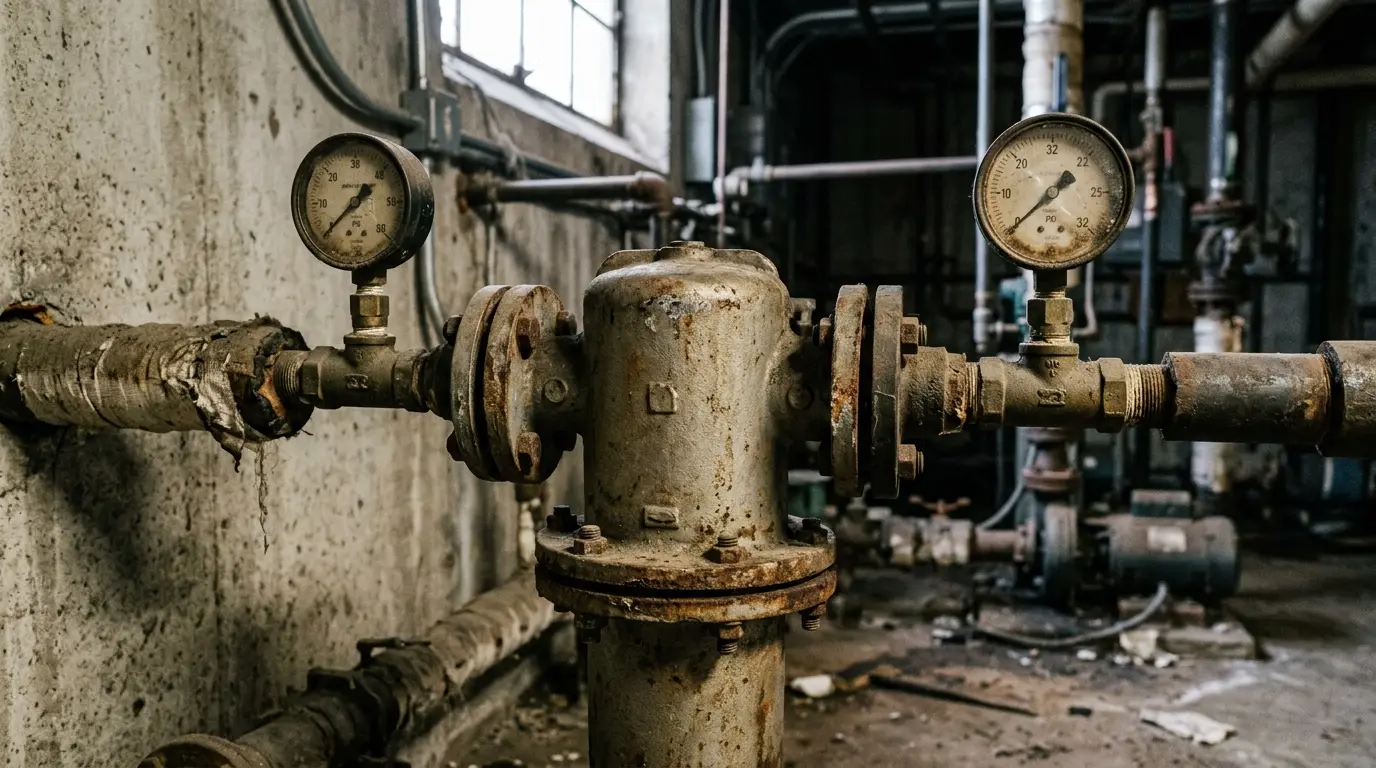
Practical guidance: allow generously on the filter's rated flow rather than sizing to it exactly, keep the piping at the housing the same diameter as the main it interrupts, and put a pressure gauge before and after the system so a rising differential tells you a cartridge is loading up. Two gauges cost very little and they turn maintenance from a guess into a reading.
Installation details that matter
Six things that separate a system you can live with from one you resent.
A bypass. So the house has water while a cartridge is changed or a tank is serviced. Non-negotiable on point-of-entry equipment.
Unions or flexible connectors at every vessel. Filtration systems get reconfigured as water chemistry or household needs change. Anything soldered solid will be cut out by somebody later.
Shutoffs either side of each stage. So a single component can be isolated without draining the whole train.
Clearance and access. Cartridge housings need room beneath them to unscrew the sump, and a bucket underneath is part of the routine. A system installed tight against a joist is a system nobody will maintain.
A drain for backwashing equipment, with an air gap, sized for the backwash rate rather than a trickle. Iron filters in particular move real volume during a backwash cycle.
Grounding continuity. Where the metal water service forms part of the electrical grounding path, interrupting the pipe interrupts that path. A bonding jumper across the installation restores it.
And one sequencing point: filtration goes in ahead of the water heater, so the heater sees treated water, and any hard-water branch (outside taps, irrigation) is taken off before treatment rather than after.
Maintenance is the whole game
Filtration is unique among plumbing installations in that it stops working silently. A neglected sump pump announces itself with a wet floor; a neglected carbon filter simply passes chlorine again while nothing visible changes.
So build a schedule at installation and write it on the housing. Sediment cartridges every three to six months, or when the pressure differential across the system rises noticeably. Carbon cartridges every six to twelve months, sooner on chloraminated water. Media beds backwashing on their own timer, with the media replaced roughly every five years. Ultraviolet lamps annually, without exception, because a lamp that still glows may have lost most of its useful output. Reverse osmosis membranes every two to five years, with the pre-filters more often.
Then retest the water at intervals. On a municipal supply, annually is plenty. On a private well, test annually for coliform and nitrate, and after any work on the well, any flooding event, or any change in taste, smell, or colour. Water chemistry from a well is not a fixed property of the address.
What drives the cost
Directional rather than quoted, and the range here is wider than almost anything else on the site because the equipment ranges from a single cartridge to a five-stage well train.
How many stages. A sediment filter alone is a modest job. Sediment plus carbon is the common municipal specification. A well needing iron, manganese, sulphur, softening, and ultraviolet is five vessels and a day's work.
Cartridge versus backwashing. Cartridges are cheaper to install and cost more in attention. Media tanks cost more up front, need a drain, and then look after themselves.
Media type. Catalytic carbon for chloramine costs more than standard carbon. Specialist media for arsenic or radium costs more again.
Flow rate. A larger house with high peak demand needs larger vessels and larger piping, which is a step change rather than an increment.
Where it goes. A basement with the main, a drain, and a floor to stand tanks on is easy. A crawl space, a utility closet, or a condo mechanical room is not.
Point-of-use additions. An under-sink reverse osmosis unit with its own tap, and a drain connection for it.
If the test comes back and the answer is that a sediment cartridge and a good under-sink filter will do everything you actually want, that is what we will tell you.
Common Questions
Answers before you call
Do I need a whole-house filter on Chicago water?
Need is a strong word. Lake Michigan water is treated to a high standard and meets the regulatory limits. What a whole-house carbon filter changes is the aesthetics (the chlorine or chloramine taste and smell, and the sediment that arrives after work on a water main) along with reducing the chlorine load on a softener's resin and on rubber seals throughout the house.
So it is a comfort and equipment-protection upgrade rather than a safety measure. If the concern is specifically lead, a point-of-entry filter is the wrong tool; that is answered at the tap and in the service line.
What is the difference between chlorine and chloramine, and does it matter?
It matters for the equipment choice. Chlorine is removed readily by ordinary granular activated carbon. Chloramine (chlorine combined with ammonia, used by many utilities because it is more stable in the distribution system) is much more stubborn and needs either catalytic carbon or a considerably longer contact time.
A carbon filter sized for chlorine on a chloraminated supply underperforms and the owner concludes filtration does not work. Ask your utility which disinfectant they use; it is a published figure and it changes the specification.
My well water stains everything orange. What fixes that?
Iron, and the treatment depends on how much and in what form. Clear water that turns orange on standing is dissolved ferrous iron; water that arrives already orange carries oxidised particulate iron. Low levels of the dissolved form can be handled by a softener; anything more wants dedicated iron removal ahead of it, typically by oxidation and filtration.
Black staining alongside the orange suggests manganese, which needs a higher oxidation state to remove and is frequently missed. A rotten-egg smell means hydrogen sulphide, which is treated similarly but not identically. All three are measurable, and guessing between them is how the wrong filter gets installed.
Will a filter remove bacteria?
A standard sediment or carbon filter will not, and treating a bacteriological problem with a carbon filter can make it worse, because a carbon bed is a hospitable place for bacteria to live.
For a private well with a positive coliform result the sequence is: find and fix the cause (a compromised well cap, a failed casing seal, surface water reaching the well), then shock disinfect, then retest. Ultraviolet treatment is the right ongoing safeguard afterwards, and it needs water that is already clear, because turbidity shades the organisms from the lamp.
How often do filters need changing?
Sediment cartridges typically every three to six months, and sooner after any water main work in the street. Carbon block cartridges every six to twelve months. Backwashing carbon media beds regenerate themselves and the media is replaced every five years or so.
The failure mode of a neglected filter is worth knowing: a plugged sediment cartridge restricts flow, which people notice, but an exhausted carbon cartridge simply stops working while flow stays normal, which nobody notices. That is the main argument for a backwashing system over cartridges in a household that will not keep to a schedule.
Is reverse osmosis worth it?
At the kitchen sink, frequently yes. A point-of-use reverse osmosis unit produces genuinely excellent drinking and cooking water, removes a very wide range of contaminants including lead and nitrate, and is the sensible answer where the concern is what you drink rather than what you bathe in.
Whole-house reverse osmosis is a different proposition: expensive, wasteful of water, and it strips the minerals that make water pleasant, which then usually has to be added back. For all but unusual circumstances, point of use is where reverse osmosis belongs.
Not sure what you are actually treating?
Chlorine taste, orange staining, a sulphur smell, and lead concern all point at different equipment. Call and we will work from a test rather than a catalogue.
24/7 · Chicago metro dispatch · (833) 615-3680