Trenchless sewer repair, and when it is genuinely the better option
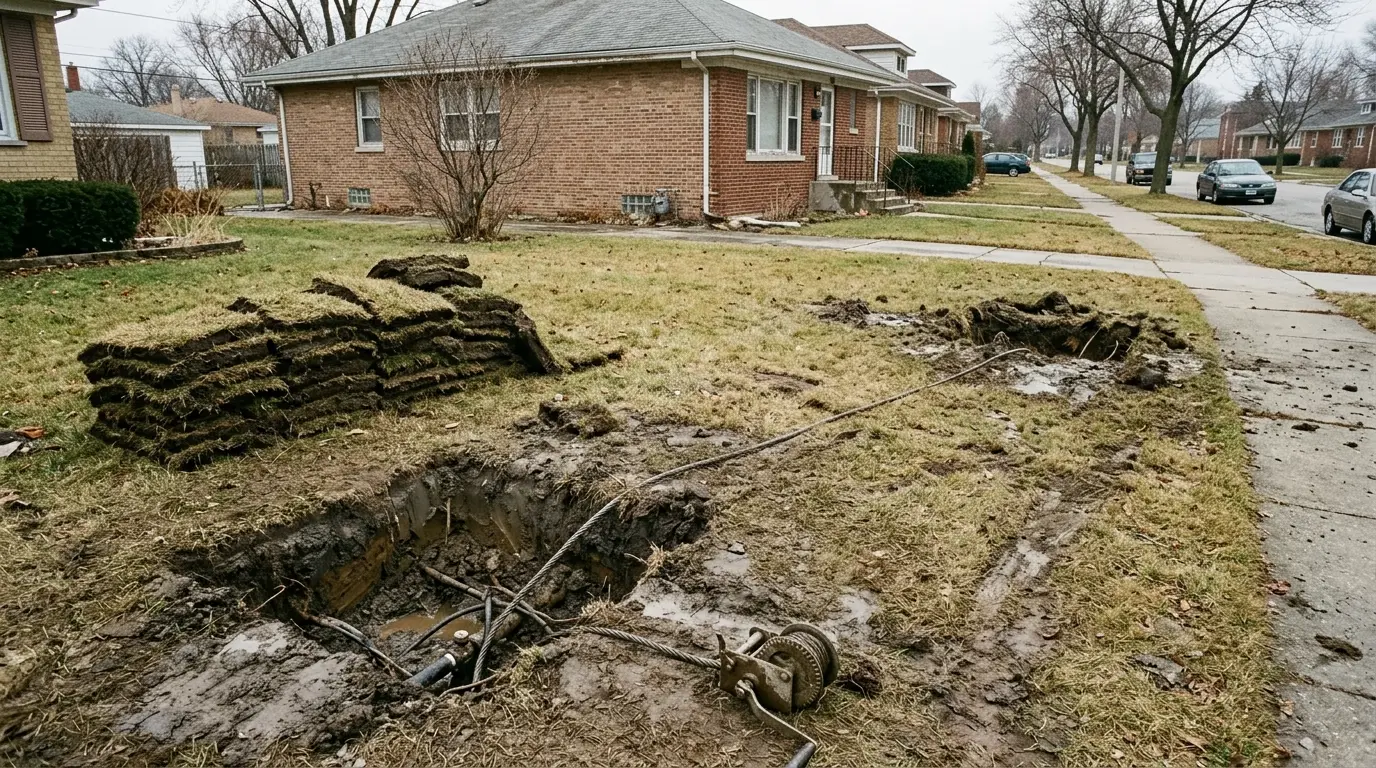
Lining and bursting renew a lateral through access pits rather than a trench down the length of it. Whether either applies is a question the camera footage answers, not a preference.
What trenchless actually means
The term covers a family of methods that share one property: the new pipe is installed along the existing route without excavating a continuous trench above it. Access pits are dug at each end, typically one near the building and one near the connection to the main, and the work happens underground between them.
For residential laterals in this region, two methods do essentially all the work. Cured-in-place pipe lining forms a new pipe inside the old one. Pipe bursting destroys the old pipe and pulls a new one through the space it occupied. They solve different problems and they are not interchangeable.
What trenchless is not is a universal alternative. It is a set of techniques with real prerequisites, and a contractor who recommends it before looking at footage is selling rather than diagnosing. The footage determines which method is viable, or whether either is.
The deciding factor is the surface
Trenchless costs more per foot and saves on restoration. Under a long concrete driveway or a street it is usually the clear winner. Under open lawn, open-cut is often cheaper and equally sound.
Cured-in-place pipe lining
A flexible tube saturated with thermosetting resin is drawn or inverted into the cleaned lateral, inflated so it presses against the host pipe wall, and then cured: with hot water, steam, or ultraviolet light depending on the system. The resin hardens into a rigid, jointless pipe bonded to the inside of the old one.
The result is genuinely a new pipe. It has no joints along its length, which is the property that matters most here: root intrusion in this region is overwhelmingly a joint problem, and a jointless liner removes every entry point at once. It is chemically inert, its bore is smooth, and it is structurally self-supporting once cured.
The prerequisites are strict. The host pipe has to be structurally continuous enough for the liner to form against: cracked is usually fine, offset slightly is often workable, collapsed is not. The line must be cleaned to bare pipe first, because resin will not bond to grease or scale, which is why jetting and lining are always sequenced together. And the geometry has to permit it: sharp bends, multiple connections, and severe deformation each complicate or prevent a proper cure.
A belly deserves specific mention because it is the most commonly mishandled case. A liner follows the host pipe. Line a sagged section and you get a sagged liner, the standing water problem is unchanged and now it is permanent. Correcting grade requires excavation, and any proposal to line a known belly should be questioned directly.
Pipe bursting
A conical bursting head is pulled through the existing pipe on a cable or rod string. The head fractures the old pipe outward into the surrounding soil while simultaneously drawing new high-density polyethylene pipe in behind it. The old pipe becomes part of the backfill.
Because it destroys rather than lines, the host pipe’s condition is far less limiting. Collapsed clay, badly deformed Orangeburg, and pipe that has lost sections entirely are all workable. It also does not reduce capacity, the new pipe is at least the same size and can be a size larger, which occasionally solves an undersizing problem alongside the failure.
Its constraints are about surroundings rather than the pipe. The fracture displaces soil outward, so there has to be room for that displacement: adequate depth, adequate soil, and adequate clearance from anything else buried nearby. Utility congestion is the usual disqualifier, and on a dense city lot with gas, water, and telecoms sharing a narrow corridor it is frequently decisive. Rock, and proximity to foundations or trees with significant root plates, also count against it.
HDPE is fusion-welded at the joints, producing a continuous pipe with no mechanical connections along its length, the same jointless advantage as a liner, in a full replacement rather than a lining.
What makes a good candidate
Reading a set of footage, the features that point toward trenchless:
- Root intrusion at multiple joints, sound pipe between them. The textbook lining case, the defects are all joints, and lining eliminates joints.
- Longitudinal cracking without deformation. The pipe still holds its shape; a liner restores structural integrity.
- Corrosion or scaling with the wall largely intact. Cast iron that has roughened but not channelled through.
- Something expensive on the surface. Concrete driveway, paved alley, mature trees, established hardscaping, or a public street. This is where the economics move decisively.
- A straight or gently curved run at consistent grade. Simple geometry cures reliably and pulls cleanly.
- Restricted access. A rear lateral running to an alley main with no machine access, where open-cut means hand digging.
And pointing specifically toward bursting rather than lining: collapse, severe deformation, Orangeburg, or a lateral that is genuinely undersized for the building and would benefit from an upsize.
What rules it out
Stated plainly, because these are the cases where trenchless gets sold anyway.
A belly or incorrect grade. Neither method corrects fall. Lining preserves the sag; bursting largely follows the existing path. Fixing grade means excavating and re-bedding.
Misalignment that needs correcting. If the lateral runs somewhere it should not (under a structure, at the wrong depth, into the wrong connection) trenchless renews it exactly where it is.
Total collapse with no path through. Bursting needs a route for the rod string. Where a section has collapsed completely and cannot be reamed through, an excavation at that point is required at minimum.
Utility congestion. Chiefly a bursting constraint, and a common one on narrow city lots.
Multiple connections along the run. Each lateral connection into the section being lined has to be reinstated after curing, usually by robotic cutter. It is routine on commercial work and it adds cost and complexity that can tip a small residential job back toward open-cut.
Insufficient depth. Bursting needs cover for the displacement. A shallow lateral may not have it.
The footage answers this in about ten minutes of viewing. It is worth doing before accepting any quote.
Call and go through the footageWhat the work looks like on the day
Locating and permits first. Every buried utility marked, permits in hand, right-of-way approval where the work crosses the parkway or street. Lead time on this is real and belongs in the schedule.
Access pits. Usually two, each a few feet square, one near the building and one at the connection. This is the excavation, and it is the part people are surprised still exists.
Cleaning and pre-inspection. The line jetted to bare pipe and camera-verified. For lining this is non-negotiable, resin does not bond to grease. Defects hidden under the deposit sometimes appear at this stage and can change the plan, which is why the quote should say what happens if they do.
Installation. Liner inverted or pulled, inflated, and cured, a few hours depending on length and cure method. Or the bursting head pulled through, drawing the new HDPE behind it, typically a single working session for a residential lateral.
Reinstatement and connection. Any lateral connections cut back open, tie-ins made at both ends, and the system tested.
Post-inspection and handover. Camera run through the finished pipe, footage handed over. That recording is the proof of work and the baseline for any future inspection.
Backfill and restoration of the two pits, compacted in layers. Drainage is typically out of service for hours rather than days, which for an occupied building is the main practical advantage over a multi-day trench.
The economics against open-cut
The comparison is not pipe against pipe. It is total project cost, and the variables are surface restoration, excavation volume, and disruption.
Trenchless carries higher unit cost for materials and specialised equipment, and it requires cleaning and inspection as prerequisites rather than options. Against that it eliminates trenching along the run, which eliminates the spoil handling, the shoring, and, usually the largest item, the surface restoration.
Where that lands depends on what is on top. Restoring open lawn is inexpensive; restoring a concrete driveway, a paved alley, or a street to municipal specification is not, and municipal restoration standards in the right-of-way are frequently the single biggest line item on an open-cut lateral job. Mature landscaping and parkway trees add a cost that is partly financial and partly not recoverable at all.
There is also a disruption cost that does not appear on either quote: days of no vehicle access, a garden out of use for a season, or a business without a usable frontage. Those are real and they are worth weighing explicitly rather than treating the cheaper quote as the cheaper option.
What to ask before signing
Six questions that separate a considered proposal from a sales pitch.
May I see the footage, and where exactly are the defects? Located and measured, not described. If footage is not offered, that is the answer.
Is there a belly or a grade problem? And if so, how does this method address it, because neither lining nor bursting does.
What exactly is being lined or replaced, and what is not? A partial liner on a lateral where the rest is the same age and condition is a partial solution, and that should be explicit.
What happens if cleaning reveals more? A stated basis for pricing additional findings, agreed in advance.
What restoration is included, to whose standard, and who returns if it settles? Backfill settles for a year or two; someone should own that.
What will the post-installation footage show me, and do I keep it? The recording is the deliverable that proves the work. It should be handed over as a matter of course.
Common Questions
Answers before you call
Is trenchless cheaper than digging?
Per foot of pipe, no, the materials and equipment cost more. Total project cost frequently yes, because the largest line item on an open-cut job is usually not the pipe, it is getting to it and putting the surface back.
So the comparison depends almost entirely on what is above the lateral. Under a long concrete driveway, a paved alley, mature landscaping, or a public street, trenchless usually wins clearly. Under open lawn with machine access, open-cut is often cheaper and just as good.
How long does a liner last?
Manufacturers rate cured-in-place liners at around fifty years, and the material properties support that. It is a jointless epoxy composite with nothing for roots to enter and nothing to corrode.
The honest caveat is that the liner is only as good as the installation and the host pipe. A liner cured properly in a structurally sound host is a genuinely long-term repair. A liner installed over a poorly cleaned pipe, or one that had to bridge a defect it should not have, is a different proposition.
Does lining reduce the pipe diameter?
Slightly, yes, the liner has wall thickness and it goes inside the existing pipe. In a four or six inch residential lateral that loss is usually immaterial, and the smooth bore of the new liner often improves actual flow compared with a rough, scaled old pipe.
It matters when the lateral was already marginal for the building it serves, or on a long run with minimal fall. Those are cases where bursting, which can go up a size, or open-cut replacement is the better answer.
Can you line a pipe that has already collapsed?
No. Lining needs a host pipe to line: the liner takes the shape of what it is inserted into, so a collapsed section gives it nothing to form against and often no path to get through at all.
That is precisely the case pipe bursting exists for: it destroys the old pipe outward and pulls new pipe in behind, so the old pipe's condition matters much less. Where bursting is also ruled out, it is an excavation.
Will it fix roots permanently?
This is where lining is at its strongest. Roots enter through joints and cracks, and a cured liner is jointless and seals every one of them along its length. Removing the entry points removes the problem rather than managing it.
The qualifier is coverage. Lining the section with the known intrusion leaves the unlined sections exactly as they were, so if the whole lateral is old clay under mature trees, a partial liner buys a partial result.
Do I still need permits for trenchless work?
Yes. It is sewer work and it is usually work in the public right-of-way, so the permitting is broadly the same as for open-cut. What changes is the restoration obligation, which is much smaller.
Access pits still have to be excavated, inspected, backfilled and restored, so there is still surface work, just at two points rather than along the whole run.
Got footage and a quote for a full dig?
Trenchless is not always the answer, but it is worth knowing whether it applies before a trench goes across your garden.
24/7 · Chicago metro dispatch · (833) 615-3680