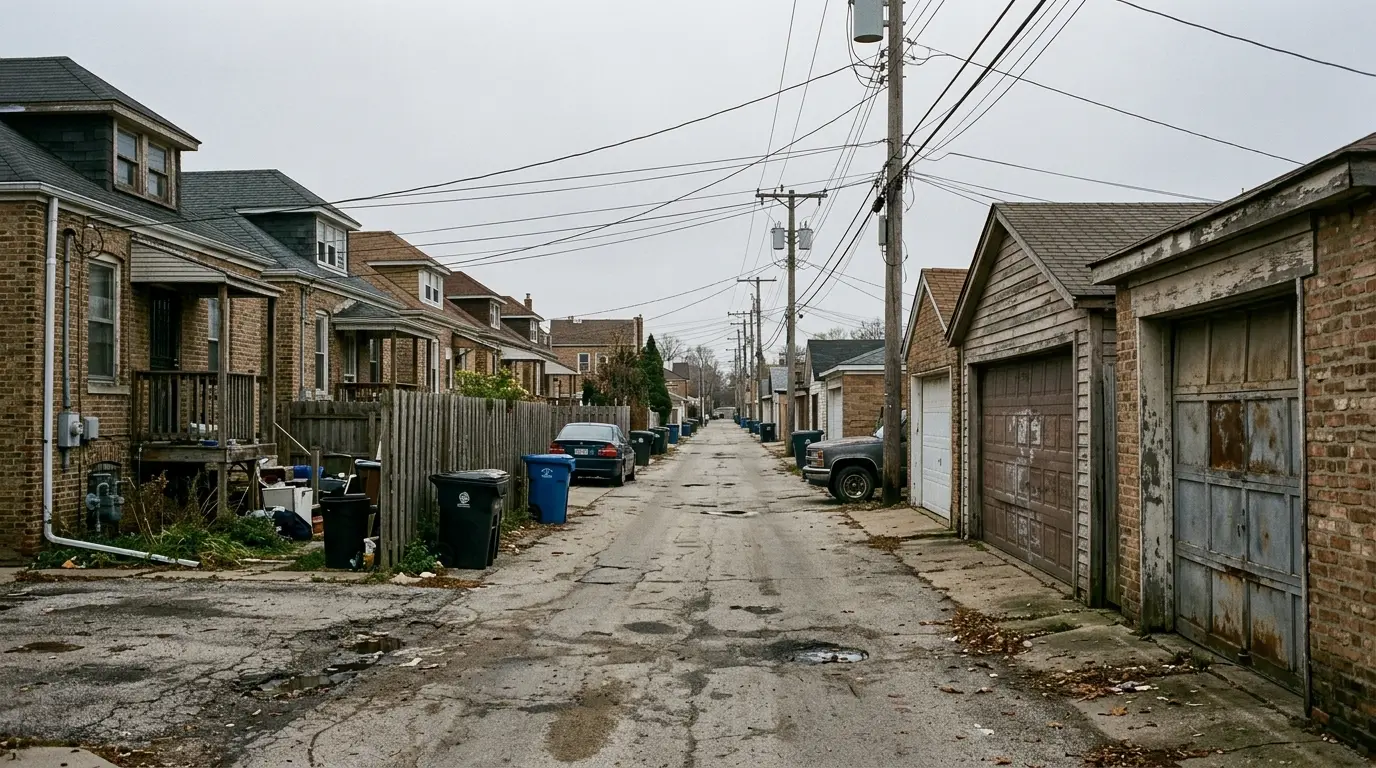
Plumbing on the Southwest Side
Bungalow and ranch blocks where two things are unusually common: a catch basin still doing its job in the gangway, and a second kitchen in a finished basement feeding into it.
The pit in the gangway
The Southwest Side has more catch basins still in active service than almost anywhere else in the city, and they are the single most useful thing to understand about plumbing here. A catch basin is a settling pit sitting between the building drain and the sewer lateral, a concrete cylinder three or four feet across with a lid at grade, usually in the gangway or the back yard. The logic behind it is sound: grease and grit drop out of suspension on private property rather than travelling into the public main.
It works, and it fills. When it does, the symptoms are the ones people naturally attribute to the sewer line: a whole-house drain that has gone gradually slow, or a line that gets rodded, runs beautifully for a month, and closes down again. That second pattern is the tell, and it is where money gets wasted, running a rod through a basin packed with solids re-establishes a channel that will close again shortly, and the invoice says the line was cleared.
So the first question on a slow-drain call here is whether the basin is live, filled, or bypassed, because renovations abandoned a good number of them without record. That is answered by lifting the lid and by camera footage, not by assumption, and it determines whether the right work is a pump-out, rodding, or something else entirely.
What actually blocks these lines
Roots dominate sewer failure in the tree-lined parts of the city. Here the more common culprit is grease, and it behaves differently enough to change the correct repair. Roots are a discrete obstruction at a joint: cut them and the pipe is open. Grease is a coating that builds along the whole inside of the line over years, narrowing it uniformly, and pushing a rod through the middle of that leaves the coating exactly where it was.
That is why hydro jetting comes up more on these blocks than in most of Chicago: it scours the pipe wall rather than punching through the centre. It is not the answer to everything, and the honest caveat matters, jetting a pipe whose walls have already failed can find that failure rather than clean it. Footage first, then the method, is the sequence that avoids turning a maintenance visit into an excavation.
The prevention is unglamorous and genuinely effective: fats, oils and grease into the bin rather than the sink, and hot water down the drain does not change that, it moves the grease further along the line before it cools and sticks. Households that adopt that habit measurably lengthen the interval between visits, which is more than can be said for anything sold in a bottle for pouring down a drain.
Why the same line keeps closing
Rodding a grease-coated pipe opens a hole through the middle of the deposit. The pipe looks clear on the day and re-closes in weeks, because nothing was removed. Scouring the wall is a different operation with a different result.
Second kitchens and finished basements
A large share of houses here have a finished basement, and a notable number have a second kitchen in it: a full one, used regularly, often by an extended family sharing the building. That is a meaningful plumbing fact rather than a curiosity: it roughly doubles the grease load reaching the lateral and the catch basin, and it puts a sink, and frequently a bathroom and laundry, below the level of the sewer.
Below-grade fixtures cannot drain by gravity, so everything they discharge is lifted into the house drain by an ejector pump in a sealed pit. Two things about that are worth stating plainly. An ejector is not a sump pump: one handles waste, the other groundwater, and substituting one for the other gives an early and unpleasant failure. And a basement below the surcharge level of a combined sewer is the room a storm backup arrives in, which is why backflow protection belongs in the conversation while the floor is open rather than after the finishes are in.
Long drives, hose bibs and winter
Lot geometry here produces a specific seasonal caseload. Houses on these blocks often have long side drives and detached garages at the alley, which means exterior hose bibs, garage supply lines, and occasionally a line run out to a garage that someone insulated optimistically thirty years ago. All of it sits outside the heated envelope, and a sustained freeze finds every weak point in it within about two days.
The failure point is nearly always where the pipe crosses from warm to cold, through the foundation wall, or at the bib itself if the stem is too short to put the valve seat inside the heated space. An hour in October, per outdoor hose bib winterization, closes and drains the exterior lines and removes most of that risk. It is one of the few plumbing jobs where the preventive version costs a fraction of the reactive one and the arithmetic is not arguable.
What We Dispatch For
Work called in most often on the Southwest Side
Coverage
Where this covers
Garfield Ridge and Clearing around Midway, east through Brighton Park and Gage Park, and south to Ashburn and Wrightwood.
Garfield Ridge · Clearing · Archer Heights · Brighton Park · McKinley Park · Gage Park · West Elsdon · West Lawn · Chicago Lawn · Marquette Park · Ashburn · Wrightwood · Scottsdale · Vittum Park
Common Questions
Answers before you call
There is a concrete lid in my gangway. What is under it?
Almost certainly a catch basin: a settling pit between your house drain and the sewer lateral, three or four feet across, standard on Chicago property for decades. Its purpose is to let grease and solids drop out on private property instead of accumulating in the public main, and on the Southwest Side a high proportion of them are still in service.
It needs emptying periodically, and how often depends entirely on what goes down the kitchen sink. A household that cooks with a lot of fat can fill one in a few years; another can go a couple of decades. The lid coming off once is the only way to know which you are, and it is worth doing before the drain tells you.
Rodding or jetting, which does my line need?
They do different things. Rodding cuts through an obstruction (roots at a joint, a mass of solids), and reopens a channel through it, which is exactly right when something is blocking the pipe. Jetting scours the pipe wall with water, which is what you want when the problem is not one obstruction but years of grease coating the whole inside of the line.
On these blocks the grease case is common, which is why jetting comes up here more than in most of the city. The wrong choice is not harmless: jetting a pipe whose walls have failed can find that failure, so footage first is the sequence that avoids an expensive surprise.
Is a garbage disposal a bad idea on an old line?
It is not automatically a problem, but it changes what your drain has to carry, and on a clay lateral with a catch basin it changes it in the direction that causes trouble. A disposal turns food into a slurry that stays in suspension long enough to reach the basin and then settles there, which shortens the interval between pump-outs noticeably.
If you have one, the useful discipline is what does not go into it: fats, oils and grease belong in the bin regardless of what the appliance can technically grind. That single habit does more for these lines than any product sold for pouring down them.
We want a bathroom in the basement. What does it need?
Two things beyond the fixtures. Because the fixtures sit below the level of the sewer, everything they drain has to be lifted mechanically into the house drain by an ejector pump in a sealed pit. That is not optional and it is not a sump pump. And because the room is below the surcharge level of a combined sewer, it is worth deciding on backflow protection at the same time rather than afterwards.
Doing both while the floor is open is dramatically cheaper than adding either later, and it is permitted and inspected work in Chicago, which is worth building into the schedule from the start rather than discovering midway.
Elsewhere in the City
The other sides
Rodded it, and it slowed down again in a month?
On these blocks that pattern usually means a catch basin full of solids rather than a blocked line. Rodding through a full basin restores flow for a few weeks and proves nothing, the basin needs looking at.
24/7 · Chicago metro dispatch · (833) 615-3680