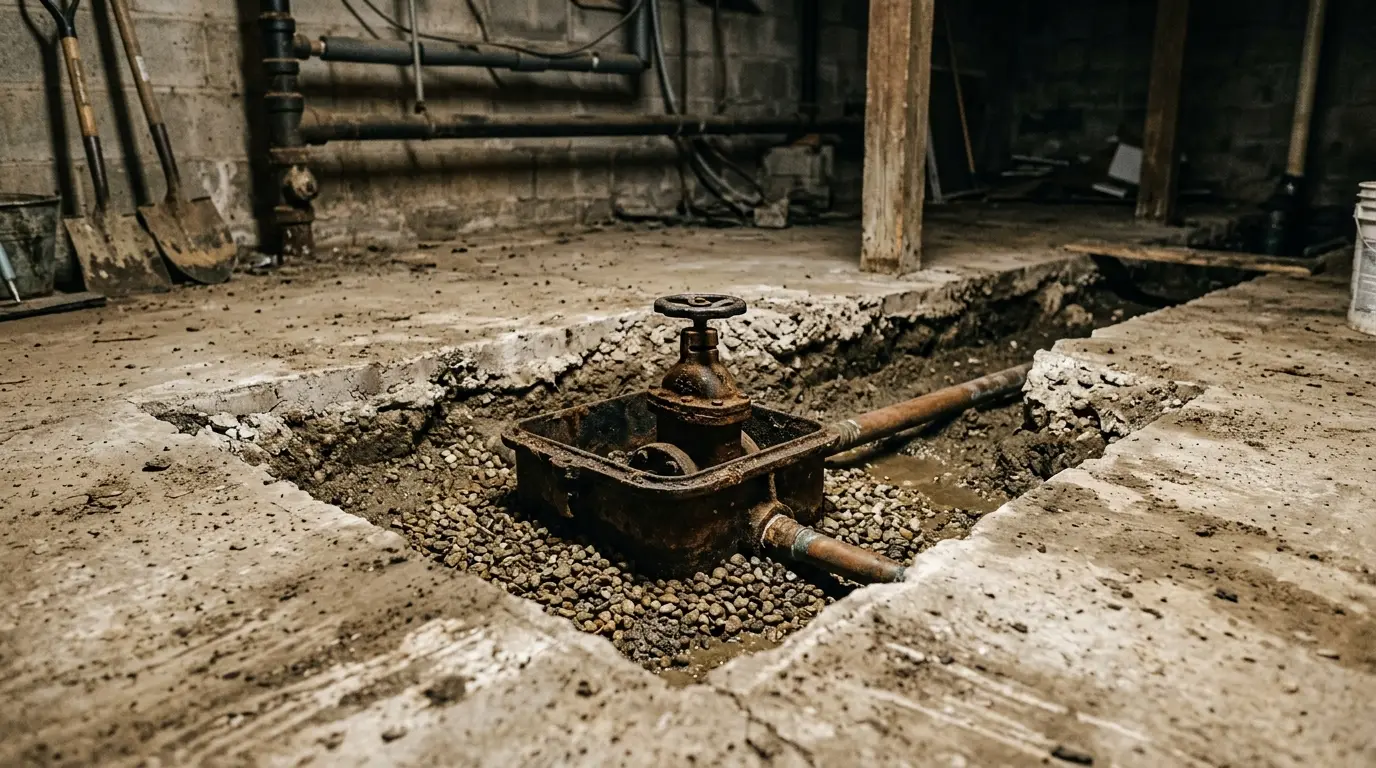
A backwater valve, and the one rule that comes with it
A one-way valve on your lateral closes when the public sewer tries to come back up it. It is the proportionate answer to an occasional surcharge, and it asks one thing of you in return.
What the valve is and how it works
A backwater valve is a short body fitted into your sewer lateral containing a hinged flap. Water leaving the building pushes the flap open and flows out normally. Water trying to come the other way, a surcharged public main pushing back up the pipe, pushes the flap onto its seat and closes the line.
There is no power, no float, no controller, and nothing to set. The same pressure that would put sewage on your floor is what shuts the valve, which is why it works during the storm-driven power cut that takes out your sump. Most bodies include a clear or removable cover so the flap can be seen and cleaned, and better installations sit in an access chamber with a lid at grade.
What it protects against is specific: reverse flow from the public sewer. It does not affect groundwater, it does not help with a blockage in your own lateral downstream of the valve, and it does nothing about a failure inside the building. Where water has been arriving by more than one route, which is common, it is one component of the answer rather than the answer.
Why this exists here
Much of the older metro is on combined sewers carrying sanitary waste and storm water in one pipe. In heavy rain the main pressurises and looks for the lowest opening on any connected building, which is a basement floor drain. A valve removes your building from that list for the duration.
The rule that comes with it
This deserves its own section because it is the thing installers under-explain and homeowners discover during a storm.
While the valve is closed, your building cannot drain. The flap is holding back the sewer, and it is equally holding back everything you send toward it. Whatever you flush or drain during that period accumulates in the lateral behind the flap, and when the space is used up it surfaces at the lowest opening, the floor drain you fitted the valve to protect.
So the household rule during heavy rain is: no toilets, no showers, no laundry, no dishwasher. For a typical event that is one to three hours. It is manageable, it needs to be known by everyone in the building, and it is a genuine constraint rather than a footnote.
Two consequences follow. First, a building with a lot of people, or with tenants who cannot be reached, is a poor fit for a valve alone. Second, if your household cannot reasonably stop using water (a two-flat with three families, a home business, a rental with turnover) the correct answer is an overhead sewer conversion, which keeps the building draining because the basement is pumped and the exit is above the surcharge level.
Where it goes
Placement is the design decision, and it is made against your fixture layout rather than for convenience.
The principle: everything upstream of the valve is protected and cannot drain while it is closed; everything downstream is unprotected and drains freely. So the valve goes downstream of the fixtures you are protecting (the basement floor drain, the basement bath, the laundry), and, ideally, upstream of nothing you would rather keep in service.
Exterior access pit. The most common arrangement: a chamber in the ground where the lateral leaves the building, with a lid at grade. It protects the whole building including the basement, and it keeps service work out of the house. It requires excavation and it needs the lid to remain findable, landscaping over a valve lid is a small tragedy that repeats itself.
Inside the basement. Where the lateral is accessible in the slab or exposed at the wall, a valve can go in there. Access is easy and dry, no excavation is needed, and the trade-off is that it sits in the building and the work involves cutting the floor.
Full-house against partial. A valve on the main lateral protects everything. A valve on a branch protects only that branch, and leaves the rest of the building draining normally, occasionally the right answer where only a basement bath is at risk and the household cannot accept the no-water rule for the whole building.
Whose building it suits
A valve is the proportionate answer in a recognisable set of circumstances.
- Occasional surcharge rather than routine. A basement that took water in an exceptional storm, not one that floods every spring.
- A basement that is not finished, or not precious. Storage, mechanical plant on a stand, a floor drain and a slab.
- A household that can stop using water for an hour. One family, present, reachable.
- A sound lateral. The valve is fitted into your pipe; if that pipe is failing, the pipe comes first.
- A sensible budget for the risk. It is a fraction of the cost of a conversion, and for many buildings the risk does not justify more.
It suits a building less well when the basement is finished and lived in, when the main surcharges frequently, when the building is multi-unit or tenanted, or when there is a below-grade bathroom that people will use without knowing there is a storm.
What installation involves
A defined job, usually completed in a day, with a permit and an inspection.
It starts with the lateral rather than the valve. A camera inspection establishes the material, the condition, the depth, and where the line runs, and it identifies the roots, offsets, or bellied sections that would make fitting a valve into it a poor idea. There is no point valving a pipe that is about to need replacing, and if the lateral does need work, the valve goes in as part of that job at a fraction of the standalone cost.
Then: excavation at the chosen point or opening the slab inside, cutting the lateral, fitting the valve body in the correct orientation with proper couplings, setting the access chamber with its lid at finished grade, backfilling in compacted lifts, and restoring the surface. Inspection follows, and the position gets recorded: on paper and, more usefully, in your memory of what that lid in the lawn is for.
Where a cleanout is absent, adding one during this work is close to free and makes every future service call cheaper.
If the lateral has never been looked at, that is the first call, it determines whether a valve is even the right thing to fit.
Call about an inspection firstAccess, and why the pit matters
The most common defect we find in existing backwater valve installations is not the valve. It is that nobody can get to it.
A valve needs opening once a year. If the chamber lid is buried under six inches of soil and a hosta, that service does not happen, and an unserviced valve is a valve that either sticks shut and restricts your drainage or sticks open and protects nothing. The failure is quiet in both directions, which is what makes it dangerous.
So the access chamber is not the part to economise on. It wants to be full-size enough to work in, brought up to finished grade with a lid that sits flush and can be lifted, and positioned where a landscaper will not decide to improve it. Where the valve is inside, the same principle applies to whatever floor access is provided, and a finished basement built over an access lid is a problem created for a future owner.
Tell the next owner too. A valve nobody knows about is a valve nobody services, and the transfer of that knowledge at sale is worth a line in the disclosure.
Annual service
Fifteen minutes, once a year, ideally in spring before the heavy rain.
- Open the chamber and look. The flap should be clean, seated, and free to swing without resistance.
- Clean the flap and its seat. Grease, wipes, and paper build up on the sealing face. A dirty seat does not close fully.
- Check the hinge. Corrosion or debris in the pivot is the usual reason a flap stops moving.
- Look for anything lodged. An object holding the flap open is the failure mode with no symptoms until the storm.
- Confirm the chamber and lid. Not silted up, not full of water, lid still findable and liftable.
- Rod the lateral on the interval it needs. Root-prone clay laterals need their own schedule regardless of the valve, and a blockage downstream of the valve is not something the valve helps with.
If it has not been serviced in several years, treat that as unknown protection rather than protection. It may well be fine; you cannot know without looking.
Valve or overhead conversion
The two real answers to a surcharging main, and they differ in kind rather than degree.
A backwater valve blocks reverse flow. It is inexpensive, quick, needs no power, and requires you to stop using water while it is closed. It leaves the low opening in place and relies on a mechanical flap to keep the sewer out of it.
An overhead sewer conversion removes the low opening. Basement drainage is re-routed into an ejector basin and the building drain leaves above the level the public sewer can reach. Nothing below the surcharge line connects to the sewer any more, so there is nothing to push back into. The building keeps draining throughout the storm. It costs substantially more, it involves slab work, and the basement now depends on a pump, which means backup power becomes part of the system rather than an option.
The decision is usually settled by three questions: how often does it happen, what is on the basement floor, and can the household stop using water on demand. Occasional, unfinished, and yes points at a valve. Frequent, finished, or no points at a conversion.
What drives the cost
Interior against exterior. An accessible lateral inside the basement is generally the cheaper installation. An exterior pit means excavation, a chamber, and restoration.
Depth and location of the lateral. A line at four feet in a lawn is straightforward. A line at eight feet under a driveway or a paved alley is a different job, and the surface above it is usually the biggest single variable.
Condition of the lateral. If the camera finds roots, offsets, or Orangeburg, that work comes first. Fitted during a lateral repair the valve is a small addition; fitted on its own it carries the whole cost of opening the ground.
Valve type and chamber. A basic flap in a serviceable chamber against a larger assembly with a full access structure. Some municipalities specify which is acceptable.
Permit and inspection. Required, priced, and worth having on the record. Ask about local subsidy programmes at the same time, several communities in this region contribute to backup protection.
What else is being done. Combining the valve with lateral work, a cleanout installation, or sump improvements shares one mobilisation and one excavation across several items.
Common Questions
Answers before you call
How does a backwater valve actually work?
It is a hinged flap inside a body fitted into the lateral, held open by normal outbound flow and pushed shut by anything coming the other way. No power, no controls, no moving parts beyond the flap itself, the pressure that would flood your basement is what closes it.
That simplicity is the point. It works during a power cut, it works while you are away, and there is nothing to fail except a flap that is dirty or obstructed, which is exactly what the annual inspection is for.
Can I still use water while the sewer is surcharged?
No, and this is the limitation to understand before fitting one. While the valve is closed, your drainage has nowhere to go. Anything you send down collects in the lateral behind the flap, and if you keep going it comes back out of the lowest fixture: the same floor drain you were protecting.
In practice that means no toilets, no showers, no laundry, no dishwasher during the storm. For most households that is an hour or two. It is a real constraint, and it is the main reason an overhead conversion is sometimes the better answer.
Where is the valve installed?
In the lateral, downstream of everything you want protected, most commonly in an access pit outside the building where the line leaves the foundation. Some installations sit inside the basement where the lateral is accessible.
The position matters more than the location. Anything connected downstream of the valve is unprotected, and anything upstream cannot drain while it is closed, so the placement is chosen deliberately against your fixture layout, not by convenience.
Does it need maintenance?
Yes, annually, and this is the part people skip. The flap and its seat need to be clear of grease, wipes, and debris, and the hinge needs to move freely. A valve gummed shut restricts your normal drainage; a valve held open by a lodged obstruction offers no protection at all.
It is a fifteen-minute job when the access is good, which is precisely why the access chamber is worth doing properly at installation rather than saving money on.
Will a backwater valve stop groundwater?
No. It only affects flow in the sewer lateral. Water arriving through the drain tile, through a crack in the wall, or from a window well is groundwater, and the sump system is what handles that.
Buildings that get water both ways need both things working, a valve on the lateral and a properly sized sump with backup power. Fitting one and calling it protection is a common and expensive misunderstanding.
Do I need a permit?
Yes. Cutting into a building's sewer lateral is permitted and inspected work everywhere in this region, and a number of municipalities have specific requirements about valve type, access, and location.
Several communities also run subsidy or reimbursement programmes for backup protection. It is worth one call to the municipality before the work is scheduled, because the requirements and the money are both local.
Flooded once and not sure what is proportionate?
The answer depends on what the camera finds in your lateral. Call and we will tell you what the options cost before you commit to either.
24/7 · Chicago metro dispatch · (833) 615-3680