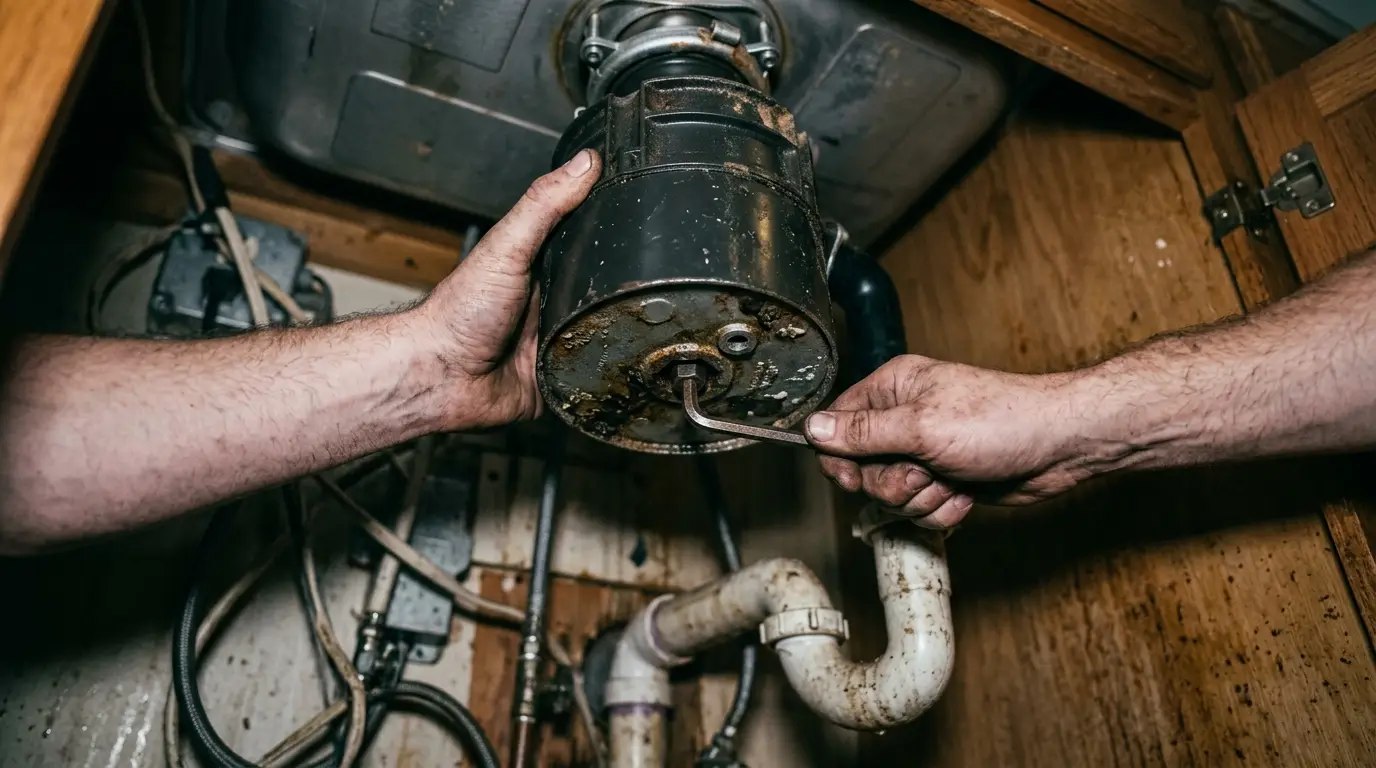
Garbage disposals, and the drain problem hiding behind them
A hum is a jam and a jam is usually free to clear. Water under the cabinet is a different question, and a sink that drains slowly is rarely the disposal's fault at all.
Five symptoms and what they mean
Disposals are simple machines and they fail in a small number of recognisable ways. The value in the list below is that two of these are free to fix and one of them is not a disposal problem at all.
It hums but does not turn. A jam. The motor is energised, the plate cannot move, and the overload cuts in after a few seconds. Clearing it is a homeowner job and the next section describes it.
It makes no sound. A power problem or a failed motor. Reset button, breaker, switched outlet, ground-fault outlet, in that order. Only after all four is the unit itself suspect.
It runs but grinds badly, with a rattle. Either something metal is loose in the chamber, a bottle cap and a teaspoon are the classics, or the impellers have worn or broken. The first is a two-minute fix; the second is a replacement.
It leaks. Where from decides everything, and there are four distinct places. Covered below, because this is the symptom people most often get wrong.
The sink drains slowly, or backs up. Usually not the disposal. If both sink bowls back up, or if water appears in the other bowl when the disposal runs, the restriction is downstream in the shared trap or branch line. That is drain work, not appliance work.
The distinction worth making before calling anyone
Does the disposal fail to run, or does the sink fail to drain? The first is an appliance question. The second is a pipe question, and replacing the disposal will not touch it.
Clearing a jam yourself
This is the one repair on the site we would rather you did without us, because it is genuinely straightforward and the alternative is paying for a visit that takes ten minutes.
Switch it off. At the wall switch, and if you are going to put a hand anywhere near the chamber, at the breaker. Never reach into a disposal that is merely switched off at the wall.
Look first. A torch into the chamber often shows the culprit: a bone, a fruit stone, a bottle cap, a piece of cutlery. Remove it with pliers or tongs, not fingers. The shredder ring is not sharp in the way people imagine, but the impellers can pinch.
Use the hex key. There is a hexagonal socket in the centre of the underside of nearly every disposal, and a key supplied with the unit (any quarter-inch hex key fits). Insert it and work the plate back and forth until it spins freely by hand. This breaks the jam even when you cannot see what caused it.
Press the reset. A red button on the base. The overload will have tripped and the unit will stay silent until it is pressed.
Run cold water and test. Water first, then the switch.
If it hums again immediately, the jam is still there. If it does nothing, the overload has tripped again or the motor has had enough. And if a jam happens repeatedly on a unit that is otherwise sound, the usual explanation is either something being put down it that should not be, or worn impellers no longer clearing what a new unit would handle.
Where disposals leak
Water in the cabinet has four possible origins and they differ enormously in what they cost to put right. The diagnostic method is to dry everything, put a bowl of water down the sink, run the disposal briefly, and watch with a torch.
The sink flange, at the top. Water appearing at the rim where the disposal meets the sink, worst when the bowl is filled. The mounting has loosened or the putty seal under the flange has aged and dried out. The repair is to drop the unit, clean the flange, re-bed it, and remount. A common and entirely fixable fault.
The dishwasher inlet. A drip from the small hose connection on the side of the housing, appearing when the dishwasher drains. Usually the clamp or the hose, occasionally a cracked inlet spigot.
The discharge connection. Where the disposal joins the trap arm. A gasket, a loose flange, or a misaligned tube. Straightforward, and often the consequence of somebody forcing the plumbing to line up during a previous installation.
The body itself. Water coming from the middle or bottom of the housing, or from the reset button area, means the internal seals or the housing have failed. This is terminal, the unit is replaced, not repaired. On a disposal past eight or ten years old, this is where most of them end.
One thing worth adding: water in a sink cabinet is not always the disposal. The tailpiece, the trap, the basket strainer on the other bowl, the faucet supply lines, and a leaking dishwasher hose all present in exactly the same place. Drying everything and watching under load is what separates them, and it is worth five minutes before anything is bought.
When it is the drain, not the disposal
This is the most useful section on the page, because a substantial proportion of disposal calls are drainage calls.
Symptoms that point downstream rather than at the appliance: both bowls draining slowly; water rising in the second bowl when the disposal runs; a gurgle from the other side of the sink; the sink backing up after the dishwasher discharges; and drainage that is fine at first and then slows as more water is put through.
The reason is almost always the same in this housing stock. Kitchen branch lines accumulate a lining of congealed fat mixed with ground food particles, coffee sediment, and detergent residue. It builds from the pipe wall inward over years, so the pipe's effective bore shrinks until a normal sink load exceeds it. A disposal accelerates this by producing a fine slurry that flows warm and settles cool.
What actually resolves it depends on how far it has gone. Cabling clears a blockage and restores flow, which is the right response to an immediate backup, see drain cleaning. But cabling punches a hole through a grease lining rather than removing it, so a line that blocks every few months needs the wall scoured rather than perforated, which is hydro jetting. Where the whole building drains slowly rather than one kitchen, the problem is the stack or the lateral, and that is sewer rodding or a camera inspection to find out why.
Two structural faults worth naming, because they cause repeat blockages that no amount of clearing will fix. A trap arm with too little fall, or a sagging section, holds water and sediment permanently. And an S-trap (a trap that drops straight down without a vented arm, common in older kitchens that have been remodelled without touching the drainage) siphons its own seal and drains sluggishly by design. Both are corrections rather than cleanings, and both are worth doing once instead of paying to cable the same line every spring.
Kitchen sink blocking every few months? Clearing it again is the cheap answer; finding out why is the one that lasts.
Call about a kitchen lineChoosing a replacement
Four decisions, and only two of them matter much.
Motor size. A third of a horsepower is the builder-grade unit and it is genuinely underpowered for a busy kitchen: it jams more, grinds coarser, and lasts less long. Half a horsepower suits most households. Three quarters is worth having in a large household or where the unit is used heavily. One horsepower is more than a domestic kitchen needs.
Grinding components. Stainless steel impellers and shredder ring resist corrosion and hold an edge better than galvanized ones. This, along with motor size, is what separates a unit that lasts twelve years from one that lasts five.
Continuous or batch feed. Continuous feed, a wall switch, is the norm. Batch feed requires a stopper to be fitted and turned to run, which makes it impossible to run with a hand inside; genuinely worth considering in a household with young children.
Sound insulation. The insulated models are noticeably quieter, which matters in an open-plan kitchen and not at all in a closed one. It is a comfort choice rather than a durability one.
Two physical checks before buying: the height of the unit against the cabinet floor and the trap position (a taller, more powerful unit can sit low enough that the discharge no longer lines up with the existing trap arm), and whether the mounting system matches, because changing brands sometimes means changing the sink flange assembly too.
Installation details that matter
Six things that determine whether a new disposal is trouble-free or a slow leak waiting to happen.
The flange seal. Properly bedded plumber's putty under the sink flange, drawn down evenly. This is the joint that leaks first when it is rushed.
Support during mounting. A disposal is heavy and it hangs from the sink. It gets supported while the mount is drawn up, not held by hand and torqued unevenly.
The dishwasher knockout. New disposals ship with the dishwasher inlet blanked off by a moulded plug. If a dishwasher is being connected, that plug has to be knocked out and removed from the chamber. Forgetting it produces a dishwasher that will not drain and a service call the following week; leaving the fragment inside produces a rattle and a jam.
The dishwasher drain arrangement. An air gap on the sink deck or a properly formed high loop under the counter, according to what the municipality requires. It exists to stop drain water siphoning back into the machine, and a great many dishwashers in this metro have neither.
A proper P-trap, correctly aligned. The discharge tube should reach the trap without being forced, and the trap arm should have fall and be vented. Where the geometry does not line up, the fix is to rework the tailpiece and trap properly, not to load the joints sideways until they meet.
Electrical. A hardwired unit gets its connections made in the unit's own box with the cord grip fitted; a cord-and-plug unit needs an outlet under the sink, which older Chicago-area kitchens frequently lack. Either way, the switch belongs above the counter where it is reachable without putting a hand near the appliance.
What actually belongs down there
Disposals are for scraps, not for waste disposal in the general sense. The list matters less as etiquette than as the difference between a kitchen line that never blocks and one that blocks annually.
Fine, with plenty of cold water: soft food scraps, small amounts of cooked vegetables, fruit flesh, small scraps from plates.
Keep out. Grease, fat, and cooking oil, which is the single biggest cause of kitchen drainage failure. Coffee grounds, which form a dense sediment in the trap. Fibrous material (celery, artichoke, corn husks, onion skins), which wraps around the impellers. Starchy quantities like potato peelings and pasta, which turn to paste. Bones and fruit stones, which jam it. Eggshells, whose membranes wrap and whose grit adds to the sediment. And anything that is not food at all, which includes the bottle caps and teaspoons we routinely retrieve.
The habit that matters most: cold water running before, during, and for a good fifteen seconds after the grinding stops. That final flush is what carries the ground material past the trap into the branch line instead of leaving it to settle six inches away.
And a note on chemical drain cleaners: they do not belong in a disposal or in the line below it. They attack the seals in the unit, they are ineffective against a grease lining, and they make a subsequent mechanical clearing hazardous for whoever opens the pipe.
Older buildings and shared stacks
Two situations specific to this housing stock where the answer is not simply "fit a bigger disposal".
Original cast iron waste piping. Cast iron in a hundred-year-old building has often scaled internally, which reduces the bore and leaves a rough wall that catches everything a disposal produces. A disposal on such a line is a blockage generator, and the honest options are to use it sparingly, to have the line properly scoured, or in some cases to leave it out and fit a strainer instead.
Two-flats, courtyard buildings, and condos on shared stacks. Where a kitchen line joins a stack shared with other units, one household's grease becomes everyone's blockage, and the building's plumbing has usually been added to piecemeal over a century. Adding a disposal in that context is worth thinking about at the building level rather than the unit level, and in some associations it is restricted by the rules. That whole territory is covered under multi-unit building plumbing.
In both cases, we would rather have the conversation before fitting the unit. A disposal that produces four blockages a year in an old building has cost far more than it saved.
What drives the cost
Directional rather than quoted, and this is one of the cheaper jobs on the site unless the drain is involved.
A jam clearance. The least expensive visit we make, and the one we would rather talk you through on the phone.
A leak repair. Re-bedding a flange or replacing a discharge gasket is short work. A leaking housing is not repairable and becomes a replacement.
The unit. Motor size and grinding components set the price, and the gap between a third-horsepower builder unit and a good half or three-quarter horsepower stainless one is small relative to the difference in service life.
Whether the mount and trap line up. A like-for-like replacement in the same brand family is quick. A brand or size change that needs a new flange assembly or a reworked trap arm takes longer.
Electrical readiness. An existing switched outlet under the sink makes it simple. No outlet at all means an electrician is part of the plan.
The drain, if it turns out to be the drain. Cabling a kitchen branch, jetting a greased line, or correcting an S-trap or a sagging trap arm are separate pieces of work with their own costs, and they are the ones that actually resolve a repeat problem.
If a jam is all it is, we will tell you where the hex key goes and you can keep your money.
Common Questions
Answers before you call
My disposal just hums. Is it dead?
Almost certainly not. A hum with no rotation means the motor has power but the grinding plate cannot turn, something is jammed between the impellers and the shredder ring. The motor's overload protection will trip within seconds, which is what stops it burning out.
Switch it off, use the hex key in the socket underneath to work the plate back and forth until it turns freely, remove whatever comes loose, then press the red reset button on the base. That clears the great majority of hums, and it costs nothing.
It makes no sound at all. What now?
Work through the power chain before condemning the unit. Press the reset button on the underside, a tripped overload is silent. Check the breaker. If the disposal is on a switched outlet under the sink, test that the outlet has power, and if it is on a ground-fault outlet, check whether that has tripped.
If power is confirmed at the unit and it still does nothing, the switch or the motor has failed. On a unit more than about eight years old, replacement is normally better value than a motor repair.
Why does my disposal smell?
Because food residue is sitting somewhere it is not being flushed away: typically under the splash guard, in the gap between the shredder ring and the housing, or in a trap that is holding grease. Disposals do not smell when they are being used properly with enough cold water.
The routine that works: pull back the splash baffle and clean its underside, grind a tray of ice cubes with the cold tap running to scour the chamber, and finish with citrus peel. What does not work is bleach, which damages seals and does nothing about the residue, or a bottle of drain chemical, which is bad for the unit and for the pipe below it.
Can I put coffee grounds and eggshells down it?
Better not. Coffee grounds are the clearest case: they pack into a dense sediment in the trap and the branch line, and they are one of the most common causes of a kitchen line that has to be cabled repeatedly. Eggshells are argued about; the membranes wrap around the impellers and the shell grit adds to the same sediment problem, so we would keep both out.
The real offender, though, is grease. A disposal grinds fat into a form that flows warm and then congeals on the pipe wall a few feet downstream, which is where kitchen line blockages come from in almost every building we work in.
Hot water or cold water while it runs?
Cold, and it genuinely matters. Cold water keeps fats and oils solid so they are ground and carried out with the flow. Hot water melts them, and they then travel a short distance, cool, and coat the inside of the pipe.
Run the cold tap before, during, and for fifteen to twenty seconds after the grinding stops. That last part is the step most people skip, and it is what carries the ground material past the trap and into the branch line rather than leaving it sitting there.
Do I actually need a disposal?
No, and that is a legitimate option. Plenty of households replace a failed disposal with a plain sink strainer and a scrap bin, and in a building with old cast iron waste piping or a lateral with a history of blockages, that is sometimes the recommendation we would make.
Where a disposal earns its place is a busy kitchen where food scraps would otherwise sit in a bin. If it is being replaced only because there is a hole in the sink where one used to be, a basket strainer costs a fraction of the price and adds nothing to the drainage load.
Sink backing up on both sides?
That is the branch line rather than the disposal. Worth clearing properly, and worth a look at why it keeps happening.
24/7 · Chicago metro dispatch · (833) 615-3680