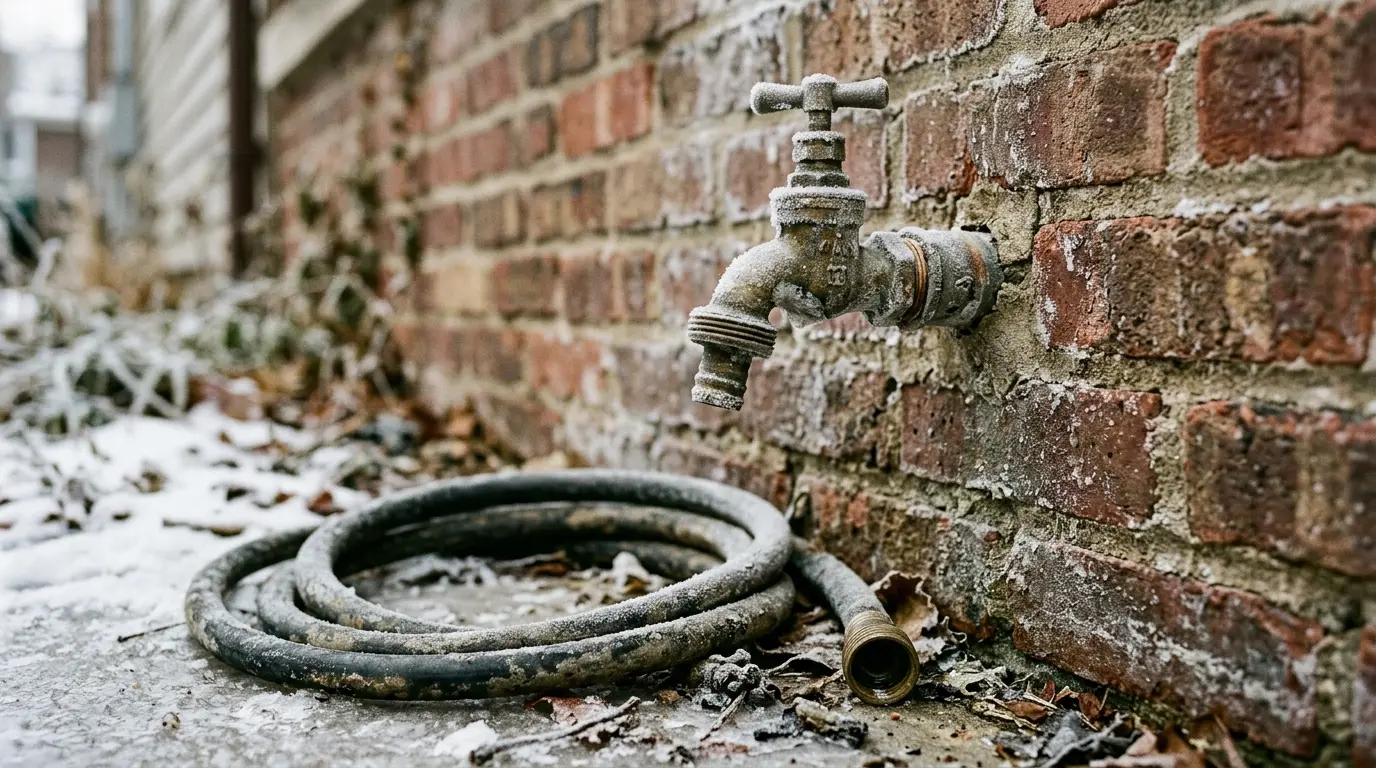
The hose bib, and the winter it has to survive
Nearly every burst sillcock in this metro traces back to one thing: a hose left connected through the first hard freeze. Ten minutes in October, or a wall opening in April.
Why sillcocks fail here
An outdoor faucet (a sillcock, on the invoice) is the only fixture in a house built deliberately through the thermal envelope. Every other pipe is either inside or outside. This one is both, which is why it is the single most-replaced piece of plumbing in the metro every spring.
The mechanism is not what most people picture. Water expanding by nine per cent as it freezes does not burst the pipe by pushing outward on the wall; it bursts it because the ice plug seals the line and the water still liquid behind it has nowhere to go. Pressure climbs in that trapped column until the weakest point splits. On a hose bib, the weakest point is almost never the brass casting you can see. It is the copper six to eighteen inches inside the wall, or the stem of the frost-free valve itself.
Three things about this housing stock make it worse than the raw temperature suggests. First, the freeze–thaw pattern: a metro winter here delivers dozens of cycles across the low twenties rather than one long deep freeze, and each cycle is another chance for a partially drained stem to trap water. Second, orientation, the bibs that fail are disproportionately on north and west walls, where wind strips heat off the masonry all afternoon. Third, the construction: a frame house with a bib through an uninsulated 2x4 wall has almost nothing between that pipe and the outside air, and a good many bungalow and two-flat sillcocks pass through twelve to sixteen inches of masonry into an unheated back porch enclosure that was never part of the heated volume of the building.
And overwhelmingly, the proximate cause is a garden hose. A hose left connected holds water against the valve seat and prevents the stem from draining, which converts a freeze-proof fixture into an ordinary one. Every autumn a proportion of the houses in this region go into winter with a hose on the bib and a splitter on the hose, and every April a proportion of those houses find out.
The failure you cannot see until April
A split inside the wall leaks nothing while the bib is closed and the interior shutoff is off. It only appears the first warm Saturday when someone opens the valve to wash a car, and then it runs into a joist bay, a finished basement ceiling, or down the inside face of the foundation, unseen, for as long as the tap is open.
What you have on the wall
Four things get called a hose bib and they behave completely differently in cold weather. Identifying yours decides what the autumn routine is.
A plain compression sillcock. The old standard, and still on a large share of pre-war buildings. The handle turns several times and gets harder as it closes, because it is driving a washer onto a seat located right at the wall face, in other words, outdoors. There is no version of this fixture that survives a hard freeze with water in it. It depends entirely on an interior shutoff being closed and the outside valve being left open to drain.
A frost-free (freeze-proof) sillcock. Recognisable by the long body: the handle operates a stem six to twenty-four inches long, and the seat it closes against sits at the far end, inside the heated space. Close it and the water column stops indoors, then the whole outdoor stem drains itself out through the spout. Correctly installed, it needs no interior shutoff and no autumn attention beyond taking the hose off.
A quarter-turn wall hydrant. A ball-valve fixture, often with an integral vacuum breaker and a removable key or loose handle, more common on commercial elevations and newer multi-unit work. Some are freeze-resistant by the same long-stem principle; some are not, and the only way to know is to measure the body.
A yard hydrant. The standing pipe in a garden, a garage apron, or a coach-house yard, fed from a buried line. These shut off below the frost line and drain through a weep hole into a gravel bed at the base. When they fail they either stop draining, the gravel silted up years ago, or they weep continuously, which is a slow leak nobody sees because it is underground.
Why a frost-free still froze
This is the most common conversation we have in April, and it is a fair complaint: the fixture was sold as freeze-proof and it split anyway. There are five reasons, and four of them are installation rather than product.
The hose was left on. The stem drains by gravity out of the spout. A hose, a splitter, a quick-connect, a timer, or a shut brass Y at the end blocks that path. The stem stays full, the water in it freezes, and the stem splits inside the wall where the split is invisible.
It was installed level or uphill. A frost-free needs a fall of roughly a quarter inch back toward the interior over its length so the stem empties. Fitted dead level into a bay, or worse, pitched up to clear a joist, it holds a slug of water at the outboard end permanently.
The stem is too short for the wall. An eight-inch frost-free through a fourteen-inch masonry wall with a furred interior finish puts the seat inside the masonry, not inside the building. It is then a compression sillcock with extra steps. Stem length is chosen by measuring: wall thickness plus enough to land the seat in conditioned air.
The interior end is in unheated space. A frost-free that terminates in a crawl space, an unheated porch, or a sealed bay behind rigid insulation has no warm room air reaching it. The seat is technically indoors and still at twenty degrees.
The vacuum breaker seized. Some fixtures cannot draw the air needed to break the siphon and drain the stem if the anti-siphon cap has corroded shut. It is a small part, and replacing it is a five-minute job that prevents a wall opening.
The autumn routine, in order
Six steps, once a year, and they take about ten minutes for a typical house. The order matters.
1. Disconnect every hose. Not just the main hose: the splitter, the quick-release coupler, the hose-end timer, the soaker line, and the fertiliser applicator that has been on the back bib since June. Anything threaded onto the spout blocks drainage.
2. Drain and store the hoses. Stretch them out downhill, let them empty, coil them loosely, and get them off the ground. A hose stored full and frozen splits its inner liner and delaminates, which is why so many hoses fail in their second spring rather than their fifth.
3. Find the interior shutoff, if there is one. Usually a small gate or ball valve on the branch feeding the bib, in the basement ceiling near the exterior wall, or in a joist bay above a laundry sink. Label it. On a house with three bibs, work out which valve serves which before you need to know in a hurry.
4. Close it, then open the outside faucet and leave it open. With the branch isolated, the open bib lets the short section between valve and spout drain and gives any residual water somewhere to expand. If the shutoff is a stop-and-waste type with a small side cap, open that cap into a bucket. That is the drain-down the fixture was designed for.
5. For a correctly installed frost-free with no interior valve: take the hose off, open the bib for thirty seconds to let the stem clear, close it, and you are done. Leaving it open all winter on this type accomplishes nothing and invites debris and insects into the spout.
6. Do it before the first hard freeze, not before the first cold snap. The line to watch is an overnight low in the mid-twenties, which in this metro shows up in the last days of October in some years and the second week of November in others. Treating the routine as a Halloween job rather than a Thanksgiving job puts it comfortably ahead of the distribution in either case.
Insulated foam faucet covers are worth a sentence because they are sold hard every October. On a compression bib whose interior valve is already closed and drained, a cover is mild insurance against wind chill on the casting. On a bib with water behind it, a cover buys a few degrees and a few hours and then the pipe splits anyway. They are a supplement to the routine and no part of a substitute for it.
Irrigation and the blow-out
An irrigation system is a hose bib problem multiplied by the number of zones, with the added difficulty that most of the pipe is buried where you cannot inspect it and the expensive parts, the valve manifold and the backflow device, are the ones nearest the surface.
Draining by gravity is adequate only on a system explicitly designed for it, with drain valves at every low point and pipe pitched to reach them. Almost nothing installed residentially in this region is. The standard is a compressed-air blow-out, and the thing that makes it safe or destructive is volume rather than pressure. A large-volume compressor moving air at modest pressure clears a zone; a small compressor cranked to its limit does not move enough air to push the water out and instead spins the sprinkler gears dry at damaging pressure.
The working numbers: keep polyethylene systems near fifty psi and PVC systems below eighty, run one zone at a time from the furthest head back, and stop each zone within a couple of minutes even if mist is still showing. Nozzles and gear drives are lubricated by water. Running them dry at pressure is how a blow-out ends up costing more than the freeze would have.
Two Chicago-specific notes. Most residential systems here are fed off the domestic supply inside the basement through a backflow device, which means the isolation valve, the device, and the short run to the exterior wall all sit indoors and need draining separately, and air must never be blown backward through the backflow assembly. And the parkway complicates things: heads set in the public right of way get hit by snow ploughs and by anyone digging a service line, so the spring startup on a parkway zone is worth doing with someone watching the heads rather than from the controller alone.
Irrigation still charged in November, or a hose you have just realised has been on the bib since summer? Both are cheap this week and expensive in April.
Call about winterizationVacuum breakers and backflow
A hose bib is the textbook cross-connection, and it is worth understanding why rather than treating the little brass cap as a code nuisance. The scenario is ordinary: a hose end sitting in a bucket of driveway salt, a wading pool, or a hose-end sprayer full of weedkiller, at the same moment that a main break or a hydrant draw drops pressure in the street. The house line goes momentarily negative, and whatever the hose is sitting in gets siphoned into the building's drinking water.
The protection at a single bib is a hose-bib vacuum breaker, a few dollars of brass that threads onto the spout and admits air the instant flow reverses. Modern sillcocks have the function built into the head. Older ones do not, and adding one is the cheapest useful thing anybody does to a plumbing system all year.
Irrigation is a different category because the hazard is continuous rather than incidental. Those systems need a testable assembly: a pressure vacuum breaker for ordinary systems, and a reduced-pressure-zone assembly where there is chemical injection, a well, or any connection that raises the hazard classification. Illinois requires cross-connection control assemblies to be inspected and tested annually, with the report going to the water supplier for the municipality you are in, and the test is a scheduled item with a paper trail rather than a visual check. If nobody has tested yours since it was installed, that is a live compliance gap and a real risk, in that order of likelihood and reverse order of importance.
Repair, replacement, and access
When a bib has failed over the winter, the first job is finding where. A split stem inside a frost-free announces itself as water at the interior end of the fixture the moment the handle opens. A split in the branch copper further inside shows up as water in a joist bay or running down the inside of the foundation, sometimes several feet from the bib. Isolating and pressure-testing the branch settles it before anything is opened up, which matters most in a finished basement where the difference is one small access panel versus a run of ceiling.
Replacement is usually straightforward from the interior: open the bay, cut back to sound pipe, fit a frost-free of the correct stem length with a quarter-inch fall, and secure it so the fixture does not rotate when someone leans on a hose. On masonry, if the existing sleeve is too tight or the new stem is a larger diameter, the through-wall hole gets cored rather than chipped, and the exterior gets sealed and flashed properly, a bib bedded in nothing but caulk is a water entry point for the wall as well as a plumbing fixture.
One judgement worth explaining. Soldering a joint six inches from ninety-year-old kiln-dry framing and a sill plate is a real fire consideration, and the mitigation is either a proper heat shield with a watch period afterward or, better, press fittings that make the connection cold. In a tight bay in a wood-frame building we default to press for exactly this reason. It is not a shortcut; it is the safer joint in that location.
While the bay is open, the interior shutoff earns replacement. Multi-turn gate valves from the middle of the last century are the single most reliable way to discover, on a January night, that the valve you were counting on will not close. A quarter-turn ball valve with an integral drain costs very little in the middle of a job that already has the ceiling open, and it is what makes next October a ten-minute routine.
Spring startup
Turn the water back on with one person at the bib and one in the basement watching the ceiling and the foundation wall below it. Open the interior valve slowly, then open the bib and run it for two full minutes. What you are listening and looking for: flow that starts strong and fades, a hiss or whistle from inside the wall, a drip appearing at a joist or along the sill, and any damp patch that grows while the tap is open and stops when it is closed. That last pattern, wet only while running, is the signature of a winter split, and it is why the tap gets closed and left closed until it is repaired.
Weak flow with no leak is usually debris in the spout screen or the vacuum breaker, both of which come apart by hand. No flow at all with the interior valve open means either the stem is broken internally or the branch is blocked, and neither is a wait-and-see item.
Irrigation startup follows the same discipline: charge the system slowly with the isolation valve barely cracked so the mains fill without slamming, then walk every zone before trusting the controller. Heads sheared by a plough, a manifold cracked by a missed low point, and a backflow device that weeps at pressure all show themselves in the first ten minutes if somebody is outside looking.
What drives the cost
Access. An unfinished basement with the joist bay open from below is the easy case. A finished ceiling, a tiled bathroom on the other side of the wall, or a bib served from a crawl space changes the job more than the fixture ever will.
Wall construction and stem length. Frame wall, short stem, existing sleeve: quick. Sixteen inches of masonry needing a cored hole for a longer-stem fixture: not quick.
How far back the damage goes. A split confined to the fixture is a fixture. A split that has taken out three feet of branch copper, or a branch that turns out to be galvanized and crumbling at the threads, is a piping decision rather than a bib decision, and that conversation belongs with whole-home repiping rather than with an outdoor faucet.
Interior valve replacement. Small money on the same visit, and the item most likely to save a future emergency.
Number of bibs and hydrants. Winterization is priced per building rather than per tap, so a three-bib house with an irrigation system is one visit. A yard hydrant that needs its drainage bed rebuilt is excavation and is quoted separately.
The honest summary: if your bibs are frost-free, properly pitched, and hose-free by the end of October, you do not need us in the autumn at all. Where we earn a call is the house with compression bibs and unlabelled valves, the irrigation system nobody has blown out in three years, and the April Saturday when the tap runs into the ceiling instead of out the spout.
Common Questions
Answers before you call
When should outdoor faucets be winterized in the Chicago area?
Treat it as a Halloween job rather than a Thanksgiving job. The threshold that matters is an overnight low in the mid-twenties, and in this metro that arrives in the last days of October some years and the second week of November in others. Doing the routine at the end of October puts you ahead of the range in either case.
There is no penalty for being early. A bib you will not use again until April costs nothing to have drained in October, and the two most expensive weeks of the year for this fixture are the first hard freeze in autumn and the first warm weekend in spring.
I have frost-free faucets. Do I still need to do anything?
Yes, but only one thing: take the hose off. A frost-free sillcock drains its own stem out through the spout when it closes, and anything threaded onto that spout (a hose, a splitter, a quick-connect, a timer) blocks the drain path and leaves the stem full of water inside the wall.
If yours has split in the past despite the hose being off, the installation is the problem rather than the fixture: the stem is too short for the wall, it was fitted without the required fall back toward the interior, the interior end sits in unheated space, or the anti-siphon cap has seized and cannot admit the air the stem needs to drain.
Are foam faucet covers worth buying?
They are a supplement, not a substitute. On a compression bib whose interior valve is already closed and drained, a cover is reasonable insurance against wind chill on the exposed casting, and on a north or west elevation that is not nothing.
On a bib with water sitting behind it, a cover buys a few degrees and a few hours and the pipe splits anyway. Spending the ten minutes on the shutoff-and-drain routine is worth more than any cover, and once you have done the routine the cover is largely decorative.
Can I just drain my irrigation system instead of having it blown out?
Only if it was designed for gravity drainage, with drain valves at every low point and pipe pitched to reach them. Very little residential irrigation in this region was. Without that, water stays in the laterals and in the valve manifold, and the manifold is the expensive part.
A blow-out is about air volume rather than air pressure. A large compressor moving a lot of air at modest pressure clears a zone quickly; a small compressor cranked up does not move enough air to push water out and instead runs the gear drives dry at damaging pressure. Air is also never blown backward through the backflow assembly.
My hose bib works, but there is a damp patch inside. What is that?
Almost certainly a winter split in the stem or in the branch pipe behind it. The signature is that the damp appears while the tap is open and stops when it is closed, because the split is upstream of nothing and only sees pressure and flow when the valve is off its seat.
Close the tap, close the interior shutoff if you can find it, and leave both closed. Water running into a joist bay for the length of a car wash does far more damage than the repair costs, and the repair does not get cheaper by waiting for the leak to declare itself more clearly.
Does my irrigation backflow device really need testing every year?
Yes. Illinois requires cross-connection control assemblies to be inspected and tested annually, and the result is reported to the water supplier for your municipality. It is a scheduled test with a paper trail, not a visual once-over.
The reason behind the rule is worth knowing independently of the paperwork. An irrigation system is a permanent connection between your drinking water and standing water in the ground, and the assembly is the only thing preventing reverse flow when pressure in the street drops. Devices do fail, quietly, and a device that has never been tested is a device nobody knows the state of.
Hose still on the bib in November?
Take it off tonight, that one step prevents most of what we get called about in April. If a bib is already wet inside the wall, the call is worth making now rather than in spring.
24/7 · Chicago metro dispatch · (833) 615-3680