Plumbing in Elk Grove Village
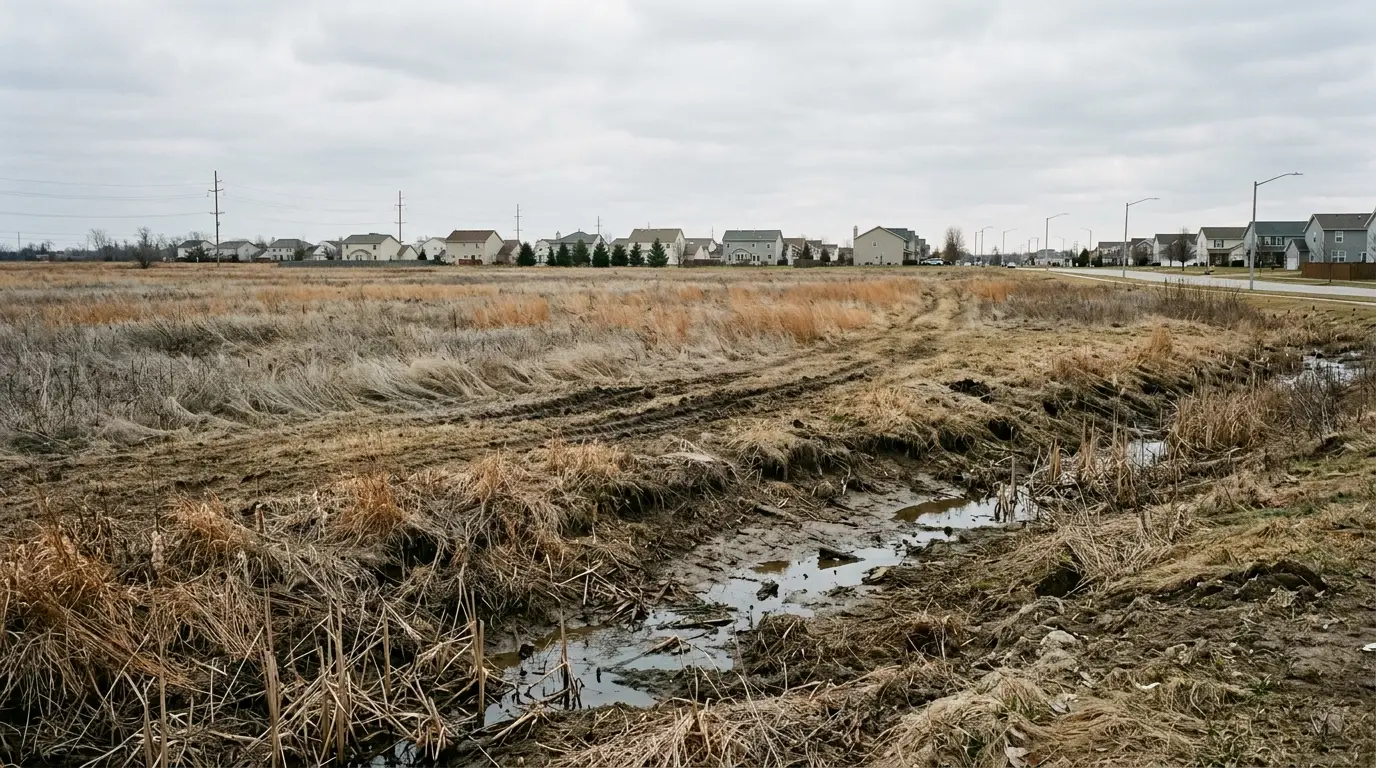
Elk Grove Village was built on ground that had to be drained before anyone could build on it. Flat, heavy prairie soil, a high water table and a century-old network of field tile underneath the subdivisions. That is the context for most of what goes wrong in a basement here.
The ground it was built on
Before the village existed, this was flat wet prairie and farmland, ground so poorly drained that farming it required laying clay field tile to carry water off the fields. That drainage history is the single most useful thing to know about plumbing here, because the ground has not changed. It is still flat, the soil is still heavy and slow-draining, the water table is still high in spring, and much of that old tile is still down there under the subdivisions.
What that means for a house: water arriving at your foundation does not soak away quickly, and in a wet spring the water level in the soil can sit close to or above your basement floor. A dry basement in Elk Grove Village is not a sealed basement, it is a drained one, drain tile around the footing collecting water and a pump lifting it away. When people here describe a basement that was dry for fifteen years and is now damp every spring, the change is nearly always in the drainage or the pump rather than in the wall.
The flatness has a second consequence that is easy to miss: there is very little natural fall to work with, so grade around the building matters more than it would on a sloping lot. A few inches of settlement against a foundation over thirty years is enough to turn the ground next to your wall from shedding water to holding it, and it is one of the cheapest things on this page to fix.
The same ground carries one of the largest concentrations of industrial and warehouse buildings in the country on the village's west and south sides. Those buildings sit on the same soil with the same water table, which is why so much commercial work here is also pumping and drainage work: large sump and lift arrangements, ejector systems for below-grade facilities, and storm detention. The physics are identical to the houses; only the scale is different.
One street, one plumbing spec
Elk Grove Village went from incorporation in the mid-1950s to substantially built out within about twenty years, and it did it in large subdivisions rather than lot by lot. The practical result is that plumbing here comes in blocks. A street is usually one builder, one year, one plumbing contractor and one specification, so the houses on it have the same pipe, installed the same way, ageing at the same rate.
That makes the failures predictable in a way they are not in a village built up gradually. Late 1950s and 1960s streets: copper supply, cast iron and copper drain, and problems concentrated at fittings and in whatever thin-wall sections the builder used to save money. Early to mid-1970s: the first plastic drain and vent work, solvent-welded, plus CPVC supply in some subdivisions, those fail at joints rather than mid-pipe, and CPVC becomes brittle with age and heat, so the failures cluster within a few feet of the water heater. Late 1970s and 1980s: mixed copper and plastic, with polybutylene turning up in a handful of pockets. Anything replumbed since the 1990s is PEX, where the failure is a crimp ring or a clamp rather than the tubing.
The block pattern is genuinely useful information and we use it. If we have repaired three pinhole leaks in thin-wall copper on one street, we can tell the fourth caller what we expect to find in their basement before we get there, and, more importantly, whether their symptom is the start of a pattern or a one-off. A single pinhole is a repair. The third one in eighteen months in a house whose neighbours are having the same conversation is the moment to price repiping the affected branches rather than buying the next four repairs one at a time.
The exception to all of this is the house that has been renovated. A 1963 ranch with a 2005 kitchen and a 2015 bathroom has three vintages of pipe in it, and the interesting parts are the transitions: where somebody joined new to old, at what diameter, and whether they used the right fitting.
Rain, field tile and the sump
The village runs separated systems: storm water goes to storm sewers, detention and the creeks, and sanitary goes to the treatment plant. The two do not share a pipe. That eliminates the mechanism people arriving from Chicago worry about, a combined main surcharging in a downpour and pushing sewage back up a floor drain, and it means a basement that takes water in a storm here is dealing with groundwater, surface water or a failed machine.
Which brings in the field tile, because it is the local complication. Agricultural tile laid to drain farmland does not respect subdivision boundaries, and lines of it still run under yards and streets. Some was cut and abandoned during construction, some was tied into storm infrastructure, and some is simply still working. It shows up in three ways: as a mysterious source of water entering a foundation drain, as a reason one house on a street stays wet while its neighbours are dry, and as an unexpected pipe in a trench. When a wet-basement story does not match the grade or the roof drainage, old tile is worth considering rather than dismissing.
Either way, the machine is the answer. A sump system here is continuous-duty for weeks at a stretch in spring, so the specification matters: cast iron rather than the cheapest plastic, a check valve that actually holds (a leaking check drops the discharge column back into the pit and makes the pump restart to move the same water, which is what kills pumps here at four years instead of ten) a float that cannot hang up, and discharge routed well away from the foundation and pitched so it drains rather than standing to freeze.
Add a battery backup, because the storm that saturates the ground is the storm that takes the power out, and the two arrive together. Houses with a below-grade bathroom or laundry have the same conversation about the ejector, with higher stakes: a failure there is sewage rather than water, and the early symptoms (a smell, a gurgle, a slow fixture) are much easier to ignore than a wet floor.
Laterals that are all the same age
The compressed build-out that gave each street one plumbing spec also gave it one sewer lateral vintage. Clay pipe in short jointed sections went in across these subdivisions within a few years of each other, and the village planted its parkway canopy as the houses filled in. Fifty and sixty years later, the trees are mature, their root systems are at the joints, and the laterals on a street are reaching the end of their service lives at roughly the same time.
Roots do not break sound pipe. They find the small gap that already exists at a joint, where moisture and nutrients escape, and then they widen it. The seasonal shape of this is familiar: low root activity in winter, so a partially intruded line still passes water; a thickening mass from May onward that catches paper and grease; and a backup in late summer that repeats within a week or two of the same date the following year. That repeating date is diagnostic, and it is the point at which another blind rodding stops being the right answer.
The cohort effect is what makes this different from a village that grew gradually, and it changes the advice. When we rod a line here we ask what the neighbours have had done, because on a street where two or three laterals have already been replaced, a line that is intruded at several joints is not an outlier. It is on schedule. That is a good reason to look properly rather than to keep clearing it.
Looking properly means a camera and a distance. One intrusion point at a known footage in a line that still holds grade: rodding on a two- or three-year cycle is legitimate maintenance and much cheaper than digging. Intrusion at four or five joints across most of the run, with offsets and standing water: the line has failed and rodding has become a subscription. And because these laterals generally run a direct route at a consistent depth, this is the housing stock where trenchless replacement most often works, a jointless pipe under the same trees without trenching the whole yard.
How dispatch works here
Elk Grove Village is central to our northwest coverage and a short run from Des Plaines and Arlington Heights, so on a normal day the drive is not the constraint. Water coming in and no water at all move ahead of everything else, and a commercial building in the industrial park with no water during business hours is in the same category as a flooding basement, it competes for the same vans, which is why we would rather tell you a real window than an optimistic one.
The details that decide what we bring: for a drain, when it last backed up, whether it has ever been rodded, and whether neighbours have had lateral work; for a wet basement, whether the water is clear, where it appears first, and how old the pump is; for a supply problem, whether it is one fixture or the whole house; for a townhouse or duplex, whether the neighbouring unit is accessible. A rodder, a camera and a pump are three different loadouts, and the phone call is what stops us arriving with the wrong two.
What We Dispatch For
Services called in most often around here
Nearby
Neighbouring communities
Part of Northwest Suburbs, see the whole region for what these towns have in common underground.
Arlington Heights · Des Plaines · Mount Prospect
Common Questions
Answers before you call
Why does my water heater keep failing early?
The answer people expect is hard water, and here that is usually the wrong one, the Lake Michigan supply this village drinks is comparatively soft, so heavy scale is much less often the culprit than it is on well water further west. When a tank fails early in Elk Grove Village, the cause is more often one of three less obvious things.
The first is thermal expansion in a closed system. Where a check valve or backflow preventer sits at the service entrance, heated water cannot expand back into the main, so every heating cycle spikes the pressure inside the tank. That shortens tank life, drips the relief valve, and is fixed with a properly sized expansion tank, a small part that a surprising number of installations here are missing. The second is the anode rod: it is a consumable, it is typically finished in three to five years, and a tank running without one is unprotected steel. The third is temperature, a thermostat left at 140 or above ages everything faster than 120 does, for no benefit a household can perceive.
One local note about position. A tank in a utility room against an unheated garage wall runs colder at the base and cycles more than the same tank in the middle of a basement. It is not the biggest factor, but on a heater that has already failed twice it is worth looking at where it lives before buying a third. A service visit that checks the anode, the expansion tank and the set temperature costs a fraction of the tank and usually explains the pattern.
The problem is in a shared wall or shared line. Who pays?
This comes up constantly here because so much of the village is townhouses, duplexes and small attached buildings. The answer is in your declaration and bylaws, not in plumbing convention, so that is the document to find before anyone starts arguing. Most declarations follow the same shape: what serves one unit only is that unit owner's, and what serves more than one unit (a stack, a shared lateral, a main shutoff, a shared water service) is common and belongs to the association.
The practical trouble is that a leak inside a party wall serves one unit while sitting in common structure, and the repair costs land in three places: the pipe, the wall, and the damage on the other side of it. That is why we write up shared-line work with the location and the ownership boundary stated explicitly, so the invoice can be allocated instead of disputed.
Two things make these jobs go smoothly. Access to both sides, a shared-wall leak diagnosed from one unit is half a diagnosis, and we will usually ask for the neighbour to be home. And an association or property manager who authorises the diagnostic separately from the repair, because on shared lines the finding often changes who is paying. If you are a single owner in a small association with no manager, the useful move is to get the camera or the leak location done and documented first, then have the ownership conversation with facts.
Does the lawn or the driveway have to be dug up?
Less often here than in the older parts of the metro, and the reason is the way the subdivisions were laid out: laterals generally run a fairly direct route from the house to a main in the street, at a consistent depth, without a century of alterations on top of them. That makes trenchless methods viable more often. Where the pipe's alignment and condition allow it, we can replace or reline from access pits at each end and leave the driveway and the lawn between them intact.
What complicates it here is not usually pavement but everything else that got buried later: irrigation systems, invisible fencing, low-voltage lighting, and the mature parkway trees the village planted as the subdivisions filled in. We locate before we dig, and we would rather find your sprinkler manifold with a locator than with a shovel. Restoration (backfill and compaction, sod, concrete where we cut it) belongs in the written quote; if it is missing from a number that looks low, that is usually why it looks low.
The honest limits: a lateral that is offset at a joint, crushed, or has lost its shape cannot be relined, and a camera inspection is what settles that. And a parkway tree is village property: if it has to come out, that is the village's decision and their process, not something we can promise as part of a plumbing job.
How quickly can someone actually get here?
Elk Grove Village sits in the middle of our northwest coverage, next to Des Plaines and Arlington Heights, so during working hours a van is usually nearby and the drive is a small share of the response. For water actively coming in, we aim to have someone with you inside a couple of hours and we will tell you on the call if the real answer is longer. For work that can be scheduled, we would rather book a firm window in a day or two than promise same-day and arrive at nine in the evening.
Two things genuinely change the answer. Weather: the first hard freeze and the first heavy spring rain generate a week's worth of emergency calls in a day, and on those days everyone in this trade is triaging. And the industrial park: a commercial no-water or backup call during business hours is an occupied-building emergency, and it competes for the same vans.
What speeds things up at your end: knowing where your main shutoff is and whether it turns, having access clear to the basement or utility room, and being able to tell us on the phone whether it is one fixture or the whole house. If the water is coming in faster than you can manage and you cannot get the valve closed, say that first, it changes the order of the queue.
What should I be doing every autumn?
Five things, none of which need a plumber, and they prevent most of what we get called about in January. Disconnect every hose, a hose left attached traps water in the bib and defeats a frost-proof sillcock. Shut and drain the outdoor bibs at their interior valve if they have one. Have the irrigation system blown out properly rather than just switched off. Test the sump pump by filling the pit with a bucket and watching it start, run and shut off, and while you are there, check that the discharge outside is clear and pitched so nothing stands in it to freeze.
Then two indoor items. Test the battery backup if you have one, because a battery three or four years old will often start the pump and then quit under load. And exercise the main shutoff valve: turn it off, turn it back on. A valve nobody has moved in fifteen years is the valve that will not close on the night you need it, and finding that out in October is a scheduled repair rather than an emergency.
The one autumn item specific to this village's housing: if your water heater or laundry sits in a utility room sharing a wall with an unheated garage, look at the pipe runs in that wall before the first freeze. That is where the cold gets in on this stock, and a length of insulation in October is cheaper than a burst line and a ceiling in February.
Repair the line or replace it?
Footage decides it, and here there is a second factor that is unusual: the age of your neighbours' laterals. Whole streets in this village went in within a year or two of each other, with the same material, the same installer and the same trees planted above them, so a lateral is not really an individual case, it is a member of a cohort. If two houses on your block have already replaced theirs, that is real information about yours.
For the individual line, the test is what a camera shows. One defect (a single root intrusion, one cracked hub) in a line that otherwise holds its shape and grade: repair the defect. That is a spot excavation or, where alignment allows, a sectional repair, and it will hold for years. Multiple intrusions across most of the run, offset joints, bellied sections holding standing water, or a length that has lost its round shape: the line has reached the end of its service life, and repairing one defect in it just moves the next failure a few feet along.
The middle case is where trenchless replacement earns its cost: a line that is failing generally but is still intact enough in alignment to be relined or burst-replaced from two pits, which gets you a jointless pipe under the same trees without the trench. The wrong answer, and the common one, is repeated rodding on a line the camera has already condemned. That is not maintenance, it is instalments on a job you have already decided to do.
Is your street on its second round of laterals?
Whole blocks here went in within a year or two of each other, which means the sewer laterals are all the same age and reach the end of their service life at roughly the same time. If two neighbours have had theirs done, yours is worth looking at before it chooses its own moment.
24/7 · Chicago metro dispatch · (833) 615-3680