Plumbing in Arlington Heights
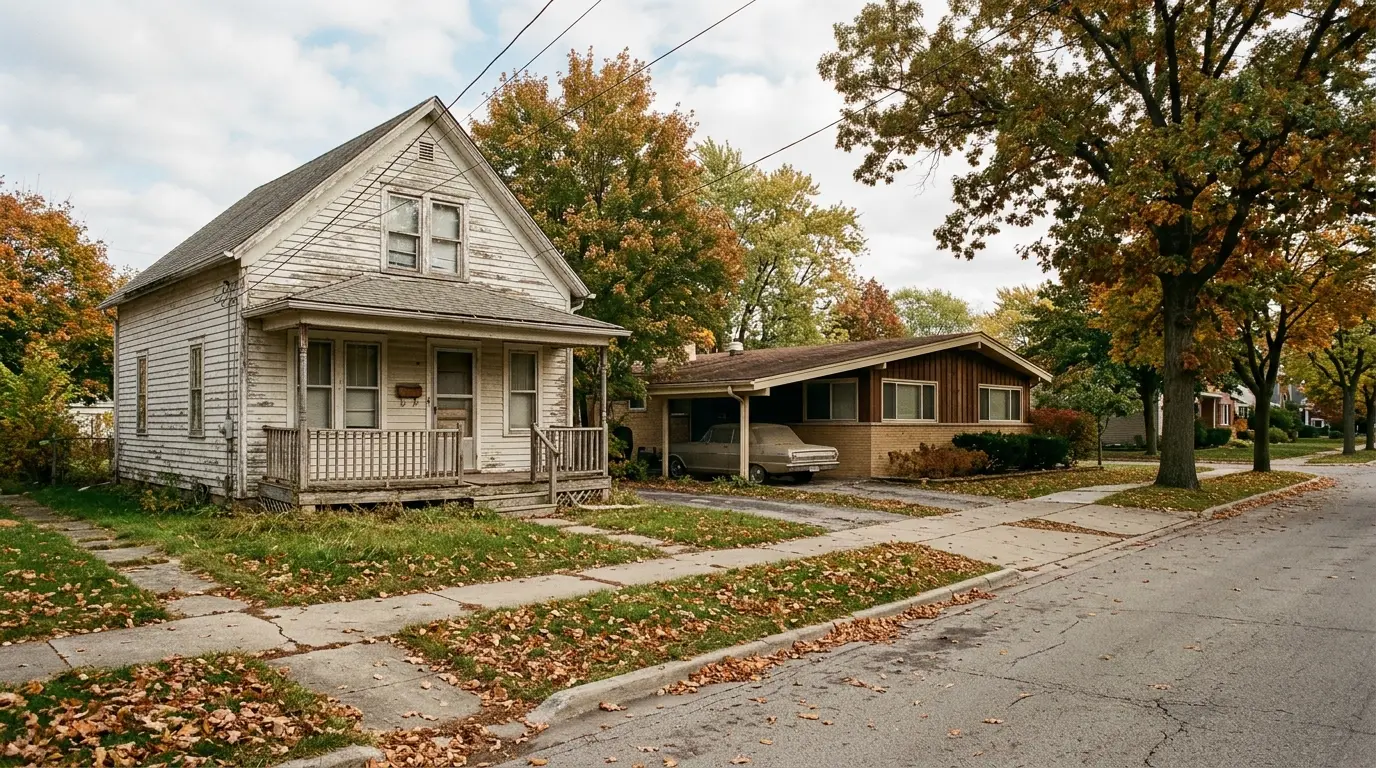
Almost everything about an Arlington Heights plumbing problem follows from one number: the year the house went up. A 1912 frame house near Dunton Avenue and a 1961 ranch off Kensington fail in different places, for different reasons, on different schedules.
Date the house, then read the pipe
Arlington Heights was a small farm town of fewer than nine thousand people in 1950 and a village of more than sixty thousand by 1970. That single fact organises most of the plumbing here. There is a pre-war core (the frame houses on and around Dunton, Vail and Evergreen, walking distance to the Metra platform), and then there is the boom, twenty years of subdivisions pushed north and west at speed, and then infill: 1980s and 1990s replacement stock, the downtown condo buildings, and the teardowns that keep the original 1955 water service in the ground under a 2015 house.
Each of those eras fails in its own way. Pre-1940: galvanised supply branches that have been closing up with corrosion for eighty years, lead goosenecks at the service connection, cast iron drains with rusted-through hubs, and the occasional lead bend still under a first-floor toilet. The 1950s and 1960s boom: copper, which is usually good news, except where a builder used thin-wall type M and where thirty years of aggressive softening has been thinning it from the inside. That is the stock we see pinhole leaks in, high on basement walls, near fittings. The 1970s and 1980s: the first plastic drain and vent work, solvent-welded, where the failures are at joints rather than in the middle of pipe. The 1990s onward: PEX and CPVC, and problems that are almost always a fitting or a clamp rather than the tubing.
This is why the first question on the phone is the build year and the second is whether anything has been replaced. A pinhole in a 1961 ranch and a pinhole in a 1912 frame house are the same symptom pointing at two different jobs, one is a repair, the other is often the moment to talk about repiping the branches while the ceiling is already open. Guessing at that from the symptom alone is how people end up paying twice.
The teardowns deserve their own note. A new house does not mean new plumbing to the street. Unless the service line and the sewer lateral were replaced as part of the build, and on many lots they were not, a 2015 kitchen is draining through a 1957 clay lateral with sixty years of root pressure on it. We camera those before anyone spends money on the assumption that new construction means a new line.
Rain is not a sewer problem here
Arlington Heights runs separated systems: storm water goes to storm sewers and the creeks, sanitary goes to the treatment plant, and the two do not share a pipe. That is worth understanding because it eliminates the single most common cause of wet basements in older Chicago, a combined main surcharging in a downpour and pushing sewage back up a floor drain. That mechanism is not available here, and a plumber who proposes a backwater valve as the answer to your storm-day basement water has skipped the diagnosis.
So when a basement here takes water during rain, it is groundwater, surface water, or a machine that stopped. Groundwater rises through the slab and at the wall-floor joint after the ground saturates, usually with a lag of hours behind the rain and often peaking after the storm has passed. Surface water arrives fast and from a known direction: a window well, a stairwell drain, a downspout discharging at the foundation, a driveway pitched back toward the house. And the machine is the sump pump, which is the only thing standing between the water table and your floor for most of the year.
The diagnostic is mostly timing and location, and it is free. Water that appears within minutes of the rain starting is surface water. Water that appears two hours in and keeps rising is groundwater. Water that appears when the power flickers is a pump with no backup. Water that comes up through a floor drain while the rest of the floor is dry is a drain problem and wants a camera inspection, not a sump.
What follows from separated storm sewers is also what your sump has to do here. It is not managing a once-a-year event; it is a continuous-duty machine cycling through the spring and after every heavy rain, and the failure mode we see most is a builder-grade plastic pump at eight or nine years old with a check valve that has quit holding, so every cycle drops the column back into the pit and the pump short-cycles itself to death. Cast iron, a check valve that seals, discharge pitched and routed well away from the wall, and a battery backup for the storms that take the power out with them.
The strip, the downtown and the scope limit
Arlington Heights has a commercial base most suburbs its size do not: the Rand Road and Golf Road corridors, the office and industrial parks along Algonquin, and a downtown restaurant row dense enough that several kitchens share a wall. Those are different plumbing jobs from the houses around them, and the difference is not size. It is that a commercial kitchen is a regulated waste stream.
The recurring work is grease. A grease interceptor that is undersized for the covers being served, or is technically adequate and simply has not been pumped on schedule, sends grease into a line that then requires jetting rather than rodding, because a cable bores a hole through a grease plug and leaves the rest of the wall coated. The second recurring item is indirect waste: prep sinks, ice machines and dish machines that must discharge through an air gap to a floor sink rather than tying directly into the drain, which is the detail most often lost during a tenant remodel done quickly between leases.
There is a real scope limit here and it is worth stating plainly. Residential plumbing and commercial plumbing are not the same trade with different sized pipe. Commercial work in a village like this means permit sets, inspections against a code chapter your house was never held to, backflow prevention with annual testing, and coordination with a health department that can close a kitchen. We do both, and we quote them differently, and the honest answer for a small strip tenant is sometimes that what you need is a scheduled maintenance interval rather than another emergency call.
For the two-flats and small apartment buildings that sit between the corridors and the subdivisions, the useful frame is somewhere in the middle: shared stacks, shared laterals, and a repair that has to be scheduled around several tenants rather than one homeowner. The plumbing is residential; the logistics are not.
Your service line, from the village record
Since Illinois began requiring municipal lead service line inventories, the first step on any water service question in Arlington Heights is not a guess and not a scratch test. It is the record. The village has an inventory of what each connection is made of, and where the record is incomplete it says so. Read your own address before you accept anyone's opinion about your pipe, including ours.
What the record cannot tell you is the condition of the part inside your wall, which is why a service line conversation usually needs both: the material from the inventory and a look at the pipe where it enters the building. A 1920s house near downtown with a lead gooseneck on a galvanised service is a different job from a 1963 ranch on copper with a pressure problem, and both are different from a house whose inventory entry reads unknown because nobody has opened the ground since it was built.
When replacement is the answer, do it end to end. A partial replacement (new pipe from the meter to the curb stop, old pipe from the curb stop to the main, or the reverse) disturbs scale along the section left in place and can raise the metal you were trying to get rid of for months afterwards. It also means paying for mobilisation, excavation, restoration and permit twice. If the reason for a partial is that the village is replacing its side on a schedule that does not match yours, that is worth waiting for and coordinating; if the reason is to make a quote look smaller, it is not.
Two related points, since they come up on the same phone call. Low pressure at a single fixture is almost never the service line; it is an aerator, a cartridge or a stop valve. Low pressure everywhere, worse upstairs, on an older galvanised service, usually is. And if you are on the fence about a service line replacement, the cheapest useful diagnostic is a static and flowing pressure reading at the outside hose bib, which tells us whether we are looking at the pipe in the ground or the pipe in the walls.
How dispatch works here
Arlington Heights is central to how we cover the northwest suburbs, which in practice means short drives and a good chance the nearest van is already inside the village or in Des Plaines or Palatine. Water coming in gets moved ahead of work that can wait, and we will tell you on the phone if the honest answer is three hours rather than one.
What helps most is what you can tell us before anyone drives: the build year, whether the basement is finished, whether it is one fixture or the whole house, and whether anything has been replaced. On a drain call, whether you have ever had it rodded and when. On a service line call, what the village inventory says about your address. Half the diagnosis happens on that call, and it is the half that decides which van and which equipment we send, a rodder and a camera are not the same truck.
What We Dispatch For
Services called in most often around here
Nearby
Neighbouring communities
Part of Northwest Suburbs, see the whole region for what these towns have in common underground.
Des Plaines · Mount Prospect · Palatine · Wheeling
Common Questions
Answers before you call
Why does my basement take water only in heavy rain?
In Arlington Heights that pattern almost never means the sanitary sewer. The village runs storm and sanitary as separate systems, so rain does not enter the pipe your toilet drains into, and a downpour cannot surcharge it the way it can in the older combined-sewer parts of Chicago. If water arrives with the storm and only with the storm, the water is coming from outside the building envelope, not backwards through the plumbing.
That leaves a short list, in rough order of how often it turns out to be the answer: a sump pump that cannot keep up or has stopped running, a discharge line that is blocked, frozen or dumping too close to the foundation, window wells with no drainage, downspouts discharging within a foot of the wall, and grade that has settled toward the house over thirty years. All five are cheaper to find than to guess at.
The way to tell them apart is where the water appears first. At the base of a wall on the uphill side, it is groundwater or grading. Around the pit, it is the pump. From a floor drain, we want a camera in the line before anyone speculates further. That is the one version of this that is a drain problem.
Is the sewer lateral mine all the way to the main?
Generally yes, and this surprises people. In Arlington Heights, as in most of the northwest suburbs, the property owner is responsible for the sanitary service line from the building out to the connection at the village main: including the run under the parkway and, where the main sits under the pavement, the part beneath the street. The village maintains the main itself. Your responsibility does not stop at the property line, which is the assumption that turns a repair quote into an argument.
The practical consequence is about where the fault is, not who is at fault. A root mass or a broken hub twenty feet out is yours whether the tree causing it belongs to the village or not. If the defect is in the main, it is the village's, and a camera inspection is what distinguishes the two. We will not put that on a homeowner's invoice without the footage to support it.
Before any excavation in the parkway we pull the village permit and locate. That is not a formality: gas, water, cable and irrigation all share that strip, and the tree roots you are chasing are usually next to something you very much do not want to hit.
What does a permit add to the job?
Time more than money. Arlington Heights requires a plumbing permit for the work you would expect (water service replacement, sewer repair or replacement, water heater changeouts, gas piping, new fixtures on new drain lines), and the fee is a small fraction of a job of that size. What it really adds is a village inspection, which means the trench or the wall stays open until an inspector has seen it. On a straightforward water service replacement that is typically a day, sometimes two.
We pull it anyway, including on the jobs where nobody would know. Two reasons. An unpermitted water service or sewer replacement is a live problem at resale, when the buyer's attorney asks for the permit record and there is not one. And the inspection is a second set of eyes on the part of our own work that gets buried (bedding, joint, depth, backfill), which is exactly the part you cannot check yourself.
The exception is a genuine emergency. A failed water heater or a burst line gets stabilised first and permitted immediately after; the village expects that, and it is why emergency work is quoted separately from the permitted repair that follows it.
What should I do in the minutes before you arrive?
If it is water you can see: shut the water off. The main valve is usually on the front or street-facing basement wall, ahead of the meter; turn it clockwise until it stops. If the leak is at a fixture and there is a stop under it, that is faster. If the valve is seized, common on anything pre-1960 that has never been exercised, do not force it to the point of snapping the stem, and tell us when we get there.
Then kill power to anything the water can reach: outlets near the floor, the furnace if it is sitting in it, the water heater. If the water is rising toward a gas appliance, shut the gas at the appliance valve, not the meter.
The rest is access and information. Clear a path to the meter, the water heater and the floor drain, move anything you would hate to lose off the basement floor, and stop running water anywhere in the house, including a dishwasher or a washing machine mid-cycle, which is what is still feeding a backup more often than you would think. Note what was running when it started. On a drain problem that single detail regularly tells us which branch we are looking at.
What is worth doing before I finish the basement?
Four things, and they are all much cheaper now than after the drywall. First, camera the sewer lateral. On the pre-1940 houses near downtown, and on plenty of the 1950s tracts, that line is clay with joints every few feet and mature parkway trees over it; you want to know its condition before you build a family room on top of the cleanout. Second, get the sump system right: a cast iron pump, a check valve that actually holds, discharge routed well away from the foundation, and a battery backup, because a finished basement means the pump now protects flooring and drywall rather than storage boxes.
Third, if you are putting a bathroom below the level of the sewer, plan the ejector pit deliberately rather than wherever it fits at the end. It needs a sealed lid, a vent to the outside and access for service, and retrofitting any of those into a finished room is miserable work.
Fourth, decide about the water supply piping while it is exposed. If the house still has galvanised branches, or thin-wall copper with a pinhole history, the marginal cost of repiping during a gut is a fraction of doing it later through a finished ceiling. None of this is upselling. It is that the cost of every one of these jobs roughly triples once the space is closed up.
Fix it properly now, or do the cheap version twice?
It depends on a number, and the number is footage. If a camera shows one failed joint or one root intrusion at twenty-two feet in an otherwise sound clay line, spot repair is the right answer and will hold for years. If it shows intrusion at four separate joints across sixty feet, offset hubs and standing water in the belly, rodding it is maintenance you are now committed to on a schedule, and two or three cycles of that costs more than the replacement while leaving you with the same line.
The same test applies to supply pipe. One pinhole in type M copper is a repair. Three in eighteen months, in different rooms, is the pipe telling you its wall thickness has run out, and patching the fourth is buying time at a bad exchange rate.
What makes the honest version of this conversation possible is measurement, which is why we camera before quoting anything structural and will tell you when the cheap version is genuinely the right call. It often is. What we will not do is quote a spot repair on a line we have watched fail in four places and let you find out next spring.
Not sure what decade your plumbing is from?
Tell us the block and roughly when the house was built and we can usually tell you what we expect to find before anyone opens a wall, which is also what tells you whether this is a repair or the start of a bigger conversation.
24/7 · Chicago metro dispatch · (833) 615-3680