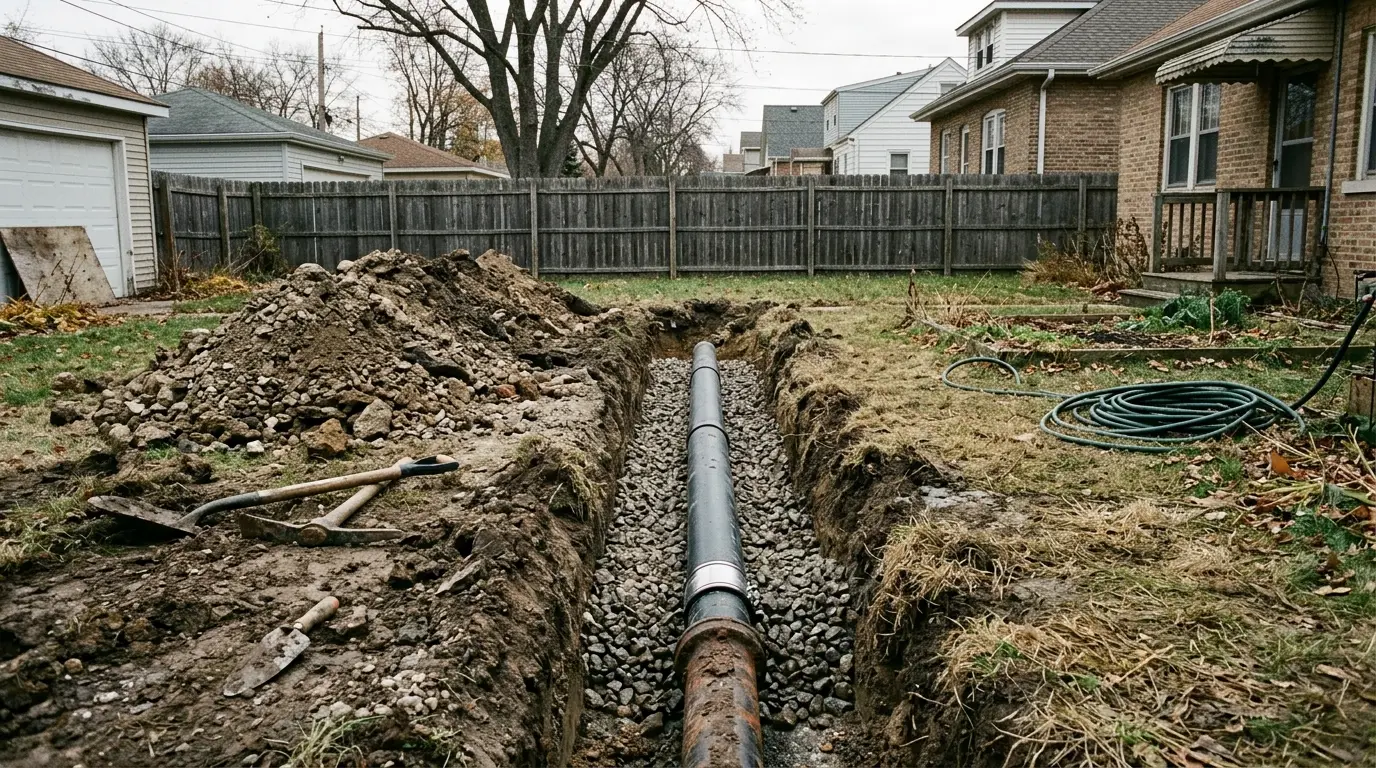
Sewer line repair, from the camera footage to the restored parkway
The lateral between your building and the public sewer is your responsibility, and in most of this region it is clay, cast iron, or something worse. What it needs depends on what the footage shows.
Where your responsibility begins and ends
This is the first thing to establish and the thing most often assumed wrongly. The public main runs under the street and belongs to the municipality. The lateral runs from your building to that main, and in most communities across this region it belongs to the property owner for its entire length: including the portion under the parkway and, frequently, under the street itself.
That surprises people, and it has consequences. It means a collapse under the pavement is your excavation, your permit, your traffic control, and your restoration. It also means the decision about how to fix it is yours to make rather than the utility’s.
The rules genuinely vary by municipality, and the variation is not predictable from the size or age of the community. A handful of places own the portion within the right-of-way. Most do not. Before agreeing to any significant work, confirm it for your address in writing with the municipality, and be sceptical of any contractor who states it confidently without checking, because the answer differs a few streets away.
Confirm before you commit
Ownership of the parkway portion changes the scope, the permit, and often the cost. It is a phone call to the municipality and it should happen before a quote is accepted, not after a trench is open.
What your lateral is probably made of
Age of building is the best first guess, and in a region where most housing predates 1970 the guesses are not encouraging.
Vitrified clay, pre-1950s, and plenty later
The dominant material under the older parts of the metro. The pipe itself is remarkably durable and chemically inert; hundred-year-old clay is often structurally fine. Its weakness is the joints: short sections mortared together, and mortar deteriorates. Every joint is a potential entry point, which is why clay laterals and mature trees are such a reliable combination of problems.
Cast iron, roughly 1900 to 1970
Used for the building drain and often for the lateral. Corrodes from the inside, worst along the bottom of horizontal runs where waste sits. The failure is channelling: the invert thins and eventually opens along a length. Camera footage of an advanced case shows the bottom of the pipe simply missing.
Orangeburg, late 1940s to early 1970s
Bituminised fibre pipe, used heavily in post-war subdivisions because it was cheap and easy to handle. It absorbs moisture and deforms under load, going oval and then collapsing. It has no realistic repair path. Any lateral of this material still in service is beyond its design life and should be planned for replacement rather than managed.
PVC: 1970s onward
What replacements go in as, and what newer construction has. Chemically stable, smooth-bored, solvent-welded joints that roots cannot enter. Its failures are installation failures (poor bedding causing a sag, joints not properly made, damage during backfill), rather than material failures.
How laterals fail
Root intrusion. The most common by a distance. Roots seek moisture and find it at a mortared clay joint or a crack; a hair root enters, thickens, and becomes a mass that catches everything passing. Growth is seasonal, so blockages cluster in the growing months and recur on a cycle specific to the tree and the defect.
Offset joints. Ground movement, settlement, and freeze-thaw cycling shift sections out of alignment. The lip that results catches solids and starts a blockage. Common in older clay where the bedding was never engineered.
Bellies and sags. A section that has settled below grade holds standing water permanently. Solids settle in the standing water and build up. A belly cannot be cleaned away. It is a geometry problem, and cleaning it is a temporary measure by definition.
Cracks and fractures. From ground movement, from load above, from a nearby excavation, or from age. They admit roots and groundwater and they get worse.
Corrosion. Cast iron channelling along the invert, as above.
Deformation and collapse. Orangeburg going oval; clay crushed under a driveway; any pipe under load it was not bedded for.
Grease and scale. Not a structural failure, but it reduces the bore and it is often what makes a marginal defect symptomatic.
Diagnosing it properly
No lateral work should be quoted without footage. That is the single most useful thing to know when getting estimates, because it is the difference between a priced repair and a priced guess.
A proper inspection produces four things. A recording you keep, not a description of what the technician saw, the actual file. A located position for each defect, measured from a known reference, so a repair can be dug in the right place. A depth reading at that position, because depth drives excavation cost more than anything else. And a plain-language statement of what each defect is and how urgent it is.
The line usually needs cleaning before it can be inspected meaningfully, a camera cannot see the pipe wall through a grease deposit or a root mass. That is why jetting and inspection are frequently sequenced together, and why footage taken through a dirty line is worth less.
A second opinion on footage is entirely reasonable on a large job, and any contractor who resists handing over the recording has told you something useful. Camera inspection stands alone as a service precisely so it can be bought independently of whoever might do the repair.
Have footage from someone else? We will read it with you and say what we would do.
Call for a second opinionRepair, line, burst, or replace
Four routes, and the footage narrows them before preference does.
Spot repair. Excavate at one location, cut out the defective section, replace it, backfill. Right when the defect is localised and the pipe either side is genuinely sound. Cheapest by a distance when it applies. The risk is doing it on a run that is failing generally, in which case you have paid for access to fix one symptom.
Cured-in-place lining. A resin-saturated liner is drawn or inverted into the existing pipe and cured, forming a new jointless pipe inside the old one. No trench along the run, access pits at each end. Excellent for root intrusion, because it seals every joint at once. Requires the host pipe to be structurally intact enough to support the liner, and it slightly reduces the internal diameter, which is usually immaterial but occasionally is not.
Pipe bursting. A bursting head is drawn through the old pipe, fracturing it outward while pulling new HDPE in behind. Replaces the pipe entirely rather than lining it, and can go up a size. Works where lining will not, collapsed or badly deformed pipe, Orangeburg. Needs pits at each end and enough clearance from other buried utilities, which is the usual limiting factor.
Open-cut replacement. Trench the length, remove the old pipe, lay new, bed properly, backfill, restore. The most disruptive and often the most certain. Sometimes the only option: where the alignment is wrong, where the depth or grade needs correcting, where a belly has to be regraded, or where utility congestion rules out trenchless.
A belly is worth singling out: it cannot be lined away. A liner follows the host pipe, so a liner in a sagged section produces a sagged liner. Correcting grade means excavating and re-bedding, and any quote that proposes lining a known belly should be questioned.
What an open-cut repair involves
Worth understanding, because it is the option with the largest footprint on the property.
Locating first. Every buried utility on the route marked before any digging: gas, electric, water, telecoms. This is a statutory step, not a courtesy, and it takes lead time that has to be in the schedule.
Excavation. Depth drives everything. A lateral at four feet is a different job from one at nine, and deeper trenches need shoring, which is a safety requirement rather than an optional extra. Spoil has to go somewhere, and on a narrow city lot that is a real constraint.
Replacement and bedding. New pipe laid on properly graded granular bedding. This is what prevents the next belly, and it is where cheap work cuts corners invisibly. Correct fall matters: too little and it will not carry solids, too much and the liquid outruns them.
Connection and testing. Tie-in at the building and at the main, then a test before anything is covered. Inspection where the permit requires it, and it usually does.
Backfill and restoration. Compacted in layers, poorly compacted backfill settles for years afterwards and leaves a trench line across the lawn. Then surface restoration: sod, concrete, asphalt, whatever was there.
Permits, the parkway, and restoration
The paperwork on lateral work is more involved than most plumbing, and it is a legitimate part of the cost.
Sewer work requires a permit in essentially every municipality here, and work in the public right-of-way requires a separate one, sometimes from a different department. Where the trench crosses a street, traffic control may be required. Where it crosses a parkway, there are usually rules about tree protection, and a mature parkway tree can genuinely constrain where a trench may go, which occasionally makes trenchless the only permitted route.
Restoration standards are set by the municipality, not by the contractor. Concrete and asphalt restoration in the right-of-way typically has to be done to a specified detail and inspected. This is the part of a quote most likely to be understated by a contractor competing on price, so it is worth asking explicitly: what is included, to whose standard, and who returns if it settles.
Inspection points should be identified in advance, and the schedule should account for them. A job that has to wait two days for an inspector is normal; a job where nobody arranged the inspection is not.
What drives the cost
Five variables, roughly in order of weight.
Depth. The largest single factor. Excavation volume, shoring requirements, and safety provisions all scale with it, and depth in this region varies a great deal with local frost-depth practice and with how the ground has been built up over time.
Length and access. A short run to a main in front of the building is straightforward. A long lateral running the length of a rear lot to an alley main, with no machine access, is a different job, and hand-digging is expensive.
What is above it. Lawn is cheap to restore. A concrete driveway, a paved alley, mature landscaping, or a public street each add substantially, and street restoration to municipal specification is frequently the largest line item after excavation.
Method. Trenchless carries higher equipment and materials cost per foot and much lower restoration cost. Which comes out cheaper depends almost entirely on what is on the surface, over a long concrete driveway trenchless usually wins, over open lawn open-cut often does.
Complications. Utility conflicts requiring hand excavation, groundwater needing dewatering, rock, and unexpected additional defects found once the line is open. These should appear in a quote as identified contingencies with a stated basis for pricing, not as blanket exclusions.
Common Questions
Answers before you call
Is the sewer line my responsibility or the city's?
The lateral, the pipe from your building out to the public main, is the property owner’s responsibility in most municipalities here, and that frequently includes the portion running under the parkway and the street.
It varies by municipality and it is worth confirming for your address specifically before assuming. Some communities own the portion within the public right-of-way; most do not. A crew that works your area regularly will know, and the municipality will confirm it in writing.
How long does a sewer lateral last?
Clay: often eighty to a hundred years, though root intrusion at the joints starts long before the pipe itself fails. Cast iron: fifty to eighty, corroding from the inside along the bottom. Orangeburg: it was rated for fifty and rarely achieves it, and any that remains in service is past due.
PVC, which is what replacements go in as, has no meaningful failure history yet at residential depth. Age alone is not the decision though, footage is. Plenty of hundred-year-old clay is sound, and plenty of forty-year-old pipe is not.
What is Orangeburg pipe and do I have it?
Bituminised fibre pipe, wood pulp bound with tar, essentially. It was used widely for laterals in the post-war building boom because it was cheap and light, roughly from the late 1940s into the early 1970s.
It deforms rather than cracks: it goes oval under load, then collapses. If your building dates from that window and the lateral has never been replaced, it is a real possibility, and it is worth a camera inspection whether or not you have symptoms. Anyone who has it should plan replacement rather than repair.
Can a lateral be repaired in one spot, or does it all have to go?
One spot is entirely legitimate when the defect is localised and the rest of the run is sound: a single cracked section, one offset joint, a length crushed by a specific event. Footage that shows good pipe either side supports a spot repair.
Replacement or full lining is the answer when the defects are distributed, when the material is at the end of its life, or when the pipe is Orangeburg. Spot-repairing a run that is failing generally means paying for access repeatedly.
Will I lose my driveway or my garden?
With open-cut, along the line of the trench, yes, and restoration is a real part of the cost that should be in the quote rather than discovered afterwards.
That is the main argument for trenchless methods, which need access pits at each end rather than a continuous trench. Whether trenchless is viable depends on the pipe’s condition and geometry, not on preference, so the footage decides it.
How long will the property be without drainage?
Usually not the whole job. A straightforward lateral replacement is commonly one to three days on site, and drainage is typically usable overnight between working days, though sparingly and with the crew’s guidance.
Lining is faster in terms of disruption: the cure itself takes a few hours and the line is out of service for that period only. Complications that extend either (utility conflicts, unexpected depth, rock, groundwater) should be flagged as contingencies in the quote rather than appearing as surprises.
Repeated backups, or footage you want a second opinion on?
Bring the recording. A lateral decision should be made from evidence, and there is usually more than one defensible option.
24/7 · Chicago metro dispatch · (833) 615-3680