Plumbing in Des Plaines
The water in the pipes here comes from Lake Michigan; the water people call about comes from the river the town is named after. Keeping those two separate is most of what there is to understand about plumbing in Des Plaines.
Two waters: the one in the pipes and the one outside
The supply here is treated Lake Michigan water, and its chemistry is the first thing worth knowing because it predicts what wears out. Lake water is moderately hard, enough to leave a film on glass and to build a scale layer in a water heater over a decade, not nearly hard enough to damage pipe quickly. It is treated, buffered and chlorinated, and it is fairly gentle on copper. So the honest short version is that the water arriving at a Des Plaines tap is not attacking the house.
What it does do is shorten the life of anything that heats it. Scale settles on the bottom of a tank where it insulates the burner from the water and drives the metal hotter than design; that is most of the difference between a heater that reaches nine years and one that reaches fourteen, and annual flushing genuinely moves the number. A tankless unit deposits the same scale inside a heat exchanger with far less tolerance for it and needs descaling on a defined interval rather than when someone remembers. Beyond heaters, hardness shows up at aerators, at shower cartridges and on glass, and a softener here is a preference about how the water feels rather than a repair.
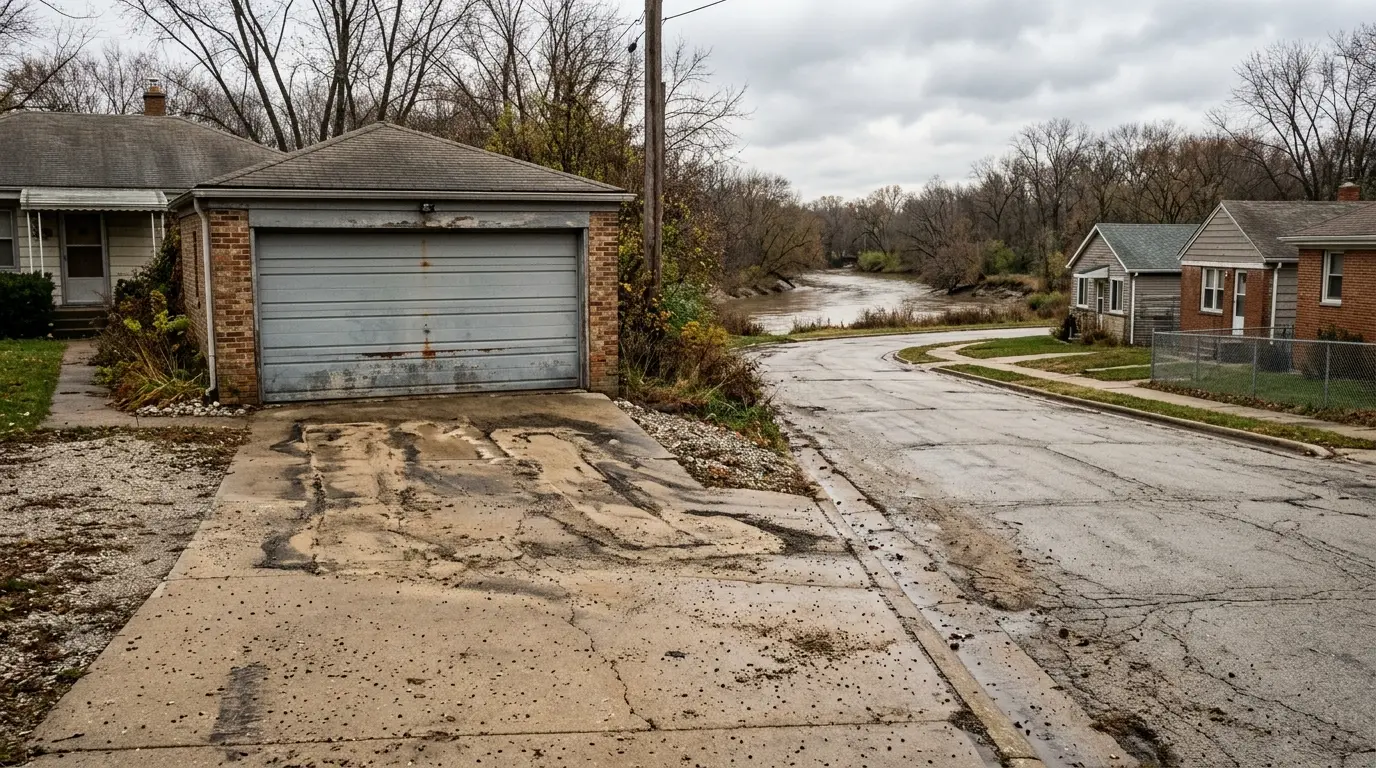
The other water is the Des Plaines River, and it is not a plumbing system. The river runs through the middle of town, the bottomland along it floods, and the city and the county have spent decades on levees, reservoirs and buyouts because of it. This matters to a plumber only in the negative sense, and it needs saying plainly: no plumbing device stops overland water. When the river is out of bank, or when runoff crosses saturated ground and comes in at grade, through a window well or along the foundation wall, the remedies are grading, window well covers, drainage capacity and in some cases elevation, not a valve and not a bigger pump.
Two questions that settle it
Where did the water appear first, and did it smell. Water at grade, at the wall-floor joint or in a window well is surface or ground water. Water rising out of a floor drain, a shower or a laundry standpipe came up through the drainage system. They cost different money and only one of them is a plumbing repair.
What each building decade put in the walls
Des Plaines was built in distinct waves and each one is legible from the basement. The pre-war core near the river and the rail line went in with galvanized steel supply and cast iron drainage. The town's great expansion was the 1950s and 1960s ranches and split-levels, plumbed in copper with cast iron drains and, later in that run, the first plastic drainage. The 1970s and 1980s brought PVC and ABS drainage as standard and, in a narrow window, plastic supply experiments.
Each fails on its own schedule and with its own symptom. Galvanized closes from the inside: the bore fills with corrosion product, so the complaint is not a leak but a gradual loss of flow, worst at the highest and furthest fixture. Cast iron thins at horizontal runs and at hubs, and it announces itself as a damp joist or a smell long before it announces itself as a flood. Mid-century copper is frequently still original and still sound, but thin-wall copper develops pinhole leaks, and the pattern (several small leaks within a few years, all on the same horizontal run) is diagnostic rather than bad luck. Early plastic drainage is generally fine; the interesting failures are at solvent joints made badly and at the couplings where somebody joined new plastic to old cast iron.
The characteristic Des Plaines failure, though, is at the seam between two eras. A 1920s house whose kitchen was redone in 1968 has copper meeting galvanized somewhere, and unless a dielectric fitting was used, that junction corrodes from galvanic action, a leak that appears at a specific fitting for a reason that has nothing to do with the age of either pipe. The same logic applies at a no-hub coupling between a 1955 cast iron stack and a 1985 plastic branch. When something leaks in a house that has been renovated in pieces, the joint between the pieces is the first place to look.
Pressure, elevation, and the three things mistaken for it
There is real elevation change in this town, the river bottom sits appreciably lower than the higher ground away from it, and static water pressure follows elevation. A house down near the river can read noticeably higher at the hose bib than a house up the hill on the same municipal system, and neither is faulty. Distance along the network and which part of the distribution system a street is fed from add to the spread.
The reason to say that first is that most pressure complaints are not pressure. Three things get reported as low pressure and none of them are: a partially closed valve, usually the curb stop after somebody worked on the line or a house shutoff that was never opened fully; a clogged screen at the meter or at an individual fixture stop; and a supply pipe whose bore has closed, which is a volume problem and shows up as pressure that collapses when a second fixture opens rather than as pressure that is low all the time. That last one is what old galvanized branch pipe does, and no regulator adjustment fixes it.
High pressure is the case people never report. Above about 80 psi, appliance valves and fixture cartridges wear quickly, water hammer gets louder, and a water heater's relief valve may start to weep, and a weeping relief valve is frequently mistaken for a failing heater. That is what a pressure-reducing valve exists for, and it is a sound device fitted for the right reason and a nuisance fitted for the wrong one. Either way the sequence is the same: read the pressure, then decide.
Winter, and the discharge line nobody checks
Frost gets to roughly three and a half to four feet in a hard winter here, and the geometry of mid-century housing decides which pipes meet it. A long low ranch has hose bibs on three or four elevations, more exterior wall per square foot than a two-storey, and frequently a water meter in a wall shared with an unheated attached garage. Kitchen and bath lines run in exterior walls on the north face. Crawl-space additions built onto the back of a house in the 1960s put supply pipe in a vented space with a thin floor above it. Those are the freeze-ups, and they are all on the warm side of the wall by inches.
The specifically local one is the sump discharge. In a town where basements depend on pumps and winters include thaws, a discharge line that exits at grade and runs across a lawn will freeze solid in a cold snap. Then it thaws overhead during a warm spell while the outlet is still iced, and the pump runs perfectly against a closed pipe: water either backs down into the pit and floods anyway, or the pump burns out trying. The call that comes in as "the pump has failed" is very often a pump doing exactly what it should with nowhere to send the water. A discharge that is pitched to drain fully, sized properly, and fitted with an accessible relief point above grade is the difference, and it is worth looking at the outside end before anyone replaces a pump in February.
On the thaw generally: a frozen pipe usually is not leaking while it is frozen, because the ice is holding the water back. Shut the water off at the main before applying any heat, and thaw from the fixture end back toward the freeze so meltwater has an escape. And in this town particularly, where some properties sit vacant seasonally or between owners, the houses that burst are the ones with the heat turned down and nobody in them. If a property is going to be empty in January, it should be either heated or properly drained down, not left in between.
How dispatch works here
We are a dispatch service: the plumber who arrives works for a local shop, not for us. You describe the problem, we match it to a plumber who works in Des Plaines and does that specific kind of work, and you get told who is coming and when. The local caseload splits between older-core repair work, mid-century material replacement, and pump and drainage work near the river: different tools and, honestly, different plumbers.
Worth having ready: roughly when the house was built, whether it has been renovated in pieces, whether the basement is finished, and whether anything is actively rising right now. If the river is the problem rather than the plumbing, we would rather tell you that on the phone than send someone to confirm it. And if a closer option will reach you sooner during an active flood, our dispatchers are told to say so.
What We Dispatch For
Services called in most often around here
Nearby
Neighbouring communities
Part of Northwest Suburbs, see the whole region for what these towns have in common underground.
Mount Prospect · Park Ridge · Prospect Heights · Schiller Park
Common Questions
Answers before you call
Why does my drain get worse every summer?
Because whatever is in the pipe is alive. Root intrusion into a clay or cast iron sewer lateral grows through the growing season and goes dormant in the cold, so the same pipe genuinely behaves like two different pipes in February and August. A line that has been fine all winter and starts backing up in July has usually not changed, the root mass inside it has thickened enough to start catching paper and grease.
There is a second summer mechanism worth knowing in this town. In dry heat, clay soil shrinks and pulls away from pipe, which can open a joint slightly or shift an already-offset section; the same soil swells again after a wet spell. Houses near the river bottom, where the soil moves more, see more of this than houses up on the higher ground.
The useful response is the same in both cases: clear it, then look at it while it is clear. Rodding restores flow and tells you nothing about the pipe. A camera run afterwards distinguishes a sound pipe with root-prone joints, which is a maintenance item, from a pipe that has lost its shape, which is not.
Where does the city's responsibility end and mine begin?
For water, the boundary is the shutoff in the parkway, the curb stop, or buffalo box. The main in the street and the tap into it are the city's. Everything from that shutoff into the house is yours, including the length of pipe running under city parkway and city sidewalk. Most people are surprised to learn they own buried pipe under ground they do not own, and it is the reason work there needs a permit and a restoration plan.
For sewer, the lateral is private for its entire length, right up to the connection at the public main. A blockage at the property line is your pipe even though the excavation happens in the street.
The exception worth checking before assuming anything: if the failure is at the connection to the main, or the main itself is at fault, that is city work and there is nothing for you to hire. A camera inspection that reaches the main settles which side of the line the problem is on, and it costs a small fraction of being wrong about it.
How disruptive is repiping an occupied house?
Less than people expect, and the reason is that a good repipe is staged rather than done all at once. The work runs bathroom by bathroom or floor by floor: new lines are routed and pressure-tested alongside the old ones, then cut over. Water is off for part of each working day and restored every evening, with one longer shutdown at the changeover. Most households stay in the house throughout.
The disruptive part is access, not water. Reaching supply runs means opening some drywall, typically strips near ceilings and in a few walls, chosen to follow the existing routes. In a Des Plaines ranch with a full basement, a large share of the work happens from underneath and the visible damage is limited to short vertical chases at the bathrooms and kitchen. In a two-storey, the upstairs branch runs cost more wall to reach.
Two things make it go badly. Trying to do it in stages separated by years, which means paying for access twice and living with mixed materials at the junctions. And doing it after finishing a basement, when what was an easy overhead route is now a ceiling. The natural time to repipe is alongside a kitchen or bathroom project, when the walls are open anyway.
Is this an emergency or can it be scheduled?
The test is whether water is going somewhere it should not be and whether you can stop it. Active flooding, sewage on a floor, no water in the building at all, or a gas smell: those are now. A drip you can catch, a slow drain, a heater that still makes hot water but sounds wrong: those are this week, and scheduling them is cheaper than dispatching them.
Two local cases sit in between. During a river flood warning, a wet basement is a drainage and grading situation rather than a plumbing emergency, and calling a plumber does not change what the river does, but a pump that has failed while water is rising genuinely is urgent, because the machine is the only thing between the water and the floor. And a frozen but unburst pipe is urgent in the sense that thawing it badly is how it bursts; the sequence matters more than the hour.
Describe what you can see rather than guessing at the category. Our dispatchers are told to say plainly when something can wait, because an overnight call that did not need to be overnight is the fastest way to lose a customer.
Do drain treatments sold in shops help?
Mostly no, and a few of them do harm. Caustic drain openers work on hair and soap in a bathroom sink or tub, and that is the honest extent of it. Against a root mass, a grease blockage in a building drain, or a pipe that has lost its shape, they do nothing except sit in the standing water above the blockage: where they are then waiting for whoever opens the trap, and where in old cast iron and old chrome trap arms they can accelerate corrosion in pipe that was already thin.
Enzyme and bacterial products are a different category and a fairer claim: used regularly in a line with a grease tendency, they can slow accumulation. They will not clear an existing blockage, and they will not touch roots.
The one product with a real place is a foaming root treatment applied on a schedule after a line has been mechanically cleared. It can lengthen the interval between rodding on a pipe whose intrusion is understood. That is a maintenance plan, not a rescue, and it starts with knowing what the pipe actually looks like.
Should I replace the service line while the trench is open?
Usually yes, and the reasoning is arithmetic. On a service line replacement the pipe is a small part of the cost, excavation, restoration and permitting are the rest. If ground is already open in the right place for a sewer repair or a main water line repair, replacing the water service in the same trench costs a fraction of what it costs as its own project a few years later.
It needs two facts checked first. What the existing service is made of, where the city's service line inventory is the place to start rather than the final word, and whether the open trench actually follows the service route. If it does not, the saving disappears and it is a separate job.
What to avoid in every case is a partial replacement, new pipe on one side of the curb stop and old pipe on the other. Disturbing an old line without replacing it end to end can dislodge interior scale and make water quality worse for a period afterwards, which is why the honest choices are the whole run or none of it.
Pump running but water still rising?
In cold weather that is very often a frozen or blocked discharge line rather than a failed pump, the machine is working and the water has nowhere to go. Worth checking the outside end before replacing anything.
24/7 · Chicago metro dispatch · (833) 615-3680