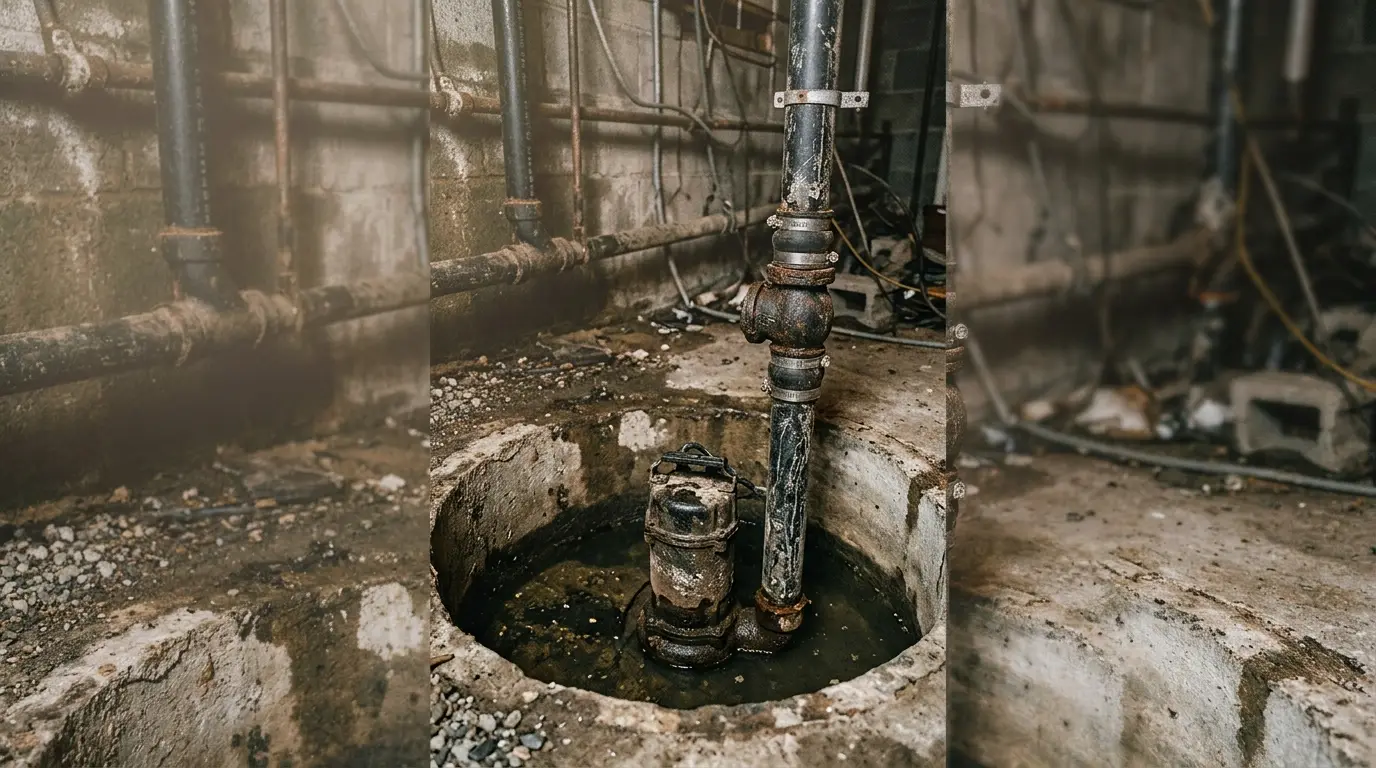
Sump pumps, sized for the water your lot actually produces
A sump pump is the only thing between groundwater and your basement floor, and it is a single mechanical component with no redundancy. That is worth thinking about before March.
What the pit is and what it drains
The pit in your basement floor (the crock, locally) is not there to catch spills. It is the low point of a drainage system built into the structure. A perforated drain tile runs around the footing, inside or outside the foundation wall, collecting the groundwater that sits against the building after rain or snowmelt. That tile falls toward the crock, and the pump lifts what arrives out of the building.
The important consequence is that a sump pump does not stop water reaching your foundation. It manages water that has already arrived, continuously, by moving it faster than the ground delivers it. That is why the arithmetic of sizing matters and why a pump running frequently in spring is not a fault. It is the system working.
Two conditions in this region make the equipment work hard. The soil across much of the metro is heavy clay, which drains slowly and holds water against a foundation for days after a storm rather than letting it move away. And a good deal of the housing stock sits on ground with a seasonally high water table: near the lake, along the river corridors, and in low-lying subdivisions built on land that used to handle its own drainage. On those lots the pump is not an emergency device. It is a utility that runs.
Two systems, two failures
Groundwater arrives through the tile and leaves through the sump. Waste water leaves through the sanitary lateral. They are separate systems with separate failure modes, and confusing them is the single most common reason people buy the wrong solution. Clean water at the wall-floor joint is the sump’s business; anything rising out of a floor drain is not.
Signs a pump is on its way out
Sump pumps rarely fail without warning. The warnings are just easy to ignore, because a basement with a working pump is a basement nobody visits.
- Short, rapid cycling. On for a few seconds, off, on again. Usually a failed check valve returning the discharge column to the pit, sometimes a float set with too little travel. It multiplies motor starts, which is what actually wears a pump out.
- Running with the pit not emptying. The motor turns and the water level barely moves. A worn impeller, a blockage, or a discharge that is restricted somewhere along its length.
- New noises. Grinding, rattling, or a rising whine. Bearings and impellers announce themselves before they stop.
- Visible rust or scale in the pit. Iron in the groundwater builds deposits on the impeller and the float, and it is a common cause of a float that sticks.
- It has not run in a long time during a wet spell. Suspicious rather than reassuring. Test it with a bucket of water.
- Age past about eight years. On a lot that cycles hard, that is the end of the design life whatever it sounds like.
- Tripping its breaker or GFCI. A motor drawing more than it should, and a warning worth acting on the same week.
The bucket test takes two minutes. Pour five gallons slowly into the pit and watch: the float should rise and switch cleanly, the pump should clear the pit and shut off without hunting, and you should hear the check valve close once. Anything else is a fault you have just found for free.
Why pumps actually fail
The switch, not the motor. Float switches are the most common failure by a wide margin. A tethered float can foul the pit wall, the discharge pipe, or its own cord; a vertical float can bind on scale. The motor is often perfectly serviceable in a pump that has stopped working.
The check valve. A small part with an outsized effect. Its job is to stop the water in the vertical discharge falling back when the pump stops. When it fails the pump re-lifts the same column repeatedly, and cycle count, not run hours, is what kills pumps.
Debris in the pit. Gravel, silt, and iron sludge reach the impeller through the intake screen. An uncovered pit also collects whatever falls off a shelf.
Power. An extension cord, a shared circuit, or a tripped GFCI in a corner nobody checks. Storm outage is the extreme version of the same problem.
Undersizing. A pump that cannot keep up does not fail so much as lose. It runs continuously, overheats, and shortens its life while the water rises anyway.
Discharge blockage. Crushed pipe, a buried outlet buried further by landscaping, a rodent nest in the line, or ice. The pump is fine; the water has nowhere to go.
Sizing: gallons, head, and your lot
Pumps are sold on horsepower, which tells you very little on its own. What matters is how many gallons per hour the pump will move against the height it has to lift them, and every specification figure drops as that height rises.
Total head is the vertical distance from the water in the pit to the highest point of the discharge, plus the friction of the pipe run. A pump rated generously at four feet of lift may deliver substantially less at ten feet with a long horizontal run, and a basement floor to grade in a house here is commonly eight to ten feet before the pipe even turns outward.
The other half is what your lot produces. That is measurable rather than theoretical: during a wet spell, time how long the pit takes to refill after a cycle and note how much the level rises. That gives an inflow rate in gallons per hour, and it is the only number that reflects your soil, your tile, your grading, and your neighbours’ downspouts. A pump should clear the peak inflow comfortably while cycling at a sensible interval, enough capacity to stay ahead, not so much that it short-cycles.
Two practical notes. A third of a horsepower is adequate for many lots and a half or three-quarters is right for high-inflow ones, but the horsepower is a proxy: read the flow-against-head curve. And a cast-iron body dissipates heat far better than plastic, which matters on any pump that runs long cycles in spring.
Discharge routing, and where it must not go
The discharge is where more installations go wrong than at the pump, and it is the cheapest part to get right.
It goes outside, to grade, and away from the building. Ten feet from the foundation is a reasonable minimum, further on clay, and always downhill from there. A discharge that dumps at the wall recirculates: the water runs back down to the tile, into the pit, and out again, and the pump spends the spring moving the same water in a loop.
Not into the sanitary sewer. Not the floor drain, not the laundry standpipe, not a wye on the lateral. It is prohibited in most communities here, it loads treatment plants with clean water, and during heavy rain it contributes to the surcharging that puts sewage in basements. It also fails at the worst moment, because a surcharged sewer will not accept the discharge.
Storm connections where they exist and are permitted. Some communities allow a sump to tie into a storm sewer or a dedicated storm line. Where that is available it is an excellent destination. It is weather-independent and cannot freeze at the outlet. It requires the municipality’s approval and the right connection detail.
Not onto the neighbour. Beyond being poor manners, drainage onto adjoining property is a dispute waiting to happen, and on tightly spaced city lots there is often only one legitimate direction to send water.
The pipe itself wants to be full-size, sloped so it drains after each cycle, supported, and fitted with a proper check valve and a union so the pump can be lifted out without cutting anything. On many installations here a small air-relief hole below the check valve prevents the pump airlocking on start.
If you can tell us how high the lift is and where the discharge currently ends, we can tell you what is wrong with the arrangement before a visit.
Call about a discharge routeThe winter failure nobody expects
Sump pumps are thought of as a spring problem, and one of the most reliable ways to flood a basement here is a January thaw.
The mechanism is straightforward. A discharge line that runs above grade, or that ends in a shallow buried run with poor fall, holds a small amount of water after each cycle. In a hard freeze that water turns to ice at the outlet and the line closes. Then a warm day arrives, snow melts, groundwater surges, and the pump starts pushing against a plug of ice. The water goes back to the pit, or out of the union, or the pump overheats trying.
The fixes are all mundane. Slope the line so it drains completely between cycles. Bury the outlet run below frost where it can be buried, and make sure the outlet is not sitting in a hollow that collects snow. Keep the last few feet clear over winter, the outlet is generally under the snow pile the plough left. Where the outlet cannot be protected, a freeze-relief fitting near the building gives the pump somewhere to discharge if the line is blocked, which is not elegant but is much better than the alternative.
The related failure worth mentioning: a house left unheated or with a failing furnace during a cold snap loses more than the sump. Water in supply lines in exterior walls freezes and splits, which is covered under frozen pipe repair, and the first evidence is often water on a floor being blamed on the pump.
Backup power and backup pumps
The case for backup is one sentence long: the storms that produce the most groundwater are the storms that take the power out. A primary pump on grid power alone is a system with a shared point of failure between the load and the supply.
Battery backup pump. The standard answer: a second DC pump on its own float, set slightly higher in the pit, with a maintained battery and a charger. It runs when the primary cannot, whether that is a power cut or a dead pump, and a good controller alarms on both. It is not a whole-storm solution at full duty; capacity is measured in hours, and battery age is the part people forget. Batteries want replacing every three to five years regardless of appearance.
Water-powered backup. Uses municipal water pressure to drive an ejector that lifts sump water, with no electricity and no battery at all. Where a house has good municipal pressure it is genuinely attractive for long outages because it runs indefinitely. It consumes treated water while it operates, needs adequate pressure to work, and requires municipal approval plus a proper backflow assembly, which some communities will not grant. Worth asking about rather than assuming.
Generator. A standby generator on the pump circuit covers the pump and everything else. It is the most capable and the most expensive, and it is a sensible answer for a finished basement with mechanical plant in it.
Alarm. Cheap, and the highest-value item on this list. A high-water alarm in the pit, ideally one that notifies a phone, converts a flood into an inconvenience. Any household that travels should have one.
What maintenance actually consists of
Fifteen minutes, twice a year, before spring and before winter, is the whole programme, and it prevents most of what we get called for.
- Test with water, not the switch. Five gallons poured slowly. Watch the float rise, the pump start, the pit clear, and the check valve close once.
- Clear the pit. Remove gravel and silt from the bottom and check the intake screen. Iron sludge on a float is a stuck float in waiting.
- Check the check valve. Listen for one clean closure. Water audibly falling back means it is failing.
- Walk the discharge to the outlet. Confirm it is not crushed, buried, blocked, or icebound, and that it still runs away from the building.
- Test the backup properly. Unplug the primary and make it run. Check battery age and terminals; replace on schedule rather than on failure.
- Confirm the power. Reset test the GFCI, verify the pump is not on an extension cord, and make sure nothing else has been added to its circuit.
- Keep the lid on. A sealed lid keeps debris out, reduces evaporation and humidity, and in older buildings limits soil gas entry.
What drives the cost
Pump against system. Swapping a pump in a sound pit with a good discharge is a modest job. Correcting an installation (new check valve, new discharge route, a pit that needs cutting deeper or lining) is a larger one, and it is frequently what is actually needed.
Capacity and construction. Cast iron with a good flow-against-head curve costs more than a plastic-bodied pump and lasts materially longer on a hard-cycling lot.
Discharge work. The variable with the widest range. Re-routing a line, burying a run below frost, cutting through a foundation wall, or making a permitted storm connection each add real excavation.
Backup type. A battery backup with pump, battery, and controller is a defined addition. A water-powered unit adds a supply connection and a backflow assembly. A generator is a different order of project.
Electrical. A dedicated, properly protected circuit is what a pump should be on. Where the pit is currently served by a cord run across the floor, that circuit is part of the job.
New pit. Installing a sump where none exists means cutting the slab, excavating, setting a crock, connecting tile, and patching concrete. It is a considerably larger undertaking than a replacement and it is usually done alongside interior drain tile work.
Timing. The least discussed factor. A pump replaced on a dry Tuesday costs what it costs. The same pump replaced at two in the morning during a regional storm, when every crew in the metro is already out, costs more, which is the argument for replacing on age rather than on failure.
Common Questions
Answers before you call
How long does a sump pump last?
Seven to ten years is the working expectation for a decent pump, and the variable is not age so much as cycle count. A pump on a dry lot that runs a few dozen times a year outlives one on a high-water-table lot that cycles every twenty minutes each spring by a wide margin.
The useful habit is to replace on schedule rather than on failure. A pump replaced in September during a dry week is a planned expense; the same pump failing during a March thaw is an emergency call plus a floor.
My pump runs constantly. Is that bad?
It is either a lot of water or a pump that is not moving what it pumps. Short, rapid cycling (on for a few seconds, off, on again) usually means a stuck or failed check valve letting the discharge column fall straight back into the pit, so the pump keeps lifting the same water.
Continuous running with the pit staying full points the other way: an undersized pump, a worn impeller, a partially blocked or frozen discharge, or genuinely more groundwater than the system was built for. The two are easy to tell apart by watching one cycle, and it is worth doing before buying anything.
Can I discharge into the floor drain or the laundry sink?
Almost certainly not, and it is the most common improvised arrangement we find. Sending groundwater into the sanitary sewer is prohibited in most communities in this region: it loads the treatment system with clean water and, during heavy rain, contributes to the surcharging that backs sewers up into basements.
There is a further practical problem: if the sewer surcharges, your sump discharge has nowhere to go and the water returns to the pit. The correct destination is outside, to grade, well away from the foundation, or to a storm connection where the municipality permits one.
Do I really need a battery backup?
If your basement is finished, or holds a furnace, a water heater, or anything you would mind losing, then yes. The reason is simple: the storms that produce the most groundwater are the storms that take the power out, so the pump fails at the exact moment it is needed most.
A backup pump on its own float, powered by a maintained battery, is the standard answer. Where a house is on municipal water with adequate pressure, a water-powered backup is worth considering because it has no battery to age. It does need the municipality’s permission and a proper backflow assembly.
Why is water coming up through the floor when the pump works?
Because there are two different systems that can put water on a basement floor, and they fail differently. Groundwater arriving through the tile and the pit is the sump’s job. Sewage or grey water rising out of a floor drain or a shower base is the sanitary lateral surcharging, and no sump pump affects that at all.
The distinguishing evidence is where it appears first and what it looks like. Clean water spreading from the pit or from the wall-floor joint is groundwater; anything rising from the floor drain itself, especially with odour, is a backup and a different job.
Can I replace a sump pump myself?
Mechanically it is within reach for a competent homeowner: a pump, a check valve, and a threaded discharge connection. The parts that get done wrong are the ones that matter: sizing to the actual lift and flow, a check valve at the right height and orientation, a discharge that cannot freeze shut, proper float travel with no chance of the switch fouling the pit wall, and a dedicated, correctly protected electrical supply.
It is also worth being blunt about the stakes. The cost difference between a pump installed properly and one installed adequately is small; the cost difference between a working pump and a flooded basement is not.
Pump running constantly, or not running at all?
Both are answerable on the phone before anything is dispatched. Call and describe what you can hear.
24/7 · Chicago metro dispatch · (833) 615-3680