Water heater repair, and knowing when to stop repairing
Most hot water faults are one of six symptoms with two or three causes each. A tank leaking from the shell is the one that ends the conversation.
Six symptoms and what they mean
Hot water problems narrow quickly, and the symptom does most of the narrowing. What follows is the reasoning we go through on the phone before anything is dispatched.
No hot water at all
On gas: the pilot or igniter, the thermocouple or flame sensor, the gas control valve, or the gas supply itself. On electric: a tripped high-limit cutout, a failed upper element, a failed thermostat, or a breaker that has gone. The high-limit trip matters diagnostically. It means something drove the temperature past its setpoint, so resetting it without asking why is treating the alarm rather than the fault.
Not enough hot water, or it runs out fast
Sediment reducing usable tank volume, a failed lower element in an electric heater, a broken dip tube mixing cold into the outlet, or a tank simply undersized for a household that has grown a bathroom since. On a gas heater, a burner that is not firing cleanly gives the same complaint.
Water too hot, or wildly variable
A thermostat out of calibration or a control valve failing. Worth setting properly rather than living with: too hot is a scalding risk, particularly with children in the house, and it accelerates scale formation inside the tank.
Rusty or discoloured hot water
Hot only, cold fine: the anode rod is spent and the tank lining is now corroding, or the tank is already failing. Both hot and cold discoloured: the problem is the supply piping rather than the heater, which is a different conversation covered under whole-home repiping.
Noise: rumbling, popping, or a kettle-like whine
Almost always sediment. Water trapped under a scale layer flashes to steam and escapes through it. Not an emergency, and a clear instruction to look at flushing before the tank floor takes further punishment.
Water on the floor
The one symptom that has to be located precisely, because the same puddle can be a five-minute repair or a replacement. Fittings and valves at the top, the drain valve at the bottom, the relief valve discharging, condensate from a high-efficiency unit, or the tank shell itself. Dry everything, wait an hour, and look with a torch before concluding anything.
The observation worth making before you call
Note whether the heater is gas or electric, roughly how old it is (the serial number carries the date), and, if there is water, whether it is coming from a connection at the top or appearing at the base. Those three facts determine what parts come on the truck.
Gas heaters: what fails
Thermocouple or flame sensor. The device that proves the pilot is lit and permits gas to flow. When it ages, the pilot lights and will not stay lit. A common, inexpensive repair.
Pilot assembly and orifice. Dust and lint block the small orifice, which produces a weak, lazy flame that fails to hold the thermocouple. Cleaning is often enough.
Igniter and control board. On electronic-ignition models, the igniter or the board rather than a standing pilot. Diagnosis is by fault code where one exists, and the part cost is higher than a thermocouple.
Gas control valve. The combined thermostat and gas valve. It fails as no-heat, as inconsistent temperature, or as a pilot that will not hold with a known-good thermocouple. A larger part, and on an older tank it is one of the trigger points for the repair-or-replace conversation.
Burner. Sooted or partially blocked, giving a yellow, lifting flame and poor recovery. Cleaning and correcting whatever caused it, usually restricted combustion air.
The air supply itself. A burner compartment starved of air burns badly and, in the worst case, spills combustion products into the room. Sealed-combustion and flammable-vapour-sensing models will lock out instead, which people report as a fault when it is a protection working.
Electric heaters: what fails
Heating elements. Two of them, upper and lower, and which one has failed produces a distinct symptom. Upper: no hot water at all. Lower: a small amount of hot water that runs out quickly. Elements are inexpensive; on hard water they scale and burn out faster, and a heavily scaled element is a sign the tank needs attention too.
Thermostats. One per element, surface-mounted against the tank. They fail as no heat, as insufficient heat, or as water far hotter than the setting.
High-limit cutout. A manual-reset safety device that opens if the water exceeds a safe temperature. It can be reset, but a tripped cutout is evidence of a stuck thermostat or a shorted element, and resetting without finding that is temporary at best.
Wiring and breaker. Loose or heat-damaged connections at the element terminals are common on older units, and a breaker that trips repeatedly is reporting a fault rather than being inconvenient.
Dip tube. The tube that delivers cold water to the bottom of the tank. When it breaks, cold water enters near the top and short-circuits straight to the outlet, so the household runs out immediately even though the heater is working.
Sediment, and why it matters here
If there is one maintenance item that changes how long a water heater lasts in this region, it is this one.
Municipal water here carries dissolved minerals, and heating it drops them out of solution. They settle on the bottom of the tank as a hard layer. In a gas heater the burner is underneath that layer, so it is heating scale rather than water: which is inefficient, noisy, and thermally hard on the tank floor. In an electric heater the sediment buries the lower element, which then scales and burns out.
Three effects follow. The tank holds less usable hot water, because the bottom of it is occupied. The heater costs more to run for the same result. And the shell is stressed in a way that shortens its life, the popping and rumbling people describe is the audible version of that.
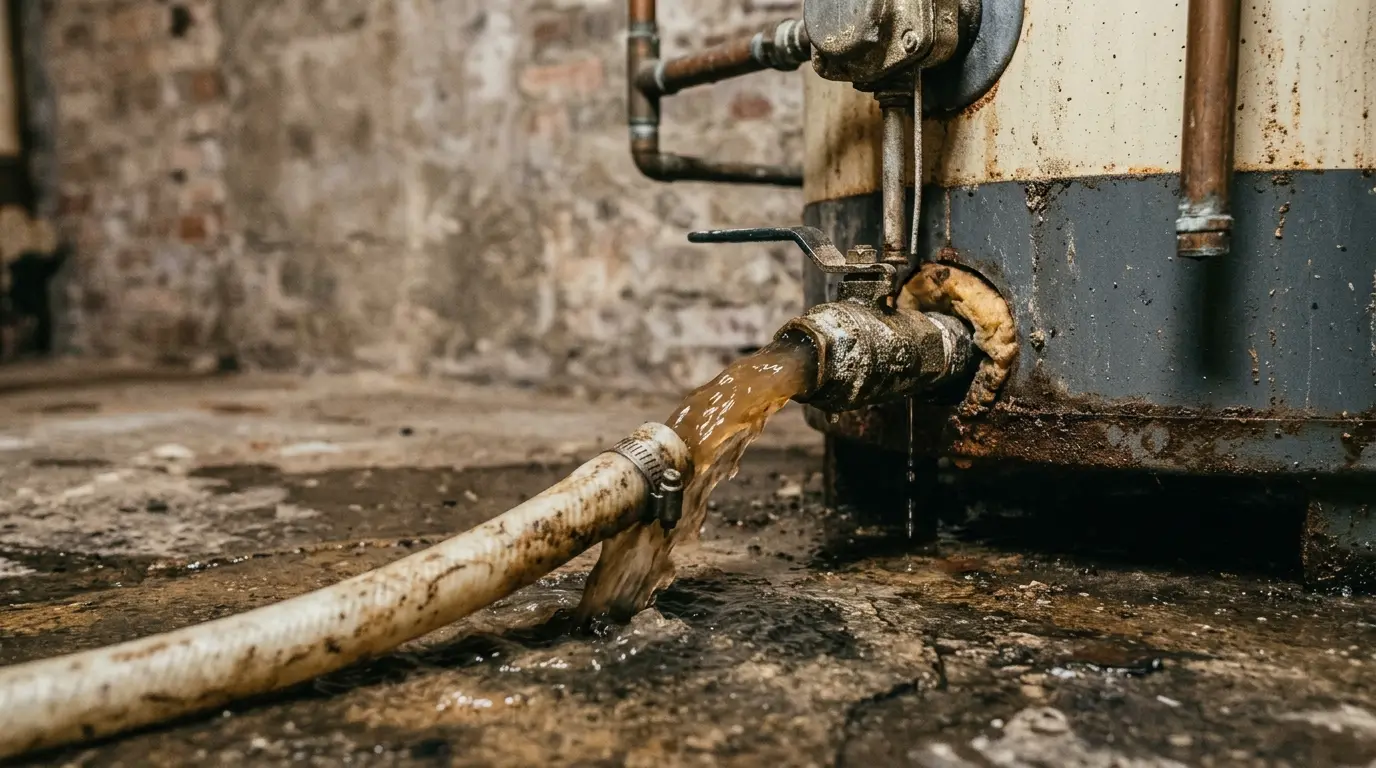
Flushing is the answer, annually, and it is genuinely within reach for a homeowner: shut off the heat source, close the cold inlet, attach a hose to the drain valve, and run it until it comes clear. Two cautions. On a tank that has never been flushed in ten years, the sediment can block the drain valve, and disturbing it occasionally reveals a leak that was being held closed by scale, so on an old, never-flushed tank it is a job to do deliberately rather than casually. And where water is notably hard, a softener addresses the cause rather than the symptom, and it protects everything else in the building as well.
Venting, draft, and the safety check
This section is why a hot water complaint on an atmospheric gas heater is not purely a plumbing call.
A conventional gas water heater vents by natural draft: hot combustion gases rise up a flue, usually into a masonry chimney in the older housing stock here. That draft depends on the chimney being clear, correctly sized, and warm, and on the room having enough air to replace what goes up it.
Several things in this region interfere with it. Old chimneys deteriorate internally and shed material that obstructs the flue. A chimney sized for a large old boiler is oversized for a modern appliance and drafts poorly. Air-sealing improvements upstairs tighten the building so the basement can no longer supply combustion air. And a powerful exhaust fan or a dryer can depressurise a basement enough to pull the flue backwards.
The consequence of a failed draft is combustion products in the room, which includes carbon monoxide. So the check is straightforward and it belongs on every visit: look at the flue connector for slope, support, and corrosion; look for soot or scorching at the draft hood; and test the draft with the appliance running and the building in its worst realistic condition, bath fans and dryer on. A heater that spills is shut down rather than adjusted.
And independently of any of that: a working carbon monoxide alarm on every level with fuel-burning appliances. It is the cheapest item in this article by a wide margin.
Soot at the top of the heater, or a smell when it fires? Treat that as urgent rather than as a hot water problem.
Call about a combustion concernThe parts that are about safety
The temperature and pressure relief valve. The one component on a water heater that prevents a genuinely catastrophic failure. It opens if the tank exceeds a safe temperature or pressure, and its discharge pipe must run full-size, downward, and terminate where a discharge would be seen and would not scald anybody. A relief valve that has been capped, plugged, or plumbed uphill is the single most serious defect we find on water heaters, and it is not negotiable.
A valve that weeps intermittently is reporting something: excessive pressure on the system, a thermostat overshooting, or thermal expansion with nowhere to go. Replacing the valve without finding the reason removes the messenger.
Thermal expansion. Where a check valve or pressure-reducing valve isolates the building from the street, heated water has nowhere to expand into and pressure rises sharply on every cycle. That shows up as a weeping relief valve, hammering fixtures, and stress on the whole system. An expansion tank, correctly pre-charged, is the fix, and it is inexpensive.
Temperature setting. Around 120 °F suits most households: hot enough for domestic use, cool enough to reduce scalding risk, and gentler on scale formation. Higher settings are sometimes wanted for other reasons, in which case mixing valves at the fixtures are the way to have both.
Pan, drain, and location. A heater above finished space wants a pan and a drain to somewhere sensible. In a basement it is less critical, but a leak detector at the base of the tank costs very little and turns a ruined floor into a phone call.
Combustion air and clearances. Adequate air, and nothing stored against the appliance. Paint, solvents, and petrol near a gas water heater are a fire risk that has nothing to do with plumbing.
Repair or replace
The honest version, because this is where people are most often oversold.
Repair is right when the tank is sound and reasonably young, and the fault is a component: a thermocouple, an element, a thermostat, a dip tube, a drain valve, a relief valve, a fitting. Those are modest repairs that return a working appliance with years left in it, and replacing a five-year-old heater because an element failed is waste.
Replace is right when the tank itself is leaking, full stop. Also when the heater is past about ten years and needs a major part, a gas control valve or a control board, because you would be spending a substantial fraction of a new heater on a shell at the end of its life. Also when it has been repaired twice already, when it is badly scaled and has never been flushed, when it has never been able to serve the household properly, or when it sits in a location that is unsafe and cannot be corrected without redoing the installation.
Two considerations people leave out. Timing: a heater replaced deliberately on a Tuesday is a scheduled expense; the same heater failing on Christmas Eve is an emergency call plus, occasionally, a floor. And a replacement is the moment to correct everything the last installation got wrong: sizing, venting, the relief discharge, thermal expansion, the shutoff. Those are close to free during a replacement and expensive as their own visits. Sizing and options are covered under water heater installation, including whether tankless makes sense for the building.
Getting a longer life out of the next one
- Flush it annually. The single highest-value habit, for the reasons above.
- Check the anode rod every few years. A sacrificial rod that corrodes so the tank does not. Replacing a spent rod costs a fraction of a tank and is the most under-used repair in this trade.
- Test the relief valve occasionally. Lift the lever, confirm it discharges and reseats. On a very old valve that has never been touched, expect it may not reseat, which is itself worth knowing.
- Keep the setting moderate. Around 120 °F. Less scale, less risk.
- Fit an expansion tank where the system is closed. It protects the heater and everything downstream.
- Address hard water at the source. A softener protects the heater, the fixtures, and the appliances at once.
- Keep the area clear and the air available. Nothing stored against a gas appliance, and combustion air maintained if the building is being tightened up.
- Know the shutoffs. Cold inlet valve and, on gas, the appliance gas valve. Five minutes on a dry afternoon.
What drives the cost
Which part. A thermocouple or an element is a modest repair. A gas control valve or a control board is several times that, and it is the point at which age starts deciding the answer.
Diagnosis against parts. Some faults are found in ten minutes; an intermittent one, or a draft problem that only appears when the dryer runs, takes longer to establish and is worth the time it takes.
Access. A heater in an open basement is straightforward. One in a closet with a door narrower than the tank, in a crawlspace, or in an attic changes the labour on every task and matters enormously if it comes to replacement.
Age and availability. Parts for current models are stocked; parts for a twenty-year-old heater may not exist, which sometimes decides the question for you.
What else has to be corrected. A capped relief discharge, a corroded flue connector, or a missing expansion tank found during a repair are safety items rather than extras, and they belong in the same visit.
Emergency against scheduled. Night and weekend response costs more. A cold shower on a Saturday morning is unpleasant; it is usually not worth an after-hours premium unless there is water on the floor.
Common Questions
Answers before you call
My water heater is leaking. Can it be repaired?
It depends entirely on where the water is coming from. A weeping inlet or outlet connection, a drain valve that will not seat, or a discharging relief valve are all repairs, and often small ones. Water coming from the body of the tank is not, the steel has corroded through and there is nothing to fix.
The test is to dry everything, then look again in an hour with a torch. Water tracking down from a fitting at the top is a fitting. Water appearing at the base with dry connections above it is the tank, and the answer is replacement.
How long should a water heater last?
Eight to twelve years for a conventional tank is the working expectation, and the variable that matters most in this region is water hardness and whether the tank was ever flushed. A well-maintained heater with a replaced anode rod can pass fifteen; a neglected one on hard water can fail at seven.
Past about ten years, the arithmetic changes. Spending several hundred on a control or an element in a twelve-year-old tank is buying time on a component whose shell is at the end of its design life.
Why do I run out of hot water so fast?
Three common causes. Sediment occupying the bottom of the tank, which reduces the volume of water it actually holds, the most common and the most preventable. A failed lower element in an electric heater, which leaves you with only the top third of the tank heated. Or a dip tube that has broken, letting cold water mix straight into the outlet.
The fourth possibility is that the tank was never big enough for the household, which is a sizing question rather than a fault. A bathroom added since the heater went in is the usual story.
Is the rumbling or popping noise dangerous?
Not immediately, but it is a symptom worth acting on. The sound is water flashing to steam under a layer of sediment on the tank floor, and it means the burner is heating sediment rather than water.
Two consequences: the heater is using more energy than it needs to, and the tank floor is being thermally stressed in a way that shortens its life. Flushing may resolve it if it is caught reasonably early; a heavily scaled tank is often past that point.
The pilot keeps going out. Is that a cheap fix?
Usually yes. A thermocouple or flame sensor that has aged out is a modest part, and it is the most common reason a standing pilot will not stay lit. A dirty pilot orifice or a failing gas control valve are the next candidates.
There is one important exception. If the burner compartment is starved of air, or if the flue is blocked and combustion products are spilling back into the room, the safety devices are supposed to shut it down, and that is not a part to replace, it is a condition to correct.
Should I switch to tankless while I am at it?
Worth considering, not automatic. Tankless gives endless hot water and takes up little space, which suits a household that runs out or a basement where the footprint matters. It costs more up front, frequently needs a larger gas supply and a different vent, and in a hard-water area it needs descaling on a schedule.
In a genuine no-hot-water emergency it is rarely the right decision, because the conversion is a bigger job than a like-for-like swap and you need hot water today. It is a good planned upgrade and a poor panic purchase.
Water pooling under the tank?
Worth establishing whether that is a fitting, the relief valve, or the shell. Two of those are repairs. Call and describe where it is wet.
24/7 · Chicago metro dispatch · (833) 615-3680