Plumbing in Schaumburg
Lake Michigan water since 1988, deep-well water before that, and in Schaumburg that date still decides what has worn out in a given house, what the pressure does at the tap, and whether a softener is earning its salt.
Where Schaumburg’s water comes from, and what it does to pipe
Start with the water rather than the buildings. Since 1988 Schaumburg has taken all of its water from Lake Michigan, treated by Chicago and pumped out to the northwest suburbs by the Joint Action Water Agency, the consortium the village formed with six neighbouring towns in 1981. Before that the village ran on eighteen of its own wells. Several are still in the ground as emergency standby, but nothing in an ordinary week comes out of them.
That date is the single most useful thing to know before diagnosing anything in a Schaumburg house, because it splits the housing stock in two. Anything plumbed before the late 1980s spent its first years carrying deep-well water: hard, mineral-heavy, and hard on every wetted surface it touched. Anything plumbed since has only ever carried lake water, which is softer, chemically steadier, and dosed with chloramine rather than free chlorine. Two houses on the same street can present completely different wear on identical fixtures, and the difference is the decade, not the plumber.
What lake water does not do is arrive at one pressure. JAWA delivers into the village system at four points and the village re-pumps from there, so the pressure at a given tap depends on which zone the house sits in, which is the next section, and the reason a pressure complaint here is worth measuring before anything gets replaced. Nor does it remove the case for a softener: lake water is moderately hard, not soft, and that is the section after.
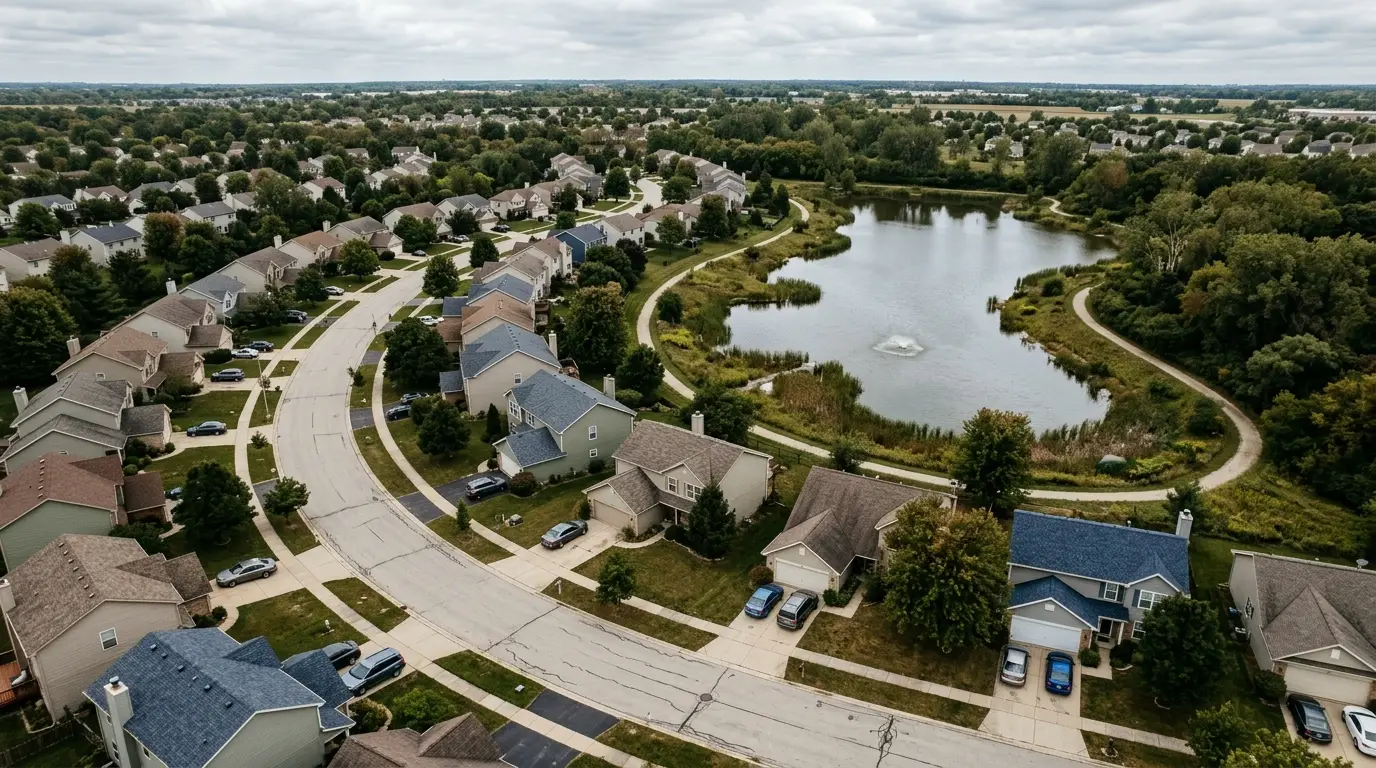
The ground matters too, mechanically rather than chemically. Schaumburg sits on flat former prairie in the headwaters of Salt Creek over heavy glacial clay that does not drain, so nearly every basement here was built with a drain tile ring and a sump as original equipment. A pump in this soil is a continuous-duty machine for months at a stretch, and any basement bathroom or laundry below the building drain sits on an ejector as well. Neither is a repair someone added; both are part of how the house was designed to stay dry.
Two numbers before you call
Static pressure at an outside hose bib, and the year the house was plumbed. The first tells us which pressure-zone behaviour we are dealing with; the second tells us whether the pipe spent its first decade on well water. Most Schaumburg diagnoses narrow sharply on those two answers.
Why pressure differs street to street
Schaumburg is large, and a large municipal system does not deliver one pressure. Water arrives at reservoirs, is boosted into the distribution network by pumping stations, and reaches a given house at a pressure that depends on which zone it is in, how far along the network it sits, and how much elevation there is between the station and the tap. Two houses a mile apart in this village can legitimately see a meaningful difference at the hose bib, and neither is broken.
That matters because pressure is the most commonly misdiagnosed complaint in plumbing. There are only a few real causes and they are distinguishable in twenty minutes with a gauge. Low pressure everywhere in the building, steady, points at the supply or at the service line: a partially closed valve, a clogged meter screen, an undersized or corroded service. Low pressure only at certain fixtures points at the fixtures: aerators, cartridges, and stop valves that were never fully opened. Low pressure only upstairs, or only when two fixtures run, is a volume and pipe-size problem rather than a pressure problem, and it is what old galvanized branch pipe does as its bore closes.
High pressure is the one people do not report and should. Above roughly 80 psi, the code threshold, fixtures and appliance valves wear quickly, water hammer gets worse, and a water heater's relief valve may weep. That is the case a pressure-reducing valve is for, and it is a genuinely useful device fitted for the right reason. Fitted for the wrong reason, to solve a volume problem, it makes the complaint worse, which is why the gauge reading comes before the recommendation.
Hardness, appliances, and where the softener drains
Schaumburg is on treated Lake Michigan water, which is moderately hard rather than hard, enough to leave a film on glass and scale a water heater across a decade, not enough to damage anything quickly. So a softener here is a preference about how the water feels and how much scale forms, and the way to decide is a hardness test that costs almost nothing rather than a sales visit.
What hardness reliably does cost you is appliance life, and the pattern is worth knowing. A water heater accumulates scale on the tank bottom where it insulates the burner and drives the metal hotter than design, which is most of the difference between a heater reaching nine years and one reaching fourteen; annual flushing genuinely extends it. A tankless unit scales inside the heat exchanger instead, where there is far less tolerance for it, and needs descaling on a schedule, a tankless installed here without that maintenance in the plan will underperform within a few years. Ice makers, dishwashers and any fixture with a cartridge collect the same deposits at a smaller scale.
There is one Schaumburg-specific detail worth stating plainly, because it is common and it is doing damage: where the softener discharges. A softener regenerates by flushing concentrated brine, and in a lot of houses here that discharge was simply run into the sump pit. It was the nearest hole. That is the wrong destination twice over. Salt water is hard on a pump's impeller, seals and check valve, and it is being pumped out to the storm system rather than the sanitary one, which is not where it belongs. Brine discharge should go to a sanitary connection with a proper air gap. If you have a softener and a sump in the same room, it is worth ten seconds to look at where the small drain line actually terminates.
Woodfield and the multi-tenant corridor
Schaumburg carries an unusual amount of commercial plumbing for a suburb its size: the retail and hotel concentration around Woodfield, the office and flex parks, and long strips of multi-tenant retail along the arterials. The work differs from residential plumbing in ways that have less to do with pipe than with ownership and load.
Multi-tenant retail produces the recurring dispute. Several tenants discharge into one building drain and often into one grease interceptor, and the lease frequently does not say clearly who maintains it. The physical consequence is predictable: an interceptor sized for one restaurant serving three, serviced when somebody notices rather than before accumulation reaches a quarter of its depth, passing grease into a shared lateral that then blocks and affects tenants who are not causing it. Establishing whose fixtures load the interceptor, and getting a service interval written down, prevents more of these calls than any repair does.
Hotels and food service bring the load questions. High simultaneous demand on hot water means a booster or a properly designed recirculation system rather than more tank capacity, and a recirculation loop that has lost its pump or its balance shows up as long waits at the far rooms rather than as a heater fault. Food-contact equipment needs indirect waste through an air gap, so that a blocked drain cannot push back into an ice machine or a prep sink. And backflow prevention on fire, irrigation and carbonation services is annually testable equipment with a paper trail, which is the sort of thing that becomes urgent only when somebody asks for the paperwork.
Our scope: repair, drain and interceptor line work, water heating, and backflow assembly repair. Build-out design, kitchen equipment specification and grease hauling belong to other trades, and saying so is more useful than sending the wrong truck.
How dispatch works here
Worth saying plainly: we dispatch, we do not carry a crew of our own. You describe the problem, we match it to a plumber who works in Schaumburg and does that kind of work, and you are told who is coming and when. The reason it matters here is that the local caseload splits between pump and groundwater work, multi-family and association work, and genuine commercial work, three different skill sets and three different vehicles.
What helps on the phone: whether the building is a house, a townhouse or a commercial space; whether anything is actively rising; whether the sump or the ejector is involved; and for a shared building, who can authorise the work. This is a low-density region to cover overnight, so an arrival time at 3 a.m. is a real drive: distance affects when someone arrives, not the rate for the work, and if a closer option will get to you faster during an active flood, our dispatchers are told to tell you.
What We Dispatch For
Services called in most often around here
Nearby
Neighbouring communities
Part of Northwest Suburbs, see the whole region for what these towns have in common underground.
Elk Grove Village · Hoffman Estates · Rolling Meadows · Streamwood
Common Questions
Answers before you call
Why do my pipes bang when the heat comes on?
In this housing stock it is usually not steam. Schaumburg is overwhelmingly forced-air heat, so the noise that arrives with the heating season is nearly always one of three mechanical things. Copper expanding as hot water moves through it, rubbing against a joist notch or a tight strap. That is a tick or a creak that follows the flow and stops when it stops. Air trapped in a hot-water baseboard loop, which does exist in some townhouse and condo buildings here, and which gurgles and knocks until the loop is bled. Or a genuine water hammer: a fast-closing solenoid valve on a washer, dishwasher or ice maker slamming shut and sending a pressure wave down a run of unsecured pipe.
The three have different fixes and none of them is a boiler. Expansion noise wants the pipe freed and re-supported, not tightened. A hot-water loop wants bleeding and, if it recurs, the reason air keeps entering. Water hammer wants pipe secured at proper intervals and, where system pressure is high, a look at the regulator and a properly charged arrestor.
If the building genuinely does have steam or hot-water radiators, the order of investigation changes completely and starts at the vents. Worth saying on the phone which one you have, because it decides who should come.
The problem is in a shared wall or shared line. Who pays?
In a townhouse or condominium the answer is in the declaration, not in intuition, and the two rarely agree. Broadly: what is inside your unit and serves only your unit is yours, fixtures, the branch to them, your water heater. What serves more than one unit is a common element even when it runs through your wall or ceiling: the stack, the risers, the building drain, the main shutoff, and usually the drain tile and the sump.
That produces the case people find unfair. Water damage in your unit caused by a common element is generally the association's repair for the pipe and often your insurer's for your finishes, which is exactly why both parties need to be told early. Work on a common element also has to be authorised by the association: a resident cannot hire it out, and a plumber who does the work on a resident's instruction can leave everyone with a dispute instead of a repair.
The practical move is to establish which side of the line the failure is on before scheduling anything, and to get the association's manager on the thread the same day. On a shared line it is also worth asking whether anyone has ever mapped the valves, because in a lot of these buildings nobody has, and that is the difference between shutting off one kitchen and shutting off eight.
How long will the water be off?
For most repairs, an hour or two, and it is usually not the repair that determines it. A fixture change, a valve replacement or a heater swap needs water off only while the connections are open. The variable is whether the shutoff you need actually closes: an old gate valve that has not been operated in decades often will not seat, which turns a one-hour shutdown into a longer one because the isolation has to be moved further upstream.
For a repipe the honest answer is measured in days, not hours, but not continuously. A staged repipe in an occupied house typically has water off for part of each working day, restored each evening, with one longer shutdown at the changeover. For a water service replacement, water is off for the working day the connection is made.
In a townhouse or condo the number that matters is not yours but everyone's. If the isolation is at a shared riser, the shutdown has to be scheduled and noticed to the other units, and that scheduling usually adds more calendar time than the plumbing does. We would rather book that properly than turn up and discover eight households have no warning.
Do you work overnight and at weekends here?
Yes, and the honest caveat is that overnight coverage in the northwest suburbs is thinner than in the dense parts of the metro, so an arrival window at 3 a.m. is a real window rather than a formality. What you should get on the phone is a straight time, not a promise.
Weekends are closer to normal. Saturday work is routine and Sunday is available for genuine emergencies: active flooding, no water, sewage backing up, a gas smell. Scheduled work such as a heater replacement, a repipe or a sewer repair is better done on a weekday here, partly because supply houses are open and partly because permitted work needs an inspector who is not there on Sunday.
One thing worth knowing: if a pump has failed during a wet spell and water is rising, the fastest legitimate answer is sometimes not us. Our dispatchers are told to say when a closer option will reach you sooner, because during an active flood the difference between forty minutes and two hours is the finished basement.
Would a backup pump have prevented this?
In Schaumburg, more often than any other single measure, because the failures here are usually pump failures rather than sewer failures. If your basement flooded during a storm and the primary pump had stopped, lost power, or simply could not keep up with the inflow, then yes: a second pump on independent power is precisely the device for that.
It has to be the right kind. A battery backup pump handles a power cut and a primary pump failure, and its real limit is runtime: a single battery is measured in hours of continuous pumping, not days, so an extended outage during a long rain event can outlast it. A water-powered backup has no runtime limit but consumes municipal water and needs adequate supply pressure to work, which brings the pressure zone into the decision. A second primary pump on its own circuit, set slightly higher in the pit, addresses volume rather than power loss.
Where a backup would not have helped: if water came in at the wall-floor joint or through a window well while the pump was dry, the problem was outside the pipes and no pump in the pit was ever going to catch it. Grading, downspout extensions and window well covers are the remedy there, and they are cheaper than any pump.
Backwater valve or overhead sewer?
In Schaumburg the honest first answer is usually neither, and it is worth saying before anyone spends money. Both devices exist to stop a surcharged sanitary main from pushing sewage back into the lowest openings in a building. This town is on a separated system (storm water goes to storm sewers and detention, sanitary sewer carries waste), so wet-weather basement water here is overwhelmingly groundwater and surface water, and neither device addresses either.
The order of investigation should be sump and drain tile, then ejector pit if there are fixtures below grade, then grading and downspouts, then the lateral. If a camera shows the lateral is sound and the pump is healthy and water still arrives in a storm, the water is coming from outside the pipes.
Where the question does become live is a building with fixtures below the level of the street main and a documented history of sanitary backup rather than groundwater, some older properties and some commercial buildings here qualify. In that case: a valve is far cheaper and protects only against backflow, and it must be accessible and maintained or it fails closed at exactly the wrong moment. An overhead conversion re-plumbs the basement fixtures to discharge upward into an ejector above the surcharge line, costs several times as much, and is the only one of the two that is passive once installed. Nobody should be selling either one in this town without having established the mechanism first.
Sump running every few minutes in a dry week?
That is usually a check valve letting the discharge fall back into the pit, or a float set too tight, a part, not a pump. Worth diagnosing before spring rather than during it.
24/7 · Chicago metro dispatch · (833) 615-3680