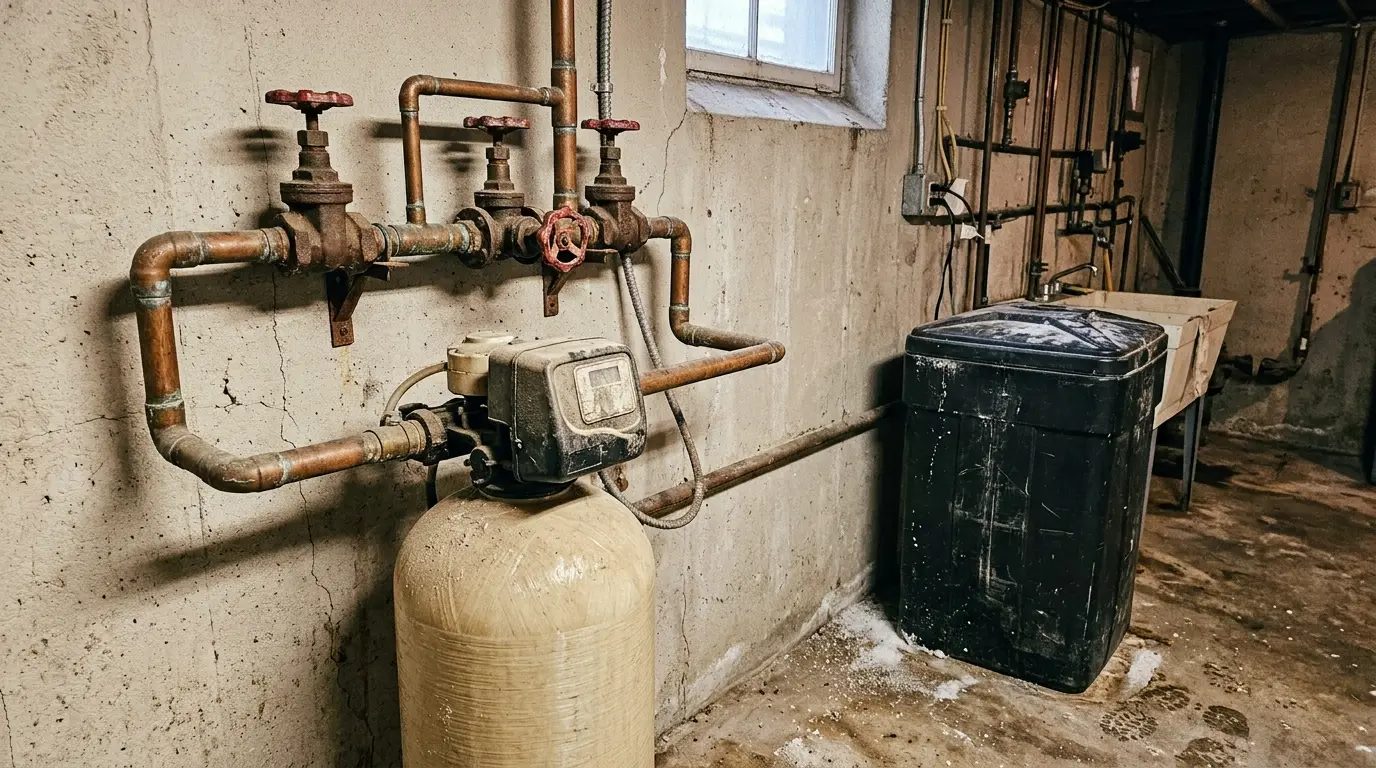
Water softeners, sized from a test rather than a sales sheet
Lake water and well water are different problems. One is moderately hard and predictable; the other can carry iron, manganese, and four times the hardness. The test comes first.
Test the water before buying anything
Water treatment is the one area of plumbing where equipment is routinely sold before the problem is measured. It should be the other way round, and the test is neither difficult nor expensive.
Five numbers decide what equipment is appropriate.
Hardness, in grains per gallon, which sets the softener's capacity requirement. Iron, in parts per million, which decides whether a softener alone is viable at all. Manganese, which stains dark and behaves differently from iron. pH, because very low or high pH affects both equipment choice and how aggressive the water is toward the plumbing. And total dissolved solids, as a general indicator of what else is in there.
For a property on a municipal supply, the utility publishes an annual water quality report and it is a legitimate starting point, but it describes the water leaving the plant, not the water at your tap after it has passed through the service line and the building's own piping. For a private well, published figures do not exist and there is no substitute for a sample.
What we will not do is recommend a model over the phone from a postcode. The recommendation follows the numbers.
The single most useful thing you can do before calling
Find your municipality's water quality report and note the hardness figure, or, if you are on a well, arrange a test. Hardness and iron between them determine ninety per cent of the specification.
Lake water versus well water here
This metro contains two entirely different water treatment problems, and which one you have depends on where the water comes from rather than how far you are from the city.
Lake Michigan supplies. The city and a large part of Cook, DuPage, and the North Shore draw treated lake water. It is moderately hard, chlorinated or chloraminated, low in iron, and above all consistent, the figures do not move much through the year. Treatment here is straightforward: a correctly sized softener, and often nothing else. The main reason to soften is protecting the water heater and the fixtures rather than curing a nuisance.
Deep and shallow wells. In the outer parts of Lake, McHenry, Kane, Will, and Kendall counties, and in a good deal of the outlying Illinois markets we cover, properties draw their own water. Hardness is commonly two to four times the lake figure. Iron is frequent, sometimes with the rotten-egg smell of hydrogen sulphide or the black staining of manganese. Nitrate is a consideration in agricultural areas. And crucially, a well's chemistry can change: after a wet spring, after work on the well, or as a shallow aquifer is drawn down.
Municipal groundwater. A number of suburbs run on their own wells rather than lake water, which puts them somewhere in between: treated and consistent, but harder than the lake and occasionally with iron of its own. Joliet, for one, has been publicly working on this question for years. It is worth knowing which category your municipality is in, because it changes the specification materially.
The practical consequence: a softener specified for a Wilmette house will be wrong for a Woodstock well, and the same brochure sells both.
What hard water is actually costing you
Hard water is a nuisance rather than a health problem, and it is worth being straight about that. The case for treating it is economic and practical.
The water heater. The largest single cost. Dissolved minerals drop out when water is heated and settle as scale, on the tank floor in a conventional heater, inside the heat exchanger in a tankless one. That is the popping noise, the lost capacity, the higher fuel bill, and the shortened tank life described under water heater repair. On a tankless unit it is severe enough that treatment is close to a prerequisite.
Fixtures and appliances. Scale in aerators, shower heads, and fill valves; dishwashers and washing machines working harder and lasting less long; toilet fill valves that seat imperfectly.
Soap and detergent. Hardness minerals react with soap rather than lathering, which is where soap scum on tile and stiff laundry come from. Households on soft water routinely use noticeably less detergent, shampoo, and soap.
Time. The one people mention most after a softener goes in: less scrubbing of glass shower doors, no spotting on glassware, taps that stay looking clean.
What a softener does not do: make water safe that was not, remove lead, remove chlorine taste, or fix a discoloured supply coming from old galvanized piping. Those are different problems with different answers, filtration for taste and contaminants, repiping where the pipe itself is the source.
Sizing: grains per day, not household size
The sizing arithmetic is simple and it is worth seeing, because it is the difference between a unit that runs efficiently for fifteen years and one that regenerates every other night.
Daily hardness load equals people times daily water use times hardness. A four-person household using around seventy gallons a person a day, on nine-grain lake water, produces roughly 2,500 grains of hardness a day. The same household on twenty-five-grain well water produces about 7,000.
The softener is then chosen so that it regenerates at a sensible interval, conventionally every three to seven days, while running its resin at an efficient salt dose rather than at its absolute maximum capacity. That is why a nominal "32,000 grain" unit does not simply divide by the daily load: run at maximum capacity it uses disproportionately more salt per grain removed.
Two mistakes follow from ignoring this. Undersized units regenerate constantly, use more salt and water, wear out sooner, and let hard water through at peak draw. Oversized units sit for long periods between regenerations, which lets the resin bed channel and, on chlorinated supplies, can leave water standing in the unit longer than is ideal. Correct is neither.
Two local adjustments worth making. Add for a large soaking tub or a household that entertains, and add for iron where an iron filter is not being fitted, each part per million of iron behaves roughly like several grains of hardness in terms of the load it puts on the resin.
Choosing equipment honestly
Four decisions, and only two of them matter much.
Metered versus timed regeneration. This one matters. A metered unit regenerates when it has actually treated its capacity of water; a time-clock unit regenerates on a schedule whether the house was occupied or not. Metered control uses materially less salt and water over a year and handles a week away or a house full of guests without intervention. There is no good reason to fit a time-clock softener in a new installation.
Single tank versus twin tank. A single-tank unit is unsoftened for the duration of its regeneration, which is why regeneration is scheduled for the early hours. A twin-tank unit always has one bed in service, which is worth having where there is genuinely round-the-clock demand, a large household with shift workers, or a small commercial property. For most homes the single tank is right.
Resin quality and capacity. A higher cross-link resin resists chlorine better, which is relevant on lake water because chlorine slowly degrades standard resin. On a chlorinated supply it is a sensible upgrade rather than a luxury.
Salt-free conditioners. Covered in the questions below. They reduce scale adhesion; they do not soften water. We will describe them accurately and let you decide.
What we will not do is bundle the softener with an under-sink drinking water system, a shower filter, and a service contract to hit a price point. If you want reverse osmosis at the kitchen sink, that is a defensible separate decision.
Installing it properly
The installation is where a good unit is made average or a modest one is made to work well for fifteen years. Six details.
Position on the supply. After the meter and any pressure regulator, before the water heater, and downstream of any iron filtration. Whatever is meant to stay hard (outside taps, irrigation, usually the kitchen cold) branches off before the softener.
A proper bypass. Either a three-valve bypass or the unit's own integral bypass, so the softener can be isolated for service without the household losing water. This is the detail most often skipped on a cheap installation and the one that makes every future service call awkward.
Unions at the unit. So it can be disconnected in ten minutes rather than cut out. Softeners are replaced roughly every twelve to twenty years; the next installer will thank whoever fitted the unions.
The drain line, with an air gap. Brine discharge must never be hard-connected into a drain. The line runs to a standpipe, laundry tub, or floor drain with an air gap, secured so it cannot whip out of position during a regeneration cycle, and run without a long uphill section the unit's injector cannot push against.
The brine tank overflow. Routed to the drain, not left to discover the basement floor.
Grounding continuity. Where a metal water service is part of the building's electrical grounding path, cutting into that piping to install a softener interrupts it. A bonding jumper across the installation restores continuity, and it is not optional.
On a private well and not sure whether you need iron removal, softening, or both?
Call and we will start with a testSalt, sodium, and drinking water
Ion exchange works by trading hardness minerals for sodium held on a resin bed, so a softener does add a small amount of sodium to the water. The quantity is proportional to the hardness removed: on nine-grain lake water it is a modest figure, on twenty-five-grain well water it is roughly three times as much.
Three ways to handle that, depending on what you care about.
Leave the kitchen cold tap hard. Simple, free at installation time, and it means drinking and cooking water is untreated. The trade is that you keep hard water in the kettle and the coffee machine.
Use potassium chloride instead of sodium chloride. Works identically in the softener and avoids sodium entirely. It costs several times more per bag, which is the only real objection to it.
Add reverse osmosis at the kitchen sink. Removes the sodium along with a good deal else, gives genuinely excellent drinking water, and wants a dedicated tap and a drain connection. This is the arrangement most households settle on where drinking water quality is a real concern.
Two further notes. Softened water is slightly more aggressive toward some metals than hard water, which is worth mentioning in a housing stock that still contains lead service lines and lead solder, if a lead service line is a possibility, that is a bigger conversation and it belongs under water service line replacement rather than being treated as a softener setting. And on a septic system, the volume and salinity of regeneration discharge is worth confirming against local rules rather than assumed.
Living with it
A softener is a low-maintenance appliance rather than a maintenance-free one.
Salt. Keep the brine tank at least a third full and use a clean grade, pellets or solar salt rather than rock salt, which carries more insolubles. Consumption depends entirely on hardness and water use; a four-person household on lake water uses far less than the same household on a hard well.
Salt bridging. A crust can form over an air gap in the brine tank, so the unit draws no brine and quietly stops softening while appearing to work. Breaking the bridge and letting the tank run lower before refilling prevents it. Water that has gone hard again with a full salt tank is usually this.
An annual look. Check the hardness at a tap, confirm the unit is regenerating, inspect the brine tank for sludge on the floor, and verify the drain line and air gap are still as installed.
Expected life. Twelve to twenty years for the resin and tank, less for the control valve, which is the part that usually fails first and is often worth repairing on a good unit.
What drives the cost
Directional rather than quoted.
Capacity and control type. A metered single-tank unit sized for a family is the ordinary case; twin-tank and high-flow units cost more.
Whether a loop already exists. Many post-war suburban houses were plumbed with a softener loop in the basement, which makes installation quick. A house with no loop needs the supply piping opened up, the bypass built, and the hard-water branches re-routed, several hours of pipe work.
Drain proximity. A standpipe or floor drain within a few feet is easy; a run across a finished basement to reach a drain is not.
Iron and other treatment. Where a well needs iron removal, or sulphur or nitrate treatment, that is separate equipment with its own cost, and it belongs ahead of the softener.
Optional extras. Reverse osmosis at the kitchen sink; a bypass for irrigation; a higher chlorine-resistant resin on lake water.
The one thing we will insist on is testing first. Equipment specified against a number is equipment that fits; equipment specified against a postcode is a guess with a price on it.
Common Questions
Answers before you call
How hard is the water in the Chicago area?
Lake Michigan supplies, the city and most inner suburbs, run moderately hard, commonly in the region of seven to nine grains per gallon. That is hard enough to scale a water heater and spot glassware, but it is consistent and free of iron, which makes it straightforward to treat.
Private wells in the outer counties are a different matter and vary street by street: twenty to thirty grains per gallon is common, often with iron and sometimes with manganese or sulphur. Two houses a mile apart can need quite different equipment, which is why a test on your own tap is the only sound basis for a recommendation.
Will a softener fix my rusty water?
Only up to a point, and this is the most common mis-sale in water treatment. A softener will remove a small amount of dissolved clear-water iron along with the hardness, but it is not an iron filter. Put a well with several parts per million of iron through a softener and the resin fouls, the capacity collapses, and within a year or two the unit needs a rescue.
Where iron is present in quantity, the correct arrangement is dedicated iron removal ahead of the softener, so the softener does the job it is designed for. That is a filtration question as much as a softening one.
Does softened water taste salty?
No. Ion exchange swaps calcium and magnesium for a small quantity of sodium; it does not add salt to the water in any taste-perceptible sense. The added sodium is proportional to the hardness removed, and on Lake Michigan water it is a modest figure.
People who are on a sodium-restricted diet, or who simply prefer untreated water for drinking, usually leave the kitchen cold tap unsoftened or add a reverse osmosis unit under the sink. Both are easy to arrange at installation and awkward to add later.
Where does the softener drain to?
The regeneration cycle discharges brine, and it needs a drain with an air gap, the discharge line must not be connected directly into a drain line, because a blocked drain would otherwise siphon back into the softener and into the house supply. A standpipe, a laundry tub, or a floor drain with the correct clearance are the usual answers.
Two local considerations. Some municipalities have rules about brine discharge, particularly where a property is on a septic system, so it is worth confirming locally. And if the floor drain in question is on a line that surcharges in heavy rain, that is worth knowing before it becomes the softener's outlet.
Can I soften the whole house including outside taps?
You can, but it is a waste of salt and capacity. Outdoor hose bibs and irrigation want hard water, plants are indifferent to hardness and softened water on a lawn is money down the drain. Good practice is to plumb the softener so the outside taps and, usually, the kitchen cold tap remain on untreated water.
That decision is made when the loop is piped. Retrofitting it afterwards means opening the piping again, so it is worth deciding on installation day.
Are salt-free conditioners any good?
They do something, but not the same thing. Template-assisted crystallisation and similar technologies alter how minerals precipitate so they are less likely to stick as hard scale. They do not remove hardness, so you will not get the soap performance, the softer laundry, or the spot-free glassware that people associate with a softener.
Where they earn their place is a property that cannot accommodate a drain or where salt handling is genuinely impractical. Where the objective is scale protection for a tankless heater and nothing more, they are a reasonable compromise. Where the objective is soft water, they are not soft water, and anyone selling them as such is overselling.
Scale on the fixtures and a heater full of sediment?
Worth measuring the hardness and iron before choosing equipment. Call and we will start with a test rather than a recommendation.
24/7 · Chicago metro dispatch · (833) 615-3680