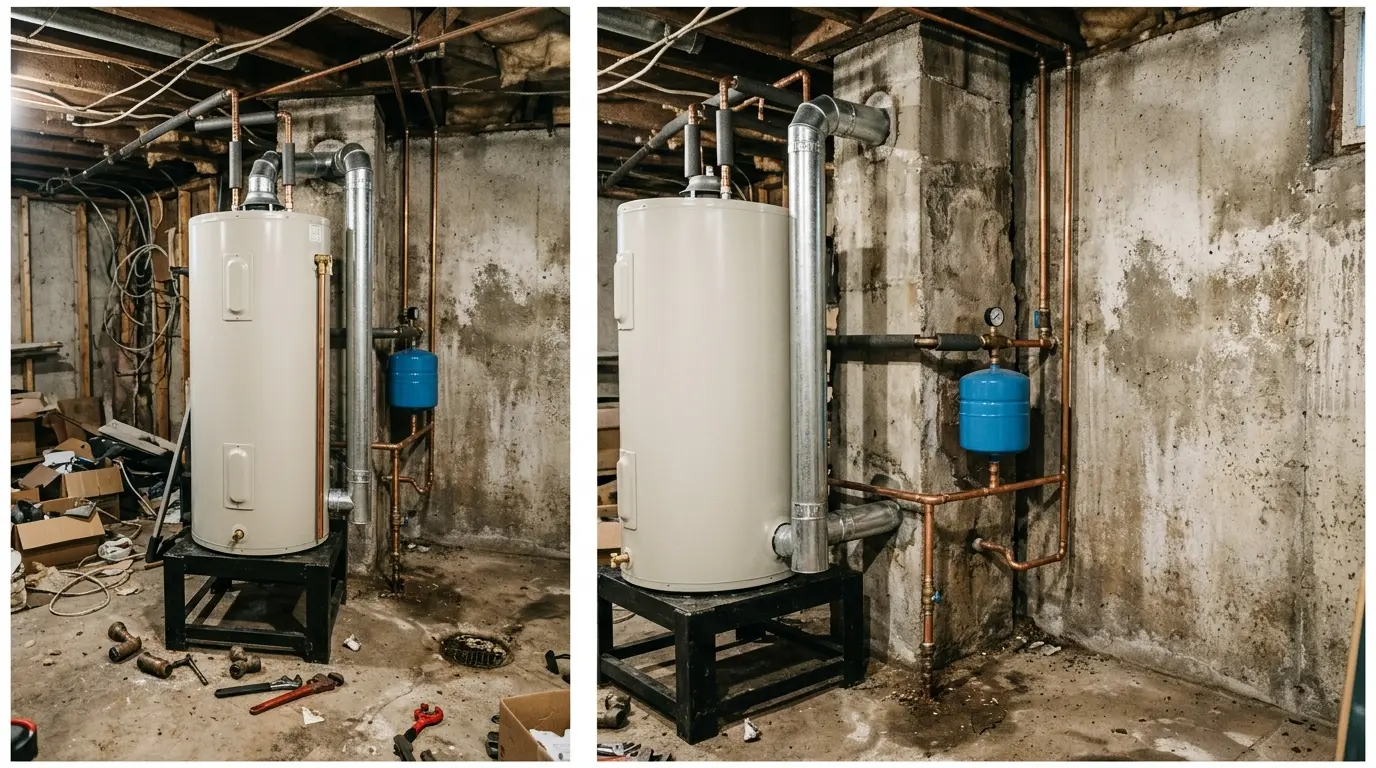
Water heater installation, done so the second one is easier
A tank swap is four decisions: capacity, fuel and vent, expansion control, and what happens when it eventually leaks. Getting those right costs little on the day and a great deal later.
Choosing what goes back in
Most people meet this decision on a bad day, with water on the floor and a supplier telling them what is on the truck. It is worth having a view before that happens, because the choice made under pressure is nearly always a like-for-like replacement of whatever failed, which may or may not be the right appliance for the building.
There are four realistic options in this region.
Conventional gas tank, atmospheric vent. The default in most of the older housing stock here, because the flue already exists. Cheapest to buy, cheapest to install, and dependent on a chimney or flue that drafts properly, which is the section below and the reason some of these installations are not as simple as they look.
Gas tank, power vent. A fan-assisted unit that vents horizontally through a sidewall in plastic pipe. It costs more, it needs an electrical outlet beside it, and it is audible. It is the answer when the chimney is unusable, unlined, oversized for the appliance, or already carrying a boiler that has to stay.
Electric tank. No vent, no combustion air, no carbon monoxide risk. Slower recovery, higher running cost in most Illinois utility territories, and it needs a dedicated 240-volt circuit, which is the cost that surprises people converting from gas.
Heat pump (hybrid) electric. Two to three times the efficiency of a resistance element, at a higher purchase price, and it needs air volume, headroom, and a condensate drain. In a full Chicago basement it is frequently the best long-run choice; in a closet it is not a candidate at all.
Tankless is the fifth option and it is a different conversation, covered under tankless water heater installation, because the gas supply and vent almost always change with it.
The question that decides most of this
Is the existing vent good? A sound, correctly sized flue keeps you in the cheap, simple lane. A deteriorated, oversized, or shared chimney pushes the job toward power vent or electric, and that is better discovered before the appliance is ordered than after it is standing in the basement.
Sizing it for the household you have now
Tank capacity is the number everyone quotes, and it is the less useful of the two. The number that describes how the heater will actually behave is first-hour rating: how much hot water it can deliver in the busiest hour, which is capacity plus how fast it reheats.
That matters because a 40 gallon gas heater with a strong burner can outperform a 50 gallon electric one on a weekday morning. Sizing by the label alone is how households end up with a bigger tank and the same complaint.
The practical method is to work out the peak hour rather than the day. Count what genuinely happens at once in the worst hour of the week (two showers back to back, the dishwasher, a load of laundry), and size for that. Then check three physical constraints before committing: height under the joists and any duct work, diameter through the doorway and around the stair turn, and the clearances the manufacturer requires around the appliance.
Two regional notes. A soaking tub is the single most common reason a household outgrows its heater, and it is worth measuring the tub's volume rather than guessing. And in a two-flat or coach house where one heater serves two kitchens and two bathrooms, sizing on the peak hour rather than on occupancy is the difference between a system that works and one that generates complaints every winter, see multi-unit building plumbing where the heater is shared.
Venting: the part old buildings complicate
On an atmospheric gas heater, the vent is not an accessory. It is the safety system, and in the Chicago-area housing stock it is the part of the installation most likely to be wrong.
A natural-draft appliance relies on buoyancy: hot combustion gases rise up the flue and pull replacement air in behind them. Four things in this region interfere with that.
The chimney is often masonry and often old. Interior faces spall, tile liners crack, and material collects at the base, restricting or blocking the flue. A chimney that vented reliably for fifty years is not thereby proven for the next ten.
The chimney is frequently oversized. Many of these flues were built for a coal or early gas boiler with an enormous exhaust volume. A modern water heater alone in that flue cannot warm it enough to establish draft, so it drafts weakly, condenses, and damages the masonry from inside. A properly sized liner is the fix, and it is a real line item that gets left out of cheap quotes.
Common venting has rules. Where a water heater and a boiler share a chimney, the connector sizes, the rise, and the order of entry all matter. Replacing one appliance with a different input rating changes the arithmetic for both.
The building may no longer supply combustion air. New windows, air sealing, and insulation have made many of these houses much tighter than they were designed to be. A basement with a gas water heater, a dryer, and a bath fan running can go negative enough to reverse a weak flue. The test is to run the appliance with the house in its worst realistic state (dryer on, fans on, doors shut), and confirm the draft holds.
Where the answer is that the chimney cannot be relied on, the honest options are a liner, a power-vented appliance through a sidewall, or electric. What is not an option is connecting a new appliance to a flue that has failed its draft test and hoping the season is kind.
Expansion, pressure, and the relief valve
Three components that are cheap on installation day and expensive to retrofit after a failure.
Static pressure. Measure it before the new heater goes in. Parts of this metro run well above 80 psi at the street, and high pressure shortens the life of a water heater along with everything else it feeds. If the reading is high, the fix belongs upstream at the pressure regulator, not in the appliance.
Thermal expansion. If the building has a pressure-reducing valve, a check valve, or a meter with backflow prevention, the plumbing system is closed and heated water cannot push back into the street. An expansion tank, pre-charged to match the measured static pressure and supported rather than hung off the pipe, is the answer.
The temperature and pressure relief valve and its discharge. Full-size pipe, no reduction, no valve in the line, running downward to a point where a discharge would be seen and would not scald anyone. Capped, plugged, or uphill discharge lines are the most serious defect we find on water heaters, and they are usually the work of a previous installer trying to tidy an inconvenience.
Connections, dielectrics, and hard water
The connections at the top of the tank determine whether the next replacement is a two-hour job or a four-hour argument with a seized union.
Unions or flexible connectors on both ports, so the appliance can be disconnected without cutting pipe. On copper, dielectric unions or brass nipples where the metals change; galvanized steel screwed directly to a copper system corrodes at the junction and is a common cause of restricted flow on older installations.
A full-port shutoff on the cold inlet, reachable without moving anything. Old gate valves that have not been turned in fifteen years frequently will not close when they are finally needed, which is exactly when a homeowner needs them.
A new flexible gas connector and a shutoff at the appliance, with the joints tested rather than assumed. Reusing an old connector on a new appliance is false economy of the most literal kind.
Then hard water, which in much of this region is the variable that decides how long the new tank lasts. Dissolved minerals drop out of solution when the water is heated and settle on the tank floor, insulating the burner from the water above it. That is the popping noise, the lost capacity, and the shortened life all in one mechanism. Three responses, in order of effectiveness: treat the water with a softener, flush the tank annually, and check the anode rod at around the five-year mark. A powered anode is worth considering where water chemistry has eaten conventional rods quickly.
Not sure whether your chimney can carry a new atmospheric heater? That is worth establishing before anything is ordered.
Call to talk through optionsPan, drain, and planning for the leak
Every tank water heater ends its life by leaking. The installation either anticipates that or it does not.
Above finished space (a closet on a main floor, a unit over a downstairs neighbour) a pan with a piped drain to somewhere sensible is not optional, and in a condo or two-flat it is the difference between a plumbing bill and a claim against you.
In a basement the stakes are lower but the same logic applies. A pan piped to the floor drain costs very little. A leak detector with a shutoff valve at the tank costs somewhat more and turns a ruined stored-goods pile into a phone call. And where the basement is finished, keeping the heater's footprint out of the finished area, or curbing it, is worth thinking about while the walls are open rather than after.
One further detail specific to basements here: if the floor drain the pan discharges to is on a line that surcharges in heavy rain, understand that before relying on it. That is the same drainage question covered under basement flood and sewer backup.
Permit, inspection, and the old tank
Water heater replacement is permitted and inspected work in most municipalities in this metro, and the details vary enough village to village that it is worth confirming locally rather than assuming. Where the vent, the gas piping, or the electrical supply changes, a permit is close to universal.
The inspection is genuinely useful rather than a formality. It is the one independent check that the relief discharge, the vent connector, the combustion air, and the gas connection are right, the four things that are invisible once the job looks finished.
Three things a complete job includes beyond the appliance itself: removal and correct disposal of the old tank, a carbon monoxide alarm confirmed working on that level where the appliance burns fuel, and a walk-through of the shutoffs with whoever lives there. The last one takes five minutes and is the difference between a small leak and a flooded basement two winters from now.
What the day looks like
So there are no surprises, in order: shut off fuel and water and let the tank cool; drain it, which is the slow step and slower still if it has never been flushed; disconnect and remove the old unit; correct or renew the vent connector, gas connector, shutoffs, and any galvanized-to-copper junctions; set the new tank level, on a pan where one is needed, with the required clearances; make up the water and fuel connections; fit or re-pre-charge the expansion tank; fill and purge air before energising, because firing a dry electric element destroys it immediately; light or energise; then test.
Testing means a draft check with the building in its worst realistic condition, a leak check on gas and water joints, a temperature check at a fixture rather than at the dial, and a look at the relief discharge. Then the old tank leaves with the crew.
What drives the cost
Costs on this site are directional rather than quoted, and for this job the appliance is often the smaller half of the number. What moves it:
Appliance type. Conventional atmospheric gas is the cheapest to buy and install; power vent adds several hundred; heat pump and tankless are materially higher on purchase price and lower on running cost.
Vent work. A chimney liner, or a new sidewall vent penetration for a power-vented unit, is the single largest variable and the one most often left out of a quote that looks unusually cheap.
Fuel change. Gas to electric means a new 240-volt circuit; electric to gas means new gas piping and a vent. Both are additional trades.
Access. A tank that has to be manoeuvred up a narrow stair, through a finished room, or out of a crawl space takes longer, and a 75 gallon tank in a tight mechanical room takes longer still.
What has to be corrected. Seized valves, galvanized junctions, a relief line that was plumbed uphill, missing combustion air, an old gas cock, all of it is discovered with the old tank out, and all of it is cheaper to fix then than later.
Capacity and efficiency. Going up a size is usually modest. Going up in efficiency class changes the appliance price rather than the labour.
We will say plainly which of those apply to your basement before anything is ordered, and if a like-for-like swap is genuinely the right answer, that is what we will recommend.
Common Questions
Answers before you call
How long does a water heater installation take?
A straight like-for-like swap in an accessible basement is generally two to four hours, including draining the old tank, which is the slow part. Add time where the old heater has to come up stairs, where the connections are galvanized and seized, or where the gas shutoff is old enough that it needs replacing before anything is reconnected.
Changing anything structural (tank to tankless, gas to electric, atmospheric vent to power vent) is a different job and usually a day or more, because the vent, the gas supply or the electrical circuit all change with it.
Do I need a permit to replace a water heater?
In most Chicago-area municipalities, yes. A water heater is a fuel-burning, pressurised appliance and its replacement is generally permitted and inspected work, with the specifics set locally: some villages inspect every swap, some only when the vent or the gas piping changes.
It is worth doing properly for two unglamorous reasons: the inspection is the only independent check that the vent and the relief discharge are right, and an unpermitted appliance is a problem that surfaces years later when the house is sold.
Should I stay with the same size tank?
Usually, but not automatically. Sizing follows the household's peak hour rather than the number of people, so a bathroom added since the last heater went in, or a large soaking tub, is a real reason to go up. Going from a 40 to a 50 gallon tank is often only a modest cost difference and it is the single most common upgrade worth making.
Going up in size is not free of consequences. A taller tank has to fit under the joists and duct work, and a larger gas heater may need more combustion air and a differently sized vent connector than the one that is there.
Is a heat pump water heater a good idea in a Chicago basement?
It can be an excellent choice, with two caveats specific to this climate and this housing stock. It needs air volume around it, a small mechanical closet will not do, and it produces cool, dehumidified air as a by-product. In a damp basement in July that is a benefit. In February it is heat being taken out of a space you are paying to warm, which most units offset by switching to their resistance elements when they need to.
It also needs a condensate drain and it is taller than the tank it replaces. Where the headroom and the air volume are there, the running-cost difference is significant enough to be worth the higher purchase price.
Why does the installer want to add an expansion tank?
Because heated water expands and, on a building isolated from the street main by a pressure-reducing valve or a check valve, it has nowhere to go. Pressure then spikes on every heating cycle. That shows up as a relief valve that weeps, banging pipes, and shortened life on the heater and every fixture in the house.
An expansion tank absorbs that expansion. It is an inexpensive component, it is required in most local codes where the system is closed, and its pre-charge should be set to the building's static pressure rather than left at whatever it left the factory with.
Can you install a water heater I bought myself?
Often, and it is a fair question to ask before buying. The things worth checking first are the height and diameter against the space, whether the vent type matches what the building can actually support, and whether the model's warranty requires professional installation to stay valid.
The honest caution is that a retail unit purchased on specification alone is where sizing and vent mistakes originate. If the box is already in the basement and the vent is wrong, nobody wins, so ask before it is ordered rather than after.
Replacing a tank that has already failed?
Shut the cold inlet and the gas or breaker first, then call. Same-day like-for-like replacement is usually possible; a fuel or vent change is not a same-day job.
24/7 · Chicago metro dispatch · (833) 615-3680