Plumbing in Hoffman Estates
Hoffman Estates plumbing runs on a calendar. Roots close laterals through the growing season, the first hard freeze finds the lines nobody winterised, and the spring thaw tests every sump within a mile of Poplar Creek. Knowing which month you are in usually tells you what the call is.
The year, month by month
Hoffman Estates has a more clearly seasonal caseload than most of the northwest suburbs, and the reason is the housing pattern: a village built mostly after 1955 on flat, poorly drained prairie ground, subdivided fast, planted heavily with fast-growing shade trees, and now sixty-plus years into the consequences of all three. The calls arrive in a recognisable order.
June through September is drain season, and it is the busiest part of the year here. Root systems reach their annual maximum through the growing season, so a lateral that ran acceptably in February closes up in August. The classic call is a laundry standpipe or a basement floor drain backing up in the same week of the same month two years running, that repeat timing is diagnostic, and it is a camera job rather than another blind rodding.
October and November are the winterising months, and the failures are almost all outdoors: hose bibs left with a hose attached, irrigation systems not blown out, a frost-proof sillcock that was never actually frost-proof because it was installed pitched the wrong way. December through February brings the freeze calls proper, and in this village they concentrate in two places: the pipe run through an uninsulated garage wall or cantilevered bay, and the sump discharge line, which freezes solid at the outlet and then backs a working pump up into its own pit.
March and April are the water calls: thaw plus spring rain on ground that is still frozen at depth, so the water has nowhere to go but sideways and down along the foundation. Sumps run continuously for days, and the machines that were marginal in a dry autumn fail here. May is the quiet month and the right time to do the work you have been deferring, which is the practical point of thinking about the year this way. The cheap version of nearly every repair on this list happens in the shoulder month before its season rather than in the middle of it.
Roots, clay and the footage that decides
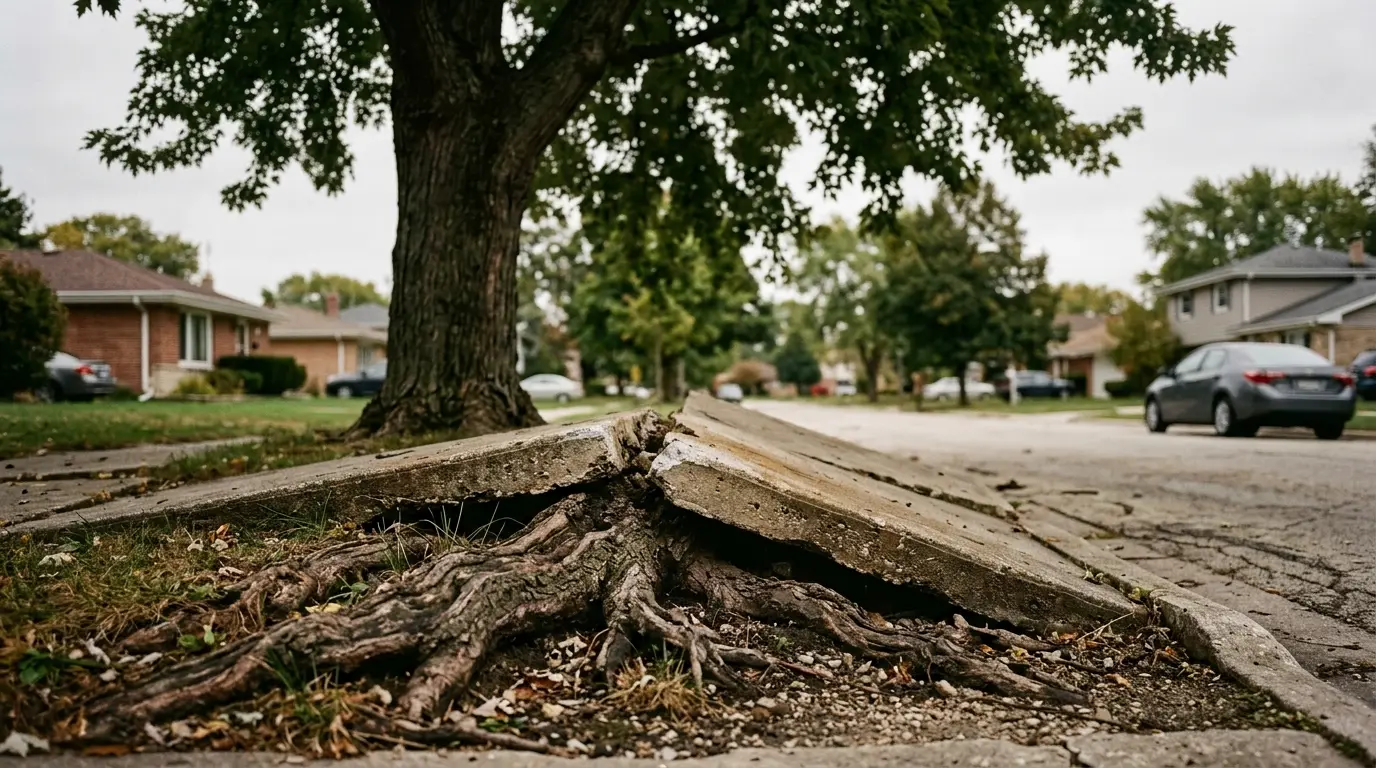
The 1950s and 1960s sections of the village were laid out with clay sewer laterals in short lengths with a joint every few feet, and then planted with silver maples, elms and willows on parkways directly above them. Sixty years later, those trees are mature, and the joints are the only place on a sealed pipe where moisture and nutrients escape. Roots do not break into good pipe; they find the gap that is already there, and then they widen it.
The seasonal pattern follows the tree, not the plumbing. Through winter, root activity is low and a partially intruded line still passes water; from May the mass thickens, catches paper and grease, and the effective diameter drops until something backs up. This is why a homeowner can honestly report that the drain has been fine for years and also that it has backed up every August since 2022.
What we actually do about it is decided by footage, and that number is the whole conversation. One intrusion point in an otherwise sound line: rodding on a two- or three-year interval is legitimate maintenance and much cheaper than digging. Intrusion at four or five joints spread over most of the run, with offset hubs and standing water in the low sections: rodding is no longer maintenance, it is a payment plan on a pipe that has already failed, and the honest recommendation is repair or replacement of the affected length.
The only way to know which of those you have is to look. A camera inspection gives distances, and distances make the decision obvious rather than a matter of opinion, including the cases where the answer is that your line is in good shape and you should keep rodding it every third summer and spend the money on something else. If the blockage is grease rather than root, the method changes too: jetting cleans the pipe wall, where a cable simply bores a channel through the deposit and leaves the rest in place.
Service line material, from the record
Illinois now requires every water system to inventory its service line materials and publish what it knows, address by address, and that inventory is where a water service conversation in Hoffman Estates should start. Look your own address up before you accept anybody's theory about your pipe. The record will say copper, or plastic, or galvanised, or lead, or it will say unknown, which is itself useful information because it means nobody has verified it and a guess is not going to settle it.
The village's build history makes the answer reasonably predictable but not certain. Housing from the mid-1950s onward is mostly copper service lines, and the later the decade the more likely plastic. Lead is far less common here than in the pre-war parts of the metro, but galvanised service lines with lead components at the connection do turn up in the oldest pockets, and a partial replacement done at some point in the last forty years can leave a house with two materials in one run.
Where the record and the pipe disagree, the pipe wins, and the check is simple: where the line enters the building, ahead of the meter, material and diameter are visible. That is also where we take a static and flowing pressure reading, because it separates a supply problem from an interior piping problem in about ten minutes.
When replacement is the right answer, it should be end to end. A partial (replacing the house side and leaving the older section from the curb stop to the main, or vice versa) disturbs scale on the pipe left behind, can raise metals for months afterwards, and means paying twice for excavation, restoration and permit. The exception is coordination: if the village has your block on a schedule to replace its own side, waiting a season and doing both at once is the cheaper and better job. That is a conversation to have before anyone quotes a service line replacement, not after.
What your build decade put in the walls
Because the village went up in distinct waves, the build decade is a reliable guide to what is behind the drywall and how it fails. Mid-1950s to late 1960s: copper supply, cast iron and copper drains, and failures that concentrate at fittings and in thin-wall sections. Where a house has spent decades on hard water and aggressive softening, the copper thins from the inside and produces pinhole leaks, typically high on a basement wall or near an elbow, and typically in threes rather than singly.
The 1970s and early 1980s brought plastic drain and vent work, solvent-welded, and CPVC supply in some subdivisions. Those systems fail at joints rather than mid-pipe: a solvent joint that was dry-fitted and never properly cemented can hold for thirty years and then weep, and CPVC becomes brittle with age and heat, so the failures cluster near the water heater. The late 1980s onward is PEX and modern copper, where the problem is almost always a fitting, a crimp ring, or a clamp that was set at the wrong depth.
There is one cross-cutting item worth naming: the water heater. On the harder water in this village, sediment accumulates faster, and a tank that could have run twelve years is often failing at eight. That is the single most predictable appliance failure in the housing stock, and a yearly flush plus an anode check genuinely moves the number.
The reason to care about the decade is that it changes the recommendation for the same symptom. A single pinhole in 1965 copper is a repair. The third pinhole in eighteen months in different rooms is the pipe reporting that its wall thickness has run out, and at that point repiping the affected branches while a ceiling is already open costs less than the fourth, fifth and sixth repairs will. A weeping CPVC joint near a water heater is a repair; brittle CPVC throughout a 1979 house that has already given you two failures is not.
How dispatch works here
Hoffman Estates sits at the western edge of our northwest coverage, next to Schaumburg and Palatine, and in practice that means a van is usually close during working hours and the drive is the shorter part of the response. Water actively coming in moves ahead of everything else; a slow drain in August, honestly, does not, and we will say so on the phone rather than give you a window we will miss.
The details that change what we send: for a drain, when it last backed up and whether it has ever been rodded or camera'd; for a supply problem, whether it is one fixture or the whole house and whether it is worse upstairs; for a service line question, what the village inventory says about your address. A rodder, a jetter and a camera are three different trucks, and the ten minutes on the phone is what stops us arriving with the wrong two.
What We Dispatch For
Services called in most often around here
Nearby
Neighbouring communities
Part of Northwest Suburbs, see the whole region for what these towns have in common underground.
Common Questions
Answers before you call
Why is my water pressure worse upstairs than down?
Some of it is physics you cannot argue with: every foot of height costs you a little under half a pound of pressure, so a second-floor shower reads eight or nine pounds lower than the basement hose bib on the same system. If that is the whole story, the upstairs is merely less generous, not weak.
The version worth fixing is when the difference is large, or when it got worse. Three causes, in order of likelihood in Hoffman Estates. Undersized or restricted branch piping, common where a 1960s or 1970s house has had a bathroom added off a half-inch run that was already feeding two fixtures. Scale and corrosion narrowing the pipe, which is a real issue in the older parts of the village that spent decades on hard well water before the switch to Lake Michigan supply. And a failing pressure regulator or a partially closed valve somewhere upstream, which shows up as low pressure everywhere but is noticed upstairs first.
The measurement that sorts this out takes ten minutes: static and flowing pressure at an outside hose bib, then the same at the highest fixture. A big static drop between the two means the supply into the building is the problem. Good static and a big drop as soon as water moves means the pipe inside the walls has closed up, which is a repiping conversation rather than a valve one.
Who is responsible when the problem is under the street?
Two different answers, depending on which pipe. For the sanitary sewer, the property owner in Hoffman Estates is responsible for the service line from the building all the way to the connection at the village main, parkway and pavement included. For water, the split is at the point defined in the village code, typically at or near the curb stop, with the village responsible for the main and its own side of the connection.
So the useful question is not who owns the street but where the defect is, and that is a factual matter rather than a negotiation. A camera puts a distance on it. If the intrusion is at thirty-one feet and your lateral is fifty-two feet long, it is inside your run and the repair is yours. If the camera reaches the main and the failure is at the main, that is the village's, and we will give you the footage and the recording to take to them.
Where it gets genuinely shared is a village-owned parkway tree whose roots are in your lateral. The tree is not yours; the pipe is. Municipalities almost never pay for the pipe, but some will remove or root-prune the tree as part of the resolution, and it is worth asking, particularly if you are about to open the parkway anyway and the tree will otherwise put the same roots back in the same joint.
How long will the water be off?
For most repairs, under two hours. A water heater changeout, a fixture, a valve replacement, a soldered repair on an accessible line: we shut down, do the work, and bring it back the same visit. We will tell you the window before we close the valve, and we would rather quote you three hours and finish in ninety minutes than the reverse.
The long ones are the ones that involve the ground. A water service replacement means no water from the time we cut in until the new line is pressure-tested and the meter is reconnected, realistically a full working day, occasionally spilling into a second if the village inspection lands late or the ground is frozen. Repiping a house in stages keeps water on overnight; doing it in one pass does not.
What we do about it is planning rather than heroics. Fill what you need before we start, know that the water heater will be cold for a few hours after the water returns, and expect discoloured water and air in the lines for the first few minutes at every tap, run the lowest fixture first and let it clear before the upstairs ones. If someone in the house has a medical need for continuous water, tell us at booking, because that changes how we sequence the job rather than whether we can do it.
You have been out before for this. Why is it back?
If it is a drain, because rodding cuts roots and roots grow back. That is not a failure of the work; it is what rodding is for. A cable clears the blockage and restores the line to its usable diameter, and then the same tree puts the same roots through the same joint over the following season or two. Any plumber who told you a rodding was permanent on a clay lateral under a mature parkway tree was selling something.
What should change is the plan, not the method. Two visits in three years on a fifty-foot line with one intrusion point is normal maintenance and cheaper than a repair. Two visits in twelve months, or intrusion at several joints across most of the length, means the line has lost the argument and rodding has become a subscription. We put a camera down before recommending a third clearing of the same line, because the footage is what tells you which of those two situations you are in.
For grease and soft blockages the answer is different: rodding leaves the pipe wall coated, and if it keeps coming back at the same interval the line wants jetting to actually clean the wall rather than another hole bored through the middle of the deposit.
Is there anything a yearly service visit would catch?
Genuinely yes, and mostly cheap things that turn expensive. On a yearly pass we look at the water heater's anode and relief valve and flush the sediment out of the bottom, sediment is what turns a twelve-year tank into an eight-year tank, and on the hard-water side of this village it accumulates faster than most people expect. We exercise the main shutoff and the fixture stops, because a valve that has not moved in fifteen years is a valve that will not close on the night you need it. We check supply lines to the washing machine and the dishwasher, which are the single most common cause of a genuinely destructive indoor flood.
Outside, we look at the hose bibs and whether they were actually winterised, the sump pump and its check valve and backup, and the discharge line's route and pitch. In the crawl and basement we look for the pinhole history: green staining at fittings, dampness on a joist above a run, a drip you have been ignoring.
What a yearly visit will not do is predict the sewer lateral, which is why we schedule a camera on a longer interval, typically every three to five years on a house with a known root history, and once before you finish a basement. The point of the annual visit is the machines and the valves. The point of the camera is the pipe you cannot see.
Tank or tankless?
In the housing stock here, the deciding factor is usually the gas line and the venting rather than the appliance. A typical Hoffman Estates house from the 1960s through the 1980s has a gas system sized for a forty-thousand BTU tank; a tankless unit wants roughly four times that, which often means a larger gas line run back toward the meter, and sometimes a meter upgrade. Add stainless venting and a condensate drain, and the installed cost is meaningfully higher than the sticker difference suggests.
When it is worth it: a household that runs out of hot water with a fifty-gallon tank, a finished basement where reclaiming the floor space and removing a flood risk both matter, or a long-term hold where twenty years of better efficiency pays back the install. When it is not: a straightforward swap for a family whose current tank comfortably keeps up, or a property you expect to sell inside a few years.
The middle answer that suits a lot of houses here is a well-specified tank with a softener ahead of it and a yearly flush, which gets most of the life extension without the gas and venting work. If you do go tankless, budget for the annual descale, because on harder water an un-serviced tankless loses capacity in a way that feels exactly like a failing unit.
Drain slowing down again this summer?
If a line backs up at the same time every year, the question is not how to clear it. It is how many feet of the lateral the roots are actually in. That is a camera answer, and it is the difference between annual maintenance and a repair you only pay for once.
24/7 · Chicago metro dispatch · (833) 615-3680