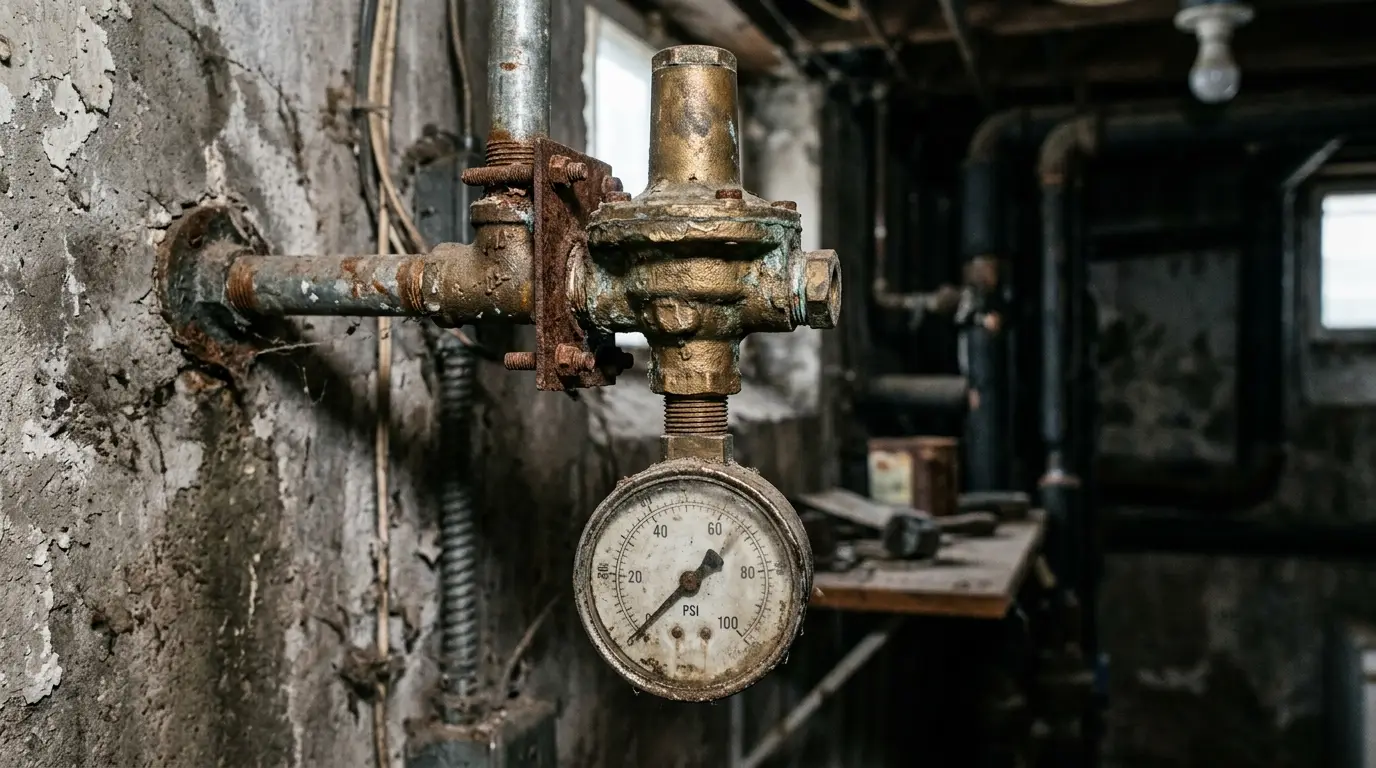
Pressure regulators, and the difference between pressure and flow
A ten-dollar gauge on a hose bib settles most of this. High pressure damages a house quietly for years; low flow is usually a different problem wearing the same clothes.
Measure it first
Almost everything on this page follows from one number, and the number costs about ten dollars to obtain. A screw-on pressure gauge at an outside hose bib or a laundry tap, with nothing else running in the house, reads static pressure directly.
Three readings are worth taking rather than one.
Static pressure, daytime. Nothing running, gauge open, read it.
Static pressure overnight. Leave the gauge on with the needle-hold feature, or read it early in the morning. Street pressure rises when the neighbourhood stops drawing water, and a system that reads 72 psi in the afternoon can be sitting at 95 psi at four in the morning. A gauge that records the maximum reached is the single best diagnostic tool a homeowner can own.
Pressure with a fixture running. Open a nearby tap and watch the gauge. A small drop is normal. A large drop is a flow restriction (a supply problem, not a pressure problem), and it points at the service line or the interior piping rather than at a regulator.
Then interpret. Under 40 psi is low enough to be a complaint. Between 50 and 70 psi is the comfortable band. Over 80 psi is beyond what codes generally permit at fixtures and needs regulating. Over 100 psi is doing active damage and is not unusual in parts of this metro, particularly on the pressure zones that serve higher ground or the ends of long mains.
The reading that matters most
The overnight maximum, not the afternoon figure. Pressure damage accumulates at the peak, and the peak happens when nobody is awake to notice it.
What high pressure does
High pressure is a slow, expensive fault that presents as a series of unrelated-looking problems. Recognising the pattern is what turns five service calls into one.
Fixtures wear out early. Tap cartridges, toilet fill valves, and shower valves are designed for a pressure range. Above it, seals extrude and seats erode, so taps drip and toilets run. A house where every fixture seems to need attention at once is often a pressure problem rather than bad luck with fixtures.
Appliance hoses and valves fail. Washing machine and dishwasher fill valves and supply hoses are common casualties, and a washing machine hose failure while nobody is home is one of the more damaging things that happens to a house. Braided stainless hoses and a habit of replacing them every five years are cheap insurance either way.
Water hammer. The bang when a tap or a solenoid valve closes is much louder and more damaging at high pressure. Repeated hammer loosens joints and fatigues pipe over years.
The water heater suffers. High pressure stresses the tank, and combined with the closed-system effect described below it produces relief valve discharge, which is what most people notice first.
Small leaks become large ones. A pinhole in old copper that would weep at 55 psi sprays at 100. When something does let go, see burst pipe repair, the volume that escapes before anyone finds it scales with the pressure behind it.
Water is wasted. A running toilet, a dripping tap, and an irrigation head all pass more water at higher pressure. On a metered supply that is a bill rather than an abstraction.
What a regulator is and where it goes
A pressure-reducing valve is a simple mechanical device: a spring-loaded diaphragm that throttles the incoming water so that the downstream pressure stays near a set value regardless of what the street is doing. No power, no controls, nothing to program.
Its position matters. It belongs on the incoming supply, downstream of the meter and the main shutoff, upstream of everything it is meant to protect, which is the whole building. In a typical Chicago-area basement that means within a few feet of where the service line enters, ahead of any branch takeoffs, any softener or filtration, and the water heater.
Two arrangements that cause trouble. A regulator fitted after the first branches leaves those branches unregulated, which defeats the purpose and produces a house where some fixtures suffer and others do not. And a regulator fitted with no shutoff or union either side turns every future replacement into a pipe-cutting exercise.
Good practice on a new installation: a full-port shutoff before the regulator, unions either side, a pressure gauge downstream so the setting is readable without tools, and enough space around it to get a wrench on the adjusting nut. Where the building's incoming pipe is old galvanized, this is frequently the moment to renew that short section rather than thread a new valve onto a corroded nipple.
Closed systems and thermal expansion
This is the part that surprises people, and it is the reason a regulator is never quite a standalone fitting.
Without a regulator, a building's plumbing is open to the street: when the water heater warms its contents and the water expands, that expansion pushes gently back into the main and nothing happens. Fit a regulator (or a check valve, or a meter with integral backflow prevention), and the system becomes closed. Now the expansion has nowhere to go, and because water is effectively incompressible, pressure climbs steeply on every heating cycle. It is common to see a system settle at 60 psi and spike well past 100 psi each time the heater fires.
The symptoms are exactly the high-pressure list above, plus the tell-tale one: a temperature and pressure relief valve on the water heater that weeps or discharges for no other apparent reason.
The fix is an expansion tank on the cold feed to the water heater, and three details decide whether it works. It must be pre-charged to match the measured static pressure, a tank left at its factory charge does part of the job at best. It must be supported, not hung off a half-inch nipple, because a waterlogged tank is heavy. And it should be checked every year or two, because a tank that has lost its air charge is invisible until the relief valve starts dripping again.
So the correct scope, whenever a regulator is fitted to a building that did not have one: regulator, gauge, and expansion tank together. Fitting the first without the third simply changes which component complains.
Over 80 psi on the gauge, or a relief valve dripping every evening? That is a half-day job with a lasting payoff.
Call about a regulatorHow a regulator fails
Regulators do not usually break; they drift. Recognising the two directions saves a lot of misdiagnosis.
Creeping upward. The seat wears and the valve gradually stops holding its setting, so downstream pressure climbs toward street pressure. The household notices new banging, taps that start dripping, or a relief valve discharging, and treats each as its own problem. A gauge reading identifies it in a minute. Adjustment may recover it briefly; if the setting will not hold, the valve is finished.
Failing closed or restricted. Internals fail or debris lodges in the valve, and the house loses pressure everywhere simultaneously. This is distinguishable from a flow problem by the gauge: a regulator failing closed shows low static pressure, while a flow restriction shows normal static pressure that collapses when a tap opens.
Noise. A regulator that whistles or hums is usually operating far outside its intended pressure range or is partially obstructed. It is a symptom rather than a nuisance to live with.
Two things worth knowing about age. Many of these valves were fitted when the house was built and are older than the people complaining about them, and rebuild kits exist for some bodies but the labour to fit one is close to the labour to replace the valve. Where the surrounding pipe is sound and accessible, replacement is usually the better value.
Low pressure, or low flow?
Half the calls that come in about "pressure" are about flow, and diagnosing the wrong one wastes money. The gauge separates them cleanly: attach it, read static pressure, then open a tap and watch.
Static pressure low. Genuinely a pressure problem. Candidates: a regulator failed closed or set too low, a partially closed main shutoff or b-box valve, a meter or utility-side issue, or a genuinely low-pressure zone in the municipal system.
Static pressure fine, pressure collapses when a tap opens. A flow problem, and the causes live in the pipe rather than the pressure. An undersized service line, three-quarter-inch service into a house with two bathrooms is a common legacy in this housing stock. A corroded or partially blocked service line, which is the subject of main water line repair. Galvanized interior piping narrowed by scale, which is the subject of whole-home repiping. A clogged aerator or shower cartridge, if it is one fixture only. Or a partially closed valve somewhere along the way.
One fixture weak, everything else fine. Almost always the fixture: aerator, cartridge, angle stop, or a supply line kinked behind a vanity.
Hot water weak, cold fine. Points at the water heater or its shutoff rather than the supply, a partially closed valve on the cold inlet, or scale in the heater.
The reason this matters commercially: no regulator adjustment will improve a flow problem, and a household that has had a regulator fitted to solve weak showers has bought the wrong thing. We would rather establish which it is with a gauge in five minutes.
Fitting or replacing one
What the work involves, so there are no surprises.
The water is shut off at the main, or at the b-box where the interior valve is not trustworthy, and on older houses that valve frequently is not, which is why a new full-port shutoff often goes in at the same time. The pipe is opened at the chosen position, the old regulator removed or the new one's tees prepared, and the valve set in the correct orientation with the flow arrow the right way round, which sounds obvious and is a real error.
Unions and shutoffs go either side, a gauge goes downstream, and where the incoming pipe is galvanized the corroded section gets renewed rather than reused. Then the expansion tank if the system is now closed and does not have one, pre-charged to the pressure the regulator is being set to. Water back on, air purged, and the setting adjusted with the gauge reading rather than by feel.
Two further items on this housing stock. Where the metal water service forms part of the building's electrical grounding path, cutting it interrupts that path, and a bonding jumper across the work restores continuity, not optional. And where the incoming pipe turns out to be lead rather than galvanized or copper, the conversation changes entirely and belongs under water service line replacement, because disturbing lead pipe has its own consequences.
Typical duration for a straightforward basement replacement is two to three hours. A first-time installation where a shutoff, unions, and an expansion tank all go in with it is a half day.
Setting it, and living with it
Set it between 50 and 65 psi in most houses. Toward the upper end where the building is three storeys or the household dislikes a soft shower on the top floor; toward the lower end where fixtures are old, the piping is aged copper, or there is any history of leaks.
Adjustment is done with a gauge attached: loosen the lock nut, turn in small increments, open a tap briefly to let the system settle at the new setting, then read and re-tighten the lock nut. Guessing at a tap is not adjustment.
Then two habits. Read the gauge once a year, ideally with a maximum-recording gauge left on overnight, so a creeping regulator is caught before it costs fixtures. And check the expansion tank's charge at the same time, tapping it gives a rough answer, a tyre gauge on the valve with the system depressurised gives a real one.
One last note for anyone with irrigation or a fire sprinkler system. Both have their own pressure requirements and both may sit upstream or downstream of the house regulator depending on how they were installed. Changing the house setting can affect them, so it is worth knowing which side of the valve they are on before making a change.
What drives the cost
Directional rather than quoted, and this is one of the better-value jobs on the site: the parts are inexpensive and the damage they prevent is not.
Replacement versus first installation. Swapping a like-for-like regulator where unions already exist is a short job. A first installation means cutting into the incoming pipe, adding shutoffs and unions, and often an expansion tank as well.
The expansion tank. Modest in itself, and it should be counted as part of the job rather than an upsell, a closed system without one will show up as a dripping relief valve within weeks.
What the surrounding pipe is made of. Sound copper is straightforward. Corroded galvanized means renewing a section, and a seized old shutoff means shutting down at the b-box, which adds time.
Access. A basement meter at chest height is easy. A crawl space, a meter pit, or a regulator buried behind finished walls in a condo is not.
Whether the b-box has to be operated. Where the interior main shutoff will not close, the shutoff at the parkway is used, which sometimes means coordinating with the water department.
Gauges and shutoffs. Small money, and worth every dollar for the next fifteen years of diagnosis.
If your gauge reads 60 psi and your relief valve is dry, the honest answer is that you do not need us for this, and we will say so.
Common Questions
Answers before you call
What should my water pressure be?
Somewhere between 50 and 70 psi suits most houses: enough for a good shower on an upper floor, gentle enough on the plumbing to be sustainable. Codes generally cap static pressure at fixtures at 80 psi, and above that a regulator is required rather than optional.
Below about 40 psi the household starts to notice, particularly on a second floor or when two fixtures run at once. The number to measure is static pressure with nothing running, taken at an outside hose bib or a laundry tap.
How do I know if I have a pressure regulator?
Look at the incoming water pipe just after the meter, or just after it enters the building. A regulator is a bell-shaped bronze or brass body, usually four to six inches long, with an adjusting screw and lock nut on top. If the pipe runs straight from the meter to a tee with nothing bell-shaped in it, there is probably no regulator.
Its absence is not automatically a fault. Where street pressure is moderate, plenty of houses have never needed one. It becomes a fault when the measured static pressure is above 80 psi.
My pressure is fine but the flow is weak. Why?
Because pressure and flow are different things, and this is the single most useful distinction on this page. Pressure is the force available at rest; flow is how much water can actually move through the pipe. A house can show a healthy 65 psi standing still and still deliver a disappointing shower.
The usual causes of poor flow with good pressure are an undersized or corroded service line, galvanized interior piping narrowed by decades of scale, a partially closed valve at the meter or the b-box, or simply too many fixtures on too small a branch. Fitting or adjusting a regulator does nothing for any of them.
Why does my relief valve on the water heater keep dripping?
In a large majority of cases it is thermal expansion rather than a faulty valve. If the building has a regulator, a check valve, or a meter with backflow prevention, the plumbing is a closed system: when the heater warms 50 gallons of water, the expansion has nowhere to go and pressure climbs sharply until the relief valve lifts.
The fix is an expansion tank, pre-charged to the measured static pressure. Replacing the relief valve without addressing the expansion removes the messenger and leaves the message.
How long does a regulator last?
Ten to fifteen years is the working expectation, and they rarely fail cleanly. The two failure modes are creeping (the outlet pressure slowly rises toward street pressure, often noticed first as a weeping relief valve or new banging), and failing closed or partially closed, which presents as a house that has gradually lost pressure everywhere at once.
Because the drift is gradual, a gauge reading once a year is a genuinely worthwhile habit in a house that has one. A regulator that cannot be brought back to setting by adjustment has reached the end of its life.
Can I adjust it myself?
You can, and it is a reasonable thing for a homeowner to do carefully: loosen the lock nut, turn the adjusting screw in small increments (clockwise raises, anticlockwise lowers), and watch a gauge on a hose bib while you do, then re-tighten the lock nut.
Two cautions. Adjust with a gauge attached rather than by feel at a tap, because the tap tells you about flow, not pressure. And if the adjustment produces no change, or holds for a day and drifts back, the regulator is not out of adjustment, it is finished, and continuing to wind it up puts the whole system above 80 psi with nothing limiting it.
Banging pipes, or a relief valve that keeps weeping?
Both are usually pressure or thermal expansion rather than the fixture that is complaining. A gauge reading takes two minutes and tells us most of it.
24/7 · Chicago metro dispatch · (833) 615-3680