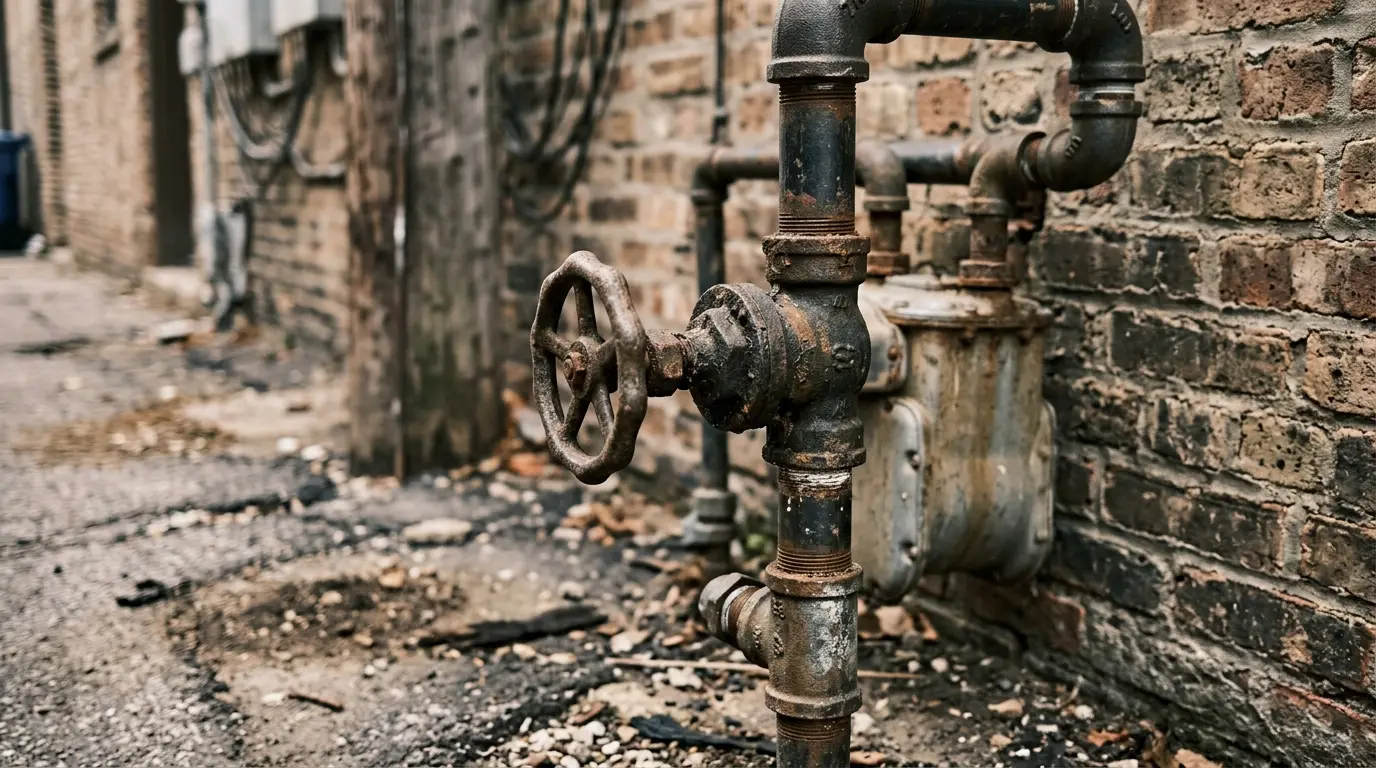
Gas line work, sized and tested rather than assumed
Gas piping is arithmetic before it is craft: total the appliance loads, measure the developed length, then choose the pipe. Skipping that step is how a new range starves the furnace.
If you smell gas, read this first
Gas work has a hierarchy: safety, then supply, then convenience. If there is a smell of gas in the building right now, this section is the only part of the page that matters.
Leave. Take everyone with you, including pets. Do not operate light switches, appliances, or the garage door opener, and do not use a phone inside the building. Any of those can provide an ignition source.
Do not hunt for the leak. That is not a homeowner's job, and a strong smell means the concentration is already significant.
Close a valve only if it is safely on your way. The appliance shutoff, or the valve at the meter if it is outside and accessible. Do not go looking for it in a basement that smells of gas.
Call the gas utility's emergency line from outside. They respond around the clock, they do not charge for a leak investigation, and they have authority to shut the supply and lock the meter. Do that before you call anyone else, including us.
Then call for repair. Once the utility has made the supply safe, they will typically leave the appliance or the section they identified as faulty locked out. Restoring it is the plumbing work: find the fault, repair or replace the piping, pressure test it, and get it inspected where the municipality requires it.
Two additional signals worth treating with the same seriousness. A hissing sound near a gas appliance or meter. And symptoms in the household (headaches, nausea, drowsiness that improves outdoors), which point at carbon monoxide from incomplete combustion rather than a gas leak, and which are an immediate call to emergency services followed by a combustion and draft investigation. Every level of a building with a fuel-burning appliance needs a working carbon monoxide alarm; it is the cheapest safety device in the house.
The order that matters
Out of the building, utility first, repair second. A gas leak is one of the few plumbing situations where the correct first call is not to a plumber.
Who owns which part of the system
Confusion here wastes time on the phone, so it is worth stating plainly.
The gas utility owns the main in the street, the service line to the building, and the meter itself, including the valve at the meter. They are responsible for leaks on that side, they perform meter changes and capacity upgrades, and they respond to leak reports without charge.
Everything downstream of the meter belongs to the property: the house piping, the shutoffs, the appliance connectors, and the appliances. That is the work described on this page.
Three practical consequences. A meter upgrade for a larger load is requested from the utility and has a lead time, so it belongs at the start of a project rather than the middle. A leak reported on the house side will be isolated by the utility, not repaired. They will shut it off and leave it to a plumber. And where a project involves both (a tankless heater needing both a larger meter and a larger branch, for instance) the sequence has to be coordinated so the new piping is ready when the meter changes.
Sizing: the arithmetic that decides everything
This is the part that separates gas piping that works from gas piping that produces intermittent complaints for years, and it is arithmetic rather than judgement.
Every gas appliance has an input rating in BTU per hour on its data plate. A furnace might be 80,000. A water heater 40,000. A range 65,000 with all burners and the oven going. A dryer 22,000. A tankless water heater 150,000 to 199,000, which is why that appliance so often forces this conversation.
Three checks follow.
Does the meter cover the total? Meters have a capacity rating, and the sum of connected appliance inputs has to fit inside it with margin. Where it does not, the utility supplies a larger meter.
Can each pipe segment carry its share? Capacity depends on diameter, the total developed length from the meter to the appliance, and the number and type of fittings along the way, which add equivalent length. Longer runs carry less. This is why a half-inch branch that has fed a dryer happily for twenty years cannot feed a tankless heater fifty feet from the meter, and why the answer is usually a larger-diameter branch rather than a longer one.
Does pressure hold under load? The test that matters is measured pressure at the appliance with every other appliance firing, not at rest. A system that reads correctly with nothing running and starves the furnace when the range is lit is a sizing failure, and it presents as nuisance faults on whichever appliance is furthest away.
One further variable in this region: some buildings, particularly larger ones and those with generators or high-load equipment, run elevated gas pressure with a regulator at each appliance. That changes the sizing arithmetic substantially and it is worth identifying at the start.
Pipe materials and what is used here
Four materials appear in Chicago-area gas systems, and which is appropriate depends on the jurisdiction as much as on the application.
Black steel pipe, threaded. The traditional and still dominant material for interior gas piping here, and the default in the city. Durable, mechanically robust, and unaffected by the rodents and physical knocks that a basement provides. Labour-intensive to install because every joint is cut, threaded, and made up.
Corrugated stainless steel tubing. Flexible, fast to install, and routed through joist bays and stud cavities in long single lengths. Widely permitted in the suburbs and historically restricted in Chicago itself. Where it is used, two requirements are non-negotiable: physical protection where it passes through framing, and bonding to the electrical grounding system exactly as the manufacturer specifies. That bonding requirement exists because of the tubing's thin wall, and it is skipped often enough that we look for it on every inspection of an existing system.
Copper. Permitted for gas in some jurisdictions and not others, depending in part on the gas composition being distributed. Not something to assume either way.
Polyethylene. For buried exterior runs only (a line out to a garage, a pool heater, or a generator), with the transition to steel above grade, and with tracer wire so the line can be located later. Never used inside a building.
Whatever the material, three rules apply. Piping is supported at the intervals its material requires rather than allowed to sag. It is protected wherever it can be struck, and sleeved where it passes through masonry. And joints are made up with a compound rated for gas, not for water.
Appliance connections and the details that fail
Most gas faults we are called to are not in the pipe run. They are at the last three feet.
A shutoff at each appliance. Accessible, in the same room, and reachable without moving the appliance. This is what lets a range be pulled out or a dryer replaced without shutting down the whole house, and it is what a homeowner needs in an emergency.
A sediment trap before the appliance valve. Described in the questions below. Cheap, required, and routinely omitted.
A new flexible connector, correctly rated and correctly sized. Connectors are not permanent fittings and they are not reusable, reusing an old one on a new appliance is a false economy with a bad failure mode. They must also not pass through a wall or a cabinet partition; where the appliance is not immediately adjacent to the outlet, the piping goes to the appliance and the connector stays short.
No connector under strain. Kinked, stretched, or pinched behind a range being pushed back into place is the single most common defect we find in kitchens.
Every joint leak-tested. Soap solution or an electronic detector at each connection, with the appliance running, before the job is called finished. Not by smell.
Combustion air and venting considered. Adding a fuel-burning appliance to a basement adds to that room's combustion air demand. In the increasingly air-sealed housing stock here, that is a real constraint rather than a formality, and it interacts with the draft on any natural-vent appliance already there, the issue described under water heater repair.
Suspect a small leak, a faint smell near an appliance that comes and goes? Have the utility check it first, then call us for the repair.
Call about a gas repairFinding a leak properly
Leak detection on gas piping is methodical, and the methods are worth knowing because they establish whether a repair is targeted or exploratory.
Soap solution at joints. Unglamorous and highly effective on accessible threaded connections. Bubbles do not lie.
Electronic gas detection. A combustible gas detector sweeps a run and finds concentrations well below what a nose registers. Useful along inaccessible runs and around appliances.
Pressure decay testing. The definitive method for a system or an isolated section: the section is isolated, pressurised with air to the required test pressure, and watched on a gauge for the required period. A pressure that holds proves the section; a pressure that falls proves a leak exists, though not yet where.
Sectional isolation. Where a test fails, the system is divided and retested progressively to bracket the leak into one segment. This is how a leak inside a wall or under a slab is located without opening everything.
Then the repair. A leaking threaded joint is remade rather than tightened, tightening a threaded joint that has already been made up frequently makes it worse. Corroded pipe is cut back to sound material and replaced, not patched. And a run that has corroded once, typically where it passes through masonry or sits in a damp basement corner, is inspected along its whole length, because the condition that produced one failure produced it everywhere.
One category worth naming: abandoned lines. Older houses here often contain runs from gas lighting or an appliance removed decades ago. A dead leg that is properly capped at a live tee is acceptable; a long abandoned run left in the fabric of the building, capped with an untested plug or ending at a valve behind plaster, is worth cutting back to the live main and capping properly.
Pressure testing, permits, and inspection
New gas piping is proven before it carries gas, and that proof is a pressure test: the new work is isolated, pressurised with air, and held at the pressure and for the duration the local code requires while a gauge is watched.
In most municipalities in this metro, new gas piping and added appliance runs are permitted and inspected work. The inspection covers pipe material and size, support and protection, shutoffs and sediment traps, bonding where flexible tubing is used, and the pressure test itself. Where a meter change is involved, the utility has its own process running in parallel.
This is worth doing properly for reasons beyond compliance. The pressure test is the only independent evidence that the piping holds. The inspection is the only independent check on the details that become invisible once the drywall goes back. And unpermitted gas alterations reliably surface during a property sale, where they cost far more to resolve under time pressure than they would have cost to permit.
Two process notes specific to this region. Municipal requirements genuinely vary (Chicago's rules differ from those of the suburbs around it, and suburbs differ from each other), so the answer to "what is required" is local rather than general. And in a two-flat or a condo, gas work frequently touches common piping, which brings the association or the other owner into the conversation before the work rather than after; that is the territory covered under multi-unit building plumbing.
Common projects
What people actually call about, and what each involves.
A gas range in a kitchen that has never had one. A new branch from the basement up into the kitchen, an accessible shutoff, and the routing question, which usually means finding a path in a joist bay or a cabinet run. In a house with plaster walls this is as much a carpentry problem as a plumbing one.
A gas dryer replacing an electric one. A branch to the laundry area, a shutoff, and confirmation that the dryer's exhaust duct is correct, because a gas dryer's venting matters more than an electric one's.
A patio grill or fire feature. A buried polyethylene run with tracer wire, a transition and shutoff above grade, and a keyed valve where one is required. The advantage over cylinders is never running out mid-cook; the constraint is that the trench has to go somewhere and locates have to be done before it is dug.
A standby generator. Frequently the largest single load on a residential system, and almost always the project that forces a meter capacity conversation. Sizing here is done against the generator's full-load input, not its average draw.
A tankless water heater. The most common driver of gas work in this metro, for the reasons set out under tankless water heater installation.
Capping off for a remodel or an appliance removal. Cut back to the live main, cap properly, pressure test the remaining system. Done properly it is a small job; done badly it leaves a hazard inside a wall.
What drives the cost
Directional rather than quoted.
Length and diameter of new pipe. The core of most quotes. A short run in an open basement is inexpensive; a long run in larger-diameter steel is not.
Routing difficulty. Open joists in an unfinished basement are the easy case. Finished ceilings, plaster walls, masonry penetrations, and getting from a basement to a second floor all add hours and, sometimes, patching.
Material and jurisdiction. Threaded black steel is labour-intensive; flexible tubing is faster where it is permitted. The municipality decides which is available to you.
Meter or capacity work. A utility meter upgrade has its own timeline and its own cost structure, separate from the plumbing.
Excavation for exterior runs. Trenching to a garage, a grill, or a generator, plus locates, plus restoring what was dug.
Permit and inspection. Near-universal on new piping here, and a legitimate line item rather than an overhead.
What the test reveals. Occasionally a pressure test on an older system finds a pre-existing leak in piping nobody intended to touch. That is a genuinely good outcome, and we will show you the gauge rather than simply add a line to the invoice.
Common Questions
Answers before you call
I can smell gas. What should I do right now?
Leave the building, taking everyone with you, and do not operate anything electrical on the way out: no light switches, no garage door, no phone until you are outside. Do not try to find the leak. If you can reach the appliance shutoff or the meter valve safely on your way past, close it; if not, leave it.
From outside, call your gas utility's emergency line first, they respond to reported leaks around the clock and at no charge, and they have the authority to shut off the supply. Call us after the supply is safe, for the repair and the retest.
Can I add a gas range or dryer to my existing piping?
Often, but it has to be established rather than assumed. Every appliance has a BTU input rating, and the sum of all of them must fit within what the meter can deliver and what the piping can carry over its actual length. A new range on a system already running a furnace, a water heater, and a dryer can be the load that tips it.
Where the existing piping is inadequate the answer is usually a larger branch run back toward the meter rather than replacing everything. Where the meter itself is the limit, that is a request to the utility, which is routine but not instant.
Is flexible gas tubing allowed here?
It depends on the jurisdiction, and this metro is not uniform. Corrugated stainless steel tubing is widely used in much of the country and permitted in many suburbs here; Chicago itself has historically been considerably more restrictive and rigid steel pipe remains the norm in the city.
The practical answer is that we work to the rules of the municipality the property is in, and where flexible tubing is used it must be bonded to the electrical system in the manner the manufacturer requires, a step that is skipped often enough to be worth naming.
Do I need a permit for gas work?
For new piping, an added appliance run, or a meter change, generally yes. Gas work is permitted and inspected in most municipalities in this region, and the inspection includes a pressure test on the new piping. Simply replacing an appliance connector on an existing outlet is usually not permit work.
It is worth doing properly. The pressure test is the only proof the new piping holds, and an unpermitted gas alteration is a problem that resurfaces at the point of sale, often at the worst possible moment in a transaction.
What is a sediment trap and why does my appliance need one?
A short capped nipple pointing down, fitted in the gas line just before the appliance's control valve. Debris and moisture carried in the piping drop into it instead of reaching the valve, where they cause intermittent faults that are difficult to diagnose.
Most appliance manufacturers require one and most codes do too, and it is one of the most commonly omitted fittings on otherwise tidy installations. On a new water heater or furnace it costs almost nothing to include.
There is an old capped gas line in my wall. Is that a problem?
It depends entirely on how it was capped and whether it is still connected to live piping. Older Chicago-area houses commonly contain abandoned runs from gas lighting or a long-removed appliance, and a run that is properly capped at a live tee is a normal, acceptable condition.
What is not acceptable is a line left with a valve and no cap, a line capped with a threaded plug that has never been tested, or a line hidden inside a wall with no access. Any of those is worth pressure testing and, where the run has no future use, cutting back and capping at the live main rather than leaving a long dead leg in the fabric of the house.
Adding a range, a dryer, or a grill line?
The first question is whether the meter and the existing piping have the capacity. That is a ten-minute conversation and it decides the whole job.
24/7 · Chicago metro dispatch · (833) 615-3680