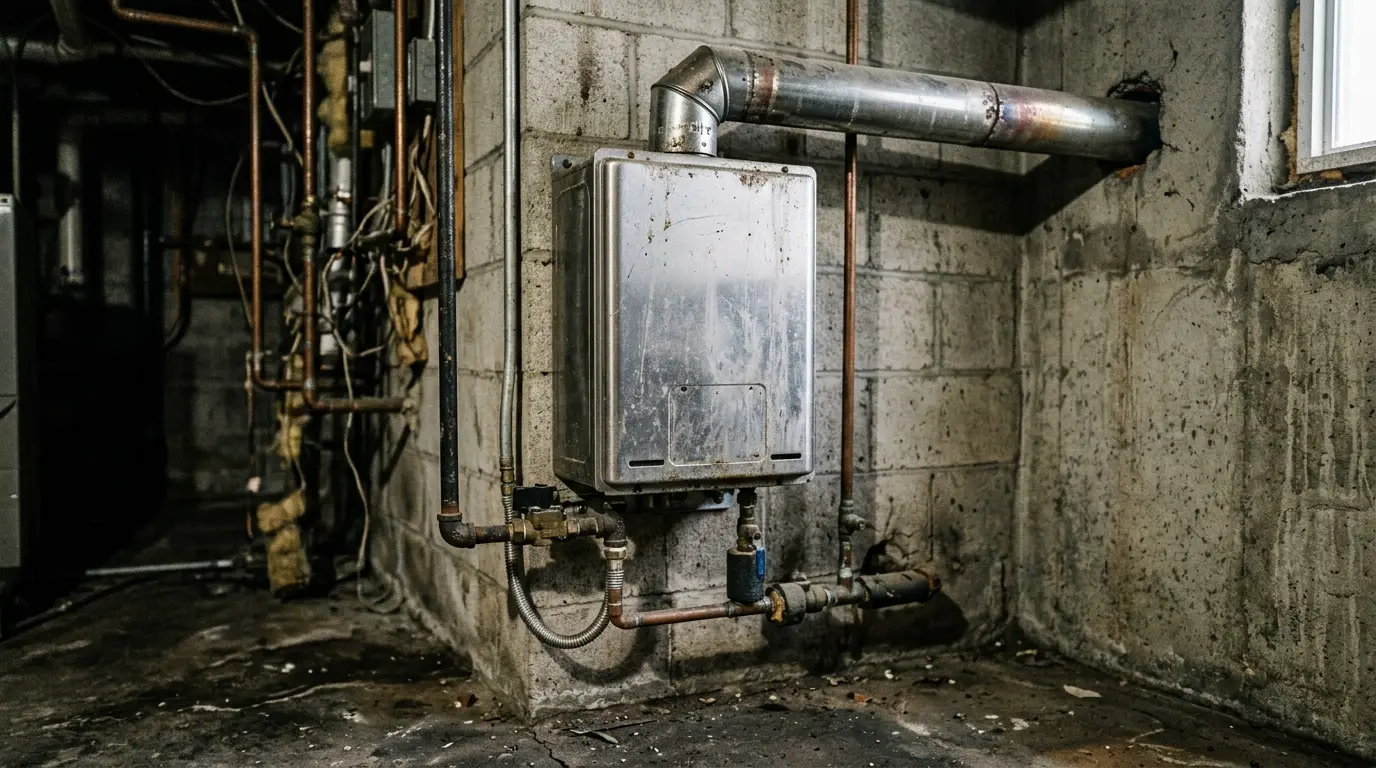
Tankless water heaters, and whether yours is a good candidate
Endless hot water is real. So are the gas line, the vent, a 40 °F winter inlet temperature, and descaling on a schedule. This page covers all five before anything is ordered.
How a tankless heater behaves
A tank heater stores hot water and reheats it. A tankless heater stores nothing and heats water as it passes through a heat exchanger, firing only when a tap opens. That single difference produces every advantage and every limitation worth knowing about.
The advantages are straightforward: no stored volume to run out, no standby loss between draws, a footprint the size of a small suitcase on a wall, and a service life that commonly runs fifteen to twenty years rather than eight to twelve, because there is no steel shell sitting full of hot water waiting to corrode.
The limitation is that performance is expressed as flow rather than capacity. A tankless unit can raise a certain number of gallons per minute by a certain number of degrees. Demand more flow than that and the temperature drops, the water keeps coming, but not as hot as you asked for. So the sizing question is not "how many people live here" but "how many fixtures run at once, and how cold is the water arriving".
That second half is where this region asserts itself, and it gets its own section below.
The three things that decide the job
Gas supply, vent route, and water hardness. Everything else (brand, model, mounting position) is detail. If any of those three is a problem, it is better known before an appliance is ordered.
Are you a good candidate?
Some households are obviously suited and some obviously are not, and the honest assessment takes about ten minutes on the phone.
Good candidates. A household that regularly runs out of hot water with a correctly working tank. A small basement or a condo closet where the floor space genuinely matters. A house with a large soaking tub that a tank cannot fill. An owner planning to stay long enough to see the payback and willing to do the annual descaling. A property where the existing gas service is already generous, often the case where a large old boiler was once fed.
Poor candidates. A household in a genuine no-hot-water emergency, because this is a bigger job than a swap and you need hot water today. A property with a small gas meter and a long, undersized branch, where the gas work costs more than the appliance. A situation where the vent cannot reasonably reach an exterior wall. Very hard, untreated water combined with no appetite for annual maintenance. And an all-electric building: electric tankless units exist, but whole-house models draw enough current that the service upgrade is usually prohibitive, which makes a heat pump tank the better answer there.
If the assessment lands on "not a good candidate", we will say so. A well-chosen conventional or heat pump tank under water heater installation is a better outcome than a tankless unit fighting its supply.
The gas supply is the usual obstacle
This is the section that changes quotes, so it is worth understanding rather than delegating.
A tank heater has a modest burner and a big storage buffer, so it draws gas gently over a long period. A tankless heater has no buffer, so it must produce the entire heat demand instantaneously. Whole-house models are commonly rated between 150,000 and 199,000 BTU per hour, against perhaps 40,000 for the tank being removed.
Three checks follow, and all three are arithmetic rather than opinion.
Meter capacity. The meter has a rating, and the sum of every appliance's input must fit inside it: furnace, range, dryer, and the new heater at full fire. Where it does not, the utility is asked for a larger meter, which is a routine request but one with its own lead time.
Pipe capacity. Capacity depends on diameter, total developed length, and the fittings along the way. A half-inch branch that happily fed a tank heater will not carry 199,000 BTU across a fifty-foot basement. The fix is a larger branch, often three-quarter or one inch, run back toward the meter, work covered under gas line services.
Pressure under load. The test that matters is pressure at the appliance with everything else running, not at rest. A unit starved of gas under load reports itself as a fault code, and chasing that after installation is expensive compared with measuring first.
Where the meter and the piping both need work, that cost is part of the honest comparison against a tank, not a surprise to be discovered halfway through a Saturday.
Venting and condensate
Tankless units do not use an existing chimney. They are fan-vented and, in the case of condensing models, they vent in plastic pipe through a sidewall.
Condensing models extract enough heat that the exhaust is cool and wet. They vent in PVC or polypropylene, which is inexpensive and easy to route, and they produce acidic condensate that must be drained, usually through a neutraliser before it reaches a cast iron or older drain line, because acidic water and old drain pipe are a poor combination over years.
Non-condensing models exhaust hotter and require stainless steel venting, which costs considerably more per foot. On a short run to a nearby wall that can still be the cheaper overall answer; on a long run it rarely is.
Three routing constraints specific to this housing stock. Termination clearances matter: away from windows, doors, walkways, and the neighbour's air intake, which on a Chicago lot with six feet between buildings genuinely constrains where a vent can go. Winter matters, a wall termination low to the ground disappears under a plowed snow bank, and a blocked intake shuts the appliance down on the coldest morning of the year. And plume matters, the visible vapour from a condensing unit lands somewhere, and "somewhere" should not be a footpath that then freezes.
Winter inlet temperature and sizing here
This is the calculation that gets skipped, and it is the reason some correctly installed tankless heaters disappoint their owners in January.
A tankless unit's output is a temperature rise across a given flow. The rise it must achieve depends entirely on how cold the water arriving at the house is. In this region that number swings substantially with the season: incoming water can be around 60 °F in late summer and drop to roughly 40 °F in late winter, and lake-influenced supplies run colder than most.
Work an example. A comfortable shower wants about 105 °F. In September, from 60 °F, that is a 45-degree rise. In February, from 40 °F, it is a 65-degree rise, roughly forty per cent more work for the same shower. Because output is fixed, the flow the unit can deliver at temperature falls by a similar proportion. A unit that comfortably ran two showers in autumn manages one and a half in February.
So sizing here is done against the winter condition, never the annual average, and the specification sheet's headline gallons-per-minute figure, usually quoted at a gentle 35-degree rise, is not the number to buy on. For a two-bathroom household running simultaneous fixtures in a Chicago winter, this is usually the reason the answer is a larger single unit, or two units in parallel, rather than the model the box recommends.
Want the winter-condition sizing worked out for your household rather than the sales-sheet number?
Call and we will size it properlyHard water and descaling
A tank heater tolerates scale badly and slowly: sediment accumulates on the floor, capacity drops, and it eventually kills the tank. A tankless heater tolerates scale badly and quickly, because the water is heated in narrow passages where a thin deposit is a large percentage of the cross-section.
The symptoms of a scaled exchanger are recognisable: reduced flow, temperature that swings during a shower, longer delay before hot water arrives, and eventually a fault code. Left long enough it is an exchanger replacement, which is a substantial part of the appliance's value.
Three things prevent all of that.
Isolation valves fitted at installation. A pair of service valves with hose ports on the inlet and outlet, so descaling is a routine hour with a pump and a bucket rather than a partial disassembly. They cost very little on installation day and they are the single best predictor of whether a tankless heater actually gets maintained.
Annual descaling. Circulating a descaling solution through the exchanger, then flushing and restoring. Annually on untreated water in this region; every two years where the water is softened.
Treating the water. A softener addresses the cause rather than the symptom and protects the fixtures, the dishwasher, and the kettle at the same time. Where a tankless unit is going in on notably hard water, treatment is close to a prerequisite rather than an upgrade.
What the installation involves
A like-for-like tank swap is a few hours. This is not that job, and it is fairer to describe it accurately.
The work: confirm the gas meter and branch capacity, and upgrade the branch where needed; establish the vent route and cut the sidewall penetration; mount the unit on the wall with its required clearances; run the gas with a shutoff and a sediment trap at the appliance; connect water through isolation valves with service ports; run and neutralise the condensate on a condensing model; provide the electrical supply the unit needs; fit an expansion tank where the system is closed; then commission, gas pressure under full fire, vent verification, temperature setting, and a flow test at more than one fixture at once.
Where the gas branch and the vent both need work, expect a day and a half rather than a morning, and expect the permit and inspection that go with a new gas run and a new vent penetration. That is the honest schedule, and it is why this is a planned project rather than an emergency response. If the current heater has already failed and the household needs hot water tonight, the right sequence is a tank now and a tankless conversion later, not a rushed conversion.
When we say don't
There are four situations in which we will recommend against it, and it is worth stating them plainly.
When the gas work costs more than the appliance and the household's hot water complaint was really a sizing problem a larger tank would solve. When there is no reasonable vent route, an interior mechanical room in a condo with no exterior wall within reach is a genuine dead end. When the water is very hard, the owner does not want a softener, and nobody is realistically going to descale it annually; that unit will disappoint within four years. And when the property is about to be sold, because the payback horizon belongs to the next owner while the cost belongs to this one.
None of those are reasons tankless is a bad technology. They are reasons it is the wrong fit for a specific building, and that distinction is what an assessment is for.
What drives the cost
Directional, as everywhere on this site, and unusually variable for this job because so much of it is not the appliance.
The gas work. The largest single variable. A short run from a generous meter is minor; a new three-quarter-inch branch across a fifty-foot basement plus a meter upgrade request is a significant line item.
The vent. A short sidewall run in plastic on a condensing unit is inexpensive. A long run, a difficult penetration, or stainless steel for a non-condensing model is not.
Condensate handling. Neutraliser and a route to a drain, modest, unless the nearest drain is a long way away or a condensate pump is needed.
Unit capacity and type. Condensing models cost more and vent more cheaply; non-condensing models cost less and vent more expensively. Two units in parallel for a large household is a step change in both.
Water treatment. A softener where the water is hard, which we will recommend rather than assume.
Permit and inspection. Near-universal here, because the gas piping and the vent are both new work.
What we will not do is quote a tankless conversion on the appliance price and discover the gas branch afterwards. The assessment exists so the number you hear is the number for your building.
Common Questions
Answers before you call
Will a tankless heater really never run out of hot water?
It will not run out, but it can run short. A tankless heater has no stored volume, so instead of a tank that empties it has a flow rate that it can heat to a given temperature rise. Ask for more gallons per minute than it can raise to temperature and the water arrives lukewarm rather than stopping.
That distinction is the whole sizing problem. A correctly sized unit genuinely does deliver an hour-long shower and a full bath in sequence. An undersized one produces a household that has traded running out of hot water for never having a hot shower while the dishwasher is running.
Does a tankless unit need a bigger gas line?
Frequently, yes, and this is the item that changes the price of the job most. A 40 gallon tank heater might draw 40,000 BTU. A whole-house tankless unit commonly wants 150,000 to 199,000 BTU on demand, which is often more than the existing half-inch branch can deliver and sometimes more than the meter is rated for.
Both are solvable (a larger branch run, or a meter upgrade requested from the utility), but they must be established before the appliance is chosen, not after. We measure the run length, count the fittings, and total the other appliances before saying yes.
How much space does it save?
A meaningful amount, and in a small Chicago basement or a condo mechanical closet that is often the actual reason people convert. A wall-hung unit is roughly the size of a carry-on suitcase and it frees the floor area a 50 gallon tank occupied.
It does need clearances around it for service and combustion, and the vent has to reach an exterior wall, so the space it saves is floor space rather than wall space.
Do tankless heaters need maintenance?
Yes, and in this region that is not optional. Water here carries enough dissolved mineral that scale forms inside the heat exchanger, which is a narrow passage rather than a large tank. Scale reduces flow, causes temperature swings, and eventually triggers fault codes.
Descaling is a straightforward procedure, circulating a descaling solution through the exchanger for an hour, and it wants doing annually on untreated water. Fitting isolation valves at installation makes it a routine visit rather than a partial disassembly, and a softener extends the interval considerably.
Is the cold-water sandwich a real problem?
It is real and it is mild on modern units. When hot water is drawn briefly, stopped, and drawn again, the slug of water sitting in the pipe between the heater and the tap arrives cool before the heater catches up. People notice it most at a kitchen sink used in short bursts.
Units with a small internal buffer tank reduce it substantially, and a recirculation arrangement removes it at the cost of some standby energy. It is worth knowing about in advance because it is the most common post-installation complaint on an otherwise correct job.
Is it cheaper to run than a tank?
Usually yes, and the reason is the absence of standby loss rather than the burner being more efficient in use. A tank keeps 50 gallons hot around the clock whether anyone is home or not; a tankless heater burns nothing between draws.
The savings are real but modest in absolute terms for an average household, and they do not on their own justify the conversion cost. The good reasons to convert are endless hot water, reclaimed space, and a longer service life, with lower running cost as a bonus rather than the business case.
Worth a look before you commit
The three things that decide it are the gas meter and pipe size, the vent route, and how hard your water is. Call and we will work through them with you.
24/7 · Chicago metro dispatch · (833) 615-3680