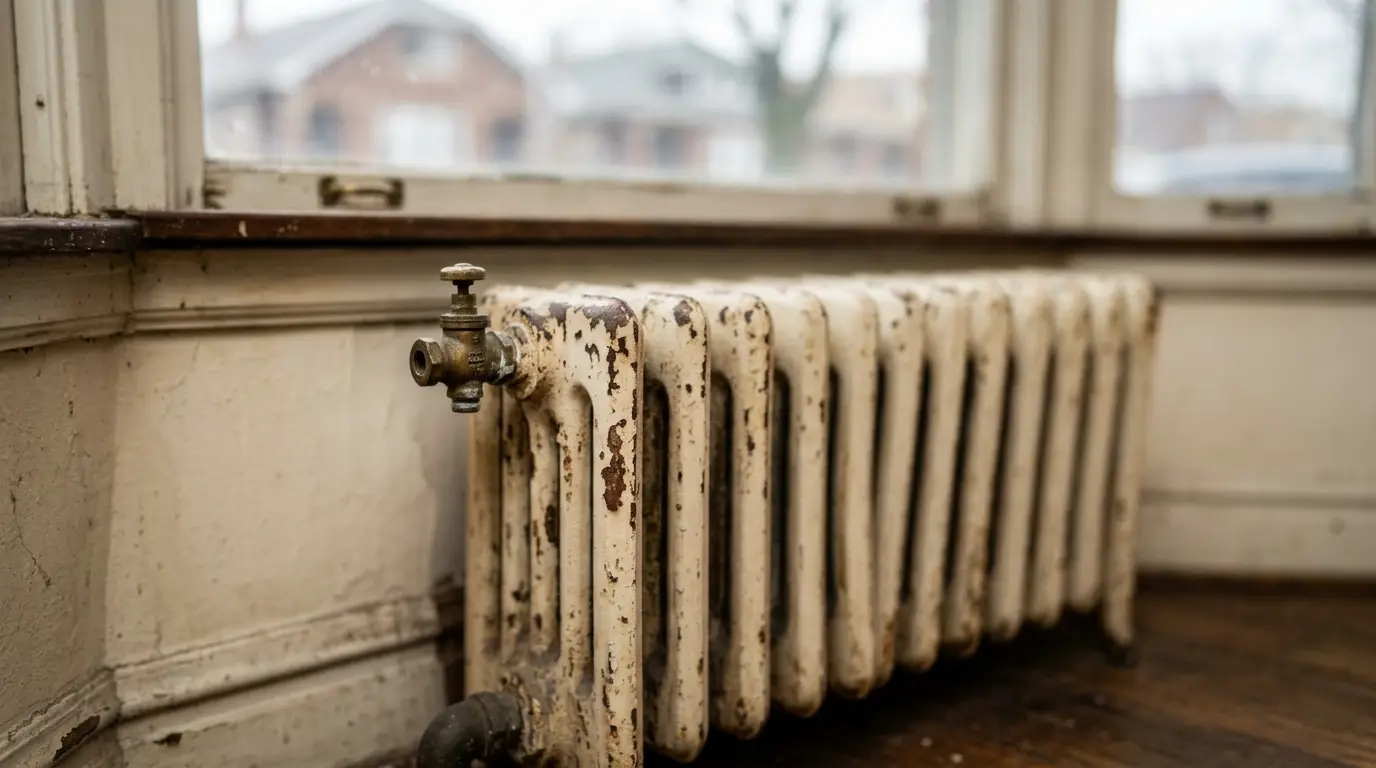
Steam and hot water heat, understood rather than guessed at
A one-pipe steam system is a machine that works on air, pitch, and patience. Most of what people replace boilers over is a vent, a valve, or piping that was never right.
Which system do you have?
Chicago-area buildings run three distinct hydronic systems and they fail in completely different ways, so identifying which one is in the basement is the first step in every call.
One-pipe steam. Radiators with a single connection at the bottom and a small brass or aluminium vent on the side, a boiler with a sight glass, and mains that are large and wrapped in insulation. The most common system in the city's pre-war housing and two-flats. Steam goes up the pipe and condensate comes back down the same pipe, which is why pitch matters so much.
Two-pipe steam. Radiators with connections at both ends and a steam trap at the outlet rather than an air vent on the body. Common in larger apartment buildings and older commercial work. When traps fail, the system loses its ability to separate steam from condensate and behaves badly in ways that look like everything else.
Hot water (hydronic). A circulator pump on the boiler, an expansion tank, and radiators or baseboard with valves at both ends and no sight glass on the boiler. Often a mid-century installation or a converted gravity system. The characteristic problem is trapped air rather than trapped condensate.
If you are not sure which you have, look for the sight glass. A glass tube on the side of the boiler showing a water level means steam. A pump strapped into the piping and no glass means hot water.
The thing worth knowing before anyone quotes you
A steam system that bangs, heats unevenly, or costs too much to run is usually reporting a vent, a pitch, or a near-boiler piping problem, all of which are repairs. Replacing the boiler without correcting those buys a new appliance with the same symptoms.
One-pipe steam: how it actually works
Worth two minutes, because almost every fault makes sense once the principle is clear.
The boiler boils water at very low pressure, residential one-pipe steam is designed to run on ounces, not pounds. Steam expands and moves toward the radiators, but it can only get there if the air already in the pipes and radiators gets out of the way. Air leaves through vents: a small vent on each radiator and, crucially, a larger vent on each steam main near the end of its run.
When steam reaches a radiator it gives up its heat, condenses back to water, and that water runs back down the same single pipe it arrived through, against the incoming steam, to the boiler. That is the whole cycle, and it depends on three conditions holding: air can escape, pipes are pitched so water runs the right way, and the steam leaving the boiler is dry rather than carrying water with it.
Three consequences follow, and they explain most service calls.
Vents are the control system. A radiator heats when its vent lets air out, and stops when the vent closes on contact with steam. So a clogged vent means a cold radiator; a vent stuck open means steam escaping into the room; and mismatched vent sizes across a floor mean rooms that heat in the wrong order. Balancing a one-pipe system is largely the art of choosing vent rates.
Main vents matter more than radiator vents. Air in the mains has to leave before steam can reach any radiator on that branch. A missing or dead main vent forces all that air out through the small radiator vents, which is slow, uneven, and expensive because the boiler runs longer to achieve it. Fitting proper main vents is one of the highest-value repairs available on these systems and it is frequently absent.
Pitch is not optional. Every radiator should lean toward its supply valve, and every main should slope back toward the boiler. A century of settling, a new floor, or a radiator moved for decorating undoes it. Shims are a legitimate, permanent repair.
Cold radiators and where the air is stuck
The diagnostic sequence for a cold radiator on one-pipe steam, in order.
Is the supply valve fully open? One-pipe radiator valves are on-or-off devices. Partially closing one does not gently reduce output; it obstructs the single path condensate uses to leave, which produces banging. Either fully open or fully closed.
Is the vent working? Hold a hand near it during a call for heat. Air should be leaving. A vent that is silent and cold while the radiator stays cool is clogged. Vents are cheap and consumable; on a system that has never had them changed, replacing all of them is a reasonable first move.
Is the radiator pitched correctly? Water pooling in a radiator occupies the space steam needs. Shim the foot at the far end from the valve.
Are several radiators on the same run cold? Then look at the main vent, not the radiators. This is the pattern that gets misdiagnosed as an undersized boiler.
Is the whole system slow to heat? Check the pressuretrol setting, water level and cleanliness, and whether the mains are insulated. Uninsulated mains condense steam before it reaches anything and waste a remarkable proportion of the fuel.
On hot water systems the equivalent sequence is about air rather than vents: bleed the high points, verify the circulator is running, check the expansion tank pre-charge, and confirm zone valves are actually opening.
Banging and water hammer
The most common complaint and the most misunderstood. Steam hammer is steam colliding with liquid water. Find the water and the noise ends.
Standing water in a radiator or a main. A pitch problem. Shim the radiator, support the sagging main, or correct the run.
Wet steam leaving the boiler. This is the near-boiler piping problem, and it is the one worth understanding because it is what makes a new boiler bang. A steam boiler needs its outlet piping arranged so water droplets separate out and return before the steam heads for the mains: a header at the correct height above the water line, the number of risers the manufacturer specifies, and an equaliser and Hartford loop returning condensate. Modern boilers hold a fraction of the water the old ones did, so their steam leaves faster and carries more water with it, which is precisely why they need that piping done properly and why cutting corners there is the commonest installation failure in this trade.
Dirty water. Cutting oil, pipe dope, and sediment raise surface tension and make the boiler surge and carry over water. Skimming, drawing off the surface film slowly through a skim port, is the correct fix and it is a patient job rather than a quick one.
Overpressure. A system driven at several psi instead of ounces pushes water around instead of letting steam travel gently. Setting the pressuretrol correctly is free.
A partially closed radiator valve. Covered above, and worth repeating because it is so often the answer in one room.
A new boiler that bangs is usually a piping problem rather than a defective appliance, worth having looked at properly.
Call about steam hammerTwo-pipe steam and traps
Two-pipe systems separate supply and return, which means something has to stop steam from entering the return: the steam trap at each radiator, and often traps on the ends of mains as well.
Traps are consumable. When they fail closed, condensate backs up and the radiator goes cold. When they fail open, the more common and more damaging mode, steam passes into the return line, which pressurises the returns, prevents other radiators from draining, and produces heating that is wildly uneven across a building. In an apartment building it presents as some units baking and others cold, with the boiler running constantly.
The right approach on a building with widespread trap failure is a survey rather than a piecemeal replacement: identify which traps have failed and in which direction, replace the failed ones with correctly sized elements, and then verify return line temperatures to prove no steam is passing. Where a building has had decades of partial repairs, this is often the single change that transforms both comfort and fuel bills. In shared buildings that work sits alongside the riser and valve mapping described under multi-unit building plumbing.
Thermostatic radiator valves are worth mentioning here. On two-pipe systems they give genuine per-room control and are a real comfort upgrade. On one-pipe systems there are one-pipe-specific versions that work with the vent rather than throttling the supply, a conventional valve fitted to a one-pipe radiator causes the condensate problem described above.
Hot water systems and air
Hot water heat has fewer exotic failure modes and one dominant one: air where water should be.
Air collects at high points and in radiators, and it blocks circulation as effectively as a closed valve. Symptoms are a cold upstairs radiator, a gurgling sound at a baseboard, or a zone that simply refuses to heat while the boiler cycles happily. The fix is bleeding, but the question worth asking is where the air keeps coming from: a system that needs bleeding every year has a leak, a failed air separator, or an expansion tank that has lost its charge and is drawing air in.
The components that need attention on these systems:
Expansion tank. On modern diaphragm tanks the pre-charge should match the system fill pressure. A waterlogged tank causes the relief valve to discharge on every heating cycle, which people report as a leaking boiler. On old-style steel tanks in the joists, the fault is usually that it has filled with water and lost its air cushion.
Circulator. Bearings and seals eventually go. A circulator that has seized presents as a boiler that heats but no heat reaching anything.
Air separator and automatic vents. They remove dissolved air continuously; when they stop working, the annual bleeding starts.
Zone valves and controls. A zone valve that fails closed is a cold zone; one that fails open is a zone that overheats and a thermostat with no authority.
Fill valve and backflow preventer. The connection between the boiler and the drinking water supply. It must not allow boiler water back into the house supply, and a failing fill valve slowly overpressurises the system.
Converted gravity systems deserve a note. Many older Chicago homes had large-pipe gravity hot water heat later fitted with a pump. They work well, but the enormous water volume makes them slow to respond and they are easy to oversize a replacement boiler against.
The boiler itself: water, safety, and venting
Four things we check on every visit, on either system type.
Low-water cutoff. The device that shuts the burner down if the water level falls too far. On steam it is the most important safety control in the basement, and on many systems it needs flushing periodically to keep the sensing chamber clear. A cutoff that has been jumpered out, and we do find them, is an immediate stop-work condition.
Water quality and make-up water. Every gallon of fresh water added brings dissolved oxygen and minerals that corrode the boiler from the inside. A system that needs frequent topping up has a leak that is worth finding, whether that is a wet return under the floor, a failed radiator valve, or a boiler section beginning to go. Automatic water feeders make this invisible, which is convenient and dangerous in equal measure, they hide leaks and can feed a system to death.
Relief valve and pressure controls. A relief valve that has discharged and is weeping is reporting a fault upstream, not asking to be replaced. On hot water the fault is usually the expansion tank; on steam it is usually a pressuretrol or a blocked pigtail on the gauge.
Combustion and draft. Most of these boilers are natural-draft appliances venting into masonry chimneys of considerable age, often shared with a water heater. Chimneys deteriorate, they are frequently oversized for the appliance now attached to them, and air-sealing work upstairs has left many basements unable to supply the combustion air the appliance needs. The consequence of a failed draft is combustion products in the building, which includes carbon monoxide. So the draft gets tested with the building in its worst realistic condition, and a working carbon monoxide alarm on that level is non-negotiable, the same discipline described under water heater repair, for the same reason.
Replacing a boiler, and sizing it by EDR
When a boiler genuinely is finished (cracked sections, leaking through the jacket, a heat exchanger past repair) two decisions determine whether the replacement is a success.
Size it by the radiators, not by the house. On steam this is the rule that gets broken most often. A steam boiler must be matched to the connected radiation (the total heat output of the radiators actually installed, measured in EDR), because it has to produce enough steam to fill them, no more and no less. That means measuring and adding up every radiator in the building. Sizing from a heat loss calculation, from the old boiler's nameplate, or from square footage produces an oversized boiler that short-cycles, wastes fuel, and never runs comfortably. Hot water systems are sized on heat loss instead, and there the old nameplate is usually a considerable overestimate.
Pipe it the way the manufacturer requires. Header height above the water line, the specified number of risers, the equaliser and Hartford loop, and drop headers where the installation calls for one. This is the difference between a quiet new boiler and a noisy one, and it is where the price difference between two quotes usually lives.
Two further items that belong in a complete replacement: insulating the mains, which is cheap and pays back quickly, and correcting the vents while the system is down, because a new boiler on a system with dead main vents will disappoint. Where the chimney is questionable, a liner or a change of vent strategy comes into the same conversation.
What drives the cost
Directional rather than quoted, and the spread on this work is wide.
Vents, valves, and pitch. The cheapest and highest-value work on a one-pipe system. Radiator vents, main vents, and shimming are a service visit rather than a project, and they resolve a large share of complaints.
Skimming and water treatment. Labour-intensive but modest, and often the answer to surging and hammer on an otherwise sound boiler.
Trap replacement on two-pipe. Scales with the number of radiators. A survey first is cheaper than replacing every trap in a building.
Near-boiler piping corrections. A day or so of skilled pipe work, and frequently the fix for a system that has behaved badly since its last boiler went in.
Boiler replacement. The largest number on this page, and it varies with connected radiation, with whether the chimney needs lining or the vent strategy changes, with gas supply capacity, and with how much of the near-boiler and return piping is being renewed at the same time. Permitted and inspected work in most municipalities here.
We would rather sell you main vents than a boiler. If the boiler is genuinely finished we will say so, and show you what the sections look like.
Common Questions
Answers before you call
Why do my radiators bang so loudly?
Almost always condensate trapped where steam is trying to travel. In a one-pipe system every radiator and every main must be pitched so water runs back to the boiler; where a radiator has settled the wrong way, or a main sags, steam hits standing water and the noise is that collision.
The other common cause is near-boiler piping that carries water over into the mains as wet steam. Shimming a radiator or correcting pitch fixes many systems in an afternoon; a header that was never piped correctly is a bigger but finite job. Neither is a reason to replace a sound boiler.
One radiator never gets hot. Is it the radiator?
Rarely. On one-pipe steam it is usually the air vent on that radiator, steam cannot enter until the air can leave, so a clogged vent means a cold radiator regardless of how hot the boiler is. Vents are inexpensive and they are consumable items rather than permanent fittings.
If several radiators on the same main are cold, look at the main vent rather than the radiators. A failed main vent starves an entire branch, and it is the single most commonly missing component on these systems.
Can I just replace the boiler and keep the radiators?
Yes, and in most cases you should. Cast iron radiators are extraordinarily durable and there is nothing to gain by removing them. What has to be got right is the near-boiler piping between the new boiler and the existing mains (header height, riser count, and the equaliser), because a modern boiler holds far less water than the one it replaces and is much less forgiving of piping shortcuts.
Most complaints about a new steam boiler that bangs, surges, or short-cycles trace to that piping rather than the appliance.
Should I convert steam to forced air?
It is a large project and usually not the best value in this housing stock. Converting means abandoning the radiators, finding routes for ducts and returns in a building that has none, and losing the even, quiet heat that steam delivers well.
A steam system that has had its vents, pitch, and near-boiler piping put right is comfortable and controllable. The honest cases for converting are a desire for central cooling using the same ducts, or a system so far gone that its distribution has to be rebuilt anyway.
What is the sight glass telling me?
Water level, and it should sit roughly midway when the boiler is cold and steady. A level that bounces violently in operation usually means dirty water, oil and sediment from installation or repairs raising the surface tension, which is corrected by skimming rather than by adding chemicals.
A level that keeps dropping means a leak somewhere in the system or a boiler that is losing water, and constantly adding fresh water to a steam boiler shortens its life considerably because every gallon brings dissolved minerals and oxygen with it. A rising level on a hot water system points at a failing fill valve.
How often should a boiler be serviced?
Annually, before the heating season. On steam the visit covers the low-water cutoff, the sight glass and gauge glass, water quality, the pressuretrol setting, the vents, and a combustion and draft check. On hot water it covers the expansion tank pre-charge, the air separator, the circulator, the relief valve, and the same combustion and draft check.
The pressuretrol setting is worth singling out. Residential one-pipe steam runs on ounces of pressure, not pounds, and a system set to two or three psi is being pushed hard for no benefit: it makes noise, wastes fuel, and stresses everything downstream.
Radiators banging, or one room never warm?
Both are usually vents, pitch, or near-boiler piping rather than a failing boiler. Worth diagnosing before anyone quotes a replacement.
24/7 · Chicago metro dispatch · (833) 615-3680