Toilets: the running one, the weak one, and the one that rocks
Three quarters of toilet calls are a flapper, a fill valve, or a flange. The fourth quarter is the floor, and that is the one where the price of doing it properly earns its keep.
The running toilet
The most common plumbing complaint in any housing stock, and the one most often repaired by replacing the wrong part. Everything inside a toilet tank is a system for filling to a level and then releasing to the bowl, so the diagnosis is a question of which half is misbehaving.
Colour in the bowl means the tank is leaking into it. The dye test settles this in half an hour. A flapper that has hardened, cupped, or distorted no longer seals; a flush valve seat with mineral build-up will not let even a new flapper seal. On hard water the seat matters as much as the flapper, and cleaning it is part of the repair rather than an optional extra. A chain that is too short holds the flapper slightly open; one that is too long tangles under it.
A dry bowl with a tank that keeps refilling means the fill valve. Modern fill valves are inexpensive and easy to replace, and they are consumable items on hard water, grit lodges in the seat and they stop shutting off cleanly. A fill valve set too high sends water down the overflow tube continuously, which sounds identical to a leak and is a two-minute adjustment.
A ghost flush, the tank refilling by itself every hour or two, is a slow leak past the flapper. Same answer as above.
A hiss or a whistle while filling is usually the fill valve itself, and sometimes the angle stop being partially closed against a valve that then chatters.
Water hammer when the fill valve shuts points at the house pressure rather than the toilet. Above 80 psi, fill valves shut hard and wear quickly, and the fix belongs at the pressure regulator.
A full rebuild (flapper, fill valve, seat cleaned, supply line and shutoff renewed) is inexpensive, takes under an hour, and on a toilet whose porcelain and flange are sound it resets the clock by a decade. That is usually better value than a replacement, and we will say so.
Before you call
Do the dye test, and look at whether the water on the floor appears while flushing or all the time. Those two observations narrow a toilet call from six possibilities to one or two.
The weak flush
A toilet flushes by getting a quantity of water into the bowl fast enough to start a siphon. Anything that slows the water down, or reduces the amount of it, weakens the flush.
Scale in the rim jets. Water enters the bowl through small holes under the rim and, on most designs, one larger jet at the bottom. On hard water those holes gradually close with mineral deposit, so the water dribbles in instead of sheeting round. The tell is a bowl that does not rinse evenly and a flush that has lost its energy. Descaling the jets restores it, and it is a genuinely satisfying repair on an otherwise good toilet.
Tank level too low. The flush depends on volume as well as speed. A fill valve adjusted down, or a tank with the wrong flapper letting it close early, reduces both.
A partial blockage. A flush that begins normally and then hesitates or rises before draining is being restricted downstream: the trap, the branch, or the lateral. If more than one fixture is slow, it is not the toilet: that is drain cleaning or, where the whole house is affected, sewer rodding territory.
A venting problem. Gurgling from a nearby fixture during a flush, or a flush that pulls sluggishly with no blockage present, means air is not getting into the drainage system where it should. In older Chicago-area buildings this is often a vent that was undersized to begin with, or a bathroom added downstream of the original venting arrangement.
The toilet itself. Early water-saving models genuinely flushed badly, and no repair fixes a poor design. This is the one case where replacement is the honest recommendation from the outset.
Leaks, and where they come from
Water on the floor around a toilet has five possible sources, and telling them apart matters because two are trivial and one is not.
The supply line or the shutoff. Visible, usually a weep at a compression nut or a corroded angle stop. The shutoff on an older Chicago bathroom is frequently a multi-turn valve that has not been operated in twenty years and will not close when needed; replacing it with a quarter-turn stop while the toilet is off is worth doing every time.
The tank-to-bowl connection. Water appearing behind or under the tank, worst immediately after a flush. The bolts and the large gasket between tank and bowl are a kit and a straightforward repair.
Condensation. A tank sweating in a humid basement bathroom in July looks exactly like a leak and is not one. Wipe it dry and watch whether it returns without a flush.
The seal at the floor. Water appearing at the base only when the toilet is flushed, or a persistent smell with no visible water. This is the one that matters, because the water is going somewhere: usually into the subfloor and, in a two-flat, into the ceiling below. It also tends to worsen slowly, so it is often found as damage rather than as a leak.
A cracked bowl or tank. Rare, and terminal. A hairline crack in porcelain is not repairable in any way worth paying for.
For the fourth of those, the correct approach is to lift the toilet rather than to caulk around it. Caulking the base of a leaking toilet traps the water under the fixture and hides the damage, which is why we treat a bead of silicone around an old toilet as a symptom worth investigating.
Flanges, wax, and the toilet that rocks
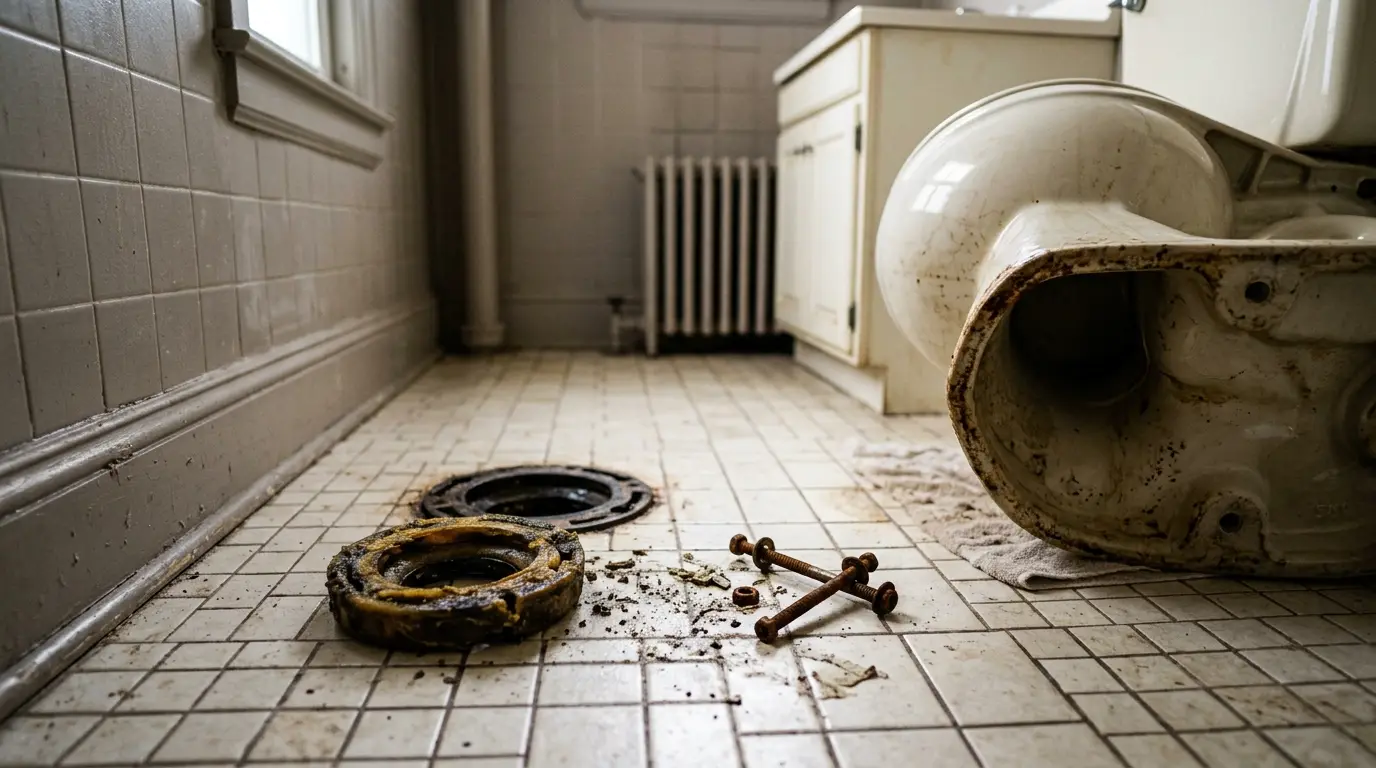
The closet flange is the fitting that connects the toilet to the drain and anchors it to the floor. In the older housing stock here it is the component that most often turns a simple job into a real one, and it is worth understanding why.
Original flanges in Chicago-area houses are frequently cast iron or lead, set into a cast iron closet bend. Sixty to a hundred years of moisture, and often decades of a slightly loose toilet working against them, corrode the flange ring where the bolts anchor. The result is a flange that will not hold a bolt, which means the toilet cannot be clamped down, which means it rocks, which means the seal works loose and it leaks, a self-reinforcing cycle.
Then there is height. A flange should sit level with or just above the finished floor. Every new floor covering laid over the old one raises the floor and effectively lowers the flange, and in a house that has had tile over vinyl over the original floor, the flange can end up half an inch below where the toilet sits.
The honest repair options, in order of how often they are the right answer:
A repair ring. A stainless or brass ring that goes over the damaged flange and picks up sound material or the subfloor, restoring solid bolt anchorage. Fast, permanent, and the usual answer for a corroded cast iron flange.
A flange extender. Where the flange is sound but low, a proper extender ring with the correct gasket brings it to floor level. This is the correct alternative to the shortcut of stacking two wax rings, which fails in a few years.
Replacing the flange. Where the ring is beyond repair, the flange is cut out and replaced. On a cast iron closet bend that means a mechanical joint to the existing pipe, and it is a bigger job than it sounds because the bend itself has to be sound to accept it.
Repairing the closet bend or the subfloor. The largest version, and the one found where a leak has been quietly running into the floor for years. Rotten subfloor around a toilet is not a plumbing repair, and pretending otherwise puts a new toilet on a soft floor.
Shims deserve a mention because they are so often done badly. A toilet on an uneven floor needs solid, non-compressible shims bedded so the fixture cannot move at all, then the joint made and the excess trimmed. Shims that let it move by a millimetre are the same as no shims.
Toilet rocking, or a smell that keeps coming back in the bathroom? That is worth lifting rather than caulking.
Call about a toilet resetReplacing one: rough-in and fit
Replacement is straightforward when three measurements are taken first, and awkward when they are not.
Rough-in. The distance from the finished wall behind the toilet to the centre of the closet bolts. Twelve inches is standard; ten and fourteen inch rough-ins exist and are common in older buildings and in bathrooms carved out of odd spaces. A twelve-inch toilet on a ten-inch rough-in does not fit, and the mistake is discovered with the old fixture already out and in the hallway.
Clearances. Distance from the centre line to the side wall or vanity, and the clear space in front. Codes set minimums and older bathrooms frequently do not meet them, which is legal as an existing condition but constrains what will physically fit.
Bowl shape and height. Elongated bowls need more room in front than round ones. Comfort-height fixtures suit most adults and are a genuine improvement for anyone with mobility issues, but they are noticeably taller and worth sitting on before buying.
Then the work itself: water off at the stop, tank drained and sponged, supply disconnected, bolts cut where they have corroded solid, toilet lifted and set on a protective sheet, old seal removed and the flange inspected. That inspection is the moment when the real scope becomes clear, and it is why a quote for a replacement is honest only when it names what happens if the flange is corroded.
Setting is unglamorous and matters: new bolts, correct seal, the toilet lowered square and pressed evenly rather than rocked into place, bolts drawn down alternately and gently, shims where the floor demands it, and a new supply line and quarter-turn stop. Then a flush test, a look for movement, and a check for leaks at every joint before the tools go away.
Choosing a toilet that suits the drain
Three practical distinctions matter more than brand.
Flush mechanism. A conventional gravity toilet is quiet, simple, and repairable with parts available anywhere, the right default. A pressure-assisted toilet uses trapped air to produce a much more forceful flush; it is louder, its parts are more specialised, and it earns its place in a basement bathroom, a heavily used household, or a fixture on a long, flat branch line. A dual-flush unit saves water in principle and, in practice, works well when the household actually uses both buttons.
Trapway and glazing. A fully glazed trapway and a well-designed bowl matter far more to real-world flush performance than the marketing figures. Skirted designs are easier to clean and slightly harder to service.
One piece or two. One-piece units are easier to clean and heavier to handle in a tight bathroom. Two-piece units are cheaper, lighter, and have a tank-to-bowl gasket that will eventually need attention.
One local note. In buildings with original cast iron waste piping, we favour a strong-flushing fixture and, where a household has had recurring slow drainage, a camera look before choosing. Cast iron that has scaled internally has a reduced bore and a rough wall, and it is better to know that before blaming a new toilet for a pre-existing condition.
Basement and below-grade toilets
A toilet below the level of the sewer main is a different installation with different failure modes, and this metro has a great many of them.
Where the basement floor is below the lateral, waste has to be lifted. That is an ejector system: a sealed basin in the floor, a pump, a vent, and a check valve, all covered under ejector pump repair and installation. A toilet on such a system fails in ways a ground-floor toilet does not: the pump, the check valve, and the basin vent are all in the chain, and a slow-draining basement toilet is more often the pump than the fixture.
Where the basement floor is above the lateral but the neighbourhood sewer surcharges in heavy rain, a basement toilet is one of the lowest openings in the building's drainage, which makes it a route for a backup onto the floor. That is the subject of basement flood and sewer backup, and the protection options are a backwater valve or an overhead sewer conversion.
The practical advice for anyone adding a basement bathroom: establish where the lateral is and how deep before designing the room, and decide the backup protection strategy at the same time. Both are far cheaper to address while the floor is open.
Bidet seats and other additions
Two requests that have become common enough to be worth covering.
Bidet seats. Straightforward to fit, and they need two things the average older bathroom does not have: a cold water tee at the toilet supply, which is simple, and a nearby electrical outlet for the heated models, which is often not. Worth planning together rather than fitting the seat and then running an extension lead. On a low-pressure system, the spray performance will disappoint, which is another reason to measure pressure first.
Wall-hung toilets and concealed cisterns. Attractive, space-saving, and a commitment: the carrier and cistern go inside the wall, so the wall has to be built for them and future service is through an access panel. Sensible in a new bathroom, awkward as a retrofit into a plaster-and-lath wall in a 1920s house.
Macerating toilet systems. The answer where a toilet is wanted somewhere that has no gravity drainage at all, an attic conversion, a powder room under a stair. They work, they need power and a vent, and they are noisier and more maintenance-dependent than gravity drainage. A legitimate solution to a genuine constraint, and not a shortcut where proper drainage is achievable.
What drives the cost
Directional rather than quoted, and this is one of the areas where the honest range is wide because the flange decides it.
A rebuild versus a replacement. Flapper, fill valve, seat clean, new supply and stop is the cheapest useful visit in plumbing. Replacing a sound toilet that only needs those parts is spending money for no benefit.
The fixture itself. A good gravity two-piece is modest; pressure-assisted, one-piece, skirted, and wall-hung units each cost more.
What the flange turns out to be. The single largest variable. Sound flange: a straightforward reset. Corroded cast iron: a repair ring and an extra hour. Failed flange or damaged closet bend: a materially bigger job, occasionally with floor repair attached.
Rough-in and fit. A non-standard rough-in narrows the fixture choice and sometimes forces an offset flange, which is more work.
Access and removal. A second-floor bathroom with a narrow stair, or an old one-piece unit that has to come out in one piece, takes longer. Disposal of the old fixture is part of a complete job.
Below-grade complications. A toilet on an ejector system brings the pump, the basin, and the check valve into scope.
We would rather rebuild a good toilet than sell you a new one, and where the porcelain is sound and the flange is solid, that is what we will recommend.
Common Questions
Answers before you call
My toilet runs intermittently. What is it?
Nine times in ten it is the flapper or the seat it lands on. The flapper is rubber and it hardens and distorts with age, and mineral deposits build a rough ridge on the flush valve seat that the flapper can no longer seal against. Water then trickles from tank to bowl, the level drops, and the fill valve wakes up every few minutes to top it up.
The test takes ten minutes: put a few drops of food colouring in the tank, do not flush, and come back in half an hour. Colour in the bowl means the flapper or the seat. A dry bowl but a tank that keeps filling means the fill valve is not shutting off, or the overflow tube is being overtopped.
How much water does a running toilet waste?
More than people expect. A steady trickle that is barely visible in the bowl can pass thousands of gallons a month, and a fill valve that cycles every few minutes runs continuously in energy terms. On a metered supply it shows up on the bill before it shows up as a puddle.
It is also the most common cause of an unexplained jump in water use. Where a bill has risen and nothing obvious is leaking, the toilets are the first thing to test with dye, before anyone starts opening walls or slabs.
Why is the flush weak in my old house?
Four candidates, in order of likelihood. Mineral scale blocking the rim jets and the siphon jet, which is very common on hard water and often fixable with descaling. A tank water level set too low, which is an adjustment. A partial blockage in the trap or the branch line, which shows as a flush that starts and then hesitates. And a venting problem, which shows as a flush that gurgles and pulls slowly.
The fifth possibility, on a genuinely old low-flow toilet from the first generation of water-saving designs, is that the toilet itself was never good. Modern low-consumption toilets flush far better than the early ones did, and replacing a bad 1990s unit is one of the few upgrades that is unambiguously worth it.
Can a rocking toilet be fixed by tightening the bolts?
Rarely, and over-tightening is how porcelain gets cracked. A toilet rocks because the floor under it is not flat, because the flange is below the finished floor level, or because the flange itself has failed. Tightening the bolts against an uneven surface loads the china rather than fixing the geometry.
The correct sequence is to lift it, look at the flange and the floor, correct whatever is wrong (a repair ring, an extender, a levelling shim set bedded properly), and reset it on a new seal. A rocking toilet also works its seal loose over time, which is why it eventually becomes a leak at the base.
Should I use a wax ring or a rubber seal?
Both work when used correctly. Wax is the traditional choice, it is forgiving of small irregularities, and it is single-use, once the toilet has been set and lifted again, that ring is finished. Waxless rubber or foam seals can be repositioned, tolerate a slightly high flange better, and are more forgiving if the toilet has to come up again for access.
What is not acceptable in either case is stacking two seals to make up for a flange that sits too low. That is a common shortcut and it produces a joint that fails within a few years. A flange extender or a repair ring is the right answer to a low flange.
Are low-flow toilets a problem on old drain lines?
Occasionally, and it is worth being honest about it. A modern toilet uses around a quarter of the water a 1950s unit did, and on a long, nearly flat branch line, the kind found in older buildings where a bathroom was added far from the stack, there can be less water available to carry solids the whole way.
In practice, modern designs move waste well and problems are usually revealed rather than caused by the new toilet: a line with a sag, a partially blocked section, or root intrusion was marginal already. Where a household has had recurring blockages after a change of toilet, a camera look at the branch and the lateral answers it definitively.
Water on the floor around the base?
That is either the tank-to-bowl connection, the supply, or the seal at the floor, and only one of those gets worse if it waits. Call and describe where it is wet.
24/7 · Chicago metro dispatch · (833) 615-3680