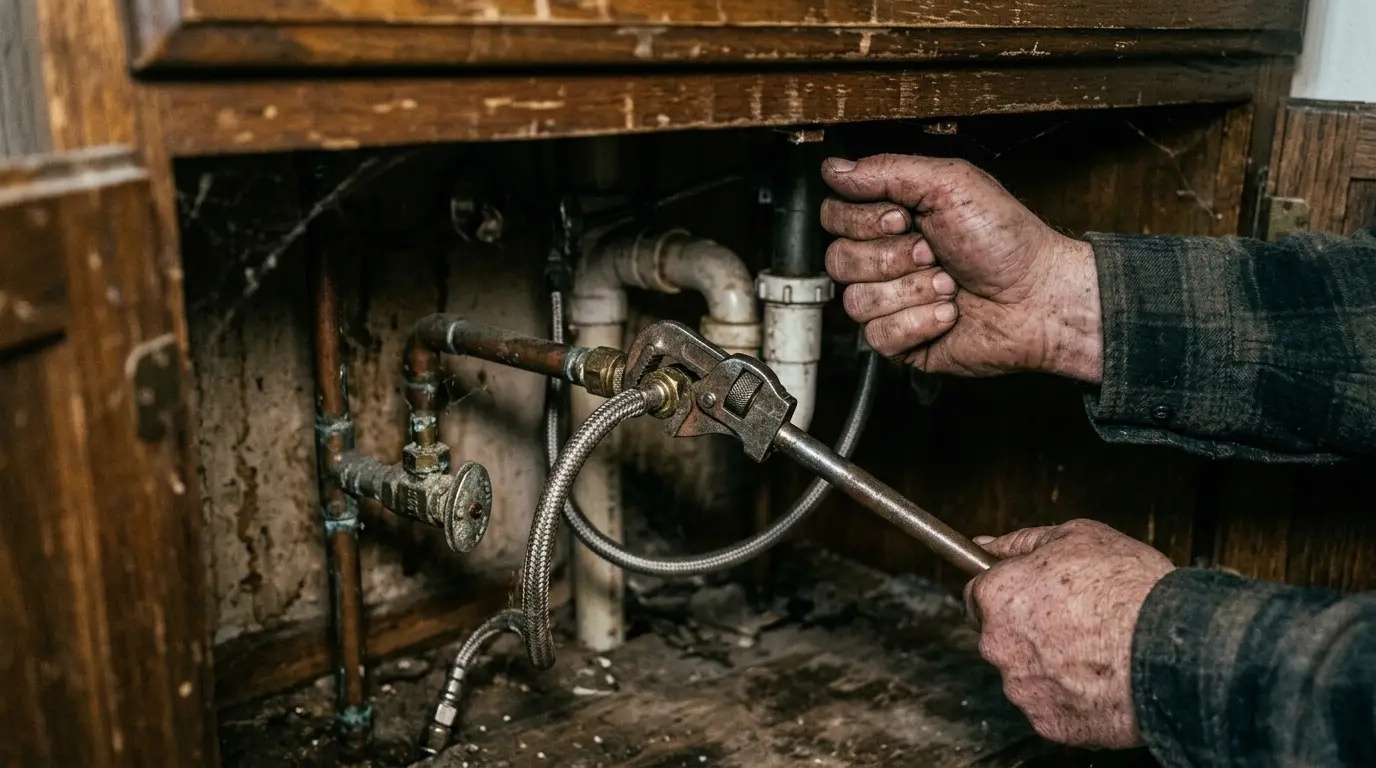
Faucets, and the reasons a simple swap turns out not to be
The faucet is the easy part. The shutoff that will not close, the nut nobody can reach, and the nipple that shears off are what the hour actually goes on.
The dripping tap, and whether to repair it
A tap drips because something that is meant to seal no longer does, and which something depends on the type of valve inside. Identifying it decides whether this is a five-dollar part or a new fixture.
Compression valves, separate hot and cold handles that turn several times and get harder as they close, are the oldest design and the most repairable. A washer and, where needed, a re-cut or replaced seat restores them. Plenty of these are still in service in this housing stock and there is no reason to remove a sound one.
Cartridge valves use a single replaceable insert. When they drip, the cartridge is replaced as a unit. Most major manufacturers still supply cartridges for fixtures decades old, often at no charge.
Ball valves, the classic single-lever kitchen design, are repaired with a kit of seats, springs, and a cam. Straightforward, and the parts are widely available.
Ceramic disc valves are the modern standard, extremely durable, and usually defeated by grit or scale rather than wear. On hard water they are worth cleaning before they are condemned.
Where the drip is not from the spout but from around the base of the handle or under the deck, it is O-rings and seals rather than the valve seat, a different kit and usually a smaller job. A leak under the sink while the tap is running is the tailpiece or the drain rather than the faucet at all.
The honest decision rule: repair a good fixture, replace a cheap one. A well-made faucet body with a serviceable cartridge is worth keeping for twenty years. A builder-grade unit with a plated plastic body and no parts availability is not worth an hour of anyone's time, and we will tell you which one you have.
The five-minute check that saves the visit
Before a faucet is bought, try both shutoffs under the sink. If they turn easily and shut the water off completely, the job is a swap. If either one will not close, the job includes new stops, and it is far better to know that in advance.
What is actually behind the fixture
The reason fixture work is unpredictable is that the visible part is new and everything behind it is as old as the building. Six conditions we find repeatedly in this housing stock.
Shutoffs that will not close. The most common one. Multi-turn stops seize with age and mineral deposit, and turning one hard enough to close it sometimes snaps the stem instead. The consequence is that the house main has to be shut down to change a faucet, which is fine, but it changes the job.
Galvanized nipples in the wall. Where the stop threads onto a galvanized nipple, decades of corrosion can mean the nipple shears when the stop is removed. Then the repair is in the wall rather than in the cabinet, and it is a genuinely different scope. Where a house has galvanized supply piping generally, this is the visible edge of the larger question covered under whole-home repiping.
Access. Faucet mounting nuts sit directly under the deck at the back of the sink, and reaching them means working blind past the drain tailpiece and the disposal with a basin wrench. In a vanity with a small door and a full trap assembly this is the single slowest part of the job.
Corroded connections. Old chrome-plated risers and compression nuts that have been in place for thirty years frequently do not come apart cleanly. Cutting them off is normal and expected.
Deck thickness. Thick stone countertops, or a sink deck plus a tile surround, can exceed a faucet's shank length. Extension kits exist for many fixtures; some fixtures simply do not fit certain installations.
Drain and trap condition. Once the fixture is off, the trap and tailpiece are exposed, and an old chrome-plated brass trap that has thinned to foil is best replaced while it is accessible rather than left to be discovered as a leak in six months.
None of that is a reason to postpone a faucet. It is a reason for the estimate to name it, and for the shutoffs to be replaced while everything is open.
Hole spacing, deck fit, and choosing well
Three measurements and one judgement decide whether a fixture fits and works.
Hole configuration. Count the holes and measure centre to centre across the outer two. Single hole, four-inch centreset, and eight-inch widespread are the common cases. Adapting down, a single-hole fixture with a deck plate over a three-hole sink, is easy. Adapting up means drilling, which is routine in stainless, careful in stone, and not sensible in enamelled cast iron.
Spout reach and height. A tall spout over a shallow sink splashes; a short reach over a large sink lands water on the back wall rather than in the bowl. In a kitchen, measure from the faucet's mounting position to the centre of the bowl and choose a reach that gets there.
Clearance behind and above. Handles that hit a window sill or a tiled backsplash when opened are a common and avoidable disappointment, particularly with wall-mounted single levers and with tall gooseneck kitchen fixtures under a window.
Quality, which is the judgement. The things that predict a long life are a solid metal body rather than plated plastic, a valve type with available parts, and a manufacturer with a genuine parts programme. Finish durability follows the same line: physical vapour deposition finishes and good chrome hold up, while cheap coloured coatings on cheap bodies do not. This is one of the few areas of plumbing where paying more up front reliably costs less over twenty years.
Kitchen specifics
The kitchen sink is the busiest plumbing assembly in most houses and it usually has four or five things connected to it, which is why work there is rarely a single item.
Pull-down and pull-out sprayers. Now the default, and the hose is the part that fails. A magnetic dock that has weakened, a hose that snags on the contents of the cabinet, or a quick-connect that weeps are the three service items. Leave the hose room to retract freely and do not store a bin directly under it.
The disposal connection. Any faucet work often turns into disposal work, because the units share the same drain assembly and the disposal is directly in the way of the mounting nuts. If the disposal is old or noisy, that is the moment to deal with it, see garbage disposal repair.
The dishwasher drain. Local requirements differ across this metro on whether a dishwasher discharge needs an air gap fitting on the deck or a properly formed high loop under the counter. Both exist to stop drain water siphoning back into the machine, and a dishwasher connected with neither is a defect worth correcting while the sink is apart.
Soap dispensers and filtered water taps. They occupy sink holes, which affects the faucet decision. Worth deciding the whole deck layout at once rather than fixture by fixture.
Undermount sink support. Not plumbing exactly, but we look at it: an undermount sink held up by adhesive alone, loaded with a heavy cast iron disposal, is a failure waiting for a full sink of water.
Bathroom and lavatory specifics
Smaller fixtures, tighter spaces, and one significant safety consideration.
Access is worse. A pedestal sink or a small vanity gives very little room to work, and on a pedestal the trap and supplies are visible, so the finish of the pipework is part of the job rather than hidden.
Pop-up drain assemblies. The lift rod, clevis, and pivot arrangement is where lavatory faucets most often go wrong, a stopper that will not seal or will not lift is nearly always adjustment rather than replacement.
Overflow and drain seals. A leak under a bathroom sink is more often the drain body's seal against the basin than the faucet, and plumber's putty at that joint is a consumable that dries out over decades.
Scald protection. The relevant point for lavatory fixtures is temperature: where a household includes small children or older adults, setting the water heater to around 120 °F, or fitting a thermostatic mixing arrangement, is worth discussing. Shower and tub valves have their own requirements, covered under shower and bathtub plumbing.
Wall-mounted fixtures. Common in older Chicago bathrooms and unforgiving: the valve bodies are in the wall, the escutcheons rarely match modern fixtures, and replacing like-for-like is usually far cheaper than converting to a deck-mounted arrangement, which means opening a plaster wall.
Replacing several fixtures at once? One visit with the water off is considerably cheaper than three.
Call to plan a fixture visitLaundry, utility, and outdoor taps
The fixtures nobody thinks about until they fail, and two of them fail expensively.
Laundry valves. The pair of hose valves feeding a washing machine spend their lives under full pressure with nothing downstream to relieve them. Old multi-turn valves seize open, which means a burst machine hose cannot be shut off, and washing machine hose failures are among the more damaging domestic water events. Two worthwhile upgrades: a single-lever laundry valve that shuts both supplies at once, and braided stainless hoses replaced every five years or so.
Utility and slop sinks. Usually fitted with a robust two-handle faucet, and worth keeping that way. The common fault is a seized handle or a perished washer, both repairable.
Outdoor hose bibs. The fixture most affected by this climate. A standard sillcock holds water in its body inside the wall; a frost-free sillcock places the valve seat well inside the heated envelope so the barrel drains when it is shut. In this region that is the correct fixture, and it has to be installed with a slight downward pitch to the outside to actually drain. The winterization side (shutting, draining, and the irrigation blow-out) is covered under outdoor hose bib and winterization.
One caution people find surprising: leaving a hose connected to a frost-free sillcock over winter defeats it entirely, because the water cannot drain past the hose. That single habit is behind a large share of the burst sillcocks we see in spring.
Low-lead fixtures and old brass
A short section, because the rule is simple and the context is regional.
Since 2014, fixtures and fittings in contact with drinking water have had to meet a weighted-average lead content of no more than a quarter of one per cent. Anything sold for potable use today complies, so this is not a decision an owner has to make. It is a reason not to install salvaged brass fixtures on a drinking water line, however handsome they are.
The reason it matters here is the legacy plumbing. This metro has a very large stock of lead service lines and, in copper systems installed before the mid-1980s, lead-bearing solder at every joint. Older brass fixtures contribute too. So replacing a fixture is a genuine but marginal improvement, and the meaningful actions are the ones described under water service line replacement and, at the tap, a point-of-use filter tested for lead reduction as covered under whole-house water filtration.
Two habits worth keeping in the meantime, in any older building: run a tap for a minute or two before drinking from it after a long period of no use, and use cold water for drinking and cooking, because hot water takes up lead more readily.
Filtered taps, instant hot, and touchless
Three popular additions and what each actually requires.
A dedicated filtered water tap. A small tap in a spare sink hole, fed by an under-sink filter or a reverse osmosis unit. Needs a sink hole, cabinet space for the housing and, with reverse osmosis, a storage tank and a drain connection. Genuinely worthwhile where drinking water quality is the concern, and it does not require treating the whole house.
Instant hot water dispensers. A small heated tank under the sink, a dedicated tap, and an electrical outlet. Convenient, and the two things to check first are that the outlet exists and that the cabinet has room alongside the disposal and any filter.
Touchless faucets. Practical in a kitchen, and dependent on power, either a battery pack that will need changing or a transformer plugged into an outlet under the sink. Worth knowing that they revert to manual operation when the batteries die rather than failing shut, and worth asking where that outlet is going to come from before the fixture is chosen.
A common thread: all three want an outlet under the sink, and older Chicago-area kitchens frequently have none. That is a small electrical job, better identified during planning than on installation day.
What drives the cost
Directional rather than quoted. Fixture work is priced on what is behind the wall, not on the fixture.
Repair versus replace. A cartridge or a seat kit on a good faucet is the cheapest useful outcome. Replacement adds the fixture and the removal.
Shutoff condition. The biggest single variable. Working stops make a swap a short job; seized stops mean shutting the house down and fitting new ones.
What the stops are threaded into. Sound copper is straightforward. Galvanized nipples that shear off move the work into the wall.
Access. A deep vanity, a pedestal sink, or a cabinet full of pipework and a disposal all add time to the same nominal task.
Hole configuration changes. Deck plates are cheap; drilling stone is careful work with a real risk attached and is priced accordingly.
How many fixtures at once. This is where the saving is. The setup, the shutdown, and the water-off time are shared, so three fixtures in one visit cost considerably less than three visits.
Related work found. Traps thinned to foil, a disposal on its last bearing, a dishwasher with neither air gap nor high loop. We will show you and let you decide rather than adding it silently.
Common Questions
Answers before you call
Is it worth repairing a dripping faucet or should I replace it?
It depends on the fixture rather than the drip. A good-quality faucet from a manufacturer that still supplies parts is worth repairing indefinitely: a cartridge, a seat kit, or a set of O-rings is inexpensive and the body itself lasts decades. Many manufacturers supply those parts under warranty for the life of the fixture.
Replacement is the better answer where the finish has failed, where the fixture is a builder-grade unit with no available parts, or where the body itself is corroded internally so scale keeps returning. Where the faucet is unbranded and twenty years old, parts hunting usually costs more in time than a new fixture costs outright.
Why does replacing a faucet cost more than I expected?
Because the faucet is rarely the work. What takes the time is the condition behind it: angle stops that will not close so the house has to be shut down, supply nuts corroded solid, mounting nuts in a position where only a basin wrench will reach, an old three-hole deck being fitted with a single-hole fixture, or a nipple that shears off and turns a swap into a repair.
None of that is discoverable from a photograph, which is why an honest quote describes the fixture and then names what happens if the shutoffs are seized. Replacing the stops while the cabinet is open is usually money well spent.
What hole spacing do I need?
Measure the centre-to-centre distance between the outer holes in the sink or countertop. Four inches is a centreset, eight inches is a widespread, and a single hole takes a one-piece fixture. Some sinks have three holes at four inches, some have three at eight, and some have a fourth hole for a sprayer or a soap dispenser.
A single-hole faucet can be fitted to a three-hole sink with a deck plate that covers the outer two. Going the other way, a widespread fixture onto a single-hole sink, means drilling, which is straightforward in stainless steel, careful work in granite or quartz, and not advisable in a cast iron or fireclay sink.
How long should supply lines and shutoffs last?
Braided stainless supply lines are inexpensive and worth replacing on any fixture visit; they are the item most likely to fail catastrophically while nobody is home. Older plastic or chrome-plated copper risers are worth replacing on sight.
Shutoffs are the more important item. Multi-turn stops from the 1960s and 1970s frequently seize and will not close when they are needed, which is exactly when it matters. Replacing them with quarter-turn ball stops while the cabinet is already open is one of the better-value things done during a faucet swap.
My new faucet has weak flow. Why?
First look at the aerator, which is where debris disturbed during the installation collects: unscrew it, rinse it, and refit. Second, check that both shutoffs are fully open, because a partially open stop is easy to leave behind. Third, on a pull-down kitchen faucet, look at the hose for a kink or a snag on the cabinet contents.
If flow is weak everywhere in the house rather than at one fixture, the fixture is not the problem. That is either low static pressure or a flow restriction in the supply, and the distinction is covered under water pressure regulator.
Do I have to use lead-free fixtures?
Yes, and it is not a preference. Fixtures and fittings that carry drinking water have been required since 2014 to meet a weighted-average lead content of no more than 0.25 per cent, which is what the "lead-free" marking on modern valves and faucets refers to. Anything sold today for potable use meets it.
The reason to care as an owner is the older brass in your own house. Pre-1980s brass fixtures and the solder used at joints in that era both contain lead, and in a metro with as much legacy lead plumbing as this one that is worth knowing. Replacing a fixture is a small improvement; the service line is the larger question.
Shutoff under the sink that will not turn?
That is the usual reason a faucet swap becomes a plumbing job. Worth replacing while the cabinet is open rather than the next time there is an emergency.
24/7 · Chicago metro dispatch · (833) 615-3680