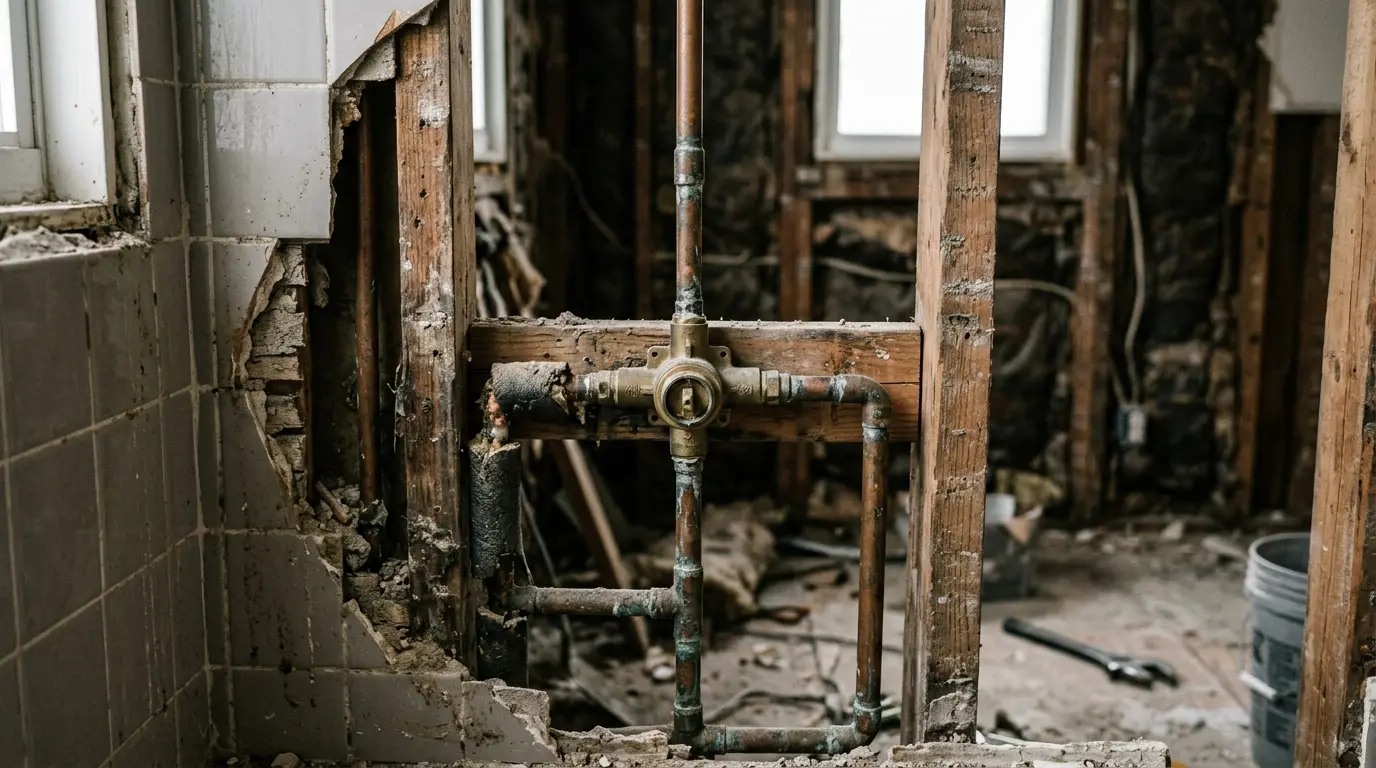
Showers and tubs, and how to open a tiled wall only once
Most of this work is behind tile, so the plan matters more than the part. Where the access goes, and what gets replaced while it is open, decides the whole cost.
Valves: what you have and what it should be
Nearly every shower and tub complaint comes back to the valve, so it is worth being able to identify what is in your wall.
Two separate handles, turning several times. A compression valve, with individual seats and washers for hot and cold. Original in most pre-war bathrooms here. It mixes by proportion, so it cannot compensate for a pressure change on either side: which is the cold-shower-when-a-toilet-flushes problem, and its dangerous twin, the hot surge. Repairable with washers and seats, and still legal as an existing condition, but it is not what would be installed today.
A single handle, no visible balancing. An early single-lever mixer. Better than two handles for convenience and no better for stability.
Pressure-balancing single handle. The modern standard. A spool inside the valve senses a pressure change on one side and throttles the other to match, holding the mix roughly steady. This is what codes require on a shower, and it is what a replacement will be.
Thermostatic. Holds a set temperature rather than a set ratio, and usually pairs with a separate volume control. More expensive, noticeably better, and the right choice where there are multiple outlets or where a household includes anyone at particular risk of scalding.
Two things about brands that save money. First, major manufacturers keep supplying cartridges for valve bodies decades old, frequently at no charge, so a dripping twenty-year-old valve is often a part rather than a project. Second, trim and body are matched: a new trim kit from the same family can transform the look of a shower without touching the plumbing, while a different brand's trim will not fit an existing body. Identifying the body before shopping is the single most useful thing an owner can do here.
Before anything is cut
Photograph the handle, the escutcheon, and any brand marking on the trim, and note whether the wall behind the valve is a closet, a hallway, or an exterior wall. Those two facts decide whether this is a cartridge, an access panel, or tile work.
Scald protection, honestly explained
This is the one area of bathroom plumbing where the code requirement and the safety case line up exactly, so it is worth understanding rather than treating as a formality.
Water at 140 °F can cause a serious burn in a few seconds; at 120 °F it takes minutes. Children's and older adults' skin is thinner and burns faster, and the reflex to move away is slower in both groups. That is the whole basis for two separate measures.
At the valve. A pressure-balancing or thermostatic shower valve with its high-temperature limit stop set properly. The limit stop is the part that gets missed: it is adjustable, it is set at the factory to a generic position, and setting it to the household's actual hot water temperature at installation is a two-minute job that matters.
At the heater. Around 120 °F at the tank suits most households. Where a higher tank temperature is wanted, for storage capacity or other reasons, the correct arrangement is a thermostatic mixing valve at the heater, delivering tempered water to the house, rather than relying on every fixture to be right.
Two related notes. A tub filler with no shower is not required to have the same protection, which is why so many older bathrooms here have unprotected two-handle tub valves; adding a hand shower to such a tub is exactly the moment to upgrade the valve. And in a two-flat or a small building where several units share one heater, the tempering decision affects everyone, so it belongs with the building rather than with one bathroom, the territory covered under multi-unit building plumbing.
Access strategy: opening a wall once
The cost of shower work is mostly the cost of reaching the plumbing, so the strategy is worth deciding deliberately.
From the front, through the escutcheon. Cartridges, seats, springs, stems, diverters, and trim all come out this way. No wall opening at all. This is the majority of shower valve repairs and it is where we always start.
Through an access panel behind the wall. If the back of the shower wall is a closet, a hallway, a stair cupboard, or an adjacent bedroom, a neat panel there gives permanent access to the valve and the supply connections. Cutting drywall in a closet is trivial compared with cutting tile, and once it exists, every future repair is easy. Where a bathroom backs onto usable space, we will nearly always propose this.
Through the tile. The last resort, done deliberately: a minimal opening sized to the valve body, cut rather than broken, with the pieces kept where the tile is no longer available. Older Chicago bathrooms frequently have tile that cannot be matched, which is a genuine argument for the access panel route and, sometimes, for a repair that keeps a valve alive rather than replacing it.
From below, through the ceiling under the bathroom. The right route for drain, trap, and overflow work rather than for valves, and considerably less painful in an unfinished basement than in a finished ceiling.
One rule follows from all of this: when a wall or a ceiling is open, everything reachable that is near the end of its life gets replaced. Supply connections, the valve body if it is old, the trap, the waste and overflow, and any galvanized nipple within reach. The second visit costs nearly as much as the first, and it is the opening that is expensive rather than the parts.
Leaks into the ceiling below
A brown ring on the ceiling under a bathroom is one of the most common calls we take, and it is also one of the most misdiagnosed, usually as "the shower pan", which it frequently is not.
The diagnosis is a sequence of controlled tests, each isolating one possibility, and it can nearly always be done without opening anything.
Fill the tub above the overflow and leave it. Water appearing means the overflow gasket, which is behind the overflow plate at the head of the tub and is reachable without touching tile.
Drain the tub and watch. Water appearing only on draining means the waste shoe gasket under the tub, the slip joints, or the trap.
Run the shower with the drain plugged and nobody standing in it. Water appearing points at grout, the tile substrate, a failed pan or liner, or the door seal, the tiled assembly rather than the plumbing.
Turn the shower valve on briefly and off, with the tub dry. Water appearing means the valve body or its supply connections, and that is the case where the wall or the access panel is involved.
Feel and look before concluding. A stain that is dry, sharply edged, and unchanged for months is usually historic damage from something already repaired. Where the answer is not clear from these tests, moisture metering and thermal imaging narrow it further, the methods described under leak detection.
Two structural notes for this housing stock. In balloon-framed houses, water that enters a wall cavity at a second-floor bathroom can travel a long way down before it appears, so the stain is not always under the source. And where the leak has been running for a while, the subfloor and the framing need looking at, a shower on soft framing is a repair that will be done twice.
Water appearing below a bathroom? The five tests above narrow it in an hour, before anything gets opened.
Call about a bathroom leakWaste, overflow, and drum traps
The drainage side of a tub is simpler than the valve and it contains one item peculiar to older buildings here.
The waste and overflow assembly. The shoe under the drain, the overflow elbow at the head of the tub, and the linkage between them. Its gaskets are consumables, and on a cast iron tub that has been in place seventy years they are usually the source of any drainage-side leak. Replacing the assembly needs access below or from an adjacent room; on a first-floor tub over an unfinished basement it is straightforward work.
The pop-up or trip-lever linkage. The most common non-leak complaint: a stopper that will not hold water or will not lift. Almost always adjustment of the linkage rather than replacement.
Hair and soap in the first few feet. The ordinary cause of a slow tub, and ordinary drain cleaning work.
Drum traps. Cylindrical traps with a screw lid, standard under tubs in this region before the 1950s. They hold a deep seal, they trap sediment and hair by design, and their geometry defeats a cable. A working one is not an emergency; a repeatedly blocking one is a candidate for conversion to a properly vented P-trap, which is the permanent fix and is best done when a floor or a ceiling is already open.
S-traps and venting. A tub that gurgles, or one that drains fine alone and slowly when another fixture runs, is telling you about air rather than about blockage. Older bathrooms that have been remodelled without touching the drainage frequently have an S-trap or a vent arrangement that no longer serves the fixtures connected to it. That is a correction rather than a cleaning, and it is worth doing once.
Weak flow and temperature swings
Four distinct complaints that get grouped together, with four different answers.
Weak flow at the shower head only. Scale in the head or in the valve's outlet screens. On the hard water in this region this is the most common cause by a wide margin, and descaling or replacing the head resolves it.
Weak flow everywhere in the house. Not a shower problem. Either low static pressure or a flow restriction in the supply piping: the distinction, and how to measure it, is under water pressure regulator. In houses with original galvanized supply piping, decades of internal scale narrow the pipe until an upstairs shower is simply starved; that is the subject of whole-home repiping.
Temperature swings when another fixture runs. The valve, as described above. A pressure-balancing or thermostatic valve is the fix.
Not enough hot water to finish a shower. The heater rather than the bathroom: sediment reducing usable tank volume, a failed lower element, or a tank that was never sized for a household that has since gained a bathroom. That is water heater repair territory.
One more that is worth naming because it is so often blamed on the plumbing: a diverter that no longer sends all the water to the shower head, so a proportion dribbles from the tub spout throughout. That is a worn diverter in the spout or in the valve, and it is a small repair.
Tub-to-shower conversions
A common request, particularly from households planning to stay in a house as they age, and one where the plumbing scope is larger than the visible change suggests.
The drain is the crux. A tub drain sits low and off to one side; a shower base needs its drain in the position and at the height the base or pan requires. That means opening the floor, moving the trap, and re-making the connection to the branch line, and in a second-floor bathroom it means working from below or lifting the floor. It is also the moment to correct any venting arrangement that was marginal, and to replace a drum trap if there is one.
Then the choices. A one-piece acrylic base with a matched wall surround is the most predictable, easiest to keep watertight, and quickest to install. A tiled shower with a properly built and sloped pan looks better and depends entirely on the waterproofing under the tile being right, which is where most tiled shower failures originate. A curbless or low-threshold entry is genuinely valuable for accessibility and requires the floor structure to accommodate the recess, which is a real constraint in an existing building.
Two things worth doing at the same time, because the wall will be open: replacing the valve with a pressure-balancing or thermostatic unit with its limit stop properly set, and adding solid blocking for a grab bar even if no bar is being fitted yet. The second costs almost nothing during the work and is expensive to add later.
If a remodel is coming anyway
When a bathroom is being opened up regardless, a short list of plumbing decisions is far cheaper made then than afterwards.
Replace supply piping within reach. Galvanized branches to a bathroom are the ones most likely to be restricting flow, and they are accessible exactly once.
Correct the drainage rather than reconnecting it. Trap type, fall on the trap arm, and venting. A remodel that puts new fixtures onto an old S-trap has bought a slow drain with a new finish on it.
Put in an access panel wherever the back of the valve wall allows it. The single best-value decision in this list.
Add shutoffs. Valve bodies with integral stops, or accessible branch shutoffs, so a future repair does not mean shutting down the whole house.
Block for grab bars at the tub or shower and beside the toilet, whether or not bars go in now.
Think about the second-floor drainage load. If a bathroom is being added rather than replaced, whether the existing stack and vents can carry it is a question to answer at the drawing stage, not during the tiling.
What drives the cost
Directional rather than quoted, and the range on this work is wide because access dominates it.
Cartridge or trim from the front. The cheapest useful outcome, and the one we look for first. Frequently a part and an hour.
Valve body replacement with an access panel. A half day, with drywall to patch in a closet rather than tile to match.
Valve body replacement through tile. The same plumbing plus tile removal, and then the question of whether matching tile exists. In an older bathroom that may be the deciding factor in the whole approach.
Waste and overflow or trap work. Straightforward from an unfinished basement; more involved through a finished ceiling.
Drum trap conversion. Modest when a floor or ceiling is already open, a project when it is not.
Tub-to-shower conversion. Drain relocation, base or pan, surround or tile, valve upgrade. A multi-day job with more than one trade involved.
What is found when it opens. Soft subfloor, rotten framing, or a leak that has been running longer than anyone thought. We will show you, photograph it, and price it separately rather than folding it in quietly.
The most useful thing we can do on the phone is work out whether your repair is a front-access one. If it is, this is a short visit, and we will say so.
Common Questions
Answers before you call
Can a shower valve be replaced without retiling the wall?
Often, yes. Three routes exist. If the same manufacturer still makes a compatible cartridge or a trim kit for that rough-in valve body, the repair happens entirely from the front through the existing escutcheon, the best outcome and more common than people expect on major brands. If the body has to come out, an access panel from the other side of the wall (a closet, a hallway, a stair cupboard) leaves the tile untouched.
Only when neither is available does tile come off, and then it is a deliberate, minimal opening sized to the valve rather than a demolition. We look for the first two before proposing the third.
Why does my shower go cold when a toilet is flushed?
Because the valve is an old two-handle or a non-balancing mixer, and it cannot compensate when the cold supply pressure drops momentarily. A pressure-balancing or thermostatic valve holds the mix steady through that drop, which is exactly why modern codes require one on a shower.
So the fix is a valve upgrade rather than a plumbing adjustment. It is also a safety improvement rather than a comfort one, the sudden hot surge that follows the cold drop is what causes scald injuries, particularly to children and older adults.
There is a stain on the ceiling under the bathroom. What is it?
Five candidates, and they are distinguishable. Water only when the shower runs and someone is standing in it points at the pan, the grout, or the door seal. Water only when the tub is filled above the overflow points at the overflow gasket. Water whenever the tub drains points at the waste shoe or the trap. Water whenever the shower valve is on, even briefly, points at the valve body or the supply connections. And a stain that never changes may be old damage from a fault already fixed.
That sequence is worth running before anything is opened, because four of the five are reached from below or from the tub side rather than through the tiled wall.
What is a drum trap and do I need to worry about it?
It is a cylindrical trap with a screw-off lid, common under bathtubs in Chicago-area houses built before the 1950s. It holds a large water seal and it was standard practice at the time. Two problems: it collects hair and sediment in a way a P-trap does not, and it cannot be cleared properly with a cable because of its geometry.
You do not have to replace one that is working. But when a tub line blocks repeatedly, or when the floor is open for other work, converting to a properly vented P-trap is the permanent answer rather than clearing the drum trap again.
My tub takes forever to drain. Is that the trap?
Usually it is hair and soap residue in the first few feet: at the waste shoe, around the pop-up linkage, or in the trap. That is straightforward drain work and it does not need the wall opened.
What suggests something more is a tub that drains slowly and gurgles, or one that has been cleared several times and keeps returning. Gurgling points at venting; a rapid return points at a partly blocked branch line, a sagging section, or a drum trap that cannot be cleared properly. A camera look answers it rather than guessing.
Is a tub-to-shower conversion a big job?
Bigger than it looks, and the reason is the drain rather than the wall. A tub drain sits low and to one side; a shower drain needs to be centred in the new base and set at the right height for the base or pan being used, which means opening the floor and reworking the trap and the branch connection.
In a second-floor bathroom that means working from below or lifting flooring. It is a very worthwhile change for a household that no longer wants to step over a tub wall, and it is a project rather than a fixture swap, and the honest version of the quote says so up front.
Stain on the ceiling under the bathroom?
There are five things it can be and only one of them needs the wall opened. Call and we will narrow it before anything is cut.
24/7 · Chicago metro dispatch · (833) 615-3680