Plumbing in Oak Park
Oak Park's plumbing calls arrive on a calendar: boilers in October, burst pipe in January, storms in April, roots and grease all summer. Knowing which month you are in explains most of what is happening.
The year in plumbing calls
Oak Park's caseload is more seasonal than most of this metro's, because the housing stock concentrates two things that answer to the calendar: heating systems that are part of the plumbing, and mature trees over old sewer laterals. The year has a recognisable shape, and it is genuinely useful to know which part of it you are in.
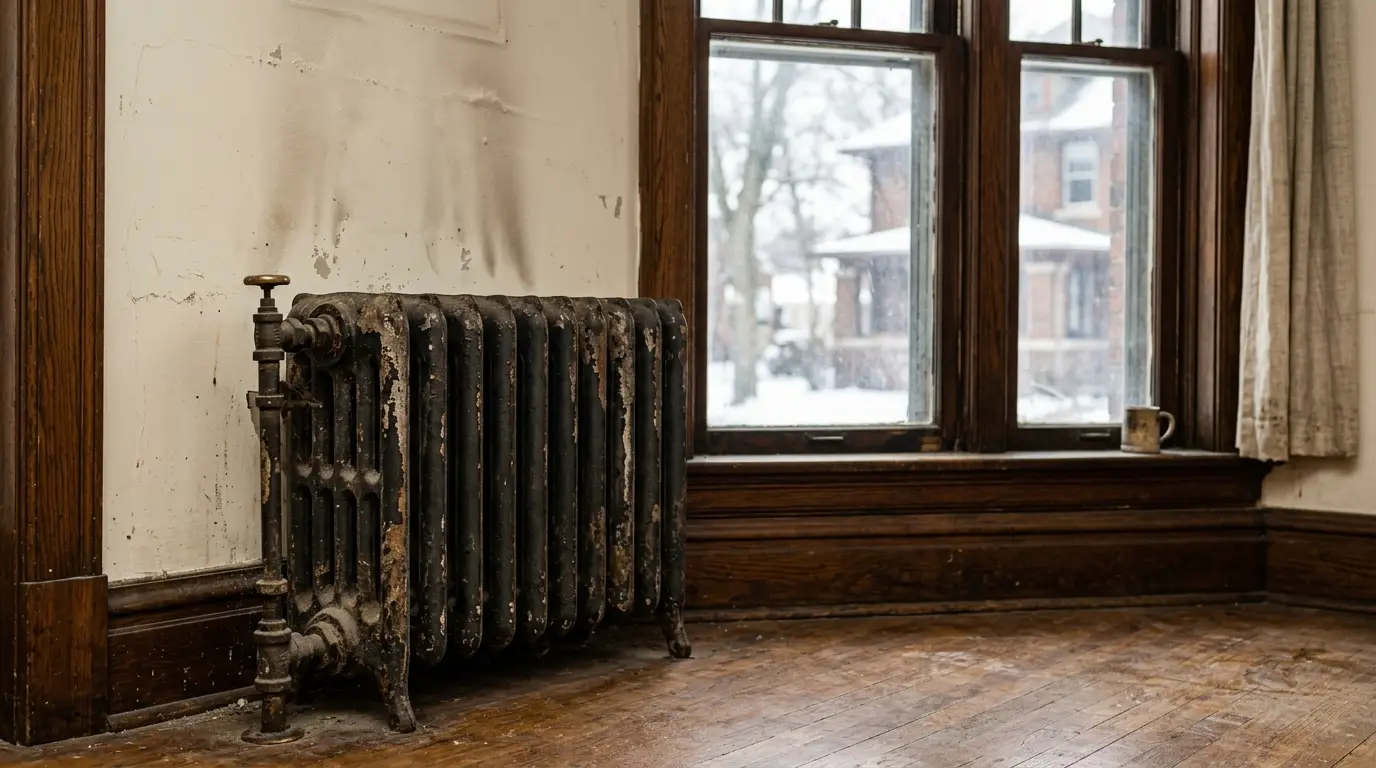
October is the heating month. First fire of the season, and a summer's worth of small faults announce themselves at once: a vent that failed closed, a trap that has stopped holding, a boiler whose water level has drifted, a radiator that will not warm. January and February are burst pipe and no-heat calls, and the two are related: a dead boiler in a hard freeze is a burst-pipe risk within hours in a building heated by water. March and April bring storms onto ground that is still frozen or already saturated, which is when the sump pumps, the drain tile and the grading get tested. Then June through September is drain season: roots reach their annual maximum, grease moves less readily in warm pipe, and the lines that have been quiet all winter start backing up.
Two things follow from that. The cheap version of almost every one of these repairs happens in the shoulder month before its season: a boiler service in October instead of a boiler emergency in January, a rodding in autumn instead of a backup in August, a sump test in February instead of a flooded basement in April. And when a fault arrives outside its season, it usually means something different: a radiator problem in July is a piping or water-level problem rather than a heating one, and a sewer backup in February is more likely to be structural than seasonal, because the roots that would explain it in September are dormant.
The shoulder-month rule
Nothing in this section is a secret and none of it is expensive. The difference between the cheap and the costly version of the same repair in Oak Park is usually eight weeks of timing, not the work itself.
Separated storm sewers change the question
Oak Park has spent decades on stormwater work, separating storm flow from the sanitary system and building relief capacity where the two used to share a pipe. Where that work is in place, and much of the village is covered by it now, one important thing has changed: rain is no longer loading the sanitary sewer on that block. That is worth understanding before spending money, because it reverses the default assumption most homeowners in this metro arrive with.
Under a combined system, a heavy storm raises the level in a single pipe carrying both rain and waste, and the lowest opening in your basement is where it surfaces. That is the mechanism a backwater valve or an overhead conversion exists to defeat. Where storm and sanitary are separated, that mechanism largely goes away, and a basement that still takes water in a storm is taking it from somewhere else. Which leaves three candidates, all of which are outside the sanitary system: groundwater rising against the foundation and arriving through the drain tile, which is the sump's job; surface water crossing saturated ground and coming in at grade, through a window well, or down a foundation wall; and a failure inside the building, such as an ejector that cannot keep up with a below-grade bathroom during heavy use.
The diagnostic sequence follows from that, and it is cheap. Where did the water appear first, and did it smell. Water rising out of a floor drain or a laundry standpipe with an odour came up through the drainage system and the lateral needs looking at. Clean water at the wall-floor joint, or in a window well, or running under a door, never touched the sewer. In the second case the money belongs in grading, downspout extensions, window well covers and the pump, and a valve installed for it will not stop a single gallon.
One-pipe, two-pipe, and what somebody removed in 1978
A large share of Oak Park is still heated by the system it was built with, and in this village that means both varieties: one-pipe steam in much of the single-family and two-flat stock, and genuine two-pipe steam and hot-water systems in the larger houses and courtyard buildings. They are not obsolete, they should not be ripped out on principle, and they are plumbing systems rather than furnaces, which is why they belong on this page at all.
The distinction matters for diagnosis. A one-pipe system moves steam and returns condensate in the same pipe, and air has to be pushed out ahead of the steam through vents on each radiator and on the mains. Those vents are consumable parts that fail closed, and a failed vent is the single most common cause of a cold radiator, uneven heat and hammering. A two-pipe system separates supply and return, and its equivalent consumable is the radiator trap, a small device that lets condensate and air out while holding steam back. When traps fail open, steam gets into the return where it does not belong, and the symptoms are dramatic: banging, wildly uneven heat, and a boiler that runs continuously without satisfying the building. Replacing a boiler to fix failed traps is the most expensive way to keep a problem, and it happens regularly.
The specifically Oak Park complication is what has been removed. Over a century, radiators get taken out during kitchen and bathroom remodels, enclosed behind cabinetry, or replaced with something smaller for the sake of a wall. A steam boiler must be sized to the connected radiation actually present, the square footage of the radiators, and not by a heat-loss calculation of the kind used for forced air. So a house that has lost radiation over the decades and then has its boiler replaced like-for-like ends up with an oversized boiler that short-cycles, never balances, and wears out early. Sizing from a measured radiation survey is the difference, and in this housing stock the honest answer is often that the correct boiler is smaller than the one coming out.
The other constraint here is architectural. In a house with original interior woodwork and plaster, near-boiler piping can be rebuilt properly in the basement, but re-routing risers through finished space frequently cannot be done without damage that nobody wants. That is a real limit on what is possible, and it is better discussed before the work than during it.
Hard water, and what it does inside a boiler
The supply is treated Lake Michigan water, moderately hard, enough to film glass and to scale a water heater over a decade, not enough to damage pipe quickly. On the domestic side, that means the same thing here as everywhere on this supply: a softener is a preference rather than a repair, an annual heater flush genuinely extends tank life, and a tankless unit needs descaling on a schedule rather than when someone remembers.
What is different in Oak Park is that a large number of buildings feed that water into a steam boiler, where hardness behaves quite differently. A steam system is supposed to be nearly closed: the water boils, the steam condenses in the radiators, and the condensate returns. Very little makeup water should be needed, which means very little new mineral should be entering. Every gallon of fresh hard water that goes in leaves its mineral content behind when it boils off, and that mineral accumulates in the boiler.
So the amount of makeup water a system takes is a diagnostic, not a detail. A boiler with an automatic feeder that runs regularly is not a well-cared-for boiler. It is a leaking system with the symptom hidden, and it is being scaled continuously from the inside while the leak goes unfound. The consequences are a boiler that loses efficiency, surges and hammers at the water line, and a low-water cutoff that fouls, which is the safety device rather than a comfort feature. The right response is to find where the water is going (a wet return, a failed trap, a valve packing, a relief valve weeping), rather than to keep feeding it.
Two practical notes. Softened water is generally not the answer for boiler makeup either, because the exchange chemistry it leaves behind carries its own problems in a steam system; the answer is to need less makeup water. And a boiler that has been fed hard water for years should be assessed on its own condition, not on its age, some are recoverable with a proper skim and a repair to the return, and some are not.
How dispatch works here
IL Plumbing Dispatch matches work to local plumbers; we do not run vans ourselves. You describe the problem, we match it to a plumber who works in Oak Park and does that particular kind of work, and you are told who is coming and when. In this village that matching is not a formality: steam heating, sewer excavation in a narrow parkway, and multi-unit work under an association are three different trades, and the plumber who is right for one is not automatically right for another.
Useful on the phone: what the building is (single-family, two-flat, condominium) what heats it, whether the basement is finished, and whether anything is happening right now. If it is a shared building, tell us who can authorise work. And if it is no heat in a freeze, say that first: in a village heated by water, that goes near the top of the list rather than the middle.
What We Dispatch For
Services called in most often around here
Nearby
Neighbouring communities
Part of West Suburbs & DuPage, see the whole region for what these towns have in common underground.
Berwyn · Cicero · Forest Park · River Forest
Common Questions
Answers before you call
Why does the water smell or taste different some months?
Because the water itself changes seasonally, and mostly for reasons that are not a problem. Lake Michigan water is warmer in late summer and colder in late winter, and temperature alone changes how people perceive taste and how much chlorine they can smell. Treatment is also adjusted through the year, and residual chlorine dissipates differently in warm water than in cold, so the same tap can taste noticeably more of chlorine in one season than another.
Some of it is the building rather than the supply. A metallic taste that shows up at one tap, worst on the first draw of the morning and clearing after a minute, is water that has been sitting in the building's own pipe overnight. A rotten-egg smell that appears only at hot taps is a reaction between the water and a decaying anode rod in the water heater: a heater problem, not a supply problem, and one with a straightforward fix. A musty or sewer smell that comes and goes with weather is usually a dry trap or a venting problem letting drain air into the room, and it tends to be seasonal because heating season dries traps out.
The one case that is not seasonal and should not be treated as such: if water is discoloured after work on the street, or if the concern is metal from an older service line, that is a question about the pipe rather than the season. The village's service line inventory is where that starts, and a first-draw sample is how it gets answered.
The problem is in a shared wall or shared line. Who pays?
Oak Park has a great deal of two-flat, three-flat and courtyard housing, and in all of it the split follows the same principle: what serves only your unit is yours, what serves more than one unit is shared even when it runs inside your wall. Your fixtures and the branch to them are yours. The stack, the risers, the building drain, the water service and the main shutoff serve everybody.
On a condominium that principle is written down in the declaration, and the declaration governs, not intuition and not who is inconvenienced. It produces the case that feels unjust: damage in your unit caused by a shared stack is generally the association's repair for the pipe and often your own insurer's for your finishes. Both need to be told the same day, not after the drying is done.
On an owner-occupied two-flat with a tenant above, or a small rented building, the owner authorises the work and the tenant reports the problem, and the fastest way to lose a day is for us to arrive where nobody present can approve anything. Say on the phone that it is a shared building. It changes who needs to be there and what we bring, particularly if isolation means shutting water to more than one household.
Is this a repair or the start of a replacement?
For a sewer lateral, the facts that decide it are visible on camera. One defect (a single offset joint, one root mass, one damaged section) in a pipe that is otherwise round is a repair. Root intrusion at most joints, a pipe that has lost its shape, a bellied run holding standing water, or a line that will not stay clear for a full year, is the beginning of a replacement, and further rodding is buying time at a rising price.
For supply pipe the test is the pattern. One pinhole in copper is a repair; three in two years on the same horizontal run means the wall thickness has reached the end of its service life. For galvanized, the test is not leaks at all but flow: if the top-floor fixtures have gradually lost pressure over years, the bore is closing and no amount of localised work restores it.
For a steam boiler, the honest dividing line is the section or the block, not the accessories. Vents, traps, controls, the low-water cutoff and the near-boiler piping are all repairable and frequently the actual fault. A cracked section or a leaking block is a replacement, and a sizing calculation should happen before anyone orders one, particularly in this housing stock, where radiation has often been removed over the decades and the correct boiler is now smaller than the one being replaced.
Do you work overnight and at weekends here?
Yes, and coverage in the near-west suburbs is genuinely better than in the outer parts of the metro, overnight arrival here is usually a short run rather than a long drive. What you should get on the phone is a specific time rather than a promise.
Saturday work is routine. Sunday and overnight are for real emergencies: active flooding, sewage backing up, no water at all, no heat in a hard freeze, or a gas smell. No heat belongs on that list in this town in a way it does not everywhere, because a house with steam heat and a dead boiler in a January cold snap is a burst-pipe risk within hours, not a comfort problem.
Scheduled work is better on a weekday, and not only for supply houses. Permitted work (a sewer repair in the parkway, a boiler replacement, a repipe) needs an inspection at a defined stage, and the inspector's calendar is a real constraint on when the job can finish.
What should I be doing every autumn?
In this housing stock, autumn maintenance is mostly about the heating system, and it is worth doing in October rather than discovering it in January. Fire the boiler for a full cycle while it is still warm outside and listen: banging, a radiator that stays cold, a relief valve that weeps or a low-water cutoff that does not respond are all cheap to correct now and expensive to correct during a cold snap. Check the boiler's water level and, if it has an automatic feeder, watch whether it is feeding more than occasionally, a feeder that runs regularly is masking a leak somewhere in the system.
Then the outside. Disconnect every hose, a hose left attached to a frost-free bib is the most common single cause of a burst stem here, because the trapped water cannot drain back out of the stem. Clear the window wells and check that downspouts still discharge away from the foundation rather than into it.
And the drains, on the same visit. Autumn is the right time to rod a line that is on a maintenance interval: roots are at their annual maximum and the ground is still workable, so if the camera finds something needing excavation you are not doing it in February. If the house has a sump, lift the float by hand and hear it cycle before the winter thaw cycles begin.
Backwater valve or overhead sewer?
First establish that the mechanism is sanitary surcharge at all, because in Oak Park it often is not. Where the village's storm separation and relief work is in place, rain no longer loads the sanitary sewer on that block, so a wet-weather basement is far more likely to be groundwater arriving through the drain tile or surface water arriving at grade, and neither device does anything about either. Buying a valve for a groundwater problem is the most common expensive mistake in this category.
Where there genuinely is a history of sewage rising out of a floor drain, laundry standpipe or basement shower, the choice comes down to two things: how far below the street main your lowest fixtures sit, and whether the device will be maintained. A backwater valve is much cheaper, is installed in the lateral, and protects only against backflow: it is a moving part in a sewer, and it must be accessible and inspected, because a valve nobody has looked at in fifteen years is the one that fails at the worst moment.
An overhead conversion re-plumbs the below-grade fixtures to discharge upward into an ejector pit above the surcharge level and abandons the gravity connection for them. It costs several times as much, takes real space in the basement, and adds a pump you now depend on, but it is the more complete answer where the basement is finished, where there is a below-grade bathroom or laundry, and where the building has already flooded more than once. In a two-flat with a rented lower unit, that calculation usually lands on the conversion.
Boiler starting up noisy this autumn?
On a steam system the first heating cycle of the year is when a summer's worth of small problems announce themselves: vents, traps, water level. October is a service call; January is an emergency call for the same fault.
24/7 · Chicago metro dispatch · (833) 615-3680