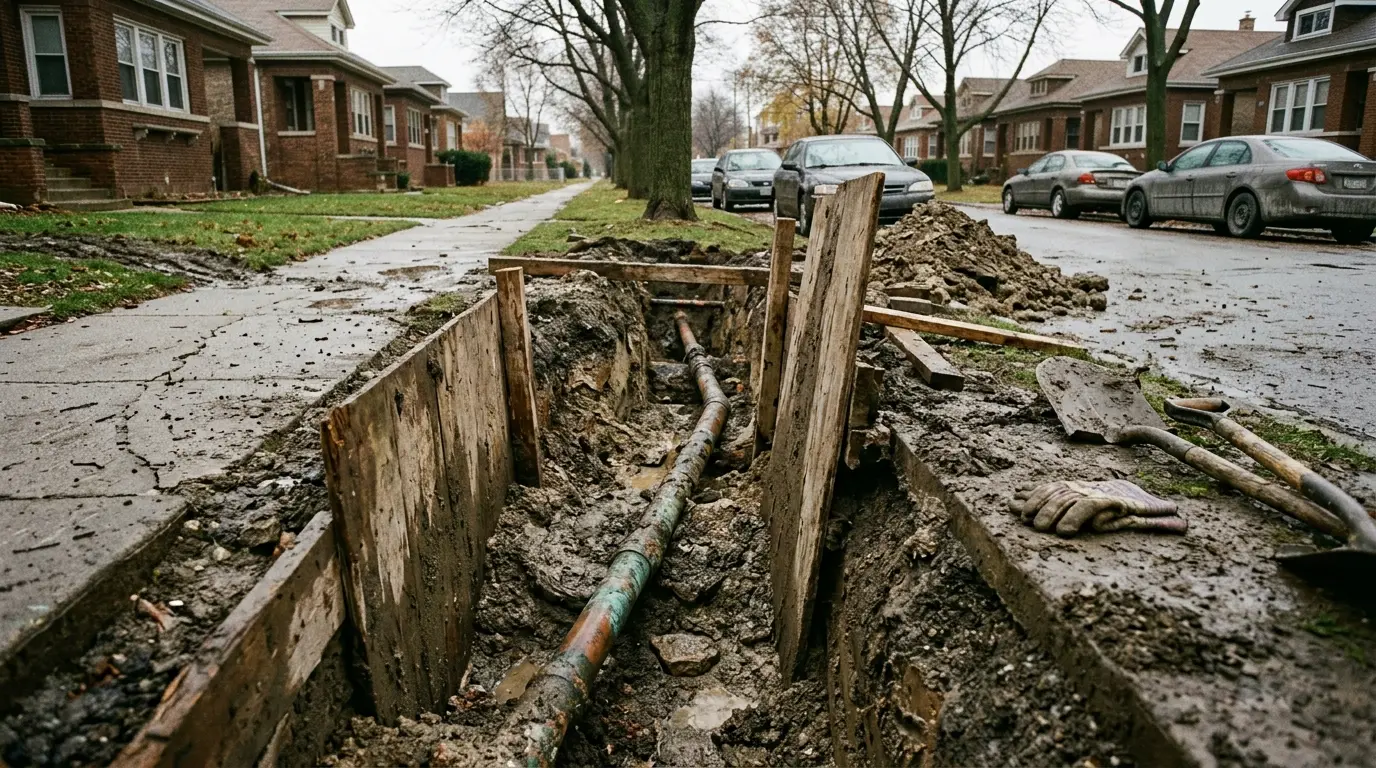
Main water line repair, located before anything is dug
The service line from the curb stop into your building is yours. When it leaks, the work is ninety percent finding it precisely and ten percent fixing it.
What you own, and where it starts
The public water main runs under the street. A short branch comes off it to a valve at the parkway, the curb stop, in a cast-iron access tube locally called a b-box or buffalo box. From that valve, the service line runs under the parkway, across your property, through the foundation wall, and to the meter inside.
In most communities across this region, everything from the curb stop inward is the property owner’s. That includes the buried portion under the parkway, which surprises people, because it looks like public ground and it is not your side of the pavement. It means a leak out there is your excavation, your permit, and your restoration.
The rules genuinely vary. A number of municipalities take responsibility to the property line instead, and a few maintain the whole service. It is not predictable from the size or age of the community, so it is worth a call to the municipality before accepting any quote, and worth being sceptical of a contractor who states it confidently without checking, because the answer differs a few streets over.
Two valves, two owners
The curb stop at the parkway is the utility’s and needs a long key to operate. The valve where the line enters your building is yours. Knowing where both are is worth five minutes on a dry afternoon.
How a service line leak announces itself
Underground leaks are quiet by nature, so the signals are indirect. Any one of these is worth acting on.
- A meter that moves with everything closed. The definitive test, and the first thing to do. Close all fixtures, watch the low-flow indicator; then close the building valve and watch again. Movement with the house isolated puts the leak outside.
- An unexplained bill increase. A step change with no change in habits. On a service line the volume can be substantial because the pipe is under constant pressure with nothing to stop the flow.
- Wet or unusually green ground over the run, in dry weather. A strip of lawn that stays lush through a dry August, following a line from the parkway toward the house.
- Pressure that has quietly dropped. Gradual, easy to normalise to, and worth checking with a gauge rather than by impression.
- Water in the basement near where the line enters. Sometimes the first visible sign, and easily mistaken for groundwater seepage.
- Sinking or settling in the ground above the line. Soil being washed out from below. This is the sign that warrants urgency, particularly near the foundation.
- The sound of running water with nothing on. Audible at the meter or where the line enters, especially at night.
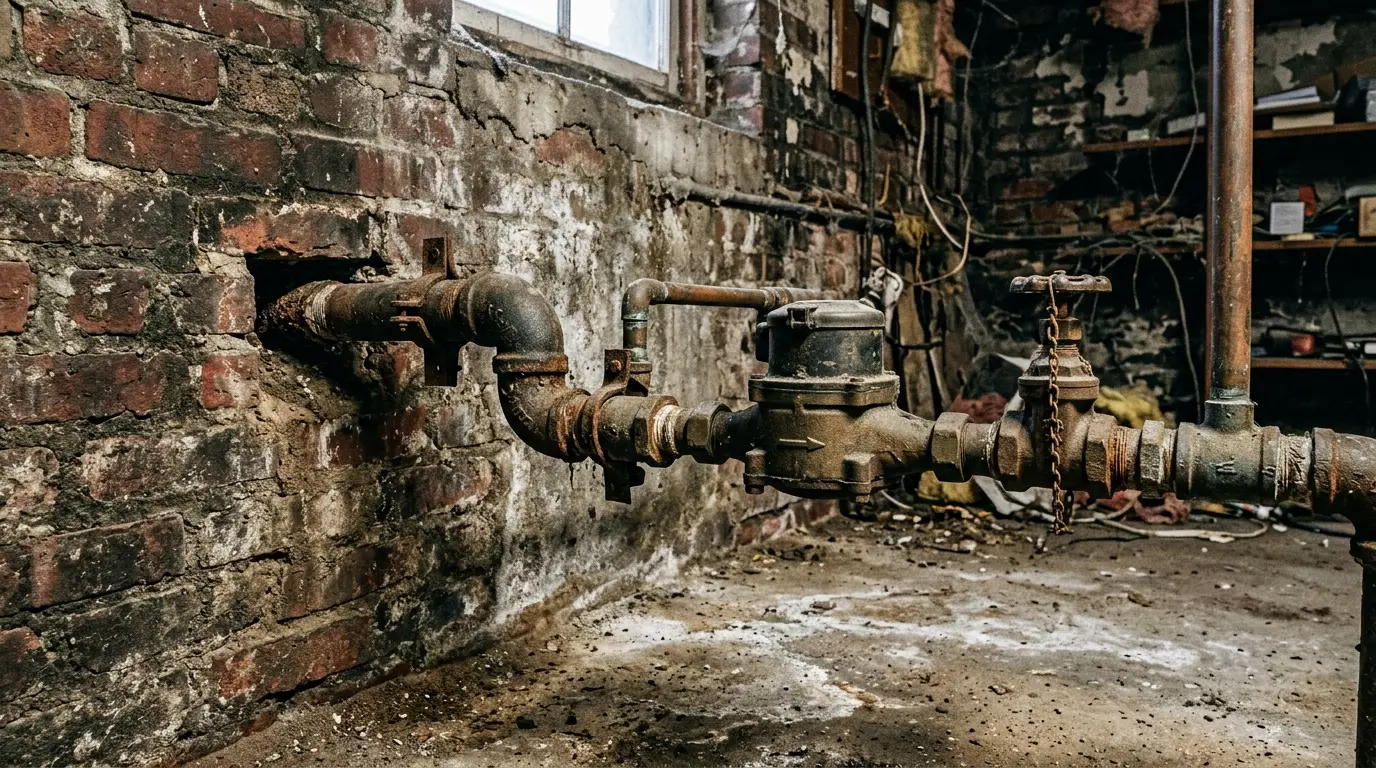
What your service line is made of
Age of building is the first indicator, and it drives both the failure mode and the repair options.
Lead, pre-1930s widely, and later in places
Standard for a long period across the older parts of this metro. Soft, dull grey, non-magnetic, often with a bulbous soldered joint at the meter. It is durable as pipe and it is a water-quality question rather than a leak-frequency one. Where any work is being done on a lead service, full replacement rather than partial is the right approach.
Galvanized steel, roughly 1900 to 1960
Corrodes from the inside, scaling closed over decades and thinning at the same time. The characteristic profile is a service line that has lost most of its effective bore, poor pressure throughout the house, and then starts leaking at a thin spot. Because the whole run is the same age in the same soil, a leak in galvanized is usually about the run rather than the spot.
Copper: 1950s onward
Common and generally good. Its failure mode buried is pitting from aggressive soil conditions, producing pinhole leaks. Copper service lines can also be damaged mechanically by later excavation and by settlement.
Plastic, recent decades
Polyethylene and PEX are what replacements go in as. Chemically inert, no corrosion, tolerant of ground movement and of freezing better than metal. Its failures are mechanical, damage during installation or from later digging, and rodent damage where a line is exposed in a crawlspace.
Locating it without digging the run
This is where the money is saved. A buried leak found precisely is one excavation; a buried leak guessed at is a trench.
Isolation first. Meter test, then close the building valve to establish which side of the wall the loss is on. Sometimes the curb stop can be closed to confirm the pipe holds pressure when the supply is removed. This costs nothing and narrows the problem more than any instrument.
Tracing the route. A pipe locator follows the line so the excavation goes where the pipe actually runs rather than where the route is assumed to run. Assumed routes are frequently wrong on properties that have been added to.
Acoustic detection. Pressurised water escaping through a small opening makes sound in a fairly narrow band. Ground microphones compare intensity at points along the traced route, and on a metal service line in reasonable conditions that produces a fix accurate enough to cut once. It works less well on plastic, which damps the signal, and it struggles against traffic and mechanical noise.
Tracer gas. An inert hydrogen-nitrogen mix introduced into the drained line escapes through the opening and is detected at the surface. This is the method for plastic pipe and for very slow leaks, and it works through soil and pavement where acoustic gets nothing.
Correlating with the surface. Wet ground, unusually green grass, and settlement all corroborate an instrument reading. None of them are reliable on their own, because water travels along the trench backfill before it surfaces.
Meter turning with the house isolated? That is enough to send the right equipment on the first visit.
Call and describe the meter readingSpot repair or replacement
The footage-equivalent question for supply lines, and the honest answer depends mostly on material and history.
Spot repair makes sense when the cause was localised and external: mechanical damage from a later excavation, a single pitted spot in otherwise sound copper, damage from settlement at one point. The pipe is exposed at the leak, cut back to sound material, and rejoined with proper fittings and a dielectric transition where materials change. One excavation, restored, done.
Replacement makes sense when the material is at the end of its life, when the line is galvanized and has been scaling closed for decades, when this is the second leak on the same run, when the line is lead, or when pressure has been poor for years because the bore is restricted. In each of those cases a spot repair fixes today’s leak on a pipe that is going to produce another one.
The economics push harder toward replacement than people expect, because the cost of a service line job is dominated by excavation and restoration rather than by pipe. Having paid to open the ground and put it back, doing it again in two years for the next pinhole is poor value. Where the line is being replaced, it is also the moment to correct an undersized service, a three-quarter inch line serving a house that has since gained two bathrooms is a real and common constraint.
Full replacement does not necessarily mean a trench along the run. Pulling new pipe through the existing route from pits at each end is routine, and it avoids opening a driveway or a parkway for its whole length. Whether it applies depends on the old pipe and on what else is buried nearby.
Lead service lines
Worth its own section, because a large number of buildings in the older parts of this metro have lead services and the subject is poorly understood.
Identification is straightforward once you know what to look for. Lead is dull grey, soft enough to mark with a coin, non-magnetic, and the connection at the meter often has a characteristic bulbous soldered joint, a wiped joint. Galvanized is also non-magnetic when heavily corroded but is hard and threaded; copper is unmistakable by colour.
The important operational point is about partial replacement. Replacing only part of a lead service, the public side or the private side alone, can disturb the protective scale inside the remaining lead and temporarily increase what comes out of the tap. That is why full replacement, coordinated so both sides are done together, is the right approach, and why many municipalities have specific programmes, requirements, and sometimes funding around it.
If you are having a service line replaced for unrelated reasons and it is lead, that is the opportunity to deal with it properly. Ask specifically how the two sides will be coordinated and what the municipality’s programme covers, the answer varies considerably across the region and it is frequently more favourable than people assume.
Frozen service lines
Uncommon and regional rather than individual. Every few winters a stretch arrives cold enough and long enough that frost drives past service depth on some streets, and buried lines start freezing.
The tell is that it is rarely just you, if several houses on a block lose water within a day or two, frost has reached service depth there. Lines that freeze are usually the shallow ones: laid to an older standard, rerouted under a driveway where plowed pavement conducts cold straight down, or disturbed by later work and backfilled higher than they started. A line at proper depth under snow-covered lawn essentially never freezes here.
Thawing means establishing which side of the curb stop is frozen and then applying electric current along a continuous metal run, or steam and hot jetting where the pipe is plastic. It is a specialised job and it takes hours rather than minutes.
The uncomfortable part: a service line that froze once at shallow depth will freeze again every hard winter until it is re-laid deeper. Thawing is the emergency measure and replacement is the fix, and it is a spring job, not a February one.
What drives the cost
Length and depth. A short run to a main in front of the building at moderate depth is straightforward. A long run at nine feet needs more excavation and shoring, and shoring is a safety requirement rather than an option.
What is on the surface. Lawn is inexpensive to restore. A concrete driveway, a paved alley, mature landscaping, or a public street each add substantially, and restoration in the right-of-way has to meet municipal specification, which is frequently the largest single item after excavation.
Method. A located spot repair is one pit. Trenchless replacement is two pits plus specialised equipment. Open-cut replacement is a trench plus full restoration. Which is cheapest depends almost entirely on the surface.
Utility congestion. Gas, electric, and telecoms sharing a narrow corridor means hand excavation near them, which is slow and therefore expensive. On dense city lots this is routine rather than exceptional.
Permits and coordination. Service line work needs a permit, work in the right-of-way needs another, and anything involving the curb stop needs the utility. Where lead is involved there may be additional programme requirements. Lead times on all of that are real and belong in the schedule rather than appearing as delays.
Common Questions
Answers before you call
Is the water line from the street my responsibility?
From the curb stop, the buffalo box out at the parkway, into the building, yes, in most communities here. The utility owns the main and its side of that valve; the property owner owns the rest, including the portion running under the parkway and often under the pavement.
It varies by municipality and it is worth confirming for your address before agreeing to work. Some communities take responsibility to the property line rather than the curb stop. The municipality will confirm it, and it changes the scope.
How do I know the leak is outside rather than inside?
The meter test settles it. Close every fixture, then close the main valve where the line enters the building, and watch the meter. If it still moves with the house isolated, the leak is upstream of that valve, a buried service line. If it stops, the leak is inside.
That takes fifteen minutes, needs no tools, and it is the single most useful thing you can establish before calling. It determines what equipment arrives and, in some municipalities, who owns the repair.
Do you have to dig up the whole line?
Not for a located spot repair. That is one excavation at the leak, not a trench along the run. Which is exactly why locating precisely comes first.
A full replacement is a different matter, and it is often done trenchlessly by pulling new pipe through the old route from pits at each end, so even then the whole length does not usually need opening.
My pressure has dropped everywhere. Is that the service line?
It can be, and a service line leak is one of the causes worth ruling out. But gradual whole-house pressure loss more often comes from interior galvanized pipe scaling closed, or from a failing pressure-reducing valve.
A gauge on a hose bib reads static pressure in seconds and a meter test separates leak from restriction. Those two checks narrow it quickly, and both are cheap.
Do I have a lead service line?
Possibly, if the building predates the mid-1980s, and in the older parts of this metro lead service lines were standard for a long period. Lead is soft, dull grey, does not attract a magnet, and the pipe at the meter often has a distinctive bulbous soldered joint.
It is worth identifying rather than assuming. Where a service line is being replaced anyway, replacing lead in full (rather than partially, which can make matters worse temporarily) is the right approach, and many municipalities have programmes and requirements around it.
Can a service line leak damage my foundation?
Yes, and it is the reason not to leave a known one. Water escaping under pressure below grade washes fine material out of the soil, and a void under or beside a footing is a structural problem rather than a plumbing one.
It is uncommon but not rare, and it is a slow process that accelerates. A service line leak near the building is the case for acting promptly rather than monitoring.
Meter turning with everything shut off?
That single observation locates the problem to one side of the wall. Call and we will tell you which.
24/7 · Chicago metro dispatch · (833) 615-3680