Plumbing in Chicago Heights
Chicago Heights houses were built in waves around the mills, and the decade tells you most of what you need to know: what is in the walls, how deep the basement is, and whether the thing keeping that basement dry is a machine somebody last looked at years ago.
What the mill years built
Chicago Heights grew as an industrial city, and its housing came in waves that track the work. The oldest stock, the 1890s through the 1920s, is worker housing built close to the plants and the rail: frame and brick, small lots, deep basements, and plumbing that has been repaired in layers ever since. Then a 1920s bungalow period, then a substantial postwar expansion of ranches and split-levels on the outer streets, and then infill and rehab work spread across every decade since.
Date the house and the failures become predictable. Pre-1930: galvanised supply that has been closing up with corrosion for ninety years, cast iron drain stacks rusted through at the hubs, clay laterals in short jointed sections, and lead at the service connection often enough that it should be checked rather than assumed. The 1920s bungalows add a specific quirk, a single bathroom stack that everything else was later tied into, which is why a bungalow with two added bathrooms can have venting problems that no amount of drain cleaning fixes.
Postwar stock is copper supply and cast iron or early plastic drains, with failures at fittings and thin-wall sections rather than general corrosion. The rehabs are their own category: a house that has been through two or three renovations has two or three vintages of pipe joined together, and the joints between materials are where we look first, because a galvanised-to-copper connection made without a dielectric fitting corrodes from the inside and eventually closes.
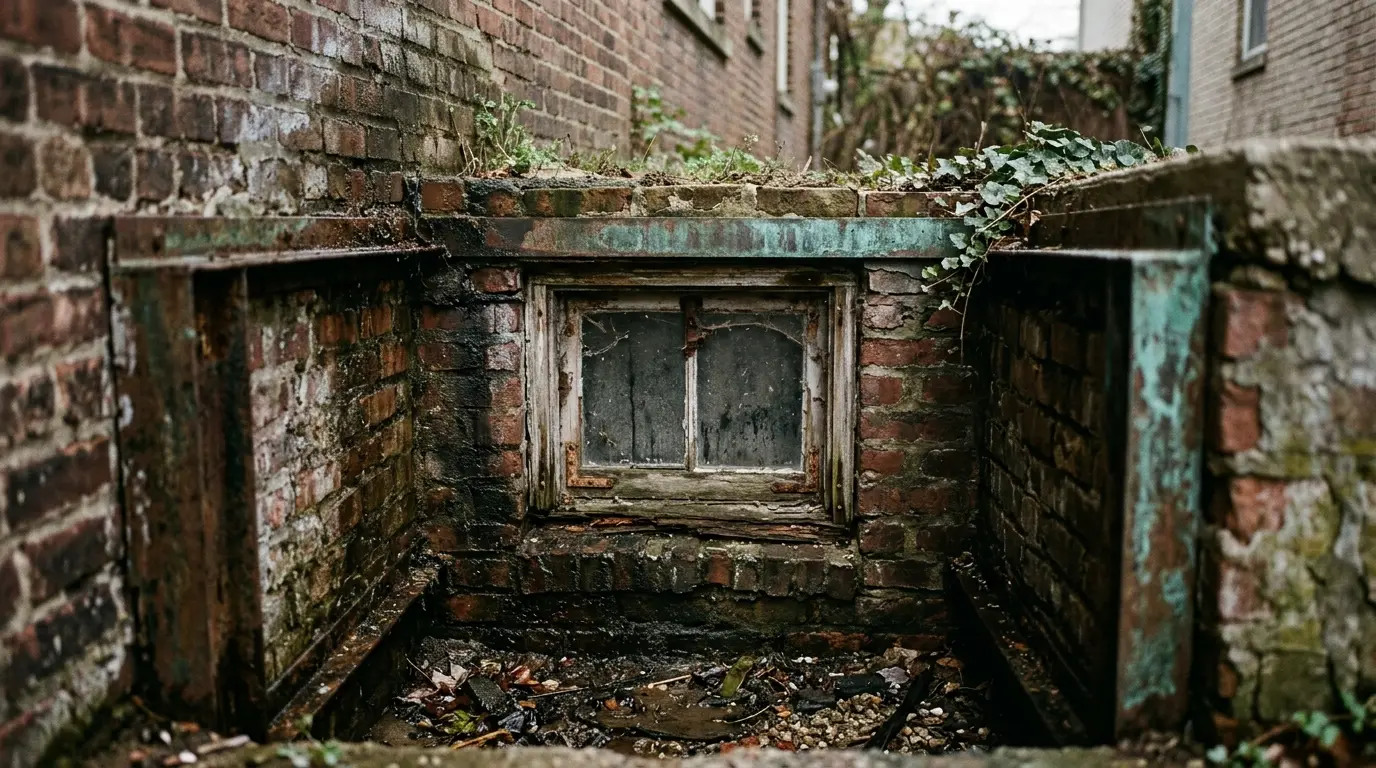
One thing the age of this stock affects more than people expect is basement depth. The older houses here were built with full basements, dug to a depth that made sense for coal storage and a gravity furnace, and that puts a lot of finished and semi-finished floor space very low relative to the ground outside. Everything in the next two sections follows from that.
A basement below the water table
This is flat ground with heavy clay-rich soil and shallow creek drainage, which is a combination that does two things to a basement. The clay drains slowly, so water that arrives at your foundation stays in contact with it for hours rather than minutes. And the seasonal high water table sits close enough to the surface that in a wet spring the water level outside your basement wall can be above your basement floor.
That is worth stating plainly, because it changes what dryness means in a house like this. A basement below the seasonal water table is not dry because it is sealed: hydrostatic pressure will find a crack, a cold joint, a pipe penetration, or simply push up through the slab. It is dry because water is being collected and pumped away faster than it arrives. Your basement is dry because a machine is running.
The signs that you are in this situation rather than a surface-water one: water at the wall-floor joint rather than running down the wall; a floor that is damp in spring and dry in August with no change in your habits; efflorescence, the white mineral bloom, on the lower foot of the walls; a sump pit that has water in it all through spring even in weeks without rain. That last one is the clearest single indicator, and it is free to check.
What follows practically is about priorities. Sealing the inside face of a wall against hydrostatic pressure does not work and should not be sold to you as a solution. Getting roof and surface water away from the foundation does work, is cheap, and reduces how much the pump has to do: downspout extensions, grade that falls away from the wall, window wells with drainage. And the drain tile and sump system need to be treated as the primary structure of your dryness rather than as a backstop, which is the subject of the next section. If a basement has flooded here, the diagnosis has to establish which of groundwater or sewer surcharge did it before anyone spends money, because the two lead to entirely different jobs.
Pumps are machines, and machines run out
In much of the metro a sump pump is a standby device that runs during storms. Here it is closer to continuous duty: through spring it may cycle every few minutes for weeks, and the total run hours accumulated by a pump in a Chicago Heights basement over five years are what a pump in a drier suburb accumulates in fifteen. That changes what you should buy and how you should treat it.
What we specify, and why. A cast iron pump body rather than the cheapest plastic, because the iron sheds heat into the water and a plastic-bodied pump running a duty cycle like this cooks its own motor. A check valve that genuinely seals, because a leaking check lets the column in the discharge pipe fall back into the pit after every cycle, which means the pump immediately restarts to move the same water, short-cycling is the single most common reason a pump here dies at four years instead of ten. A float or switch arrangement that cannot hang up against the pit wall or the discharge pipe. Discharge routed well away from the foundation and pitched so it drains, both because water dumped at the wall comes straight back and because a line that holds water freezes.
And a backup on independent power, because the two failure modes overlap exactly: the summer storm that saturates the ground is the same storm that takes the power out. A battery backup is not a luxury item in a house whose dryness depends on pumping; it is the second half of the system. Add an alarm, because most of the damage in a pump failure happens in the hours before anyone realises.
The same logic applies to ejector pumps in houses with a below-grade bathroom or laundry, with one difference: an ejector failure is a sewage failure, in a sealed pit, and the warning signs are subtler, a smell, a gurgle, a fixture that drains slowly. The pit needs a sealed lid, a vent to the outside, and service access that does not require dismantling anything. Pumps get replaced on age here rather than on failure, which sounds like a sales pitch and is actually the cheaper policy: a planned replacement is a scheduled visit, and an unplanned one is a flooded floor plus the same visit.
Frost, pavement and the thaw that bursts pipe
Frost does not go into the ground evenly, and the difference matters for which of your pipes freeze. Snow is an insulator: a lawn under six inches of snow keeps frost relatively shallow. Plowed and salted pavement is the opposite (bare, exposed, and conducting cold downward), so frost drives deepest under driveways, walks and the parkway strip that gets cleared. On a long cold snap it is the lines under or beside cleared pavement that are at risk, not the ones under the snow-covered yard.
In this housing stock the predictable freeze points are, in order: outdoor hose bibs with a hose still attached, which traps water in the vulnerable section regardless of whether the bib is frost-proof; supply lines run through an unheated garage wall, a crawl space, or a cantilevered floor section; the sump discharge line, which freezes at its outlet and then backs a perfectly good pump up into its own pit; and the water service where it crosses under a driveway at insufficient depth, which is rare but is the one that ruins a week.
The sequence people misunderstand is thaw-then-burst. Ice expanding in a pipe usually splits it while frozen, but the split does not leak while the ice plug is still in place. So the water arrives when the pipe thaws: which is why the worst indoor flooding calls do not come during the cold snap, they come on the first warm afternoon after it, often in a house nobody was in. If you have had a frozen line and it thawed without incident, check it anyway, and if you leave a property vacant in winter, shutting the water off at the main is worth more than any amount of insulation.
Thawing a frozen line is worth doing correctly rather than fast. Heat applied to one point on a frozen run raises pressure between the heat and the remaining ice plug, which is a good way to turn a frozen pipe into a burst one; open the nearest downstream fixture first so there is somewhere for the melt to go, and work from that end back. Open flame near old framing is how house fires start. Controlled thawing and, where it has already split, repair of the burst section are the same visit more often than not, we plan for both.
How dispatch works here
We cover Chicago Heights out of our south suburbs coverage, and during working hours the drive is usually the smaller part of the response time. Sewage on a floor, no heat in a freeze, and a failed pump in a wet week move ahead of everything else; a slow drain that still drains does not, and we will tell you that honestly rather than book a window we cannot hold.
What to have ready when you call: the build decade if you know it, whether the basement is finished, whether the water is clear or foul, and whether it came with the rain or without it. For a pump call, roughly how old the pump is and whether there is a backup. For a freeze, which fixtures still work, that map is what tells us where the plug is before anyone opens a wall. Ten minutes on the phone regularly saves an hour in the house, and it decides whether we arrive with a camera, a rodder, a thaw unit or a pump on the van.
What We Dispatch For
Services called in most often around here
Nearby
Neighbouring communities
Part of South Suburbs, see the whole region for what these towns have in common underground.
Matteson · Olympia Fields · Park Forest · Steger
Common Questions
Answers before you call
Why does my basement take water only in heavy rain?
In Chicago Heights there are two quite different answers and they need different work, so the first job is telling them apart. In the older core, rain and sanitary flow can share the same pipe, which means a downpour can surcharge the sewer and push water back up through the lowest opening in your basement: a floor drain, a shower, a laundry standpipe. In the newer sections, and in most of the area outside that core, that mechanism is not in play and heavy-rain water is groundwater rising into a basement that sits at or below the seasonal water table.
The tell is what the water looks like and where it appears. Sewage-bearing water coming up out of a floor drain or a low fixture, while the walls stay dry, is a surcharge. Clear water at the wall-floor joint, or seeping up through the slab, hours into the storm and often still rising after the rain stops, is groundwater. If both happen, you have both problems, which is more common here than anyone would like.
The remedies are not interchangeable. For surcharge, it is a backwater valve or, on the properties where it is justified, an overhead sewer conversion, the more expensive and more definitive answer. For groundwater, no valve helps and the work is drainage and pumping. Anybody proposing one without establishing which mechanism you have is guessing with your money.
Where does the village's responsibility end and mine begin?
The city maintains the sewer and water mains in the street and its own side of each connection. Everything from your building out to that connection (including the length that runs under the parkway and, in most cases, under the pavement) belongs to the property. That is true even though you cannot get at it without a permit and a road cut, and it is the point at which most people discover that their homeowner's insurance treats a lateral very differently from a burst pipe indoors.
In this housing stock the practical question is usually about age rather than boundaries. Many of the laterals here are original to houses built between the 1890s and the 1920s: clay, in short sections, with a joint every few feet, and now well past a century of ground movement above them. When one of those fails, it fails on the property side far more often than at the main, simply because that is where most of the length is.
What we will not do is assert that without evidence. A camera gives a distance from the cleanout, and a distance is what makes the ownership question answerable rather than arguable, and if the footage shows the defect at the main, that recording is what you take to the city.
Will the yard, the drive or the parkway tree have to come up?
Sometimes, and it is the part of a sewer or water service job people are least prepared for, so we would rather be blunt about it early. An open-cut replacement of a lateral means a trench along the line's route, and the line's route is wherever it was laid a century ago: frequently under a driveway apron, a walk, or a mature parkway tree, because none of those existed when the pipe went in.
There are ways to reduce it. Where the pipe's condition allows, trenchless methods replace or reline the line from access pits at each end rather than a continuous trench, which can save a driveway and often saves a tree. Where a spot repair will do, the excavation is a few feet rather than the length of the yard. We will tell you which of those your line qualifies for after a camera inspection, not before: a badly offset or collapsed section cannot be relined, and promising otherwise sets up a bad day for both of us.
For trees specifically: a parkway tree belongs to the city, and removing or pruning it needs their approval, which is a separate process from your plumbing permit. If a tree's roots are the reason your lateral failed, and the tree stays, expect the same roots to find the new pipe's joints eventually, which is an argument for a jointless replacement material rather than for pretending the tree is not there. Restoration (backfill, compaction, concrete, sod) should be in the written quote. If it is not, ask, because it is a real cost that is easy to leave out of a low number.
Can this wait until spring?
Some things genuinely can, and it is worth knowing which so you are not spending winter money on a summer job. A slow drain that still drains, a dripping outdoor bib that has been shut off and drained, a fixture you can live without, a lateral repair on a line that is passing water and has been camera'd as stable: those wait, and in the case of excavation, waiting is cheaper. Digging in frozen ground costs more, restores worse, and the work is harder to do well.
Some things absolutely cannot. Anything with sewage on a basement floor is a health problem now, not in March. A sump pump that has failed or is intermittent in the middle of a wet winter is the one item on this list where waiting a fortnight has cost people a finished basement. No heat in a building heated by water is a burst-pipe risk within hours, not days. And a leak that is wetting structure (a joist, a wall cavity, a sill) gets worse and more expensive on a curve, not a line.
The middle category is the interesting one: work that can wait but should be scheduled rather than deferred. If a camera shows your lateral has a failing section that is currently passing water, spring is the right time to do it, but book it in February, because the first warm weeks are when everybody who spent the winter deciding calls at once.
Would a backup pump have prevented this?
If the flood happened during a storm that took the power out, then yes, and that is the single most common version of this event. A primary sump pump is an electrical machine; a summer storm that saturates the ground and knocks out power at the same time takes away the pump at the exact hour the water arrives. A battery backup on independent power keeps the pit down through the outage, and in a house that depends on pumping to stay dry it is not an accessory.
If the power stayed on, then a backup would probably not have saved you and something else failed: the primary pump itself, a check valve that stopped holding, a frozen or blocked discharge, or a float that jammed against the pit wall. That distinction is worth establishing rather than assuming, because installing a second pump alongside a first one that failed mechanically just gives you two pumps with the same defect.
What we recommend for a house here that relies on pumping: a cast iron primary, a check valve that seals properly, a battery backup sized for a realistic outage rather than twenty minutes, and an audible alarm. The alarm matters more than people expect: most of the damage in a basement flood happens in the hours before anybody notices, and in a house with a below-grade bathroom the same logic applies to the ejector, where a failure is a sewage event rather than a water one.
Tank or tankless?
In this housing stock, the argument for tankless is often about the basement rather than about hot water. A wall-hung unit gets the appliance up off a floor that has taken water before, which is a real consideration in a house where the water heater has already been replaced once after a flood; a forty-gallon tank standing on a slab that floods is a machine waiting for its second failure. If you keep a tank, get it on a proper stand and keep the burner and controls above the historic water line.
The argument against, here, is the infrastructure. A tankless unit needs several times the gas input of the tank it replaces, and in houses of this age the existing gas piping is frequently sized for the original appliances and nothing more, so the real quote includes a larger gas run, sometimes back to the meter, plus stainless venting and a condensate drain. In a 1915 house with a masonry chimney and a tight utility corner, that work can cost more than the appliance.
So the honest split: tankless if you are staying, the gas and vent path are workable, and getting the appliance off the floor has value to you; a good tank with a drain pan, a stand and a yearly flush if the gas work is disproportionate or the horizon is short. What we will not do is quote a tankless swap without pricing the gas line, which is how people end up with a change order halfway through a Saturday.
How old is the pump keeping your basement dry?
If you cannot remember, it is older than you think. A sump pump here is a continuous-duty machine, not a standby one, and the two questions that matter are how many years it has been cycling and what happens to it when the power goes out in a storm.
24/7 · Chicago metro dispatch · (833) 615-3680