Plumbing in Evanston
Most of Evanston was plumbed before 1930, and almost everything that goes wrong here can be dated, the pipe, the heat and the drainage all belong to the decade the house was built in.
The housing was built before 1930, and the pipe follows from that
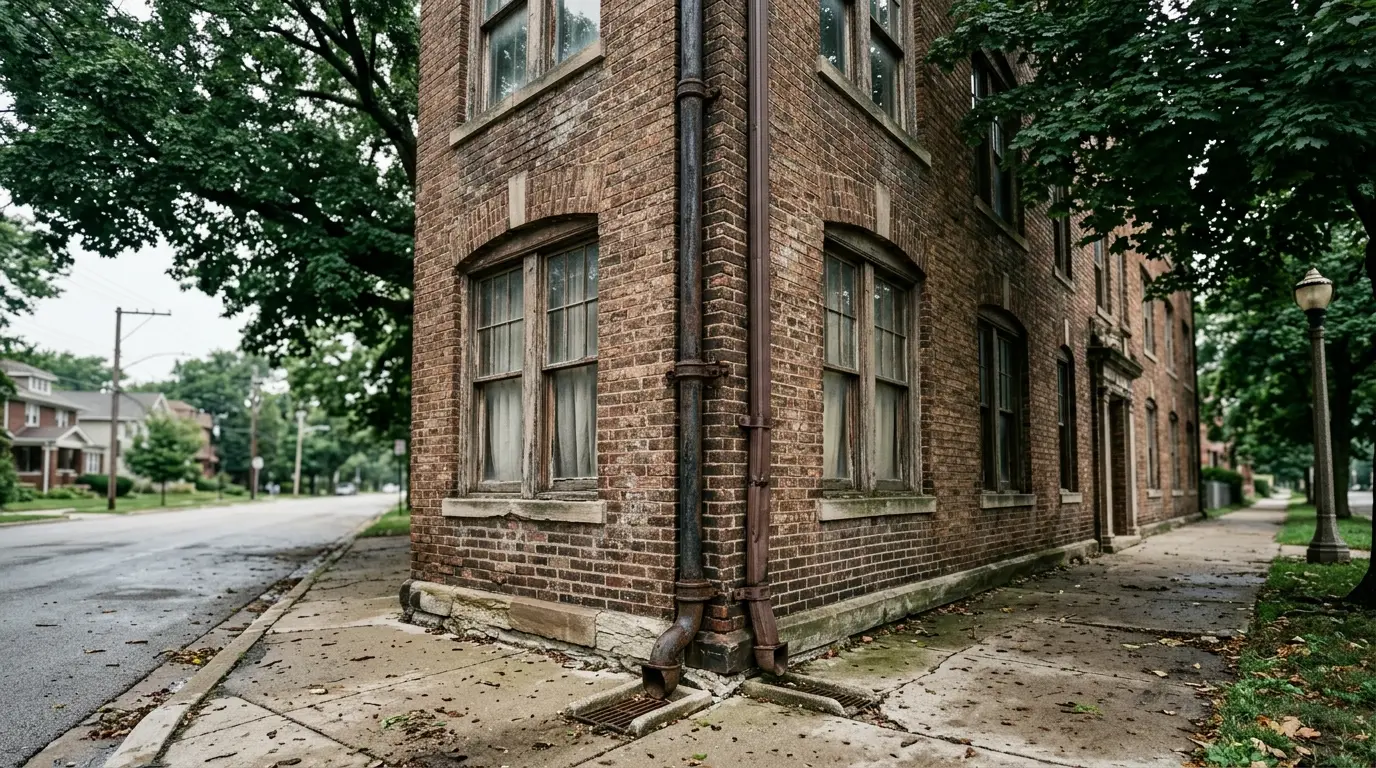
Evanston is a streetcar and rail suburb that filled in early. The lakefront and the blocks around the university went up largely between the 1890s and the 1920s; the west side and the two-flat belt through the 1910s and 1920s; and the pockets of frame cottages that predate the water and sewer network are older still. There is post-war and post-war-adjacent building here too, and a real amount of mid-century and later multi-family near the transit lines, but the dominant plumbing condition in Evanston is a house that has been on municipal water and sewer for roughly a century.
Date the house and the material list writes itself. A building plumbed in the 1900s or 1910s started with galvanized steel supply and cast iron drainage, and unless someone has been through it, some of both is still there. Galvanized fails from the inside out: the bore closes with corrosion product, so the symptom is not a leak but a gradual loss of flow, worst at the top floor and worst at the fixture furthest from the meter. Cast iron drainage fails differently and later, it thins at horizontal runs and at hubs, and it announces itself as a damp spot on a joist or a smell rather than as a flood.
Interwar houses shift toward copper supply, which in this water is frequently still original and still fine. The interesting failures in that group are at joints, at any surviving galvanized stub, and at the point where somebody's 1970s bathroom remodel met the 1925 stack. Almost every service call in Evanston is an argument between two eras of workmanship, and the useful question on arrival is not what is broken but which decade broke it.
Why the date matters more than the address
Two houses on the same Evanston block, one built in 1908 and one built in 1926, do not have the same plumbing problem, and pricing them the same way is how people end up paying to repair pipe that should have been replaced, or replacing pipe that had twenty good years left.
What frost does to an Evanston winter
Frost in this metro reaches somewhere around three and a half to four feet in a hard winter, and the depth that matters is not the average but the exception: the coldest stretch, over the surface that conducts heat away fastest. That is why the freeze-ups here are not distributed evenly across a property. Plowed and salted pavement loses heat far faster than a snow-covered lawn, and snow is genuinely good insulation, so the pipe that freezes first is almost always the one under a driveway, a sidewalk or a shovelled path, not the one under the front garden.
In a pre-1930 house the vulnerable runs are predictable. Supply lines in an unheated crawl space or against an uninsulated foundation wall. Kitchen lines in an exterior wall on the north face, especially in a kitchen that was added onto the back of the house. Hose bibs where the shutoff is inside and nobody drained the stub. And the water service itself where a century of regrading has left it shallower than it was buried.
The sequence people get wrong is the thaw. A frozen pipe is usually not leaking while it is frozen, the ice is holding the water back. The failure happens on thaw, at the split the ice already made, which is why the right move is to shut the water off at the main before applying any heat, and to thaw slowly from the fixture end back toward the freeze so meltwater has somewhere to go. Open flame, a heat gun on old solder, or heat applied at the middle of a frozen section are three ways to turn a repair into a flood. If the line has already burst, the shutoff is the whole job until someone arrives.
Two-flats, courtyards and shared systems
A large share of Evanston is not single-family, and the plumbing consequence is that ownership and hydraulics stop lining up. In a two-flat the units usually share one water service, one sewer lateral, one stack and sometimes one heating plant, with the shutoffs in a basement that belongs to whoever holds the deed. In a courtyard building the same is true across a dozen units, with risers serving stacked kitchens and baths and a single point of control for each.
So the first deliverable on a shared building is rarely a repair. It is a valve map. Which shutoff kills which fixture, which unit, which riser; where the main is; where the gas shutoff is; and which of those valves actually still closes, because a gate valve that has not been operated since 1974 frequently will not. Knowing that before an emergency is the difference between shutting off one bathroom and shutting off the building.
Authorisation is the other half. On a condominium the declaration draws the line between unit and common element, and it does not always fall where intuition says: the branch inside a unit's wall may be common, the fixture certainly is not, and a stack is common by definition. Work on a common element needs the association to authorise it, not the resident whose ceiling is stained. On a rental, the owner authorises and the tenant reports, and the fastest way to lose a day is to send someone to a building where nobody present can approve the work. When you call about a shared building, say so on the phone, it changes what we bring, and who we need on site.
Steam and hot-water heat, which is a plumbing system
A meaningful number of Evanston buildings are still heated by the system they were built with: one-pipe steam in the older single-family and two-flat stock, hot-water radiators in some of it, and steam in a good many of the courtyard buildings. It is worth saying plainly that these systems are not obsolete and generally should not be replaced wholesale. Properly vented steam heat is quiet, comfortable and long-lived. Badly vented steam heat is the noisiest, most uneven heat there is, and the difference between those two sentences is usually a few dollars in air vents.
The diagnostic order is vents, then traps, then piping, then the boiler, and it is almost always run backwards. A cold radiator at the far end of the house, banging pipes, or a boiler that runs constantly without warming the top floor are venting and distribution symptoms in the great majority of cases. Air has to get out of a one-pipe system before steam can get in, and the vents that do that job are consumable parts that fail closed. Replacing a boiler to fix a venting problem is the most expensive way to keep the problem.
When the boiler genuinely is the issue, two things determine whether the replacement works. It must be sized from connected radiation, the actual square footage of the radiators in the building, and not from a heat-loss calculation intended for forced air, because an oversized steam boiler short-cycles and never balances. And the near-boiler piping has to be built to the manufacturer's drawing, at the specified header height and with proper risers, because that is what separates water from steam. A correct boiler on shortcut piping delivers wet steam, and wet steam is what makes an old system sound like it is failing.
How dispatch works here
IL Plumbing Dispatch is a dispatch service, not a truck. You describe the problem, we match it to a plumber who works in Evanston and does that specific kind of work, and you get told who is coming and when. The reason that distinction matters in this town is that the work splits sharply: the plumber you want for a one-pipe steam system is not necessarily the one you want for a sewer excavation in a parkway, and a courtyard building with a declaration and an association is a different job again.
What we ask for on the phone is the building type, the age if you know it, what you are seeing, and whether the water is currently off. What you should get back is a straight answer about whether the thing needs to happen tonight, and if a closer option will reach you faster during an active flood, our dispatchers are told to tell you that instead of holding the call.
What We Dispatch For
Services called in most often around here
Nearby
Neighbouring communities
Part of North Shore, see the whole region for what these towns have in common underground.
Lincolnwood · Morton Grove · Niles · Skokie · Wilmette
Common Questions
Answers before you call
Why does my water heater keep failing early?
Three causes account for most of it here, and only one of them is the heater. Lake Michigan water is moderately hard, so a tank in a house with no softener carries a scale layer on the bottom that insulates the burner from the water and drives the metal hotter than it was designed to run. Second, an anode rod is a consumable. It is meant to corrode instead of the tank, and once it is gone the tank starts spending itself. Third, and most common in Evanston, the heater is a 40-gallon replacement in a house whose demand grew: a third bathroom, a soaking tub, a high-flow shower. A heater that is short-cycling on recovery every day of its life does not reach ten years.
The diagnostic is worth doing before the replacement. If the tank is scaled, the next one will scale identically unless something changes. If the anode was never replaced, a $40 part on a schedule would have bought years. If the sizing is wrong, a like-for-like swap buys you the same failure on the same interval, which is the single most common mistake in this category.
Where does the City's responsibility end and mine begin?
For water, the split is at the curb stop or the buffalo box, the shutoff in the parkway. The main in the street and the connection to it are the City's; the service line from that shutoff into the building is the property owner's, including the part that runs under the parkway and the sidewalk. That surprises people, because the pipe they own is buried under ground they do not own, which is also why the work needs a permit and a restoration plan.
For sewer, the same logic applies to the lateral: the sanitary main is public, the lateral connecting the building to it is private for its whole length. So a blockage at the property line is your pipe even though the digging happens in the street.
The practical consequence is that when a repair is on the private side, you can choose the contractor and the method; when it is on the public side, the City schedules it and there is nothing to hire out. Establishing which side the problem is on is what a camera inspection buys you, and it is worth doing before anyone opens ground.
What does a permit add to the job?
Time and paperwork, and occasionally a real cost. In Evanston a water service replacement, a sewer repair in the parkway, a boiler replacement and a repipe are all permitted work, and the permit brings an inspection at a defined stage, typically before the trench is closed or before the walls go back. That means the schedule has an inspector in it, which is the part that most often stretches a two-day job into a four-day job.
It also brings restoration standards. A street or parkway opening has to be restored to the City's specification, and that specification, not the plumbing, is sometimes the largest single line on a service line replacement.
The honest framing is that a permit is not a tax on the work. It is the record that the work happened and was inspected. Two places it pays for itself: at resale, where an unpermitted boiler or repipe becomes a negotiating point, and at an insurance claim, where the question of whether work was permitted and inspected gets asked.
Is this an emergency or can it be scheduled?
The test is whether water is moving somewhere it should not be, and whether you can stop it. Active flooding, sewage on a finished floor, no water at all in the building, or a gas smell, those are now. A leak you can catch in a bucket, a slow drain, one cold radiator, a heater that is still making hot water but sounds wrong: those are this week, and scheduling them costs less than dispatching them.
Two Evanston-specific cases sit in between. A frozen but unburst line is urgent in the sense that thawing it badly is how it bursts, so the sequence matters more than the hour. And a two-flat or courtyard building with one shutoff means a leak in one unit can require killing water to several, which turns a small repair into something that needs a scheduled window and notice to the other residents.
If you are not sure, describe what you are seeing on the phone rather than guessing at the category. Our dispatchers are told to say plainly when something can wait, because a call that did not need to be overnight and was billed overnight is the fastest way to lose a customer.
What is worth doing before I finish the basement?
In this housing stock, four things, and all of them are cheap while the ceiling and walls are open and expensive afterwards. Camera the lateral. A finished basement over a clay lateral with root intrusion is a bet that the pipe will outlast the drywall, and the inspection costs a fraction of a single cleanup.
Second, decide about backup protection while the floor is accessible rather than after it is covered. Third, replace the water heater and any run of galvanized supply that is visibly on borrowed time now, not in five years when the access panel is a wall. Fourth, if there is an ejector pit for a basement bath, confirm the basin lid is sealed and vented properly, an open or badly gasketed pit is a smell problem that only becomes obvious once you are spending time down there.
The general rule: nothing that will need access in the next fifteen years should end up behind finished surfaces without an access panel. That is a design decision made once, at the framing stage, and it is the difference between a $400 repair and a $4,000 one.
Should I replace the service line while the trench is open?
Usually yes, and the reason is arithmetic rather than salesmanship. Most of the cost of a service line replacement is not the pipe. It is the excavation, the restoration and the permit. If ground is already open for a sewer repair or a main water line repair, the marginal cost of replacing the water service in the same trench is a fraction of what the same work costs as its own project.
The decision needs two facts first. What is the existing service made of, which the City's inventory is the place to start rather than the last word, and does the trench actually run where the service runs. If the answer to the second is no, the arithmetic disappears and it is a separate job.
The one thing to avoid is a partial replacement, new pipe from the house to the curb and old pipe beyond it, or the reverse. Disturbing an old line without replacing it end to end can shed scale and make water quality worse for a period, which is why the honest options are all of it or none of it.
Radiator cold at one end of the house?
On one-pipe steam that is almost always a vent or a pitch problem rather than a boiler problem, and it is worth knowing which before anyone quotes you a boiler. Worth a look in October rather than in January.
24/7 · Chicago metro dispatch · (833) 615-3680